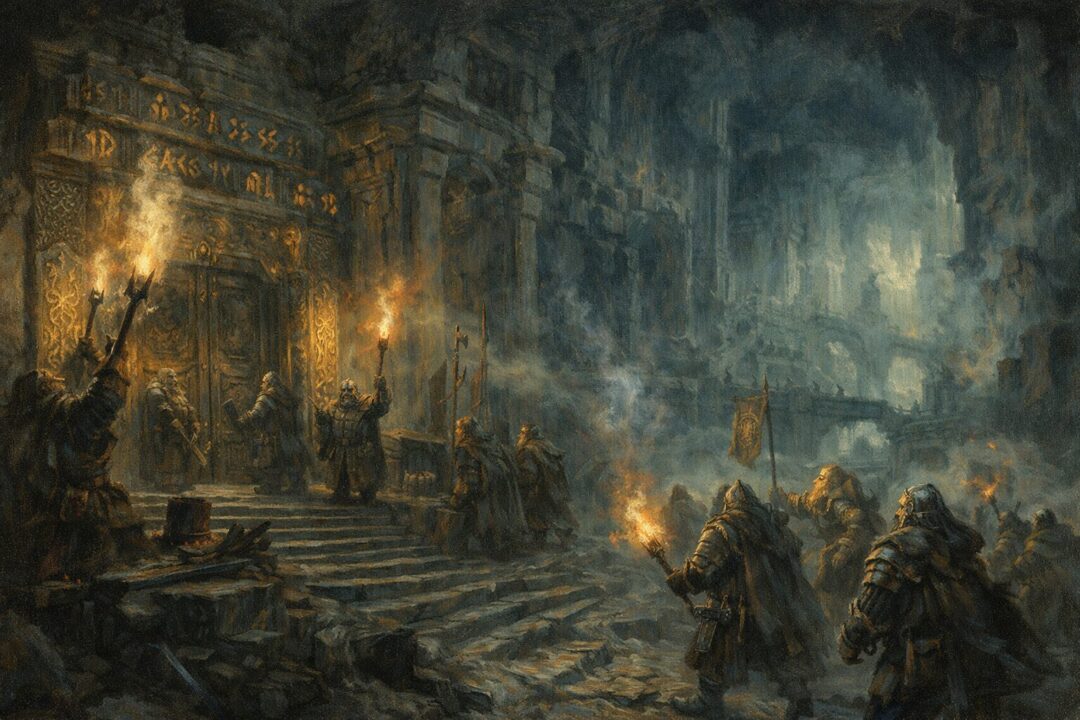
Khazad-dûm was not meant to end the way it did.
For thousands of years, it was the greatest Dwarven kingdom in Middle-earth—older than Rivendell, richer than Erebor, and so vast that entire peoples passed through its halls without ever seeing its limits. Its pillars were carved before the Sun rose upon the world. Its roads linked east and west when kingdoms of Men were still young or unborn.
To the Dwarves, Khazad-dûm was not merely a city.
It was Durin’s realm.
A place of beginnings.
A monument to endurance.
When readers think of Moria today, they imagine a ruin: broken bridges, echoing drums, and a Balrog of ancient fire striding through shadow. That image is powerful—but incomplete.
Because Moria did not fall once.
It fell, was abandoned, reclaimed—and then lost again.
And it was the second failure that ensured it would never be reclaimed a third time.
The First Abandonment: A Kingdom Retreats, Not Dies
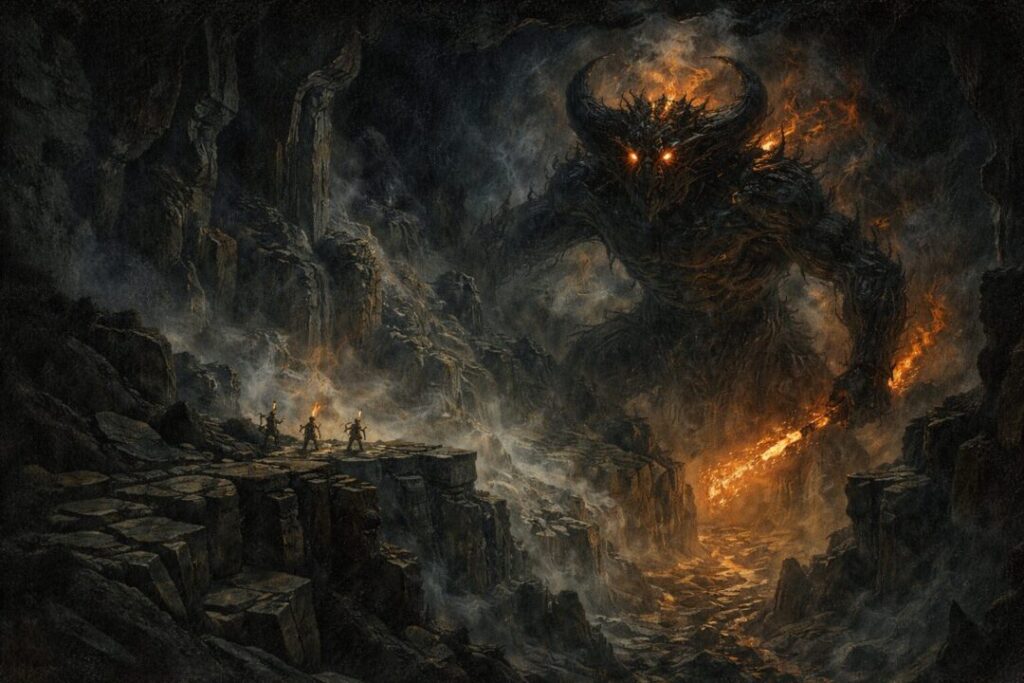
When Durin’s Bane awakened in the depths of Khazad-dûm during the Third Age, the city did not collapse overnight.
There was no final battle for the city gates.
No last stand in the great halls.
No sudden flight of a shattered people.
Instead, there was confusion.
King Durin VI was slain, but the Dwarves did not yet understand what had killed him. Balrogs were creatures of the ancient wars—beings associated with the downfall of Morgoth himself. To most in Middle-earth, they belonged to legend, not reality. Few believed that such a terror could still exist beneath the mountains.
For years after Durin’s death, life in Khazad-dûm continued in diminished form. Trade did not cease at once. The Dwarves did not immediately flee in panic. They endured, as Dwarves always do.
Only later, when Durin’s son Náin I was also slain, did the truth become unavoidable: something ancient and unstoppable had claimed the deepest places of the city.
And even then, the response was not destruction—it was withdrawal.
The Dwarves abandoned Khazad-dûm not because it was destroyed, but because it could no longer be held. They sealed what doors they could. They gathered what they could carry. And they left.
They fled east and west—to Erebor, to the Grey Mountains—carrying fear, but not clarity. They knew the city was lost. They did not fully know why.
And this detail matters.
Because the Dwarves did not yet understand the true nature of what dwelt beneath their halls.
And because of that, Khazad-dûm was never fully relinquished.
A Long Silence, Not a Final End
For centuries, Moria stood empty.
Orcs crept back into the upper tunnels. Darkness gathered. But the Balrog did not roam the city openly. It remained deep below, near the roots of the mountain, unseen and largely unchallenged.
To the outside world, Moria became a place of rumor and dread. But among the Dwarves, it remained something else entirely: a lost inheritance.
Dwarves do not forget their homes.
They count generations in stone. They measure time in endurance. A city abandoned is not the same as a city surrendered.
And so, when the world changed again—when Erebor was reclaimed, when Smaug was slain, when Dwarves once more stood strong—Khazad-dûm returned to thought.
Not as a legend.
But as a possibility.
Centuries Later: Balin’s Return Was Not Madness
Balin’s decision to return to Moria is often treated as tragic folly.
It was not.
By the late Third Age, circumstances had shifted dramatically. The Kingdom under the Mountain had been restored. Dwarves had wealth, warriors, and confidence again. They possessed ancient records, maps, and memories of their greatest city.
Balin himself was no reckless adventurer. He was wise, respected, and cautious—one of Thorin Oakenshield’s closest companions, and later a lord in Erebor.
When Balin led a colony back to Moria, he did not go alone, nor unprepared. He brought followers, guards, scribes, and craftsmen. The goal was not conquest, but restoration.
And for a time, the effort succeeded.
Orcs were driven out of the upper halls. The East-gate was secured. Mithril was found again. Chambers were reclaimed and defended. Messages were written and sent.
This is not speculation.
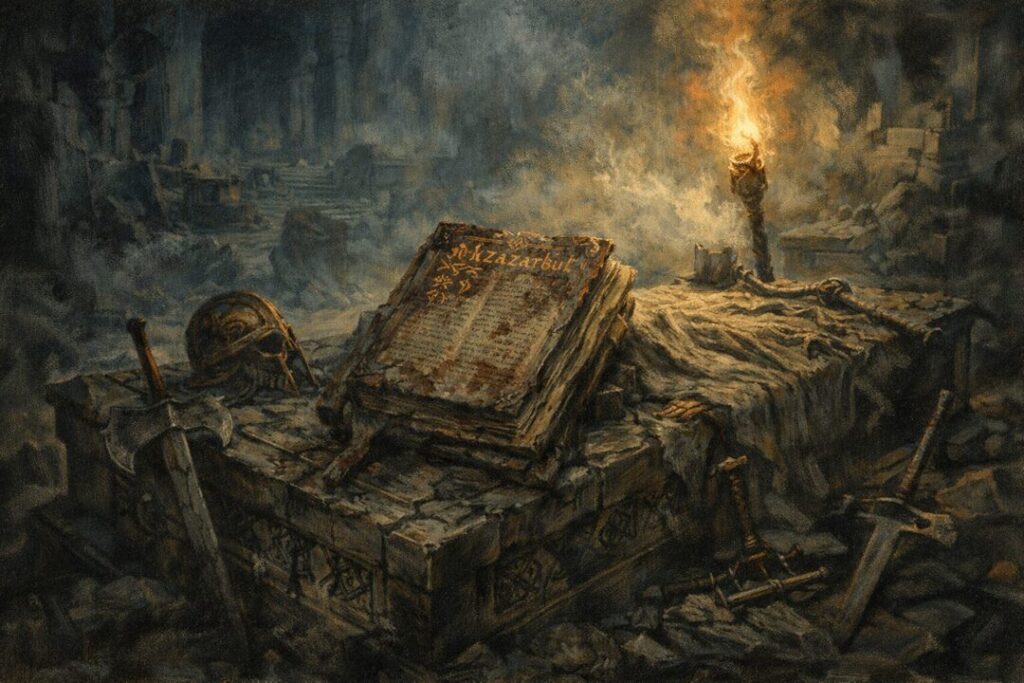
It is recorded in the Book of Mazarbul and confirmed by Gandalf himself when the Fellowship later discovers it.
For several years, Moria lived again.
Not in its former glory—but alive nonetheless.
The Second Fall: Silence, Not Slaughter
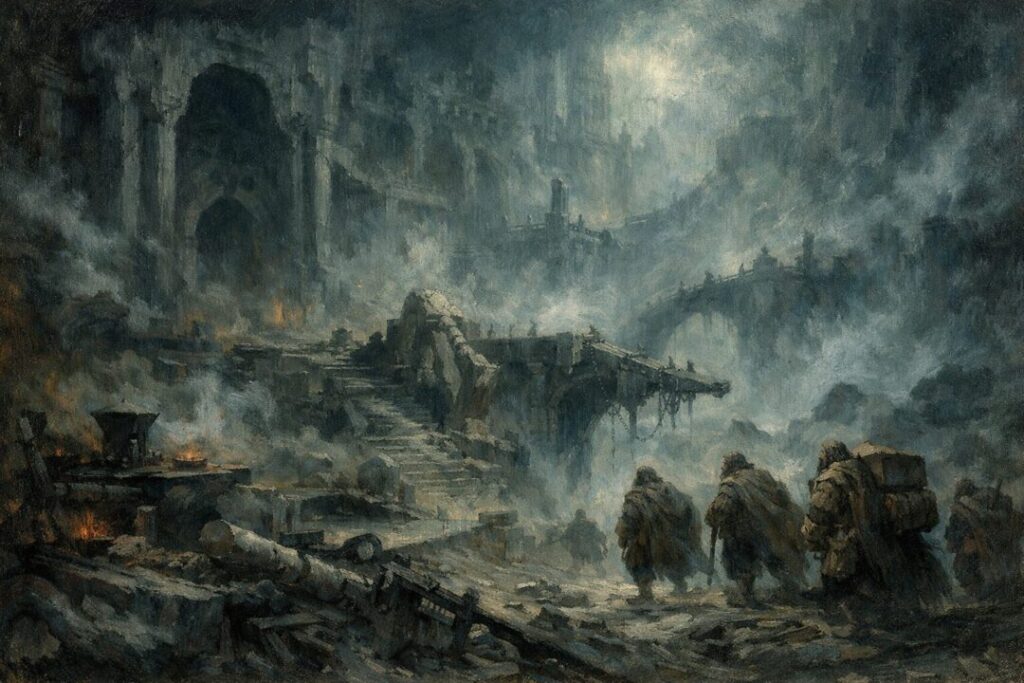
What destroyed Balin’s colony was not a single catastrophic battle.
It was isolation.
Orcs regrouped in the deeper places of the city. The Watcher in the Water made the western approaches deadly and unpredictable. Escape routes narrowed. Communication with the outside world grew sporadic—and then ceased entirely.
And always, far below, Durin’s Bane remained.
The Balrog did not need to rise and destroy the colony directly. Its presence alone shaped the fate of the city. Large-scale defense was impossible. Deep delvings were forbidden. Every victory carried the risk of awakening something that could not be defeated.
When Balin was slain at Mirrormere, the colony did not immediately collapse. The surviving Dwarves retreated inward. They barred doors. They wrote records. They hoped to endure.
And then… nothing.
No survivors escaped to tell the tale.
No warning reached Erebor.
No messenger returned.
By the time the Fellowship enters Moria in The Fellowship of the Ring, centuries have passed since Balin’s death.
The city is not recently fallen.
It is abandoned without witnesses.
Why Moria Was Never Reclaimed Again
After Balin’s failure, the truth could no longer be avoided.
Reclaiming Moria was no longer a matter of Orcs, tunnels, or defenses.
It meant confronting a Balrog.
Not in legend.
Not in theory.
But in reality.
And no Dwarven kingdom—no matter how proud—could afford that cost.
Even if Durin’s Bane could be defeated, the price would be devastating. The loss of life would be immense. And unlike Erebor, Khazad-dûm could not be held securely once reclaimed. Its size was its greatest weakness. Every hall reclaimed created ten more to defend.
The War of the Ring only sealed its fate.
As the Third Age ended, the world itself was changing. Great powers were fading. Dwarves were diminishing. The age of vast delvings and endless stone-works was passing away.
Moria belonged to an earlier world.
A Kingdom Too Old to Return To
Khazad-dûm was not abandoned because it was worthless.
It was abandoned because it was too great, too dangerous, and too deeply bound to the ancient evils of the world. It stood at the crossroads of ages—and the cost of reclaiming it no longer matched the future that lay ahead.
Some places are not meant to be reclaimed.
They are meant to be remembered.
And Moria—dark, vast, and silent—remains one of the clearest reminders that even the greatest works of stone cannot outlast the ages forever.