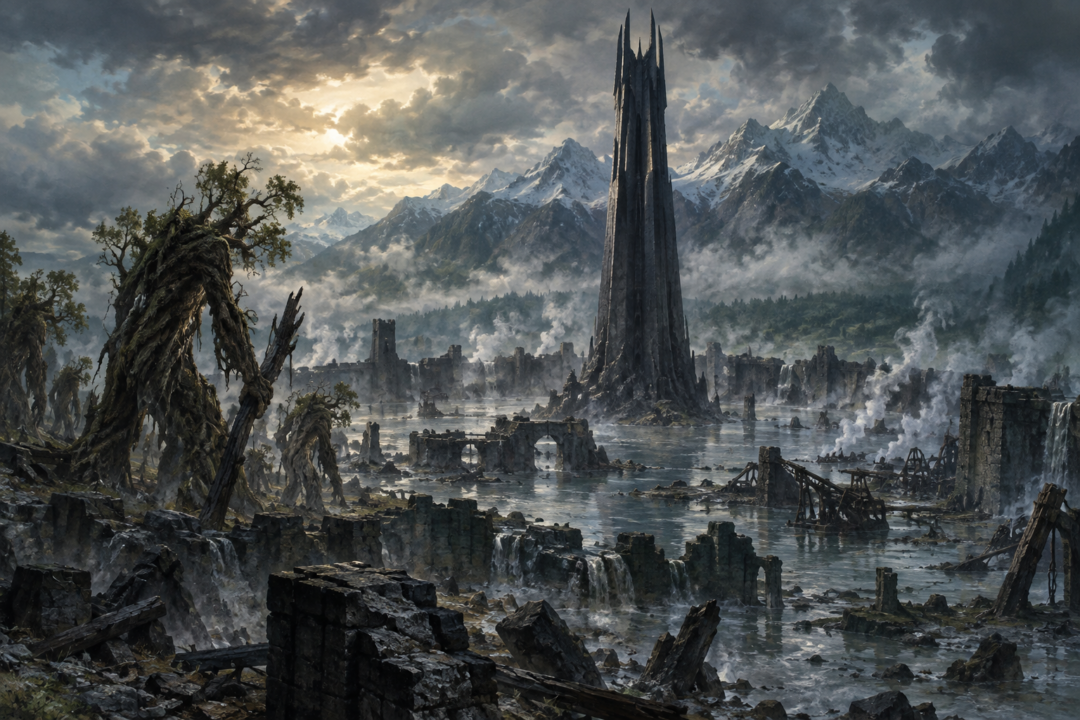
When the Ents descend upon Isengard, almost everything Saruman has made seems vulnerable.
Walls are torn apart. Gates are ruined. Machinery is smashed. Water pours across the hollow of Isengard until the furnaces and pits of Saruman’s war industry disappear beneath flood and wreckage.
Yet one thing remains standing in the middle of it all.
Orthanc.
The black tower survives not because the Ents spare it, and not because Saruman successfully defends it. They actually try to attack it. Their failure reveals something easily missed in the destruction of Isengard: Saruman’s strongest fortress is not really Saruman’s creation at all.
Orthanc belongs to an older world.
And that distinction explains both why the tower survives and why its survival is such a fitting end to Saruman’s rule.
Orthanc Was Ancient Before Saruman Came
By the War of the Ring, Saruman is so closely associated with Isengard that it is easy to think of the entire fortress as his domain.
Historically, however, Isengard long predates him.
The fortress, called Angrenost in Sindarin, was established by the Dúnedain of Gondor in the northwestern reaches of their kingdom. Orthanc stood at its centre, guarding the strategically important approaches near the Gap of Rohan.
The tower was therefore a work of the early Gondorians, heirs of Númenor, not of Saruman.
That matters because the surviving works of the Dúnedain repeatedly testify to abilities that later generations struggle to equal. Orthanc is one of the most extreme examples.
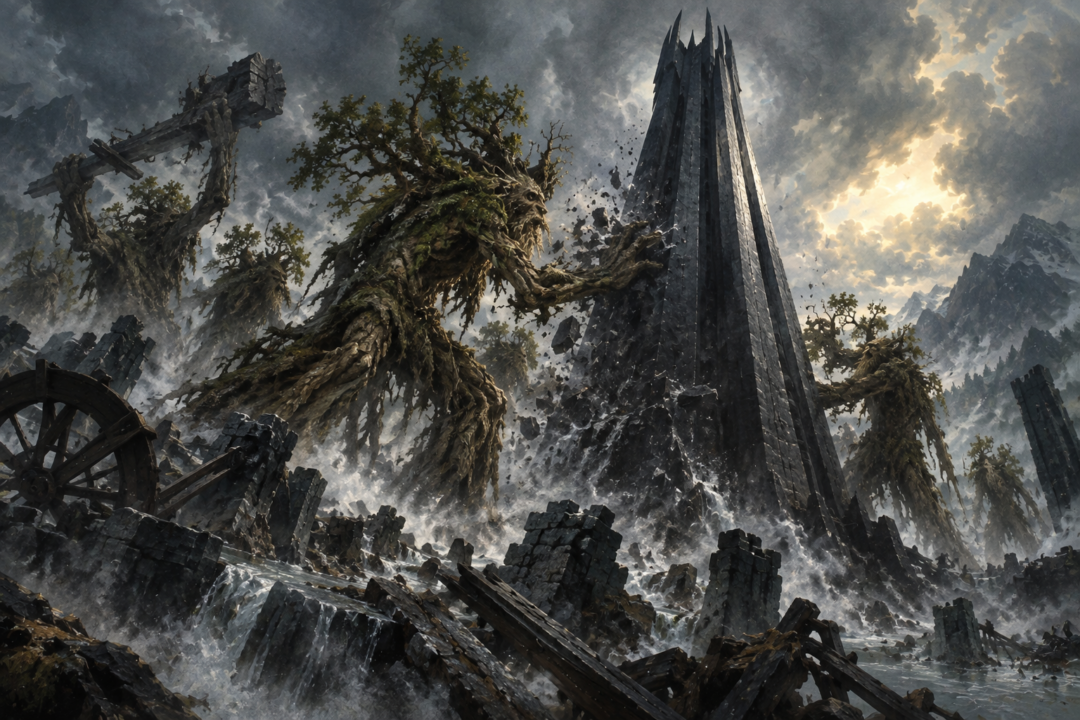
When Aragorn, Théoden, Gandalf, and their companions approach the defeated Isengard in The Two Towers, the tower is described as something almost geological. It is black and extraordinarily hard, rising in four great piers that curve toward sharp pinnacles.
Its workmanship is so strange that it scarcely appears constructed in the ordinary sense. It seems instead as though it had been shaped out of the substance of the earth itself.
The precise method by which the Dúnedain made Orthanc is never explained.
That uncertainty should be preserved. The text does not provide a secret Númenórean formula, spell, or lost technology that explains the tower.
What it does establish is simpler: Orthanc was made with a craft of extraordinary strength, and the people living at the end of the Third Age could not easily reproduce or undo it.
Saruman Destroys the Parts He Can Replace
The contrast becomes sharper when we look at what Saruman does to Isengard.
The old Isengard had once been green. Within the great stone ring were grass and trees, with roads leading toward Orthanc.
Saruman transforms that landscape.
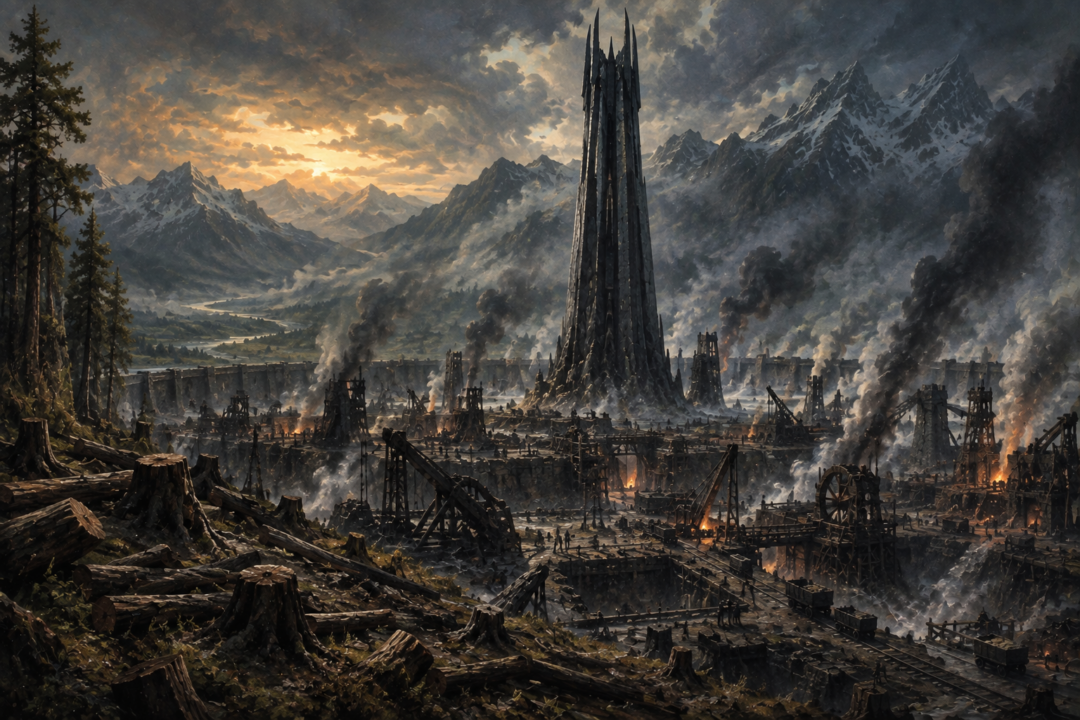
By the time Gandalf is imprisoned there, the place is being converted into a centre of war. Trees are cut down. Shafts and pits are opened. Workshops, furnaces, storehouses, and underground chambers spread through the fortress.
This is one of the great ironies of Isengard.
Saruman possesses an ancient stronghold of remarkable durability, yet much of what he adds to it is temporary.
His engines require fuel. His armies require supplies. His furnaces require constant labour. His underground works depend upon tunnels, openings, dams, and machinery.
Orthanc simply stands.
Saruman has surrounded something ancient and immensely durable with an industrial system that can be destroyed in a single catastrophic night.
The Ents expose the difference.
The Ents Can Break Isengard — But Not Orthanc
When Treebeard and the Ents attack, the outer defences of Isengard prove far less permanent than Saruman presumably expected.
Ents are terrifyingly effective against stonework when enraged. They tear at walls and structures with enormous physical strength. The destruction becomes so violent that the Ring of Isengard is breached and ruined.
But Orthanc is different.
Merry later explains that some of the Ents attacked the tower itself. Their efforts accomplished virtually nothing. The tower's stone was so extraordinarily hard that their blows could not meaningfully damage it.
That distinction is explicit.
The Ents are not incapable of destroying stone. They have just demonstrated the opposite throughout Isengard.
They cannot destroy this stone.
Orthanc belongs to a different order of craftsmanship from the surrounding structures they demolish.
Even Treebeard cannot simply pull it down.
The result is almost absurdly appropriate: Saruman, who imagined himself the master of Isengard, ends the battle trapped inside the one structure his enemies cannot destroy — a structure he did not build.
Is Orthanc Actually Indestructible?
Calling Orthanc absolutely indestructible goes beyond what the text establishes.
It is extraordinarily resistant to damage. The Ents cannot break it, and the tower survives their assault and the flooding of Isengard.
But Tolkien never lays down a universal rule that Orthanc could be destroyed by nothing whatsoever.
The safer conclusion is that its material and construction were beyond the destructive power available to the Ents in that situation.
There is also an intriguing ambiguity surrounding the craftsmanship of ancient Númenórean works. Characters sometimes encounter old structures whose durability seems almost uncanny. Yet readers should be cautious about converting that atmosphere into a precise magical system.
No explicit enchantment is required to explain Orthanc.
The tower is a surviving masterpiece of Dúnedain craftsmanship, built in an age when the Exiles of Númenor still possessed knowledge and abilities that diminished over the centuries.
Its endurance is therefore part of a much larger pattern in Middle-earth: later peoples often inhabit, reuse, misunderstand, or fail to equal the works of those who came before them.
Saruman Inherited Power He Mistook for His Own
Orthanc also tells us something uncomfortable about Saruman.
His position at Isengard was originally legitimate.
In the year 2759 of the Third Age, Steward Beren of Gondor granted Saruman the keys of Orthanc. Saruman initially occupied Isengard as a guardian and ally, although his control later became effectively his own.
Inside Orthanc he also found something far more significant than stone walls: the palantír kept there since ancient times.
Once again, Saruman’s power rests partly upon an inheritance.
The tower is not his.
The Seeing-stone is not his creation.
Even the strategic position of Isengard was chosen and fortified long before his arrival.
Saruman certainly adds his own knowledge, organization, machinery, servants, and military strength. But beneath his new order lies an older foundation created by others.
This makes the destruction of Isengard especially revealing.
The things most clearly associated with Saruman’s new regime are swept away.
The ancient tower remains.
The Flood Reveals What Saruman Actually Built
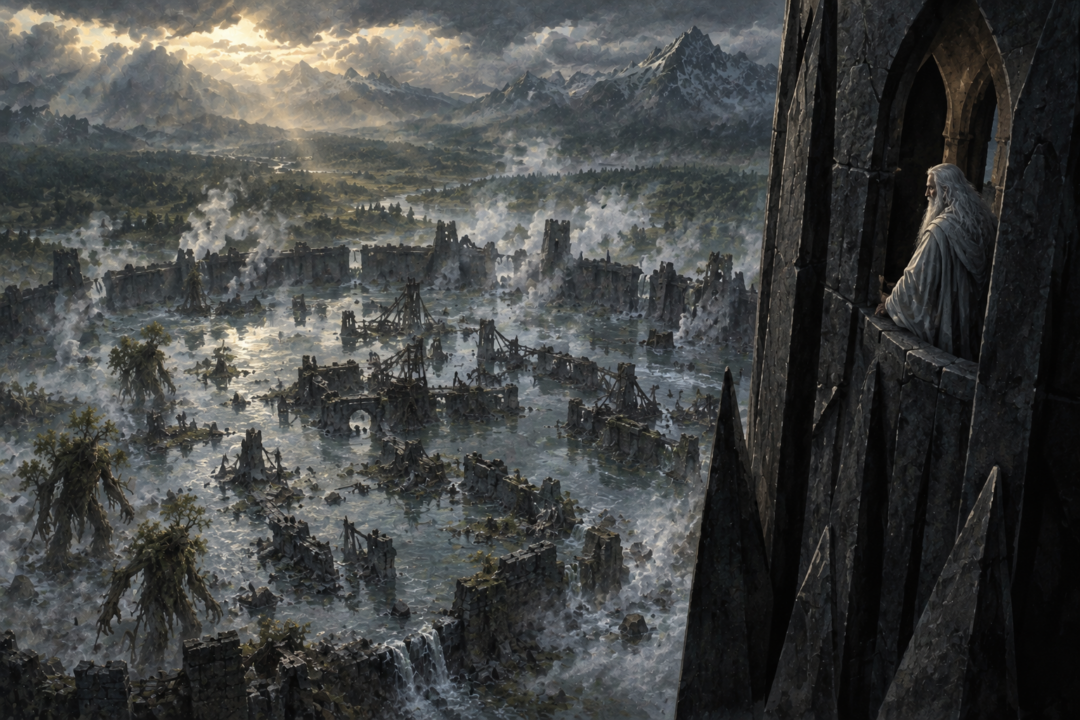
After breaking into Isengard, the Ents release the waters they have gathered.
The result is devastating.
Water floods the circle, filling holes and pits and extinguishing the fires below. Steam rises as Saruman’s underground works are overwhelmed. The industrial landscape that had replaced the greenery of Isengard is drowned.
Orthanc rises above the destruction.
The image creates a powerful contrast without requiring the tower itself to be morally good. Orthanc is a fortress, after all, and Saruman has used it for imprisonment, surveillance, and domination.
But Orthanc is durable in a way Saruman’s industrial empire is not.
He has confused rapid transformation with lasting creation.
He can cut down trees quickly.
He can breed and arm soldiers.
He can dig pits, build machines, burn fuel, and scar an ancient landscape.
What he cannot easily do is create anything comparable to Orthanc.
His apparent mastery of Isengard therefore hides a deeper dependence upon inherited things.
Why Treebeard Leaves the Tower Standing
Once the battle is over, destroying Orthanc is no longer necessary.
Saruman is trapped.
The Ents control the valley, and Treebeard undertakes to watch him. When Gandalf confronts Saruman, the Wizard eventually refuses the opportunity to leave under the conditions offered to him. Gandalf then casts him from the order and breaks Saruman's staff.
The physical tower survives, but Saruman’s authority does not.
This distinction matters.
Victory does not require Orthanc to be reduced to rubble.
Saruman’s defeat is demonstrated precisely by the fact that the tower remains while his ability to command events outside it disappears.
The fortress that once projected his power becomes his prison.
Later, after Saruman finally leaves, the Ents reshape Isengard rather than reconstructing its military works. In the postwar settlement described near the end of The Return of the King, the valley becomes the Treegarth of Orthanc.
The walls have been removed, greenery returns, and Orthanc stands amid water.
The black tower survives inside a living landscape.
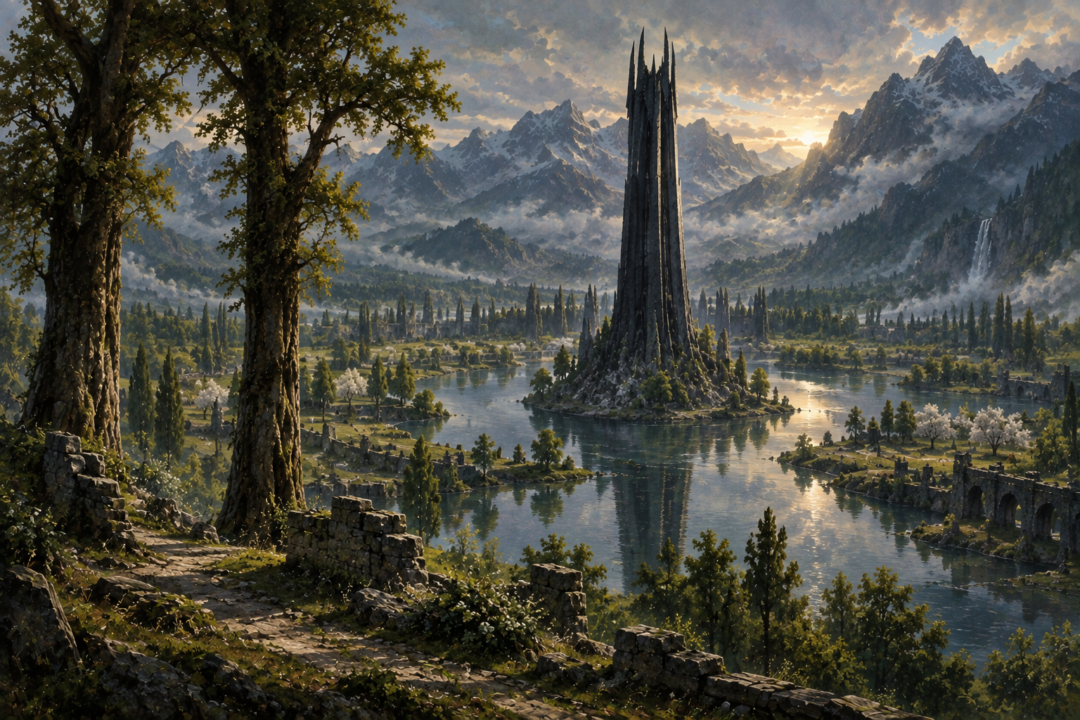
Orthanc Becomes a Monument to the World Saruman Could Not Control
There is a deeper reason Orthanc’s survival feels right.
Middle-earth is filled with ruins.
Kingdoms decline. Towers fall. Roads outlast the people who built them. Ancient objects survive long after their original purposes have been forgotten.
Orthanc belongs to this pattern, but with an unusual twist.
Saruman does not merely inherit a ruin. He occupies a functioning masterpiece of the past and surrounds it with the works of his own ambition.
Then his works become the ruins.
Orthanc remains.
The tower therefore becomes a visual measure of Saruman’s failure. He sought mastery through control, machinery, military force, and imitation of the Enemy. Yet after his power collapses, the most enduring thing associated with his realm turns out to be something he inherited from people long dead.
Even the landscape ultimately escapes him.
Water extinguishes his fires.
The Ents destroy his machinery.
Trees return to Isengard.
And at the centre stands the tower he could occupy but never truly make his own.
Orthanc survives because its ancient builders made something the Ents could not break.
But within the story, its survival does something more interesting than preserve an impressive fortress.
It separates possession from creation.
For centuries Saruman could unlock Orthanc, live inside it, use the palantír preserved there, command armies from it, and call himself Lord of Isengard.
None of that made the tower his achievement.
When everything temporary is stripped away, that truth becomes impossible to miss.
Saruman passes.
His machines vanish.
His armies are scattered.
His pits fill with water.
The trees return.
And Orthanc, the work of an older age, is still standing.
Sources & Notes
- Tolkien Gateway — Orthanc https://tolkiengateway.net/wiki/Orthanc
- Tolkien Gateway — Isengard https://tolkiengateway.net/wiki/Isengard
- Tolkien Gateway — Ents https://tolkiengateway.net/wiki/Ents
These references document Orthanc’s Númenórean construction, Saruman’s transformation of Isengard, and the Ents’ destruction and flooding of the fortress while the tower resisted them. The contrast between inherited endurance and Saruman’s temporary works is interpretive synthesis.