The Glittering Caves Promised a Different Kind of Dwarven Kingdom
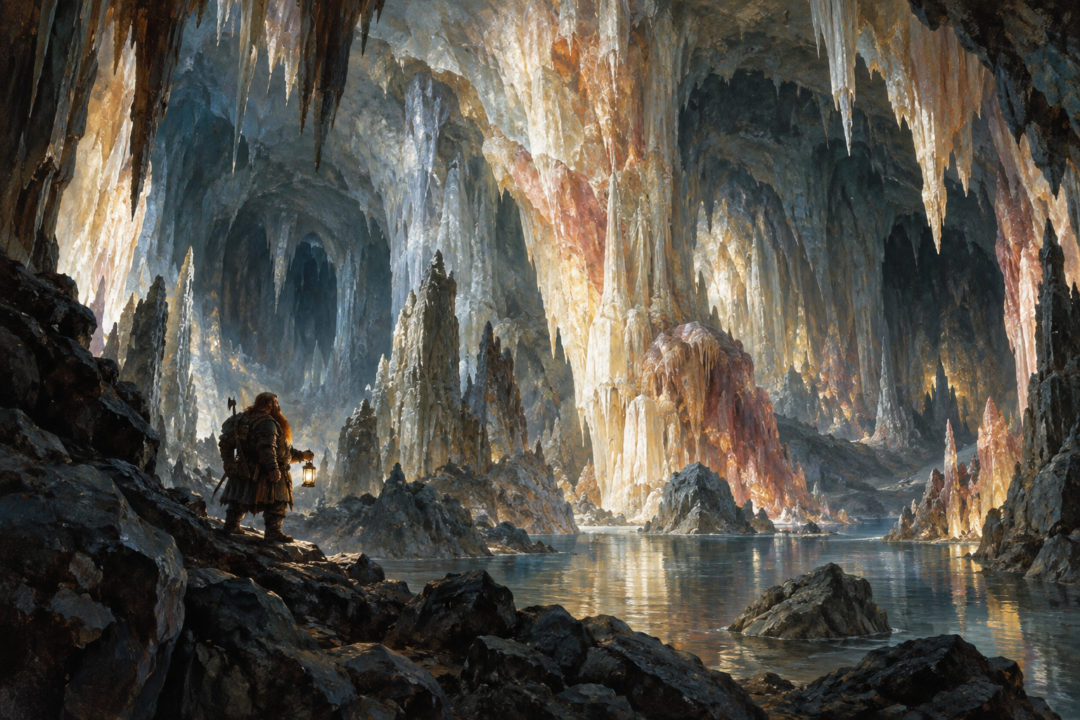
When Gimli entered the caverns behind Helm’s Deep, he discovered something almost paradoxical for a Dwarf: a treasure whose value depended on leaving most of it where it was.
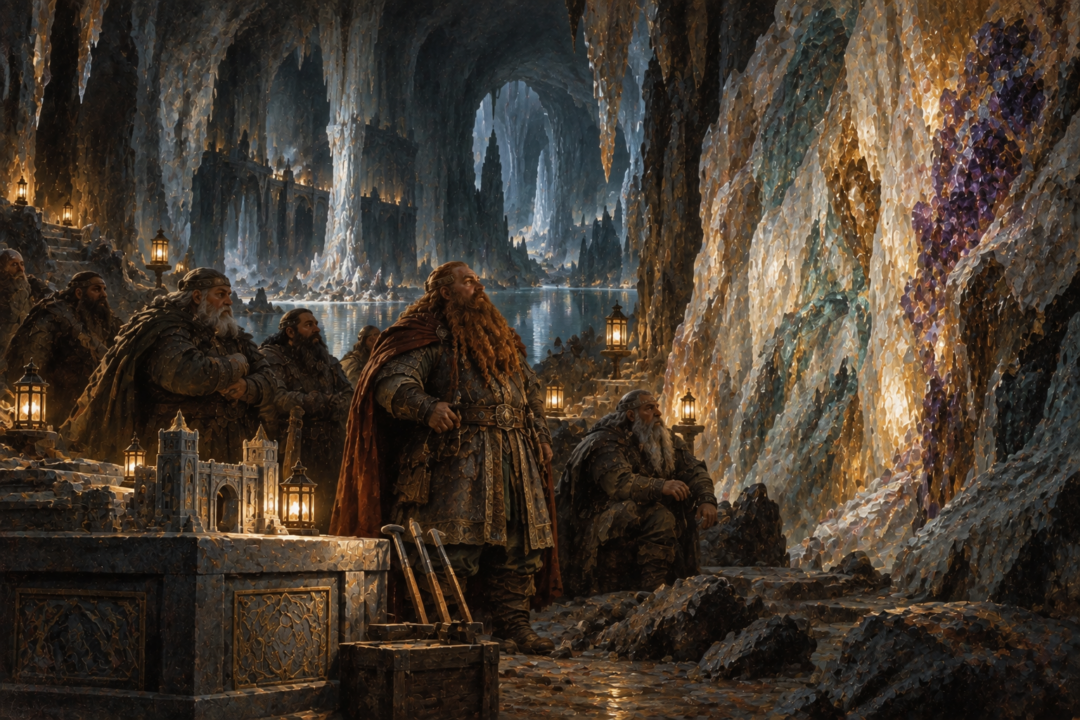
Aglarond—the Glittering Caves—contained gems, crystals, veins of ore, translucent marble, soaring columns, hanging formations, pools, and chambers disappearing into the mountain. Yet when Legolas jokingly suggested that enthusiastic Dwarves might damage such a place, Gimli rejected the idea completely. The caves were not a deposit waiting to be consumed. They were already beautiful.
His answer contains one of the most revealing descriptions of Dwarven craft in The Lord of the Rings. Gimli says his people would “tend” the stone rather than quarry it. Their work would be cautious, sometimes removing only a tiny piece of rock after a day’s labor, opening passages and placing lights so that hidden chambers could be seen.
That vision becomes especially striking when placed beside the history of Khazad-dûm.
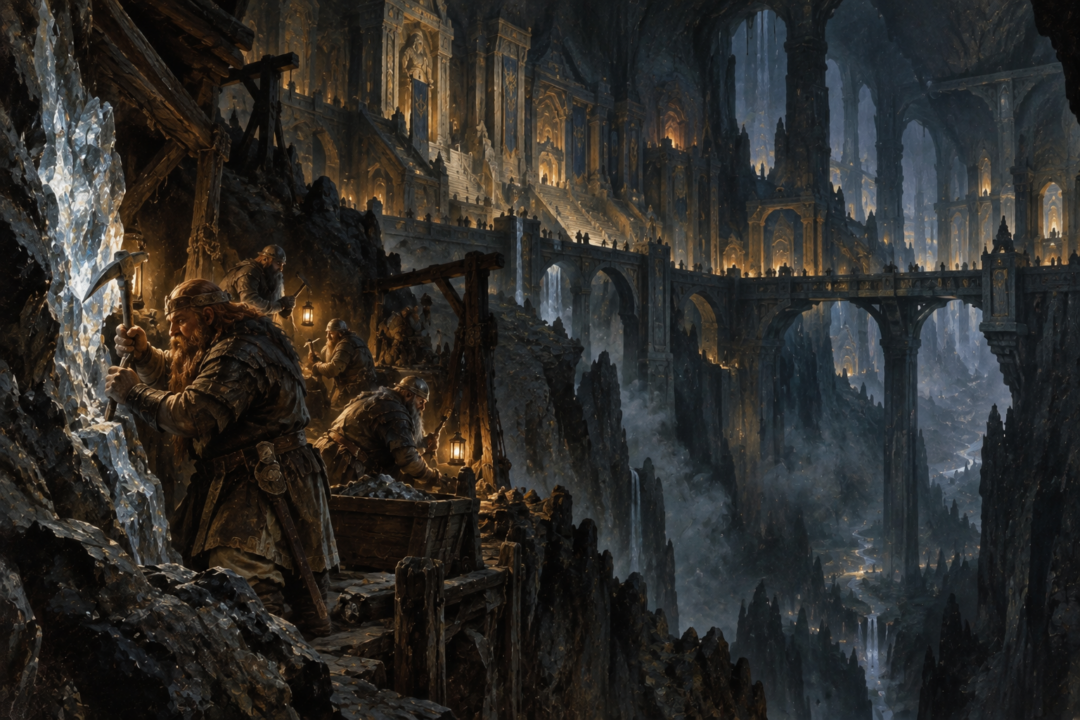
Moria had been one of the greatest achievements of the Dwarves. But its wealth in mithril also drew Durin’s Folk ever deeper beneath the mountains, until their delving awakened the Balrog that destroyed their kingdom.
Aglarond offered Gimli something different: not a rejection of Dwarven craft, but a vision of craft restrained by wonder.
Gimli Saw a Treasure Before He Saw a Resource
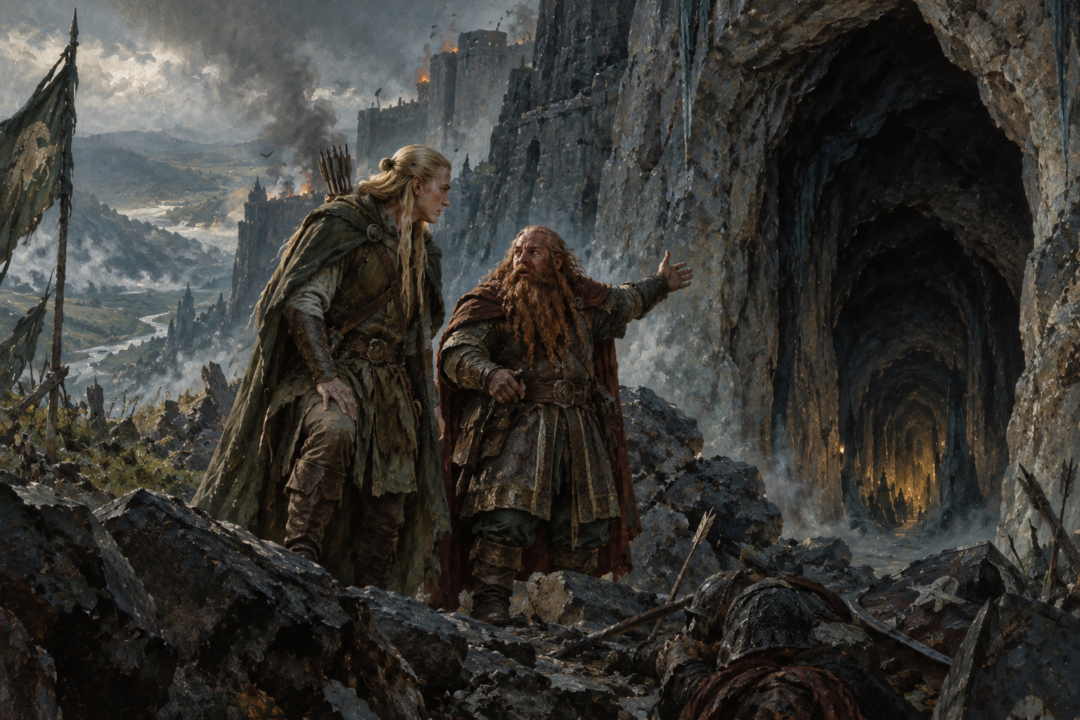
The Glittering Caves first mattered to the Rohirrim for practical reasons. The caverns behind the Hornburg could shelter people in time of war, and during the Battle of the Hornburg many of the people of Westfold took refuge there.
Gimli entered them amid the violence of that battle.
What he discovered affected him profoundly. When he later described the caves to Legolas, his language was not primarily concerned with mineral wealth. He spoke of chambers and halls, domes and stairs, polished walls where gems and ore glimmered, and extraordinary formations of stone.
Most importantly, he compared the cave formations to living and crafted beauty: flowers, clouds, banners, palaces.
This matters because Gimli certainly understands material value. He is a Dwarf of Durin’s Folk, descended from a culture renowned for mining, masonry, metalwork, and the making of beautiful things. Yet Aglarond does not first awaken his desire to possess what he sees.
It awakens reverence.
Legolas initially assumes that Dwarven involvement would mean transformation on a much larger scale. Gimli answers by insisting that no Dwarf could remain unmoved by such beauty, and that Durin’s Folk would not mine these particular caves for their stones and ores even if enormous riches could be obtained.
The distinction is crucial.
Aglarond is valuable precisely because its riches remain part of Aglarond.
The Shadow of Khazad-dûm
It is tempting to turn Moria into a simple warning that mining is bad or that Dwarves were punished for greed. The texts support something more complicated.
Khazad-dûm was not presented merely as a mine. It was the ancient mansion of Durin’s Folk, a magnificent civilization whose halls inspired longing centuries after its fall. Gimli himself reveres it. Galadriel speaks respectfully of its former greatness, and the memory of the kingdom remains central to Dwarven identity.
Its catastrophe nevertheless involved a fatal act of delving.
Mithril was extraordinarily valuable, and Khazad-dûm possessed the great known source of it in Middle-earth during the later ages. As Durin’s Folk sought it beneath Caradhras, they went increasingly deep. In Third Age 1980 they awakened a Balrog that had remained hidden beneath the mountains since the wars of the First Age.
Durin VI was killed. His son Náin I died the following year, and the Dwarves fled their ancestral home.
By the time of the Fellowship, the disaster was part of Dwarven memory. At the Council of Elrond, Glóin summarizes the tragedy with brutal economy: his people had delved too deeply and awakened the terror below.
That history gives Gimli’s later words about Aglarond additional weight.
The text never explicitly says that Gimli designed his stewardship of the Glittering Caves as a deliberate correction of Moria’s downfall. We should therefore not claim that he consciously founded Aglarond to prevent “another Moria.”
But the contrast is undeniably present for the reader.
Khazad-dûm was a place where Dwarves pursued precious material deeper into the earth.
At Aglarond, Gimli imagines Dwarves encountering precious material and deliberately refusing to extract it.
“Tend,” Not Quarry
Gimli’s choice of metaphor changes everything.
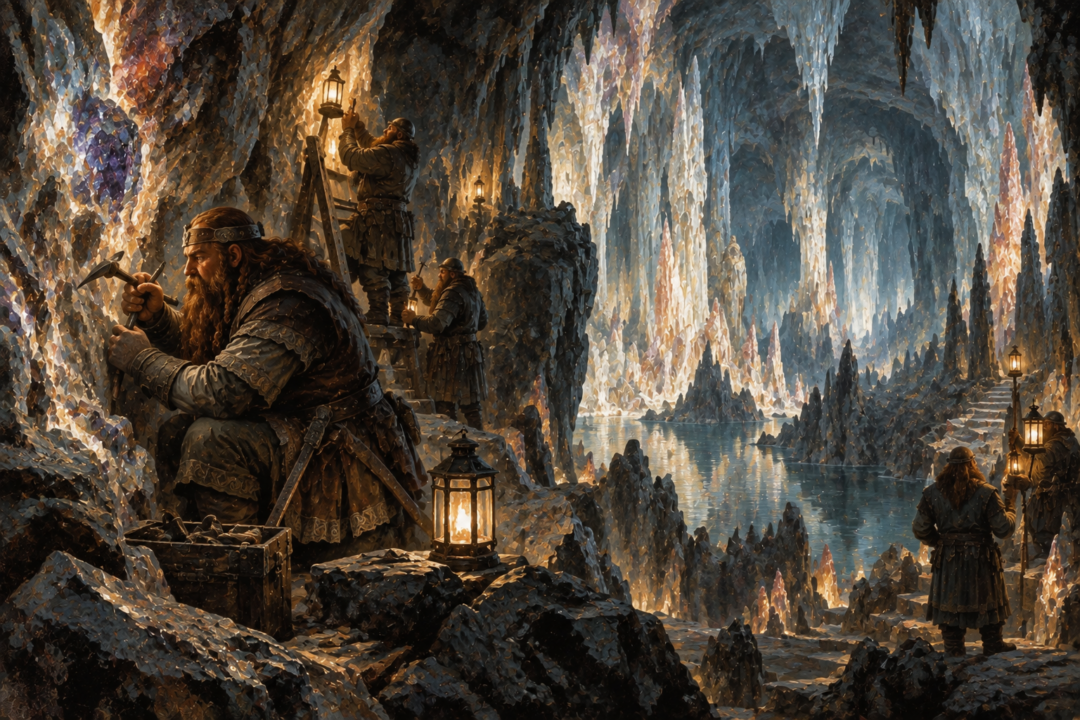
He compares destroying the caves for their mineral wealth to cutting down flowering trees in spring merely for firewood. His proposed alternative is essentially cultivation: the Dwarves would tend the “flowering stone.”
That does not mean doing nothing.
Gimli imagines skilled intervention. Dwarves would remove stone carefully. They would open new passages. They would reveal chambers currently hidden behind fissures. They would install lamps.
But the purpose of the work would be revelation rather than extraction.
This is perhaps the deepest distinction between Aglarond and the simplified stereotype of the Dwarf as a creature who sees mountains primarily as storehouses of wealth. Gimli wants to use Dwarven craftsmanship to help others perceive beauty already present in the mountain.
The craftsman becomes almost a curator.
And his restraint is remarkably specific. He imagines work proceeding so cautiously that perhaps only one small chip would be removed during an entire anxious day.
Speed is not the measure of success.
Neither is volume.
The standard is whether the work preserves and reveals the beauty that caused the work to begin.
The Darkness Would Also Be Preserved
One easily overlooked detail makes Gimli’s proposal even more unusual.
He wants to illuminate the caves with lamps recalling those once used in Khazad-dûm. But he does not imagine permanently flooding every chamber with light.
Sometimes the Dwarves would illuminate the caves.
Sometimes they would allow the ancient darkness to return.
That restraint suggests that Gimli does not consider darkness itself a defect requiring correction. The cave does not have to become wholly domesticated before it can be appreciated.
The Dwarves would alter Aglarond, but they would not seek complete mastery over its character.
This makes the reference to Khazad-dûm particularly poignant. Gimli wants to recover something from the lost civilization of his ancestors—their skill, their lamps, their ability to work magnificently beneath mountains—without necessarily reproducing every relationship they had with the underground world.
Aglarond could inherit the craft of Khazad-dûm without simply becoming another great mine.
That is an interpretation rather than an explicit statement of authorial intent, but it follows closely from the contrast Gimli himself draws between mining and tending.
Gimli’s Friendship With Legolas Matters Here
There is another reason this conversation matters.
Gimli explains his vision to an Elf.
Throughout the story, the friendship between Gimli and Legolas gradually overcomes inherited suspicion between their peoples. Aglarond becomes part of that exchange.
Legolas loves forests. Gimli loves mountains and stone.
Instead of demanding that the other abandon those attachments, they agree to enter each other’s worlds. Gimli will visit Fangorn with Legolas; Legolas will visit the Glittering Caves with Gimli.
The parallel makes Gimli’s comparison between stone formations and flowering trees more significant. He explains subterranean beauty using imagery that Legolas can understand.
Stone can have its own kind of growth-like beauty.
A cavern can deserve something resembling the care given to a grove.
Their friendship does not erase the difference between Elf and Dwarf. It allows each to recognize value in what the other loves.
After the War, Gimli Returned
Gimli’s vision did not remain merely a battlefield dream.
Appendix A records that after Sauron’s fall, Gimli brought Dwarves from Erebor to the Glittering Caves and became their lord. The Dwarves of his colony performed notable works in the restored kingdoms, including replacing the destroyed Great Gate of Minas Tirith with one made of mithril and steel.
This is important because the Dwarves of Aglarond were not anti-craft.
They remained makers.
They worked stone and metal. They repaired what war had broken. Their skill became part of the rebuilding of the West after Sauron’s defeat.
The contrast, therefore, is not between industry and untouched wilderness.
It is between different purposes for craft.
In one place, the craftsman may extract material.
In another, he may build.
And in Aglarond, he may encounter something whose existing form is so beautiful that his highest skill lies partly in knowing what not to remove.
The Lesson Hidden Beneath Helm’s Deep
The Glittering Caves are easy to overlook beside the larger events surrounding them. Helm’s Deep is remembered for siege, courage, desperation, and victory.
Yet beneath the battlefield lies one of the story’s quieter visions of restoration.
Gimli does not dream of conquering Aglarond.
He dreams of serving its beauty.
That does not erase the greatness of Khazad-dûm, nor does it reduce Moria’s fall to a simplistic punishment for greed. Khazad-dûm was a wonder of the Dwarves, and its loss was a genuine tragedy. The later restoration of Durin’s people remained part of their hope and history.
But Aglarond shows another possibility for Dwarven greatness.
The mountain contains riches, and the Dwarves know how to reach them. Yet knowledge does not automatically become permission.
Some gems can remain in the wall.
Some darkness can remain darkness.
Some stone can be shaped only enough to reveal what was already there.
And perhaps that is why Gimli’s imagined work in the Glittering Caves feels so different from the fatal descent remembered in Moria. The skill of Durin’s Folk has not diminished. Their love of stone has not disappeared. Their hammers and chisels remain.
What changes is the relationship between craft and possession.
At Aglarond, mastery is expressed through restraint.
The Dwarf does not look into the mountain and ask only what can be taken from it.
He looks—and first decides that it is beautiful.
Sources & Notes
- Tolkien Gateway — Glittering Caves https://tolkiengateway.net/wiki/Glittering_Caves
- Tolkien Gateway — Gimli https://tolkiengateway.net/wiki/Gimli
- Tolkien Gateway — Khazad-dûm https://tolkiengateway.net/wiki/Khazad-d%C3%BBm
These references document Gimli’s encounter with Aglarond, his plan for a Dwarven colony and careful craft there, and Khazad-dûm’s history of deep mithril delving. The contrast between extraction and restrained stewardship is the article’s interpretation.