
At the western edge of the Shire, beyond the Far Downs, the land rises toward three ancient towers looking out toward the Sea. By the Fourth Age, Hobbits were living beneath them. Their settlement was called Undertowers, and the family established there carried one of the most intriguing titles in the later history of the Shire: Warden of Westmarch.
It sounds surprisingly grand for Hobbit government.
A “Warden” seems to imply borders, law, administration, perhaps even command. Yet the Shire famously possessed very little formal government at all. That creates an interesting question: what did the Warden of Westmarch actually govern?
The safest answer is also the most revealing one.
We are never given a list of the Warden’s official powers.
What we are given is a new territory, a rapidly growing Hobbit population, a hereditary family at its western edge, and an extraordinary historical archive placed in that family’s keeping. From those facts, we can see what the office certainly represented—and where interpretation must begin.

The Westmarch Was a New Part of the Shire
The Westmarch did not belong to the traditional Four Farthings.
After the restoration of the North-kingdom under King Elessar, the Shire’s position changed considerably. The King confirmed the Shire as a Free Land, and Men were forbidden to enter it without permission. Later, in Shire-reckoning 1452, the King added the country between the Far Downs and the Tower Hills to the Shire.
The appendices specifically say that many Hobbits moved into this new territory.
That detail matters.
The Westmarch was not merely an empty strip added to a map. It became a region of settlement. Families were moving westward beyond the old boundaries of the Shire into land that had only recently become formally theirs.
Ten years later, according to the chronology as corrected in the later textual tradition, Samwise Gamgee—then serving another term as Mayor—requested that the Thain make his son-in-law Fastred of Greenholm Warden of Westmarch. Fastred and Sam’s daughter Elanor then made their home at Undertowers in the Tower Hills.
Their descendants became the Fairbairns of the Towers.
So the office emerges directly from the Shire’s territorial expansion.
That does not prove what its duties were, but it gives the title a clear context: somebody was now associated with the ordering of a newly settled western district.
Hobbit “Government” Was Barely Government at All
It is tempting to imagine Fastred as something like a provincial governor.
That would probably be too strong.
The Shire’s political structure was famously light. Families largely managed their own affairs, while ancient laws were obeyed mostly because Hobbits considered them reasonable and traditional.
The Thain possessed old authority connected with the Shire-moot and the Shire-muster, but by the late Third Age the office had become largely honorary because such emergencies were rare.
The Mayor of Michel Delving was the closest thing the Shire had to an ordinary public official. The mayoralty also carried responsibility for the Messenger Service and the Watch through the attached offices of Postmaster and First Shirriff.
Even the Shirriffs were hardly an intimidating police force in normal times.
This matters when interpreting the Warden.
Nothing in the texts says that Fastred acquired a bureaucracy, courts, tax collectors, soldiers, or a separate body of Shirriffs. Nothing says that the Westmarch ceased to fall under the broader institutions of the Shire.
Calling the Warden a conventional governor therefore goes beyond the evidence.
The title exists. Its detailed constitutional powers do not.

The Closest Parallel May Be Buckland
There is, however, a suggestive comparison at the opposite end of the Shire.
Buckland lay east of the Brandywine and had developed as a Hobbit colony beyond the Shire’s original bounds. Its hereditary leader was the Master of Buckland, the head of the Brandybuck family.
The Westmarch creates a striking geographical balance.
Buckland stood beyond the old Shire in the east. The Westmarch extended beyond its old border in the west. Both became associated with important hereditary families: the Brandybucks in Buckland and the Fairbairns in Westmarch.
But the comparison should not be pushed too far.
The texts actually tell us something about Buckland’s peculiar organization and traditions. They do not explicitly say that the Warden possessed the same powers as the Master.
What can safely be said is that Fastred became the titled figure associated with the newly settled western extension of Hobbit country, just as the Master was an established authority in the unusual eastern district.
That makes the Warden significant without inventing an unwritten constitution for him.
So What Was Fastred Probably Looking After?
Here we enter interpretation.
Because many Hobbits had moved into the Westmarch, some local coordination would have been useful. New settlements create ordinary problems: boundaries between holdings, roads and paths, communication with older communities, and the practical integration of newcomers into an existing society.
It is reasonable to imagine that the Warden played some role in such matters.
But none of those duties is explicitly assigned to him in the surviving text.
Likewise, the title “Warden” naturally suggests some concern for a march or border district. Yet we are never told that Fastred commanded Bounders, maintained a western watch, or possessed military authority comparable to the Thain’s ancient captaincy of the Shire-muster.
Those possibilities should remain possibilities.
The strongest conclusion is simpler: the creation of a special hereditary office indicates that the Westmarch was considered distinct enough to need a recognized local head.
Exactly how that authority worked in daily life is left unstated.
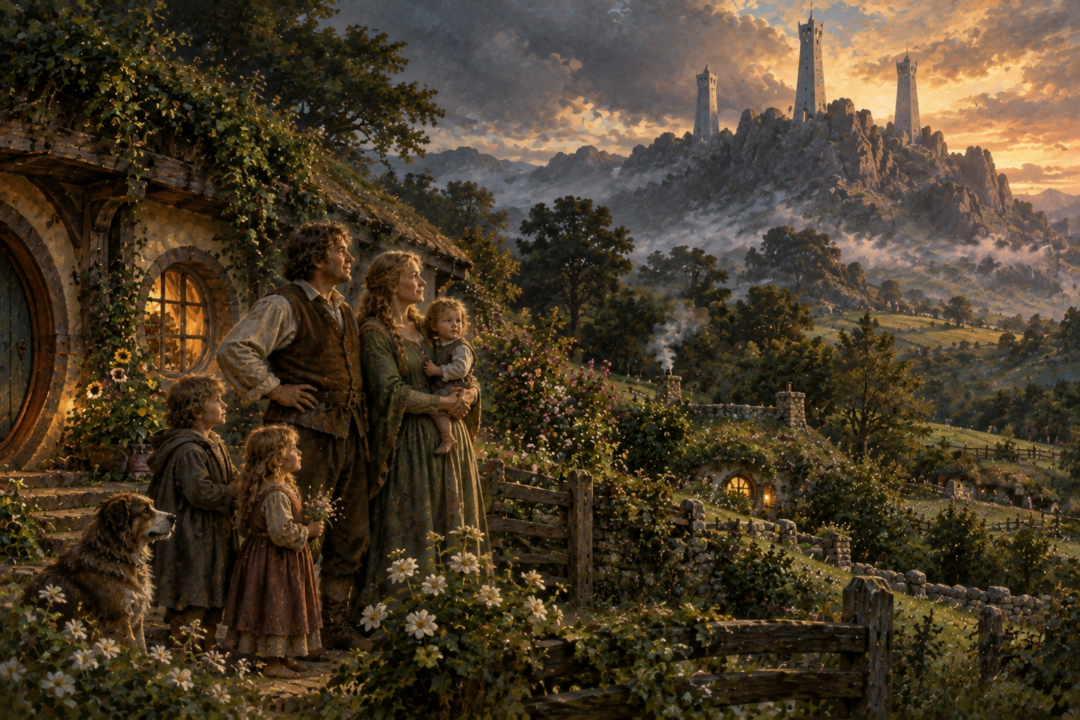
Undertowers Was an Extraordinary Place for a Hobbit Family
The Fairbairns did not establish themselves in an ordinary village.
They lived at Undertowers beneath the Tower Hills, the Emyn Beraid. Above them stood the three Elf-towers, the westernmost of which, Elostirion, had once housed a palantír that looked westward toward the Sea.
The Stone itself was no longer there by the time Fastred became Warden; it had departed over Sea with the Ring-bearers.
But the location still carried enormous historical weight.
For generations the Shire had been a comfortable rural country whose inhabitants generally paid little attention to the great history surrounding them. Now one of its leading families lived beneath monuments belonging to an older world, at the extreme western reach of Hobbit settlement.
And Elanor was uniquely suited to become part of that transition.
She was Samwise’s eldest daughter. She had met King Elessar and Queen Arwen, served as one of Arwen’s maids of honour, and travelled with her parents to Gondor.
The household at Undertowers therefore stood unusually close to both sides of the Shire’s identity: its ordinary Hobbit life and the wider history of the restored kingdoms.
Then Sam gave Elanor something more important than any political title.
The Wardens Became Keepers of the Red Book
In 1482 by Shire-reckoning, after the death of Rose, Sam left Bag End.
He travelled west and was last seen by Elanor in the Tower Hills. Before his final departure, he entrusted the Red Book to her.
It remained with the Fairbairns of the Towers.
This is one of the few responsibilities associated securely with the family of the Wardens, although the text does not define preservation of the Red Book as a formal duty of the office itself.
That distinction is important.
The Fairbairns inherited both the Wardenship and the Red Book, but we should not automatically turn one into an official function of the other.
Still, the combination is remarkable.
The Red Book contained the accounts ultimately associated with Bilbo, Frodo, and Sam, together with material concerning the Elder Days. The copies preserved and developed in the Shire became foundational historical records.
So Undertowers became not merely the home of a frontier family but one of the great centres of Hobbit memory.
The westernmost household of the Shire was looking backward across history even as Hobbit settlement moved westward.

The Real Meaning of the Wardenship
Perhaps the most interesting thing about the Warden of Westmarch is how little power the title needs in order to matter.
Fastred did not need to be a miniature king.
The Fourth Age was not about turning the Shire into Gondor. The Shire remained itself: local, familial, suspicious of unnecessary government, and governed more by custom than command.
The Westmarch appears to have been absorbed into that culture rather than transformed into a heavily administered province.
The Warden therefore fits the Shire precisely because his authority is understated.
He represents continuity in a place of expansion.
A new land had been given to the Hobbits. People were settling it. A recognized family established itself at Undertowers, and the Wardenship became hereditary among their descendants.
Later, that same house guarded the written memory of the age that had made this peaceful expansion possible.
We cannot honestly draw a map of Fastred’s jurisdictional powers or list his daily responsibilities. The surviving texts do not provide them.
But we can say what he stood at the centre of.
The Warden of Westmarch was attached to the newest territory of the Shire, where Hobbit life had pushed beyond its ancient western boundary toward the Tower Hills. His descendants remained there for generations, and their house became the keeper of the Red Book.
That may be more fitting than a detailed bureaucracy.
At the western edge of the Shire, beneath towers built in an older age, the Fairbairns guarded two things that the Fourth Age increasingly depended upon: newly inherited land and remembered history.
Sources & Notes
- Tolkien Gateway — Westmarch https://tolkiengateway.net/wiki/Westmarch
- Tolkien Gateway — Fastred https://tolkiengateway.net/wiki/Fastred
- Tolkien Gateway — Red Book of Westmarch https://tolkiengateway.net/wiki/Red_Book_of_Westmarch
These references document the Shire’s new Westmarch, Fastred’s appointment and family at Undertowers, and the Red Book’s later custody there. The Warden’s precise administrative duties are not stated, so the article marks its reconstruction as interpretation.