The strangest weapon carried into Mordor was not Sting, nor the phial of Galadriel, nor even the hard courage that kept two hobbits walking after hope had almost died. It was pity.
That sounds simple until Gollum enters the story. Gollum is not merely pitiful. He is treacherous, murderous, enslaved to the Ring, and willing to guide Frodo and Sam into Shelob’s lair so he can recover his “Precious.” Yet he is also Sméagol: a ruined hobbit-like creature, once capable of speech, fear, memory, and even a faint longing for gentleness. The great tension is not whether Gollum deserves trust. The texts make clear that he often does not. The deeper question is whether mercy can reach someone who has almost forgotten how to receive it.
Frodo’s pity holds Gollum for a time. Sam’s pity, when it finally comes, does not heal him. But that difference is not because Sam is cruel or Frodo is naive. It is because they meet Gollum from opposite sides of the wound.
Frodo Pities Gollum Before He Fully Understands Him
Frodo’s first lesson in pity comes long before he sees Gollum with his own eyes. In Bag End, Frodo reacts as many readers might: he wishes Bilbo had killed Gollum when he had the chance. Gandalf’s answer becomes one of the moral hinges of The Lord of the Rings. Many who live deserve death; some who die deserve life; even the wise cannot see all ends.
The point is not that Gollum is harmless. Gandalf knows very well that Gollum is dangerous. The lesson is about judgment. Frodo is being asked to admit that he cannot know every consequence of mercy or death. Bilbo’s refusal to strike Gollum “without need” did not make Gollum good, but it changed the moral shape of Bilbo’s own possession of the Ring. Bilbo began his ownership with pity, and the text strongly links that beginning with the lesser damage the Ring did to him.
At first Frodo says he does not feel pity for Gollum. Gandalf replies that Frodo has not seen him. That detail matters. Frodo’s pity begins as a lesson accepted from wisdom, not as an emotion naturally felt. He does not yet love Gollum. He chooses to leave room for mercy before feeling it.
Later, when Frodo becomes Ring-bearer under far greater pressure, that earlier lesson becomes personal.
The Ring Makes Frodo Recognize Gollum From Within
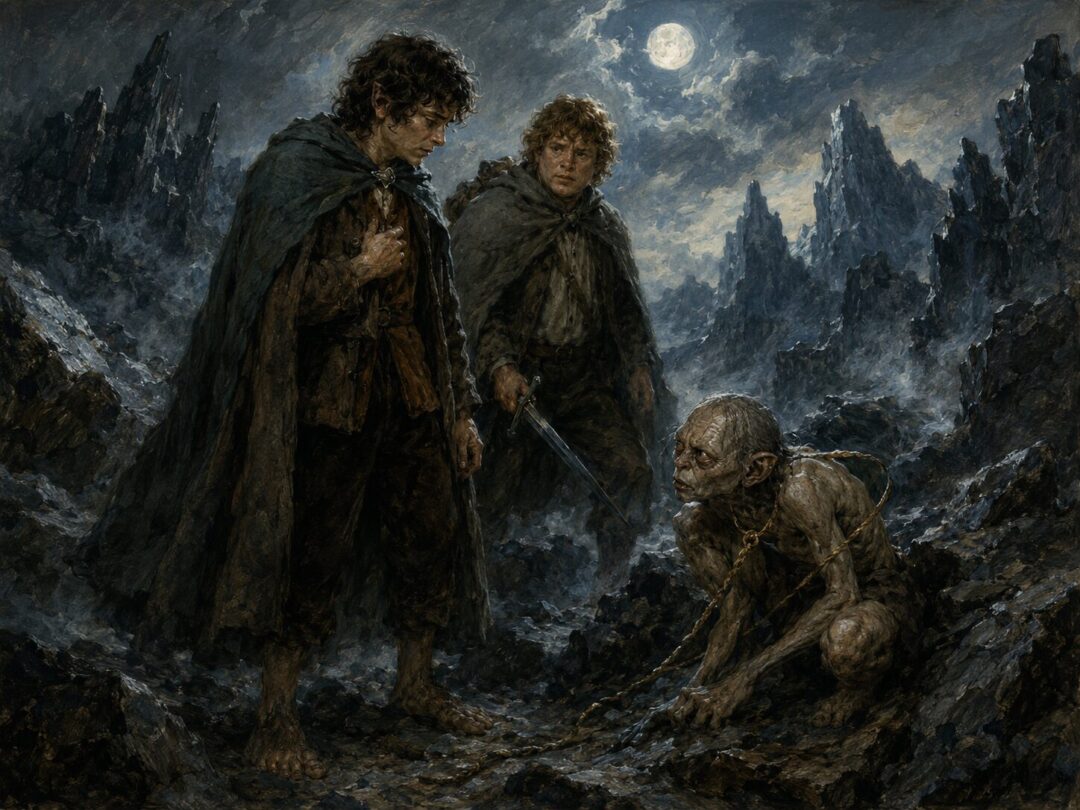
When Frodo and Sam capture Gollum in the Emyn Muil, Frodo is not dealing with an abstract villain anymore. He sees the creature’s hunger, fear, cunning, and misery. He also understands something Sam cannot fully understand: what it means to bear the Ring.
This is the central reason Frodo’s pity “holds” longer than Sam’s. Frodo does not merely observe Gollum’s corruption from outside. He feels the same power pulling at himself. He knows that Gollum is not a separate species of wickedness. Gollum is a warning of what a Ring-bearer can become.
That recognition does not make Frodo foolish. He binds Gollum with an oath. He warns him sternly not to betray them. He uses the authority of the Ring in a way that is morally uncomfortable but effective: Gollum swears by the Precious, and Frodo understands the danger of breaking such an oath. Frodo’s pity is therefore not sentimental softness. It is mercy joined to clear sight.
Frodo sees Sméagol because he knows Gollum. Sam sees Gollum because he must protect Frodo from him. Both perceptions are true, but they do not have the same effect on the creature being watched.
Sam Is Right About Gollum More Often Than He Is Wrong
It is easy to make Sam the villain of this moral failure, but that would be unfair to the text. Sam is suspicious because Gollum gives him every reason to be suspicious. Gollum has stalked them, lied, craved the Ring, and divided his own speech between Sméagol and Gollum as if argument and evasion are always alive inside him.
Sam’s loyalty is practical. Frodo is carrying the burden that may decide the fate of Middle-earth. Sam’s first duty, as he understands it, is not to redeem Gollum but to keep Frodo alive. From that angle, Gollum is not a wounded soul in need of patience. He is a knife near Frodo’s throat.
This is why Sam’s harshness is so tragically believable. He does not lack compassion in general. Sam is one of the most tender-hearted figures in the story. He loves the Shire, grieves over broken beauty, sings in darkness, and shows courage without grandeur. But he is also plain-spoken, class-conscious, protective, and deeply alert to deceit. Gollum awakens Sam’s defensive instincts almost constantly.
Sam is not wrong that Gollum is dangerous. The tragedy is that, at one crucial moment, being right about Gollum’s danger keeps him from seeing Sméagol’s possible repentance.
The Stairs of Cirith Ungol Are the True Breaking Point
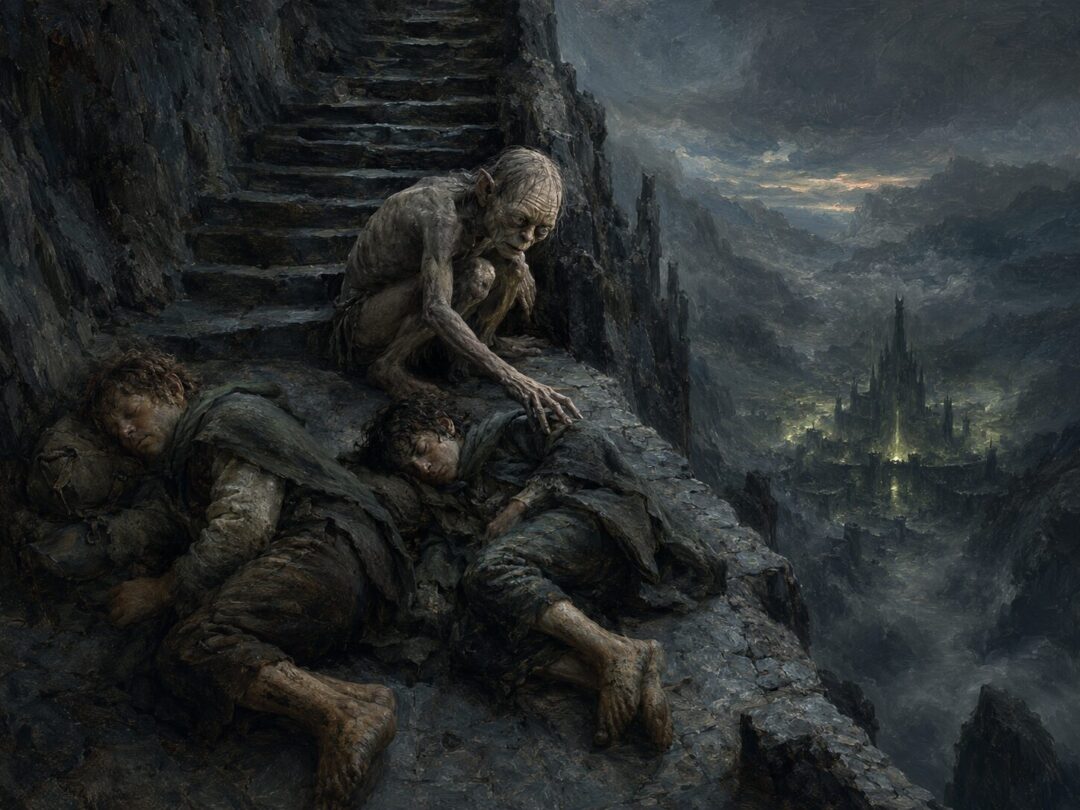
The most painful moment comes on the Stairs of Cirith Ungol, before Shelob’s lair. Gollum has already gone away to make contact with Shelob. Yet when he returns and sees Frodo and Sam asleep, the text gives him a strange, fragile pause. His face changes. The old hunger seems to fade. He touches Frodo with something almost like a caress.
This is not a full redemption. Tolkien never presents Gollum as safely healed in that instant. But the scene strongly implies that Sméagol comes very near to turning aside from betrayal. Appendix B states plainly that on March 11, Gollum visits Shelob but, seeing Frodo asleep, “nearly repents.” In a later letter, the moment is treated as one of the great tragedies of the tale: Sam fails to understand the change in Gollum, and Gollum’s repentance is blighted.
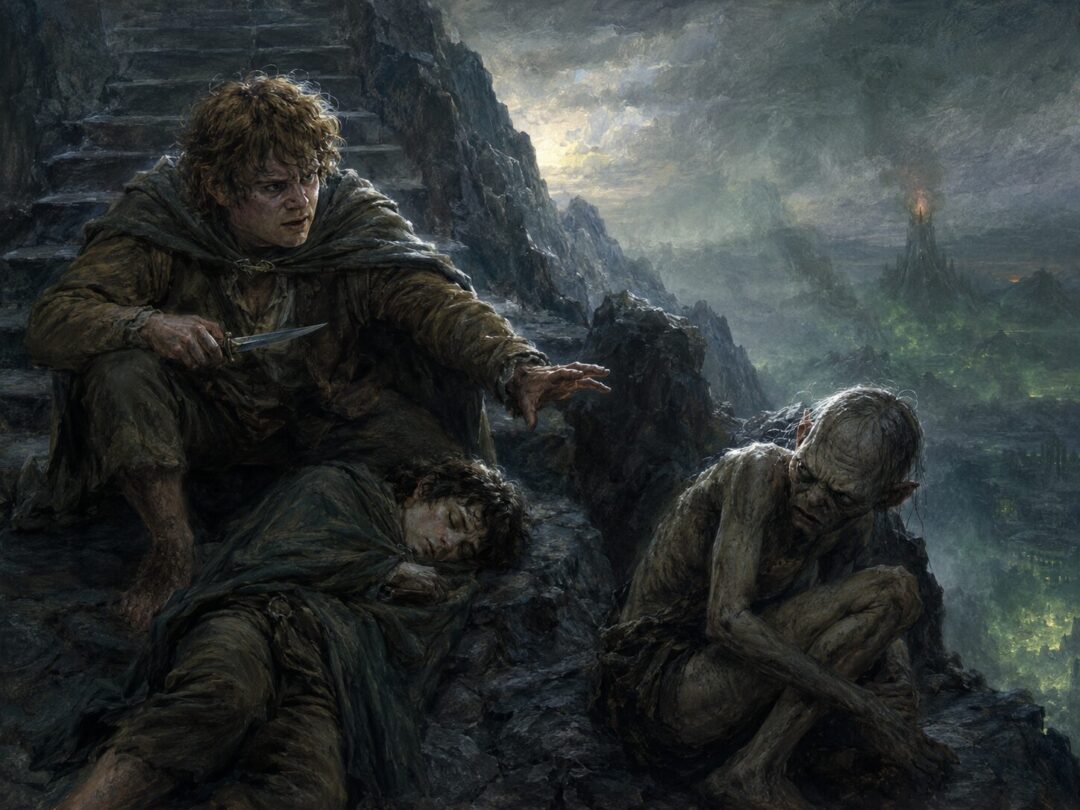
Sam wakes and sees Gollum bending over Frodo. Given everything Sam knows, his reaction is understandable. He accuses Gollum harshly. But that accusation lands at exactly the wrong second. Gollum, who had almost touched the edge of tenderness, retreats into bitterness and wounded malice. The possibility closes.
This is where Sam’s pity fails: not because he has none, but because he cannot recognize the instant when it is needed most.
Frodo’s Pity Gives Gollum a Name; Sam’s Suspicion Gives Him a Role
Frodo calls him Sméagol. That naming is not a small courtesy. In The Lord of the Rings, names carry memory, identity, and moral possibility. By using “Sméagol,” Frodo speaks to the remnant of the person before the Ring’s long ruin. He does not pretend Gollum is innocent, but he addresses him as more than a monster.
Sam usually calls him Gollum, Stinker, or worse. Again, this is understandable. Sam sees what Gollum does. He sees the crouching body, the muttering appetite, the slick excuses. But names shape the space in which a person can answer. Frodo’s language leaves Gollum a path, however narrow, back toward Sméagol. Sam’s language often pins him to the creature he has become.
The difference is not that Frodo has perfect mercy and Sam has none. Frodo is bound to Gollum by shared temptation. Sam is bound to Frodo by love. Frodo’s pity looks at Gollum and says, “I might become you.” Sam’s suspicion looks at Gollum and says, “You might destroy him.”
Both are true. Only one can invite repentance.

Sam’s Later Pity Saves the Quest, But Not Gollum
At Mount Doom, Sam has another chance to kill Gollum. By then, Gollum has betrayed them, attacked them, and become a direct threat at the worst possible moment. Sam’s anger is justified. The text even frames killing Gollum as something that would seem deserved and safe.
Yet Sam does not kill him. Seeing Gollum’s misery and understanding, at least for a moment, the torment of one enslaved by the Ring, Sam spares him. This is real pity. It is not warm, intimate, or redemptive in the way Frodo’s pity had tried to be, but it matters enormously. If Sam kills Gollum there, the final outcome may be impossible, because Frodo himself cannot cast the Ring away at the Crack of Doom.
So Sam’s pity does not fail in every sense. It fails to rescue Gollum inwardly. It does not restore Sméagol. It comes after the last opening of repentance has already been missed. But it still preserves the chain of mercy by which the Ring is destroyed.
That distinction is crucial. Sam’s pity fails Gollum as a soul, but it does not fail the Quest.
Frodo’s Mercy Is Not Rewarded With Happiness
Frodo’s pity “holds” Gollum long enough to bring him to the edge of the final act. But Frodo does not personally triumph over the Ring. At the Sammath Naur, he claims it. The moral architecture of the story is therefore not simple heroism. Frodo’s mercy helps create the condition in which the Quest can be fulfilled, but Frodo himself is broken by the burden.
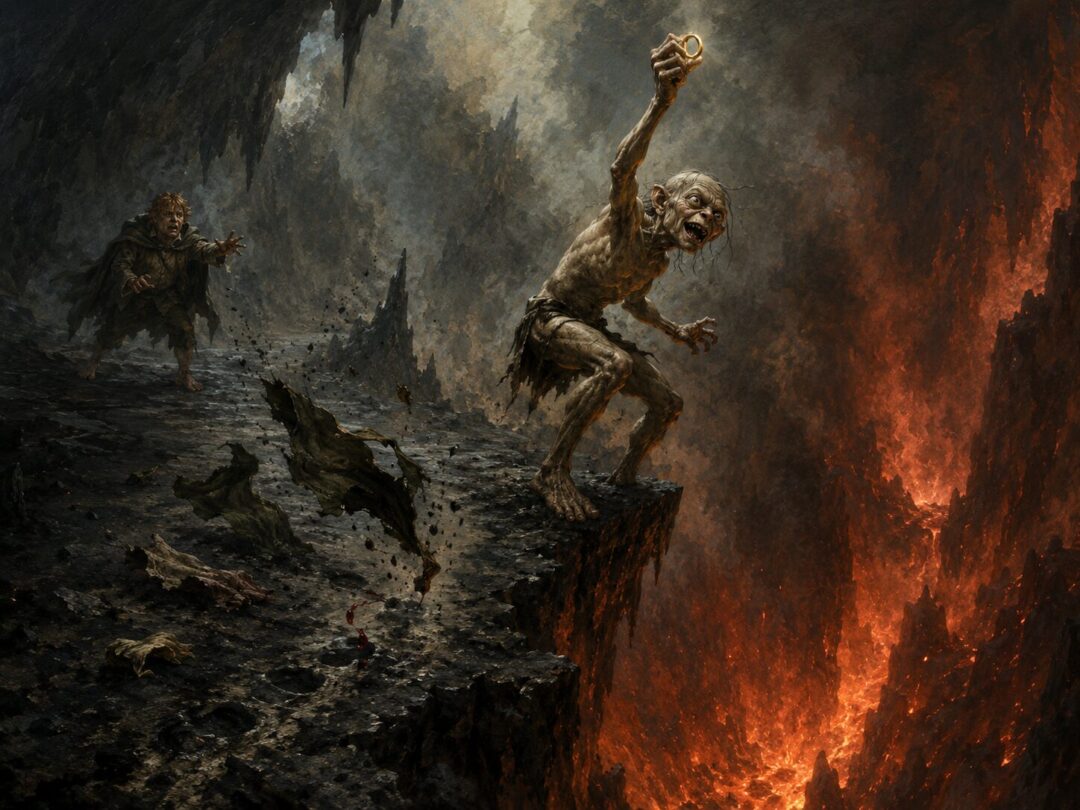
This is why Gollum’s role is so unsettling. He is not redeemed in the ordinary sense. He does not repent at the end. He seizes the Ring and falls with it. The destruction of the Ring comes through a mingling of mercy, oath, obsession, chance, and providence. Frodo’s pity did not make Gollum good. It kept him alive. Sam’s final pity also kept him alive. And because he was alive, even Gollum’s last act of possessive madness became the means by which Sauron was overthrown.
The texts do not ask us to admire Gollum’s final choice. They ask us to see that mercy can matter even when the recipient remains corrupt.
The Tragedy Is That Both Hobbits Were Needed
Frodo alone might have been too exposed to Gollum’s manipulation. Sam alone might have killed or driven Gollum away too soon. Together they create the painful, imperfect balance by which the story moves forward: Frodo extends mercy; Sam guards the merciful from being devoured by the danger he has spared.
That is why the question is not simply “Was Sam wrong?” Sam’s suspicion protects Frodo repeatedly. His courage rescues Frodo from the Tower of Cirith Ungol. His endurance carries Frodo when Frodo can no longer carry himself. But on the stairs, Sam cannot imagine that Gollum’s soul might be trembling at the edge of a choice. Frodo, asleep and helpless, has done more for that possibility simply by having treated him as Sméagol.
Frodo’s pity held because it gave Gollum a self to return to. Sam’s pity failed because, when the decisive moment came, he could only see the enemy Gollum had so often chosen to be.
Yet the final mercy belongs to both of them. Bilbo spared Gollum in the dark. Frodo spared and guided him under the weight of the Ring. Sam spared him on the slope of Orodruin. None of these mercies purified Gollum. But without them, the Ring would not have reached its end.
That is the hard wisdom of the story: pity is not powerful because it guarantees redemption. It is powerful because no one can see all ends.
Sources & Notes
- https://tolkiengateway.net/wiki/The_Shadow_of_the_Past — Tolkien Gateway, ‘The Shadow of the Past’: summarizes Gandalf’s pity lesson to Frodo, including Bilbo’s mercy toward Gollum and the warning that even the wise cannot see all ends.
- https://tolkiengateway.net/wiki/The_Taming_of_Sm%C3%A9agol — Tolkien Gateway, ‘The Taming of Sméagol’: covers Frodo and Sam’s capture of Gollum, Frodo’s decision to spare and bind him, and Gollum’s oath by the Precious.
- https://tolkiengateway.net/wiki/The_Stairs_of_Cirith_Ungol — Tolkien Gateway, ‘The Stairs of Cirith Ungol’: details the crucial moment when Gollum nearly repents while Frodo sleeps and Sam’s harsh reaction breaks the moment.
- https://tolkiengateway.net/wiki/Gollum — Tolkien Gateway, ‘Gollum’: background on Sméagol/Gollum’s corruption by the Ring, his divided personality, treachery, and final role in the Ring’s destruction.
Sources selected for Frodo’s pity lesson, the capture and oath of Sméagol, Sam’s missed mercy on the stairs, and Gollum’s Ring-corruption background.