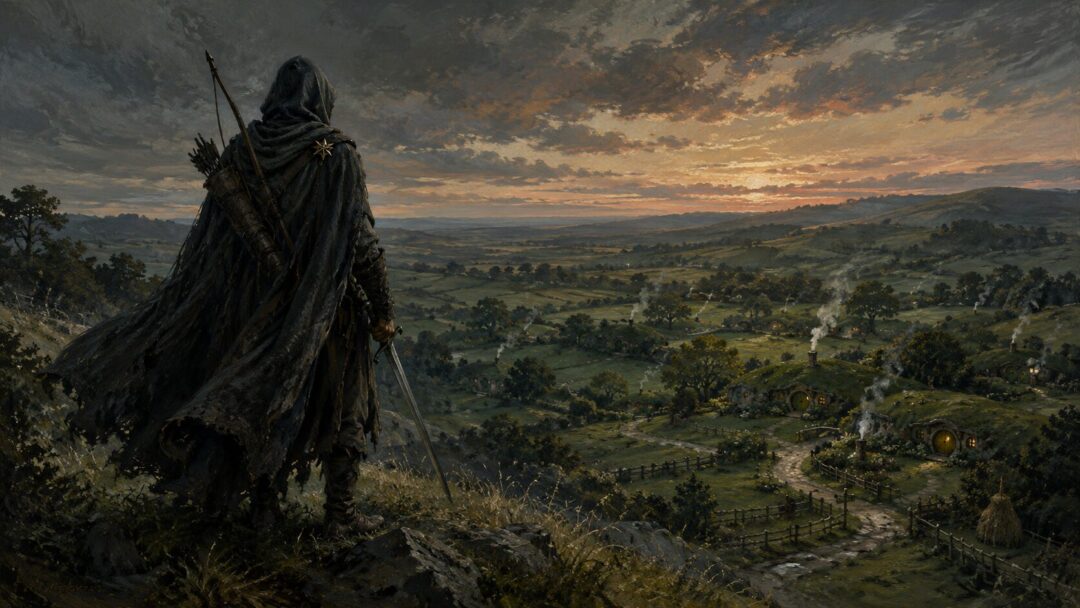
Bag End looks like the safest place in Middle-earth. A round green door, a well-stocked pantry, a view over Hobbiton, and no obvious shadow on the road except the occasional strange traveller passing by. That is exactly the illusion the Shire teaches its people to trust: that peace is ordinary, that danger belongs somewhere else, and that “outside” is mostly a nuisance.
But the Shire’s peace was never simply natural. It was maintained.
That is the overlooked contradiction at the heart of Hobbit history. The Shire loved the idea of the King, preserved his old laws in memory, and later rejoiced when the King returned. Yet for most of its long quiet life, what the Shire needed most was not a crowned ruler in a distant hall. It needed tired, weather-beaten Rangers watching roads, fords, borders, and rumours in lands the Hobbits preferred not to think about.
The King gave the Shire legitimacy. The Rangers gave it time.
The Shire Was Born Under a King, But It Did Not Live Beside One
The Shire did not begin as an isolated paradise cut off from the histories of Men. In the Third Age, Marcho and Blanco led Hobbits from Bree across the Baranduin after receiving permission from King Argeleb II at Fornost. The land they entered had belonged to the North-kingdom; the bargain was light but real. The Hobbits were to keep bridges and roads in repair, speed the King’s messengers, and acknowledge his lordship. The Shire’s own reckoning began with that crossing.
That matters because the Shire’s first relationship with kingship was not conquest or oppression. It was permission, order, and distance. The King was not a daily ruler in Hobbiton. He was the lawful shape around the land: the source of roads, boundaries, authority, and peace.
Then the North-kingdom failed. After the fall of Arnor, the Hobbits chose a Thain to hold the authority of the absent King, and the Shire became a small independent political unit in practice. Its government remained famously light: a Mayor, a Watch, Shirriffs, Bounders, family heads, custom, and what Hobbits called The Rules.
That is the first reason the Shire needed Rangers before it needed kings. For centuries there was no King close enough to protect it.
The Shire’s Own Defenses Were Built for Peace, Not War
The Shire was not lawless, but its institutions reveal what kind of dangers Hobbits expected. The Shirriffs were the nearest thing to police. There were twelve in the Shire, three in each Farthing, marked by feathers in their caps. Their work was mostly internal order, stray beasts, and small disturbances, not warfare.
The Bounders were more outward-facing. They patrolled the borders, “beat the bounds,” and kept outsiders from becoming a nuisance. Their numbers varied, and they increased as strange people and creatures began to approach the Shire before the War of the Ring.
But Bounders are not Rangers. A Bounder can turn away a suspicious traveller, a troublesome stranger, or a wandering beast. He cannot be expected to hold a ford against servants of Sauron. The Shire’s own defenses were designed for a society that had largely forgotten war. That was not foolish in ordinary times; it was part of the Shire’s gift. But it also meant that someone else had to stand between the Shire and dangers too old, too strong, or too secret for Hobbit institutions to understand.
The Shire could manage peace. It could not manufacture the conditions that made peace possible.
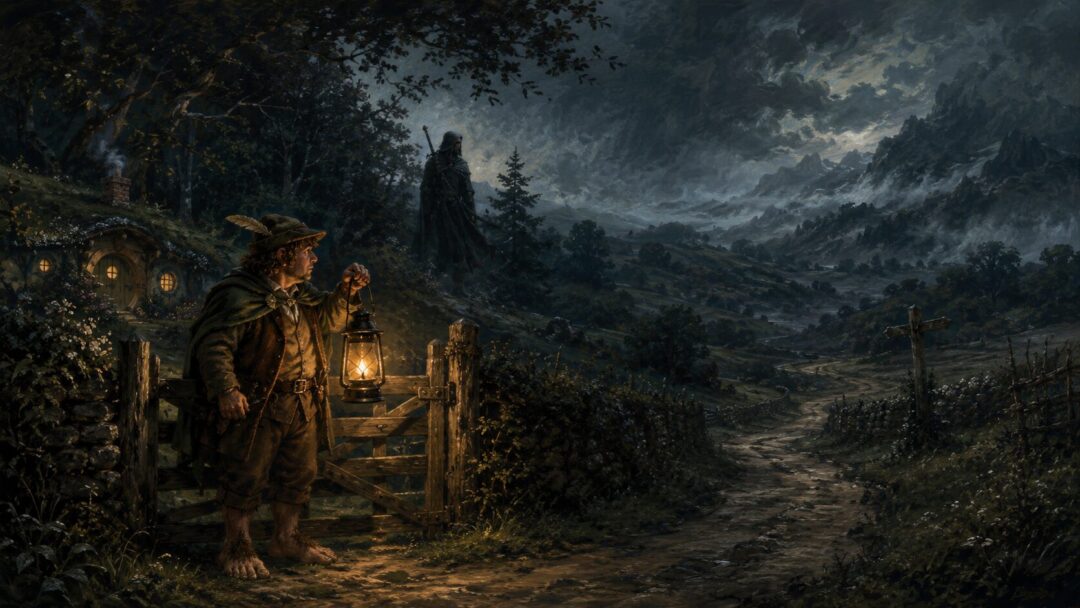
The Rangers Were the Hidden Remnant of the North-kingdom
The Rangers of the North were not wandering mercenaries or rootless adventurers. They were the last remnant of the Dúnedain of Arnor, the people of the old North-kingdom. To the Bree-folk, they were mysterious wanderers, not honoured lords. Their origin was largely unknown, and they were treated with suspicion rather than gratitude. Yet the texts identify their work clearly: they protected the lands around Bree and the Shire.
That gives the Rangers a strange moral position in the story. They are heirs of kings, but they do not rule. They defend borders, but receive little thanks. They preserve the possibility of ordinary life for people who often think them grim, strange, or disreputable.
This is why Aragorn as “Strider” is so easily underestimated. In Bree he looks like danger; in truth he is one of the reasons danger has not already overwhelmed Bree and the Shire. His kingship is not proven first by a crown. It is proven by service without recognition.
The Rangers are kingship before ceremony. They are the royal duty stripped of splendour.
The Shire Forgot the Cost of Its Own Peace
One of the most important ideas in the Prologue is that the Hobbits came to think peace and plenty were simply the normal state of the world. They forgot, or ignored, the Guardians and their labours. That line is easy to pass over because it appears before the great story has properly begun, but it quietly explains the whole Shire.
The Shire is not mocked for loving comfort. The story loves the Shire’s gardens, meals, jokes, family trees, and small decencies. But it does expose the danger of innocence becoming ignorance. The Hobbits’ peace is precious precisely because it is not universal. Elsewhere, Arnor has fallen, Angmar has risen and passed, ruins stand empty, trolls and Orcs remain in the wild, and Sauron’s shadow is lengthening again.
The Rangers know this. The average Hobbit does not.
That imbalance is the hidden moral cost of the Shire’s innocence. The Hobbits are allowed to remain Hobbit-like because others carry knowledge they would rather not carry. The Rangers live with fear, weather, loneliness, and suspicion so that the Shire can keep birthdays, gardens, inns, and harvests.
A king might be remembered in songs. A Ranger is more likely to be misnamed in a common room.
Sarn Ford Shows What the Rangers Were Really Holding Back
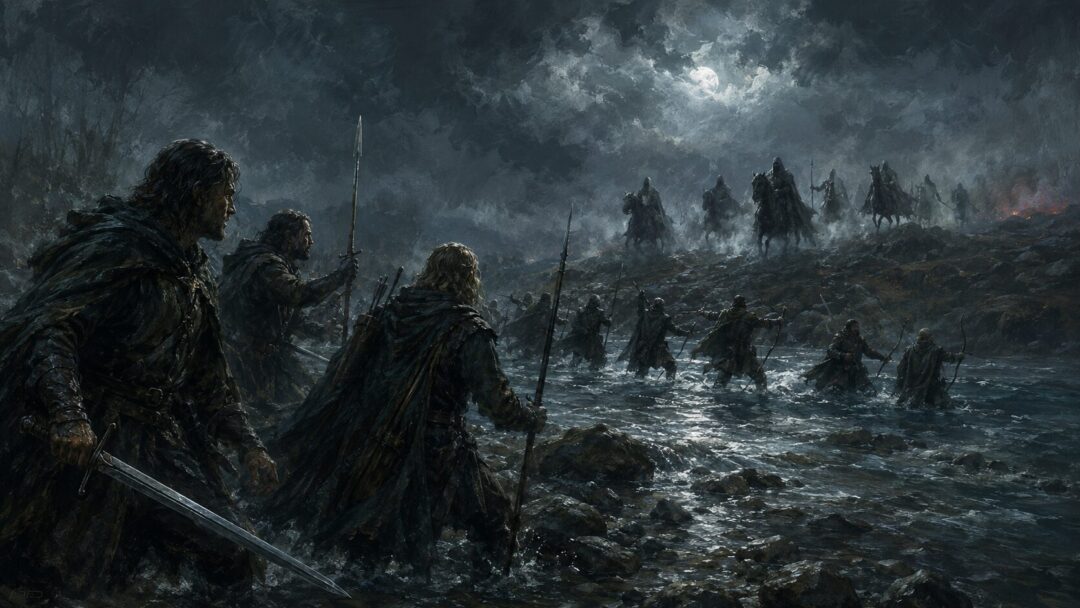
The clearest proof comes at Sarn Ford, the stone ford on the River Baranduin near the southern borders of the Shire. In September 3018, during the Hunt for the Ring, the ford was guarded by Rangers. When the Ringwraiths arrived on 22 September, the Rangers were driven off, and the Black Riders entered the Shire.
This moment is crucial because it reveals the scale of the hidden war around the Shire. The Hobbits of Hobbiton do not experience this as a battlefield. Frodo is still preparing to leave. The Shire’s surface life continues. Yet at its edge, the old struggle between Sauron and the heirs of the North has already reached the border.
The Rangers do not stop the Nazgûl forever. The texts do not make them invincible, and that is important. Their task is not glamorous triumph; it is resistance, delay, warning, and watchfulness. Even when they are overcome, their presence proves that the Shire was not simply open land waiting for the Enemy. Someone was there.
If the Shire had relied only on its own borders, the Black Riders would have found no meaningful outer defense at all.
Before the Crown Returned, Aragorn Had Already Served the Shire
Aragorn’s later kingship can make his earlier Ranger life seem like a prelude, but that reverses the emotional order of the story. His crown matters because his service came first. He did not become worthy of the Shire by ruling it after the War. He had already helped guard it when its people did not know his name.
The same pattern appears in his relationship with Gandalf. Aragorn met Gandalf in the years before the War of the Ring, and at Gandalf’s advice he became interested in the Shire; he later became known in that region as Strider. This does not mean every detail of Ranger patrols is laid out in full. Much remains implied or glimpsed. But the direction is clear: the Shire became a place of special concern because something small and easily overlooked had become central to the fate of Middle-earth.
That is another reason Rangers were needed before kings. The danger was not political at first. It was secret. A king’s army might defend a frontier against open invasion, but the Shire’s crisis began as a hunt for a name: “Baggins,” “Shire.” Against such danger, hidden watchers were more useful than banners.
The Return of the King Did Not Erase the Ranger Lesson
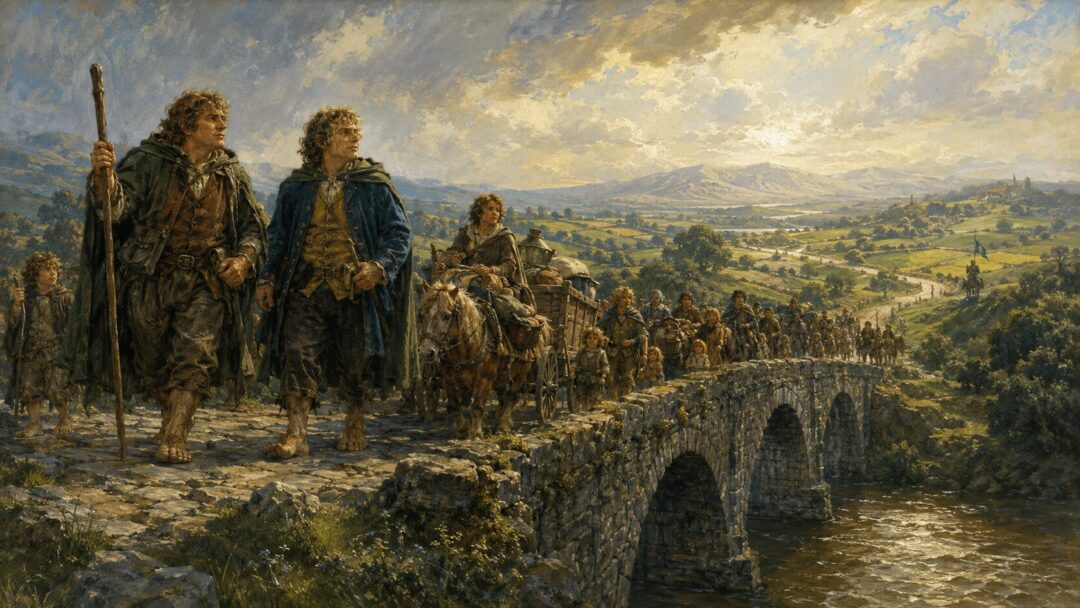
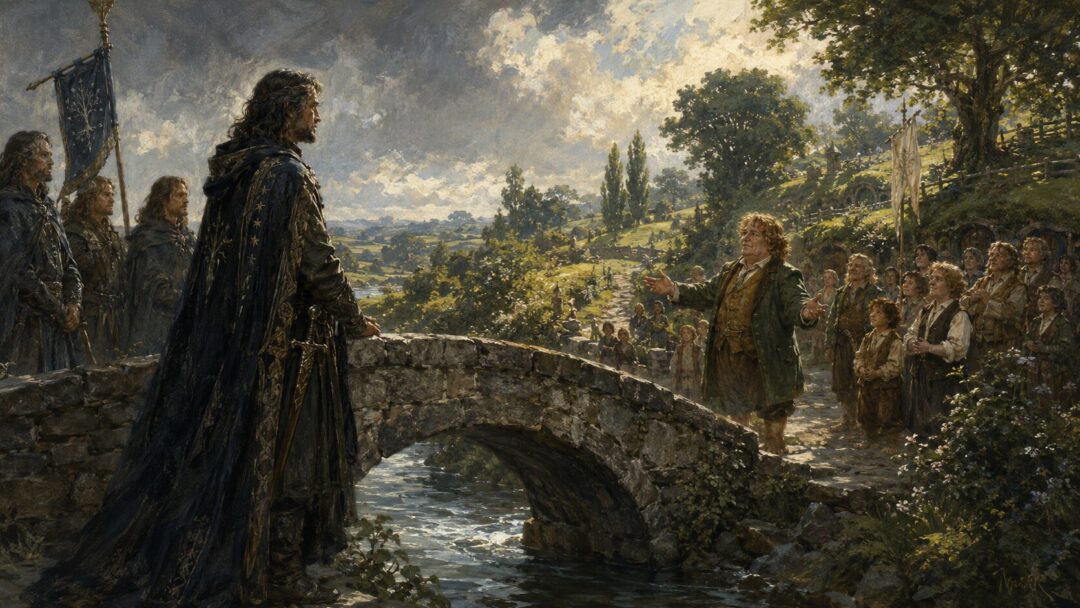
When Aragorn becomes King Elessar, the Shire is not absorbed into ordinary royal control. In the Fourth Age, he issues an edict forbidding Men to enter the Shire and makes it a Free Land under the protection of the Northern Sceptre. Later, he comes to the Brandywine Bridge to greet his friends rather than simply entering the land he protects.
That is not a small detail. It shows that the restored King understands what the Rangers had long understood: the Shire’s goodness depends partly on being shielded from the scale and violence of the wider world. Protection does not have to mean possession. Authority does not have to mean intrusion.
In that sense, the Rangers prepare the moral shape of Aragorn’s kingship. They protect without demanding admiration. They serve without erasing local freedom. They guard the boundary so that ordinary life can remain ordinary.
The King who returns is not the opposite of the Ranger. He is the Ranger fulfilled.
The Shire Needed Watchfulness Before Majesty
The Shire needed kings in one sense: it needed lawful order, old memory, and finally the restored protection of the North. But before any crown could help it, the Shire needed a harder and humbler thing. It needed people willing to be unseen.
The Rangers stood in the gap between Hobbit innocence and the world’s danger. They were the reason the Shire could afford to forget danger for so long. That forgetfulness was not entirely admirable, but it was also the condition that allowed the Shire to be what it was: a place worth saving.
The tragedy is that the Hobbits rarely knew whom to thank. The beauty is that the Rangers served anyway.
So the answer is not that the Shire needed Rangers instead of kings. It needed Rangers before kings because true kingship had to begin as guardianship. Before the throne in Annúminas could be restored, before the Northern Sceptre could protect the Shire by law, the last sons of the old kingdom had already been doing the king’s work in mud, rain, secrecy, and loneliness.
The Shire slept because the Rangers watched.
Sources & Notes
- https://tolkiengateway.net/wiki/Shire — Tolkien Gateway, ‘Shire’: background on the Shire’s founding under North-kingdom authority, its local offices, Bounders, and later status under King Elessar.
- https://tolkiengateway.net/wiki/Rangers_of_the_North — Tolkien Gateway, ‘Rangers of the North’: explains the Dúnedain remnant of Arnor and their hidden protection of the lands around Bree and the Shire.
- https://tolkiengateway.net/wiki/Aragorn_II_Elessar — Tolkien Gateway, ‘Aragorn II Elessar’: covers Aragorn as Chieftain of the Dúnedain and later King Elessar, grounding the article’s service-before-crown argument.
- https://tolkiengateway.net/wiki/Bree — Tolkien Gateway, ‘Bree’: context for the Bree-land near the Shire and the way ordinary people viewed Rangers such as Strider with suspicion.
Sources selected for the Shire’s royal origins, its light local government, the Rangers’ hidden protection, and Aragorn’s kingship after the War.