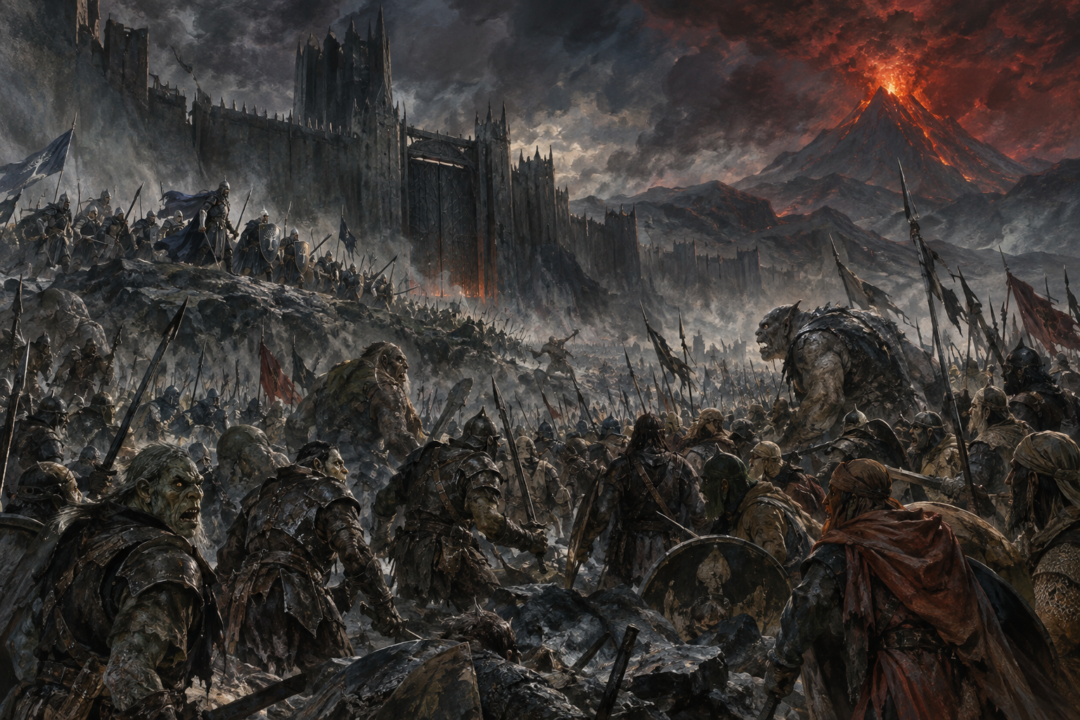
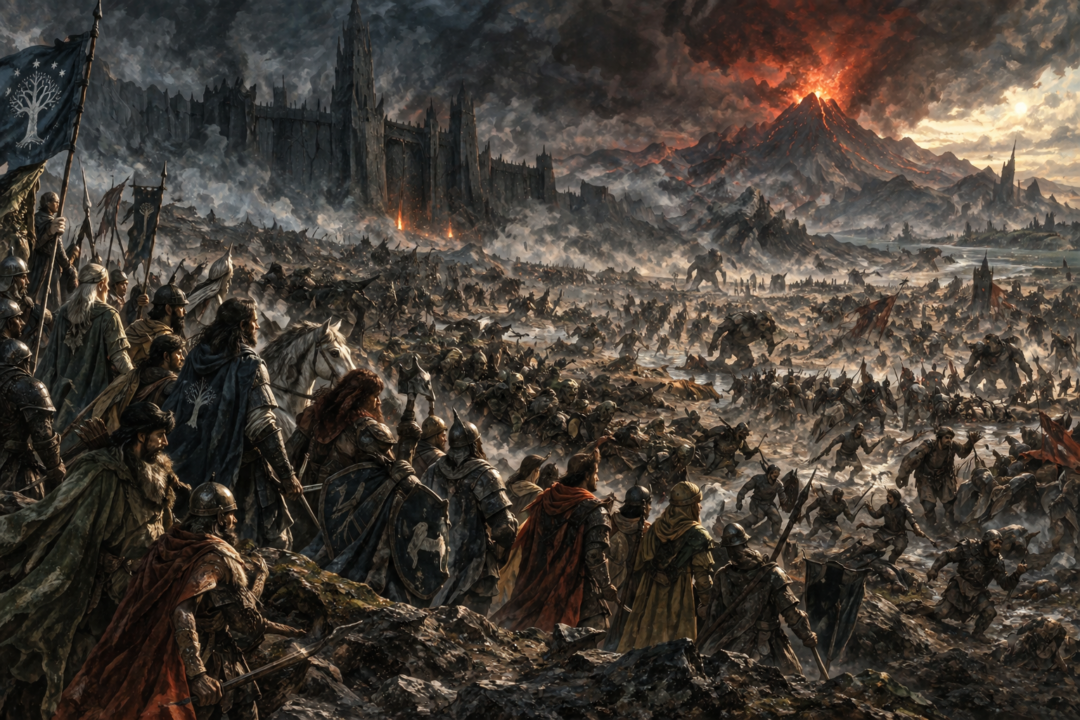
At the Black Gate, Sauron’s army seems overwhelming. Orcs, Trolls, Easterlings, Southrons, and other servants of Mordor have surrounded a vastly smaller Host of the West. Then, far behind the battlefield, the One Ring falls into the fire of Mount Doom.
What happens next is stranger than a simple military rout.
Some of Sauron’s servants lose all purpose and scatter. Some of his human soldiers run eastward. Some throw down their weapons and ask for mercy. Yet others deliberately close ranks and prepare to fight a final, hopeless battle.
The distinction matters. The fall of Sauron does not affect every soldier in the same way, because his empire is not made from one kind of obedience. Mordor holds together creatures, slaves, allies, subjects, and corrupted peoples under a single dominating power. When that power disappears, the different foundations of their loyalty are suddenly exposed.
The Moment Sauron’s Will Leaves the Battlefield
The decisive change actually begins just before the Ring is destroyed.
During the Battle of the Morannon, Frodo claims the Ring inside Sammath Naur and puts it on. Sauron finally understands what his enemies have been attempting. His attention turns violently toward Mount Doom, and the Nazgûl are summoned away from the battle.
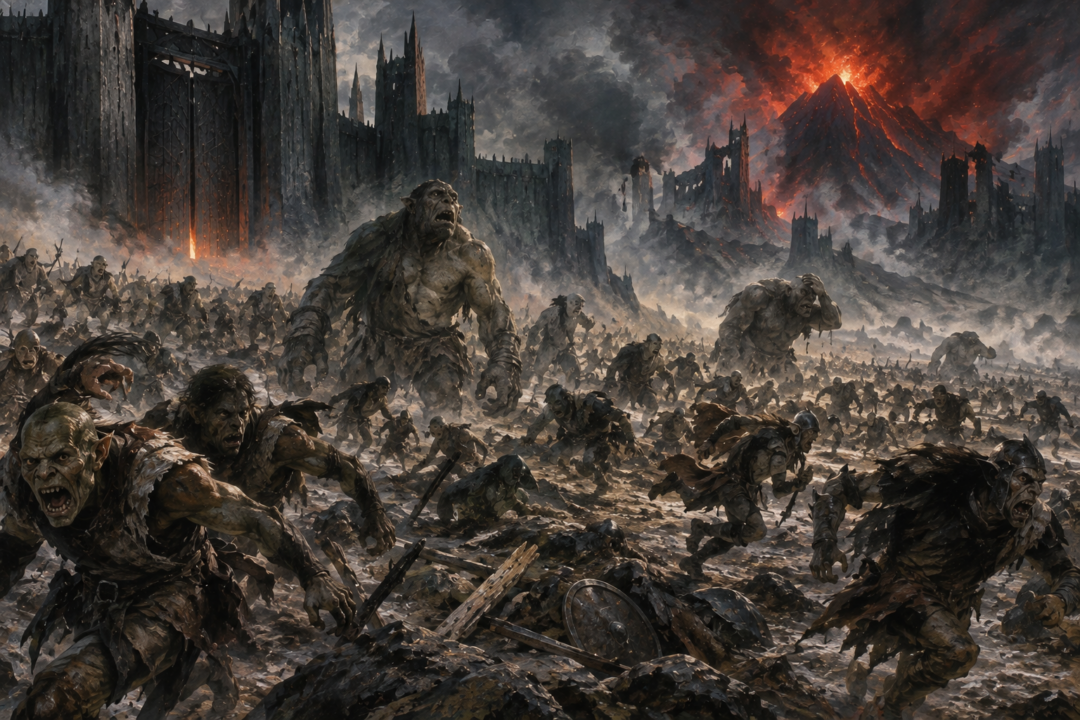
At that instant, the armies facing Aragorn experience a change. The power driving them is described as wavering, its will withdrawn from them. Soldiers who moments earlier had been attacking with fury become afraid when they look upon their enemies. The implication is unusually direct: at least part of Mordor’s battlefield effectiveness depends upon the active pressure of Sauron’s will.
🧙The Tolkien Forum🧝
This does not mean every Orc is a puppet whose limbs are literally controlled by Sauron. Elsewhere, Orcs plainly possess individual personalities, desires, rivalries, fears, and plans. Shagrat and Gorbag, for example, complain about their superiors and imagine getting away from the great powers commanding them.
But armies can possess individual soldiers while still depending upon a dominating will for unity. Sauron provides something more than orders. His presence imposes direction, fear, confidence, and purpose upon forces that otherwise have plenty of reasons to quarrel or flee.
At the Morannon, that invisible structure begins to fail.
What Happens to the Orcs and Trolls
After the Ring is destroyed, the collapse becomes absolute.
In “The Field of Cormallen,” the creatures of Sauron are compared to ants whose ruling power has suddenly perished. Orcs, Trolls, and spell-enslaved beasts run about without purpose. Some flee into dark hiding places; others destroy themselves or perish in the confusion. The power of Mordor scatters almost instantly.
It is one of the clearest demonstrations of how deeply Sauron’s domination had penetrated his war machine.
Yet the passage should not be stretched further than the text allows. It does not establish that every Orc everywhere immediately died when Sauron fell, nor does it say that Orcs were incapable of independent action before his defeat. The story repeatedly shows otherwise.
The safer conclusion is that Sauron had gathered and driven these particular forces beneath an extraordinary concentration of his power. Once that power vanished, the army ceased to function as an army.
This also helps explain why Mordor could contain so much internal hostility without tearing itself apart sooner. Orcs frequently bully, threaten, and fight one another. They fear their commanders. They resent higher authorities. What binds them together is not fellowship.
It is domination.
Sauron Rules Through Fear, Not Loyalty
The contrast with the armies opposing Mordor is deliberate.
The Host of the West is also frightened. Indeed, Aragorn allows those who cannot endure the march toward the Black Gate to turn aside rather than forcing them onward. Those who continue do so knowing that the expedition is almost certainly hopeless.
Sauron’s armies operate under a different principle.
Fear runs downward through Mordor’s hierarchy. Lesser servants fear greater ones. Orcs fear captains and Nazgûl. Even powerful servants live beneath the authority of Barad-dûr. Sauron’s strength permits him to turn mutual hatred, coercion, and terror into coordinated action.
This is why his disappearance is more than the death of a commander.
If an ordinary general falls, another officer can take command. When Sauron falls, the central power around which the entire system has been constructed disappears.
The army does not merely lose its leader.
It loses the force that made thousands of unwilling, hostile, and frightened beings act as parts of one purpose.
But the Human Soldiers React Differently
Then comes the crucial distinction.
The Men of Rhûn and Harad do not all collapse like the Orcs and Trolls.
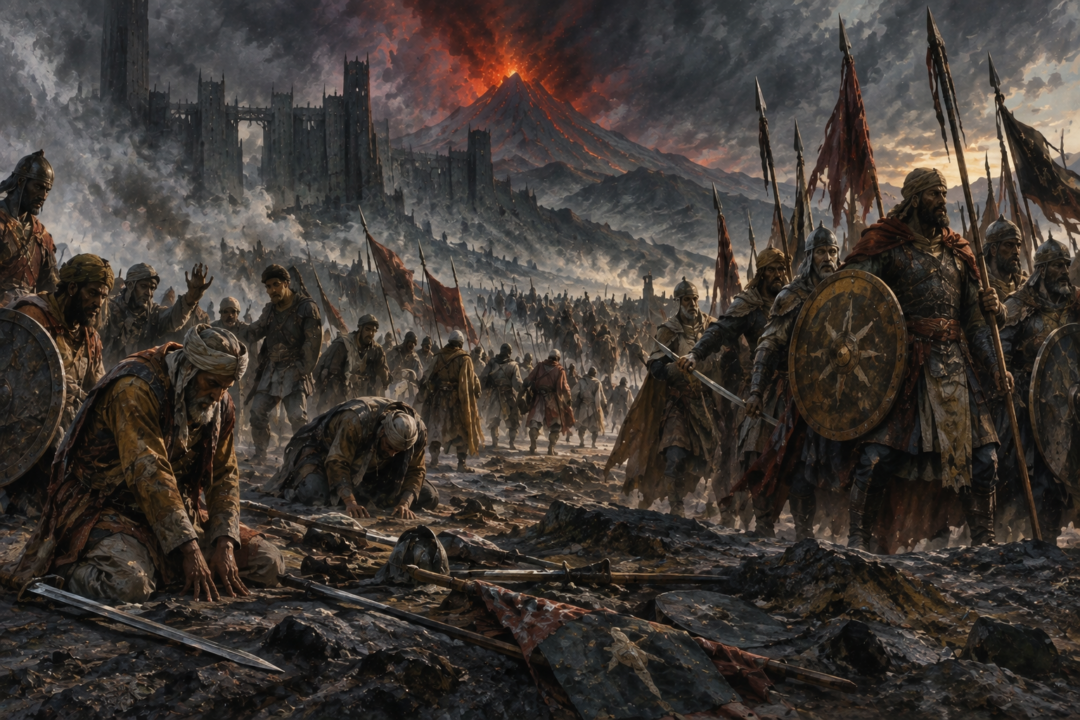
They see that the war is lost. Most flee eastward if they can, while some cast down their weapons and ask for mercy. But another group—those described as having endured the deepest and longest evil servitude and as hating the West—gather themselves for a final desperate stand.
🧙The Tolkien Forum🧝
That single passage reveals something important about Sauron’s empire.
His human soldiers retain meaningful choice.
They can flee.
They can surrender.
And they can keep fighting.
The text therefore does not present the Easterlings and Southrons simply as magically programmed extensions of Sauron. Their societies had fallen under his domination, and The Silmarillion says that in the East and South many Men were beneath his rule, regarding him as king and god and fearing him greatly. But the precise mixture of fear, political submission, inherited hostility, worship, coercion, and willing allegiance would not necessarily have been identical for every people or individual.
Science Fiction & Fantasy Stack Exchange
At the Black Gate, those differences suddenly matter.
Why Would Anyone Fight After Sauron Is Gone?
For the soldiers who continue fighting, Sauron’s destruction has not erased everything that brought them to the battlefield.
The narrative specifically associates those making the last stand with long evil servitude and hatred of the West. Their decision is therefore not portrayed merely as supernatural compulsion. They are still capable of pride and courage, but those qualities have been committed to a disastrous cause.
🧙The Tolkien Forum🧝
That is one of the darker ideas in the scene.
Courage is not automatically goodness.
A soldier can be brave and still serve evil. A person can remain loyal when surrender would be wiser. Hatred can survive the master who cultivated it.
Some of these Men may also have known little of their enemies except what generations of hostility and Sauron’s dominion had taught them. The text does not provide individual biographies for the warriors at the Morannon, so their personal motives cannot be reconstructed with certainty. What it does explicitly show is that different Men make different choices once Mordor’s supremacy disappears.
The collapse of tyranny does not instantly undo everything tyranny has shaped.
Sam Had Already Seen the Human Being Beneath the Enemy
This distinction had been prepared earlier.
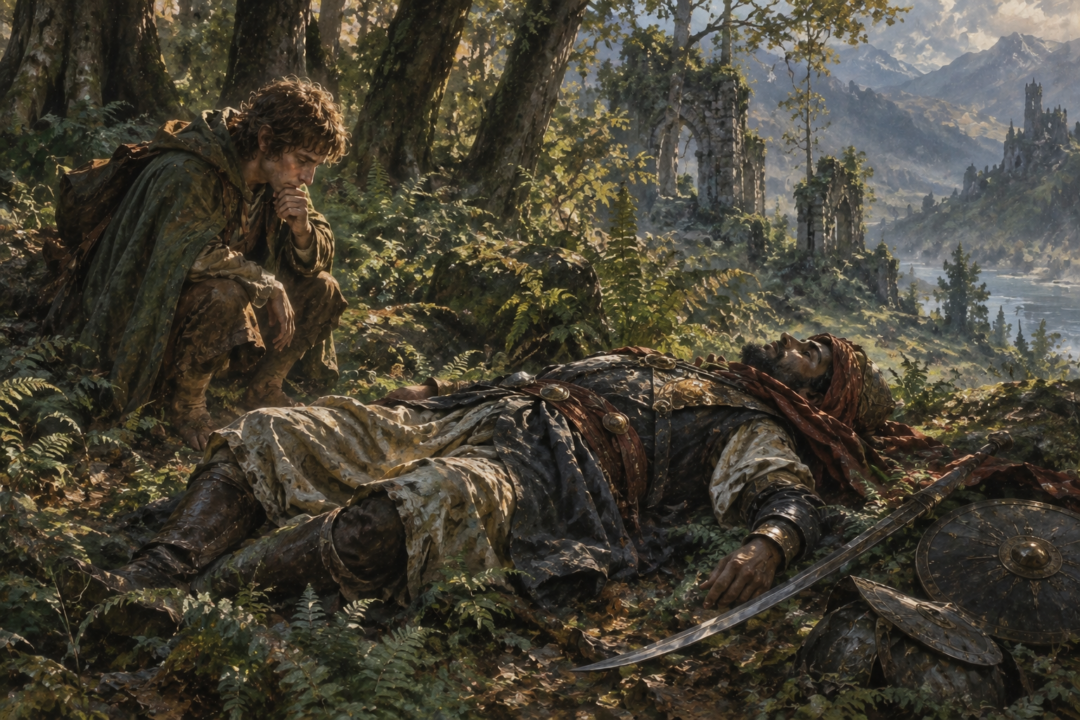
In Ithilien, Sam sees a dead Southron warrior and wonders about him. He thinks about the man’s homeland and considers whether he was truly evil at heart, or whether lies or threats had driven him far from home.
The story never answers those questions.
That is precisely why the moment matters.
Sam refuses to pretend he knows the dead man’s entire moral history merely because they stood on opposite sides of a war. The soldier served Sauron’s cause, but Sam can still imagine that coercion, deception, or circumstances beyond his knowledge may have helped bring him there.
The scene at the Black Gate later preserves that same complexity. When Sauron falls, the Men in his armies do not all make the same decision.
Their reactions expose differences that the uniform ranks of Mordor had concealed.
The Nazgûl Show the Opposite Extreme
At the far end of the spectrum stand the Ringwraiths.
They are not ordinary human allies of Mordor. The Nine Rings have reduced them over long ages to servants bound to Sauron. When Frodo claims the Ring, they race toward Mount Doom at Sauron’s command; when the Ring is destroyed, their fate is bound up with the destruction of the power that enslaved them.
They represent domination carried almost to its ultimate conclusion.
The Men of Rhûn and Harad still possess choices after Sauron falls. The Nazgûl have been consumed by their enslavement.
Between those extremes stand the Orcs, Trolls, and other creatures whose armies are held together so powerfully by Sauron that his fall sends them into catastrophic confusion.
Mordor therefore contains degrees and forms of servitude rather than one simple mechanism controlling every soldier.
The Real Weakness of Sauron’s Army
Sauron’s military power looks almost limitless because he can gather enormous forces beneath one command. But that strength conceals a structural weakness.
Everything ultimately points back toward him.
His enemies build alliances among peoples who remain distinct: Gondor, Rohan, the northern Dúnedain, Elves, Dwarves, Hobbits, and others do not become one people merely because they oppose the Shadow. Their cooperation depends repeatedly upon promises, friendship, loyalty, duty, and freely accepted sacrifice.
Sauron seeks something fundamentally different: order through domination.
That produces terrifying efficiency while the dominating power remains intact. At the Morannon, however, the Ring is destroyed and the center disappears.
The result is not one universal reaction.
Creatures most completely caught in Sauron’s power scatter in mindless terror. Human soldiers who recognize that the war is lost mostly flee or surrender. Others, shaped by long servitude and hatred, consciously make a final stand.
That is why some of Sauron’s soldiers run while others keep fighting.
The difference is not simply courage versus cowardice. It is the difference between forms of bondage—and between what remains inside a person when the power commanding them is suddenly gone.
Sources & Notes
- Tolkien Gateway — Battle of the Morannon https://tolkiengateway.net/wiki/Battle_of_the_Morannon
- Tolkien Gateway — Orcs https://tolkiengateway.net/wiki/Orcs
- Tolkien Gateway — Fall of Barad-dûr https://tolkiengateway.net/wiki/Fall_of_Barad-d%C3%BBr
These references document the Black Gate battle, Orcish agency and subjection, and the collapse of Sauron’s power when the Ring was destroyed. The article’s explanation of differing reactions among Sauron’s creatures and human soldiers is interpretive synthesis of the battle’s aftermath.