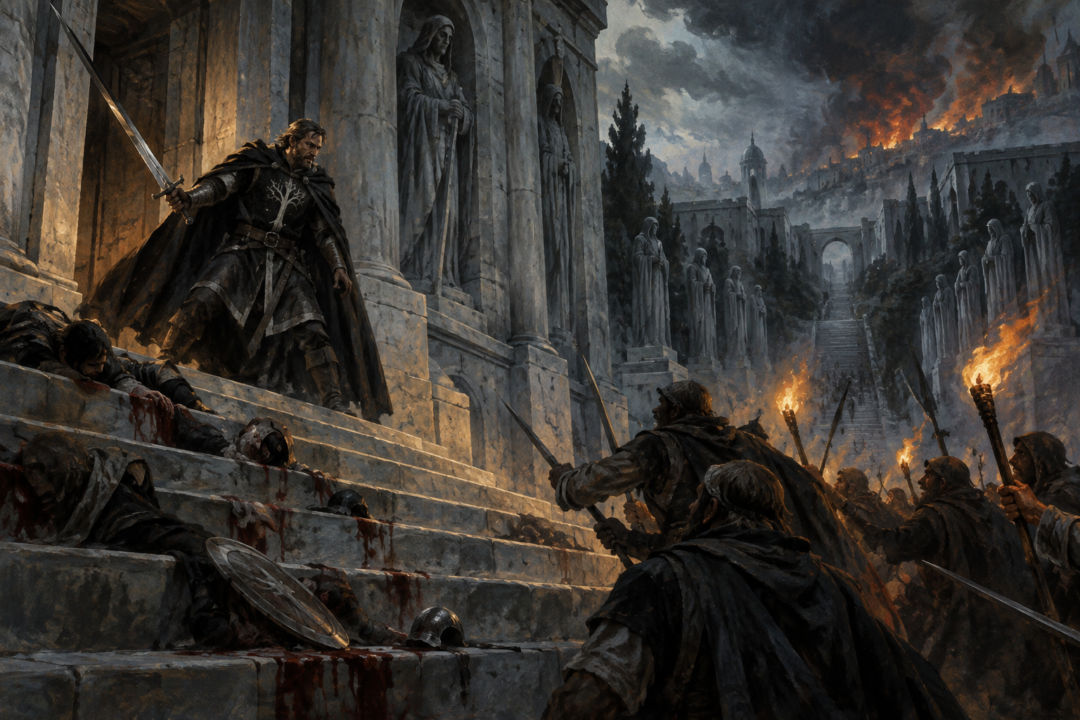
When Aragorn finally sits in judgment as King, one of the men brought before him is not an enemy, a rebel, or a servant of Sauron.
It is Beregond — the Guard of the Citadel who helped save Faramir’s life.
That should make the judgment simple. Beregond acted courageously while Denethor, overcome by despair, prepared to burn himself and his wounded son. Yet Aragorn does not simply praise Beregond and erase what happened.
He first names Beregond’s crimes.
Blood was spilled in the Hallows. Beregond abandoned his assigned post without permission. Under the old law, Aragorn says, these offenses carried the penalty of death. Only after acknowledging their seriousness does the King remit the penalty, remove Beregond from the Guard of the Citadel, and order him to leave Minas Tirith.
Then comes the reversal.
Beregond is appointed captain of Faramir’s White Company and sent to serve the very man for whom he had risked everything.
The scene is brief, but it reveals something important about the restored kingship. Aragorn does not choose between justice and mercy. He finds a judgment that preserves both.

What Beregond Actually Did
Beregond’s crisis begins during the siege of Minas Tirith.
Pippin discovers that Denethor intends to die on a funeral pyre and take the unconscious Faramir with him. Unable to stop the Steward himself, Pippin seeks Gandalf — but he also warns Beregond.
Beregond is placed in an almost impossible position.
He is a Guard of the Citadel. His identity is built around obedience, duty, and service. Yet obedience now appears to require him to stand at his assigned post while the son of the Steward is carried toward death.
Beregond chooses Faramir.
He leaves his post and runs to Rath Dínen, the Silent Street where the tombs of the Kings and Stewards stand. There he confronts those carrying out Denethor’s orders.
The confrontation becomes deadly.
When Gandalf and Pippin arrive, Beregond stands before the House of the Stewards defending its entrance. Men have fallen by his sword, and blood has been shed in the Hallows — an especially grave violation because violence there is forbidden.
Beregond has therefore crossed two boundaries.
He has abandoned his military duty without authorization, and he has killed men in a sacred precinct while resisting the commands of the ruling Steward.
Yet without his resistance, Gandalf might have arrived too late.
That is what makes Aragorn’s later judgment so difficult.
Beregond Was Right — But His Actions Still Had Consequences
It is tempting to reduce the episode to a simple principle: Beregond disobeyed an evil command, therefore he did nothing wrong.
The text does not treat the matter so casually.
Gandalf himself rejects Denethor’s claim to absolute authority. When Denethor attempts to take Faramir into death with him, Gandalf insists that the Steward has no authority to determine the hour of Faramir’s death. Denethor’s office does not make every command legitimate.
Beregond’s intervention therefore protects Faramir from something Denethor had no rightful authority to do.
But that does not magically undo everything Beregond did while intervening.
Men died.
Sacred ground was stained with blood.
A soldier abandoned his assigned post during the siege of the city.
Aragorn cannot pretend those facts are meaningless simply because Beregond’s motive was good. A restored kingdom in which law matters only when convenient would hardly be a restoration at all.
So Aragorn does something more difficult.
He recognizes both the violation and the reason for it.

Why Aragorn Cannot Simply Leave Beregond in the Guard
When Beregond is brought before him after the coronation, Aragorn explicitly identifies the offenses.
Beregond spilled blood in the Hallows and left his post without permission. Aragorn says that, “of old,” death was the penalty for such deeds.
But he immediately remits the penalty.
His reasons are significant: Beregond’s valor in battle, and even more importantly, the fact that what he did was motivated by love for Faramir.
This is not a declaration that the laws never mattered.
Aragorn still removes him from the Guard of the Citadel.
That consequence preserves the reality that Beregond broke the obligations attached to that particular office. He cannot simply return to his old position as though nothing happened.
Yet Aragorn refuses to interpret Beregond’s disobedience as ordinary treachery.
The distinction lies in what Beregond was trying to protect.
He did not abandon his duty for profit, cowardice, ambition, or allegiance to the Enemy. He abandoned one immediate duty because he believed a greater loyalty required him to save Faramir.
The King’s judgment recognizes that distinction.
The Apparent Banishment Is Also a Promotion
At first, Beregond does not understand what Aragorn is doing.
He hears that he must leave the Guard and depart Minas Tirith, and he is devastated.
Then Aragorn completes the sentence.
Beregond is to become captain of the White Company, the Guard of Faramir, Prince of Ithilien. He will live in Emyn Arnen and serve the man whose life he risked everything to save.
The punishment has not disappeared.
Beregond really does lose his old place in the Citadel.
But Aragorn transforms that loss into a new vocation perfectly fitted to the character Beregond has already revealed.
He broke his post to protect Faramir.
Now protecting Faramir becomes his post.
That symmetry is the heart of the judgment.
Aragorn does not merely pardon Beregond. He places him where the virtue behind his dangerous act can become lawful service.

Faramir Changes Too
Beregond’s fate cannot be separated from Faramir’s.
The political order of Gondor has changed.
Faramir remains Steward, but Aragorn also makes him Prince of Ithilien and grants him Emyn Arnen as his dwelling. The man whom Beregond saved from the funeral pyre now enters the Fourth Age with a new dignity and responsibility.
Beregond goes with him.
This matters because the White Company is not simply an escape from punishment. Beregond’s new position binds his future to Faramir’s.
During Denethor’s final hours, Beregond chose personal loyalty to Faramir at enormous cost. Under Aragorn, that loyalty is no longer forced into rebellion against a collapsing authority. It receives a legitimate place within the restored realm.
The old crisis is not erased.
It is reordered.
What had appeared as treason during the madness of the siege becomes honorable service under a renewed political order.
Aragorn’s Mercy Is Not Forgetfulness
This scene fits a broader pattern in Aragorn’s kingship.
His authority is repeatedly associated with restoration: healing the wounded, renewing ancient institutions, restoring relationships between peoples, and bringing legitimate rule back to Gondor and Arnor.
But restoration does not mean pretending that the past never happened.
Beregond’s case demonstrates this with unusual precision.
Aragorn could have enforced the ancient penalty mechanically. That would acknowledge the law while ignoring the extraordinary moral circumstances.
He could also have declared Beregond entirely innocent and returned him to his former station. That would acknowledge Beregond’s courage while minimizing the seriousness of abandoning a military post and shedding blood in the Hallows.
Instead, Aragorn separates the different elements of the case.
The death penalty is remitted.
The old office is lost.
The courage is honored.
The loyalty is redirected.
And Beregond receives a new responsibility rather than merely escaping punishment.
The narrative itself describes Beregond as recognizing both the mercy and the justice of the King.
Those two qualities are meant to be seen together.
The Deeper Question: What Does Loyalty Mean?
Beregond’s story also raises one of the recurring moral questions of The Lord of the Rings: what happens when obedience and goodness no longer point in the same direction?
Beregond is not naturally rebellious.
Everything about him suggests a soldier deeply attached to Gondor and its traditions. That makes his decision at Rath Dínen more significant, not less.
He disobeys because the structure he serves has reached a moment of terrible distortion.
Denethor remains Steward, but despair has overwhelmed his judgment. His attempt to kill Faramir exceeds the authority of his office, as Gandalf explicitly tells him.
Beregond therefore faces competing loyalties: obedience to command, duty to his post, reverence for Gondor’s laws, and love and loyalty toward Faramir.
There is no clean way through.
His choice saves an innocent life, but it leaves blood behind.
That moral cost is important. The episode does not suggest that righteous intentions make every action harmless. Instead, it shows a world in which doing the necessary thing can still carry consequences.
Aragorn’s task as King is to judge those consequences without losing sight of why they occurred.

Why Beregond’s New Office Is the Perfect Judgment
The brilliance of Aragorn’s sentence lies in its structure.
Beregond cannot remain exactly what he was.
But neither should the kingdom discard the courage that saved Faramir.
So Aragorn gives that courage a proper home.
As captain of Faramir’s Guard, Beregond will continue doing openly and lawfully what he chose to do at the darkest moment of the siege: protect Faramir.
The difference is that he no longer has to choose between loyalty and law.
Under Denethor’s final despair, those things had torn apart.
Under Aragorn’s restored kingship, they are brought back together.
That may be the most important meaning of the scene.
The Return of the King is not merely the return of a particular bloodline to a throne. It is presented as the restoration of right order after an age of decline, war, fear, and the growing Shadow.
Beregond’s judgment gives that enormous theme a human scale.
One soldier stands before the King carrying the consequences of an impossible decision.
Aragorn neither condemns the man for choosing mercy nor pretends that laws and oaths are meaningless.
Instead, he judges the deed, honors the motive, preserves the law, and gives the man a future.
Beregond loses his old post.
He becomes captain of a new one.
And the man once called outlaw and traitor for defending Faramir is sent away in honor to spend his life guarding him.
That is why Aragorn’s judgment works so well.
It does not simply forgive Beregond.
It restores him.
Sources & Notes
- https://tolkiengateway.net/wiki/Beregond — account of Beregond leaving his post, killing Denethor’s servants to save Faramir, and receiving Aragorn’s judgment after the coronation.
- https://tolkiengateway.net/wiki/Guards_of_the_Citadel — background on the Guard’s duties and the rule that sentries could not leave their posts except at their lord’s command.
- https://tolkiengateway.net/wiki/Houses_of_the_Dead — description of the Hallows and the Houses of the Dead, including Beregond’s intervention against Denethor’s servants at Faramir’s pyre.
- https://tolkiengateway.net/wiki/White_Company — summary of Aragorn’s settlement: Beregond’s removal from Minas Tirith and appointment as first captain of Prince Faramir’s guard in Ithilien.
- https://www.encyclopedia-of-arda.com/b/beregond.php — independent reference entry on Beregond’s defense of Faramir and his later appointment to Faramir’s guard in Emyn Arnen.
Sources document Beregond’s breach of guard duty, his defense of Faramir in the Hallows, and Aragorn’s combined sentence and appointment to the White Company.