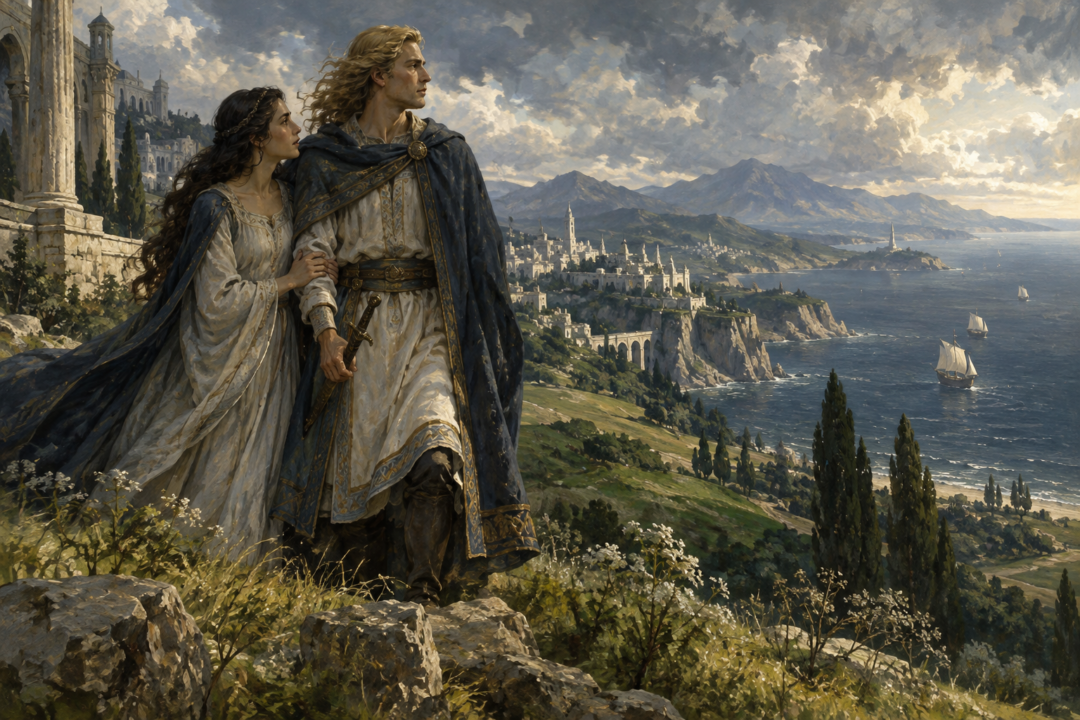
Aldarion and Erendis: The Long Betrothal That Exposed an Impossible Conflict of Duties
Aldarion loved the Sea. Erendis loved Aldarion.
That sounds like the beginning of a simple romantic tragedy, but in Númenor nothing about their relationship remained simple for long. Aldarion was not merely a restless sailor who preferred ships to home. He was the King's Heir, increasingly entangled with Middle-earth at a time when danger was beginning to return there. Erendis, meanwhile, was being asked to build her life around a man whose absences could last for years and whose greatest commitments repeatedly carried him beyond the horizon.
Their extraordinarily long courtship and betrothal therefore reveal something larger than two incompatible personalities. They expose a collision between private obligation and public duty—and the tragedy is that neither side can simply be dismissed.
Aldarion's voyages eventually prove to have political importance. Yet Erendis suffers real consequences from them long before anyone in Númenor understands how important his work abroad may become.
Their betrothal is where that contradiction becomes impossible to ignore.
Aldarion Was Already Committed to Another Life
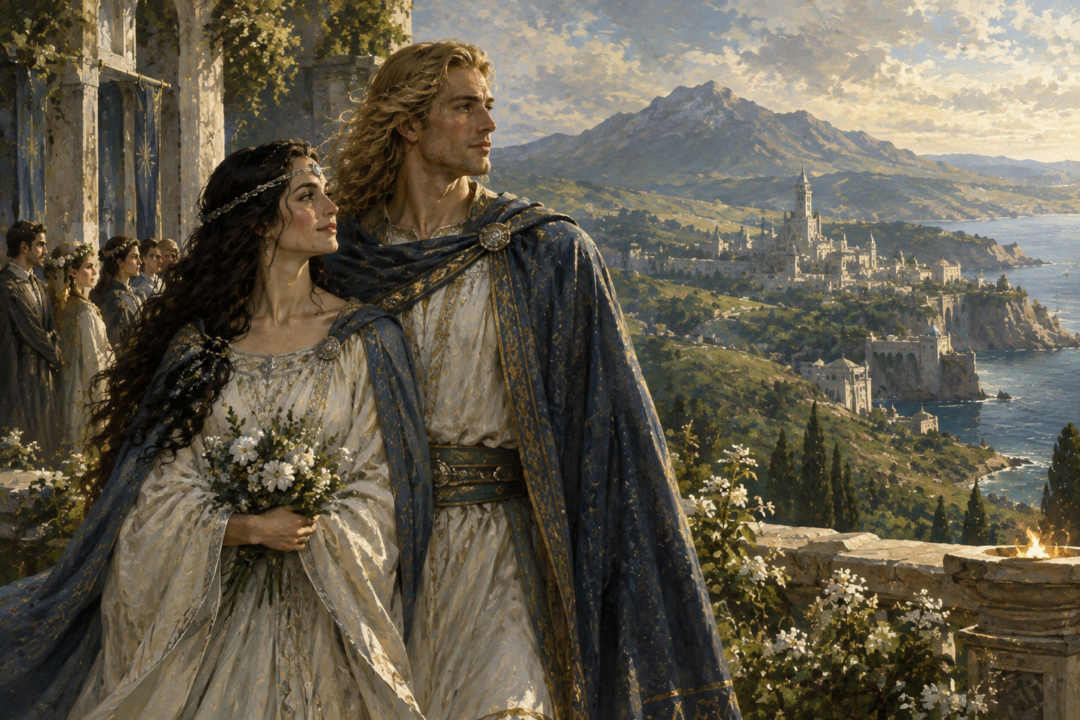
Aldarion was born in the Second Age as Anardil, son of Tar-Meneldur and Queen Almarian. From youth he developed an extraordinary attachment to ships and the Sea.
That attachment was not an occasional pastime. It became the organizing force of his adult life.
Under the influence of the great mariner Vëantur, his maternal grandfather, Aldarion sailed to Middle-earth and became increasingly involved with the havens and peoples there. He founded the Guild of Venturers and established the haven later known as Vinyalondë at the mouth of the Gwathló.
By the time Erendis became central to his life, therefore, she was not competing with a hobby.
She was confronting a vocation.
Aldarion himself seems unable—or unwilling—to imagine why marriage should fundamentally restrict that vocation. When Tar-Meneldur challenges him over his long absences after his betrothal, Aldarion argues that smiths continue smithing, horsemen continue riding, and miners continue delving after they become betrothed.
Meneldur identifies the weakness in that comparison.
Ordinary work does not normally require a husband to disappear for years.
More importantly, Aldarion is not simply a professional mariner compelled to sail for his livelihood. He is the heir to Númenor.
His choices therefore carry obligations in two directions: toward the household and kingdom awaiting him on the island, and toward the increasingly significant affairs he has discovered across the Sea.
Erendis Understands the Problem Before Aldarion Does
Erendis's reluctance to marry Aldarion is not caused by lack of love.
That is one of the most important details in the story.
She fears that she cannot possess the kind of marriage she desires while Aldarion remains devoted to the Sea. She does not want a fraction of his life while his deepest energies belong elsewhere.
The text presents this struggle starkly. Erendis imagines herself effectively at war with the Sea for Aldarion.
That attitude contains the seeds of later bitterness, but her fear is not imaginary. Aldarion repeatedly leaves Númenor, and his voyages grow longer rather than shorter.
Erendis therefore recognizes a structural problem that affection alone cannot solve.
She wants permanence.
Aldarion wants both permanence and freedom.
Their tragedy begins because each hopes the other will eventually make those desires compatible.
Neither truly does.
The Betrothal Looks Like a Resolution
After repeated difficulties, Aldarion and Erendis finally become formally betrothed in the year 858 of the Second Age.
The moment appears almost triumphal.
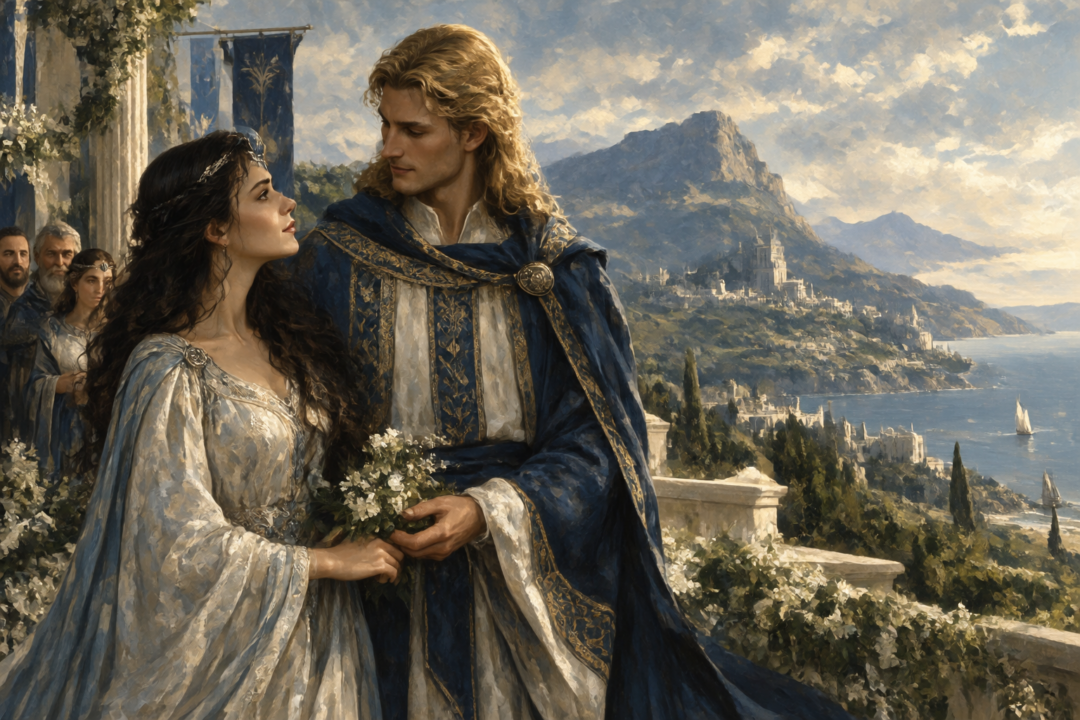
Aldarion presents Erendis to Tar-Meneldur as the betrothed of the King's Heir. The King rejoices. Erendis receives land in Emerië, where Meneldur has provided a white house for her.
She also transforms an earlier jewel from Aldarion into something symbolically powerful. A white gem is set like a star upon a silver fillet and worn on her forehead, giving rise to the name Tar-Elestirnë, the Lady of the Star-brow.
For a moment the conflict appears resolved.
It is not.
The betrothal changes their formal relationship without changing the fundamental structure of Aldarion's life.
He remains drawn overseas.
Erendis remains unwilling to accept indefinite absence as the price of loving him.
The ceremony has solved the social question of whether they belong together. It has not answered the practical question of how they are supposed to live together.
Meneldur Sees a Duty Aldarion Keeps Evading
Tar-Meneldur's role makes the dispute more complicated.
He does not merely tell his son to abandon the Sea. He recognizes that betrothal creates obligations.
When Aldarion compares himself to craftsmen who continue their occupations after becoming betrothed, Meneldur points out that a craftsman does not normally remain continuously at his work for five years.
His deeper argument is political.
Aldarion is the King's Heir.
He cannot behave as though his movements affect only himself.
Marriage, succession, kingship, and the stability of the royal house all place claims upon his time. Meneldur understands those claims more clearly than his son does.
Yet Meneldur himself does not initially understand the full importance of Aldarion's work in Middle-earth.
That becomes the great irony of the story.
The father is right that Aldarion has obligations at home.
Aldarion is also discovering obligations abroad that his father cannot yet see.
The Sea Is Becoming Political
As Aldarion's journeys continue, they increasingly connect Númenor with the western lands of Middle-earth.
He befriends Gil-galad, the High King of the Noldor, and becomes deeply involved with conditions along the coasts.
This matters because a new danger is growing.
Gil-galad eventually sends a letter to Tar-Meneldur through Aldarion. In it he warns that a servant of Morgoth is stirring again in Middle-earth and that the peoples of the West may eventually need Númenórean aid.
The enemy is not named in the letter, but the larger history identifies the returning power as Sauron.
Suddenly Aldarion's long obsession with Middle-earth looks different.
His ships are not merely instruments of personal adventure.
His knowledge of Middle-earth, his friendships there, and the maritime strength he has been developing may become strategically vital.
Meneldur is shaken by the revelation. He had hoped Númenor could remain removed from the wars and evils of the old world.
Now he realizes that isolation may not be possible.
And he recognizes something painful: Aldarion understands the emerging situation better than he does.
Being Politically Right Does Not Make Aldarion Personally Right
This is where the story becomes unusually difficult.
It would be easy to read Gil-galad's warning as a complete vindication of Aldarion.
It is not.
The political importance of his voyages does not erase the promises, delays, and absences endured by Erendis.
Nor does the text suggest that Aldarion spent every moment abroad knowingly carrying out a clearly defined mission against Sauron. His love of seafaring existed long before the geopolitical danger became clear.
His public usefulness and his private failures can therefore coexist.
That distinction matters.
A person can perform work of genuine historical importance while still damaging the people closest to them.
Likewise, Erendis can be justified in resenting years of uncertainty without every later action of hers therefore being wise.
The tragedy does not depend upon one of them being entirely correct.
It depends upon both having claims that cannot easily be reconciled.
The Long Betrothal Was a Warning
Their extended betrothal should have exposed the incompatibility.
Instead, everyone seems to hope time will cure it.
Aldarion repeatedly returns.
Erendis repeatedly hopes he will remain.
Reconciliation follows estrangement, and promises create temporary peace.
But the central disagreement never disappears.
Aldarion cannot become the man Erendis wants without surrendering something fundamental in himself.
Erendis cannot accept Aldarion's way of life without surrendering something fundamental in herself.
Her mother Núneth offers one possible philosophy: a wife must share her husband's love with the work and inner fire that make him what he is.
But Erendis's situation is harsher than that principle makes it sound.
Sharing Aldarion with his calling frequently means living without him.
And because Númenóreans possess extraordinarily long lives, these conflicts unfold across decades rather than ordinary human years.
The betrothal therefore does not merely delay their marriage.
It demonstrates, again and again, that neither has found a durable answer.
Marriage Makes the Conflict Worse
Aldarion and Erendis eventually marry, and for a time they have something resembling the life others had hoped for.
Their daughter Ancalimë is born.
But Aldarion returns to voyaging.
One departure becomes especially destructive because his absence lasts far beyond the expected term.
Erendis eventually withdraws with Ancalimë to her house in Emerië, deep within Númenor.
The symbolism is difficult to miss, though it should be treated as literary interpretation rather than an explicit rule of the legendarium.
Aldarion continually moves outward toward the coasts and Middle-earth.
Erendis retreats inward toward the island's pastoral heart.
The Sea that once separated them emotionally now separates their entire ways of life.
Even trees, which Erendis had loved, become painful to her because timber recalls the ships she has come to hate.
By this stage the disagreement has hardened into estrangement.
Their Private Disaster Reaches the Throne
The consequences do not end with their marriage.
Ancalimë grows up amid the bitterness between her parents.
Aldarion later changes Númenor's law of succession, enabling his daughter to inherit the Sceptre and ultimately become Tar-Ancalimë, the first Ruling Queen of Númenor.
The surviving material does not justify reducing Ancalimë's later personality entirely to her parents' failed marriage. But the tale clearly places her childhood within that damaged household, and her parents' conflict becomes part of the environment in which the future ruler is formed.
Meanwhile, Meneldur responds to Gil-galad's warning by deciding that Aldarion is better equipped to face the coming political problem. He eventually yields the Sceptre earlier than originally intended.
The son whose absences caused such conflict at home becomes king partly because his experience abroad has made him indispensable.
That is the deepest irony.
The very calling that helped destroy Aldarion's marriage also prepared him for a danger Númenor could no longer ignore.
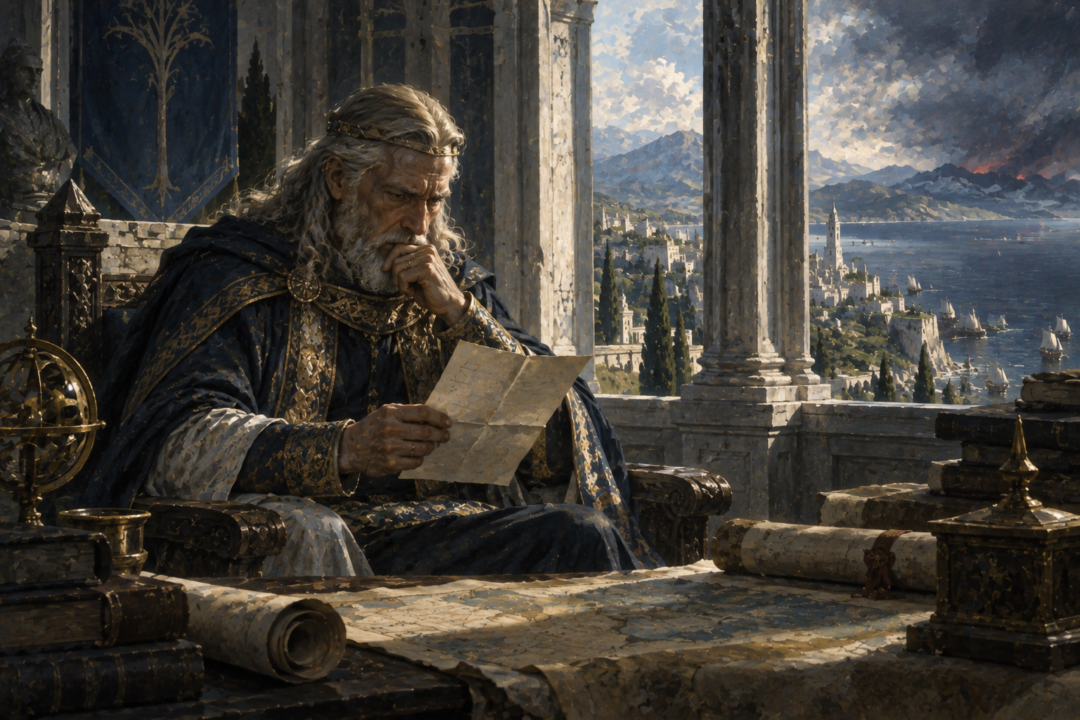
There Was Never a Simple Choice Between Love and Duty
Aldarion and Erendis endure because their story refuses an easy verdict.
Had Aldarion abandoned the Sea completely, Númenor might have lost the experience and connections that later proved important in resisting the growing Shadow in Middle-earth.
Had Erendis simply accepted his absences without protest, the personal cost of Aldarion's choices would disappear from the story.
Neither reading does justice to the surviving tale.
Their long betrothal reveals the problem before their marriage fails: Aldarion possesses several genuine duties, but he cannot satisfy all of them at once.
He is heir to a kingdom.
He is increasingly an ally of the Eldar.
He is a mariner building Númenor's knowledge and power overseas.
And he has promised himself to Erendis.
Those obligations pull in different directions.
Erendis sees one truth clearly: love cannot indefinitely survive as a promise of future presence.
Aldarion discovers another: Númenor cannot indefinitely pretend that the troubles of Middle-earth lie beyond its concern.
Neither truth cancels the other.
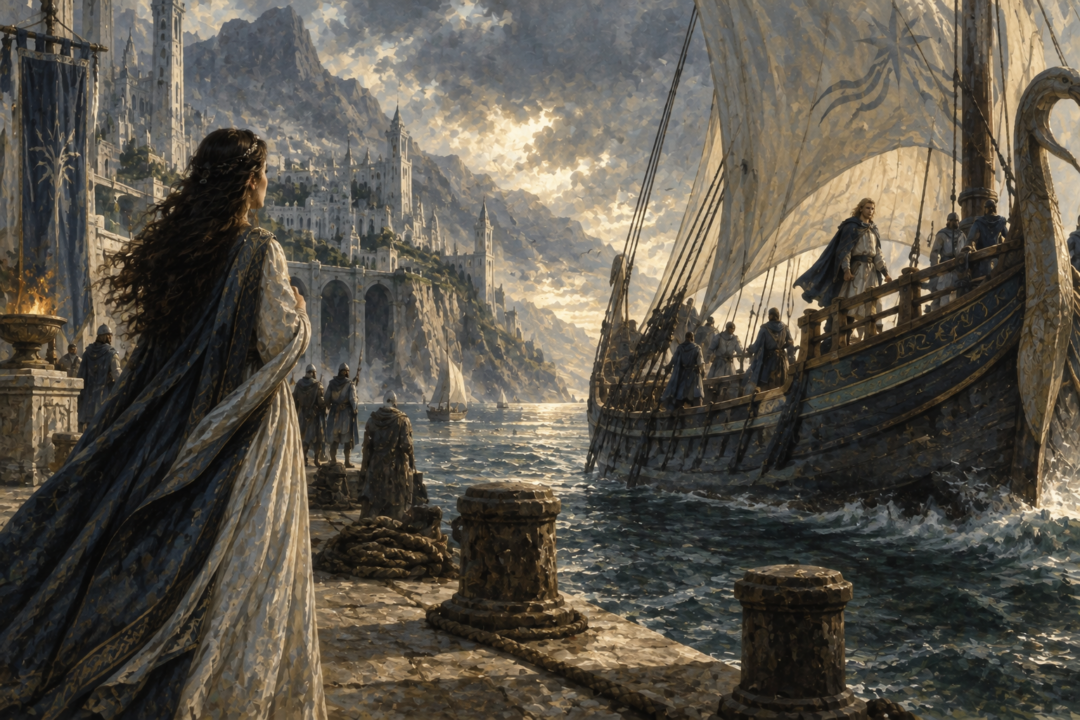
That is why the white house in Emerië and the ships sailing eastward belong to the same tragedy. One represents the home Aldarion repeatedly leaves behind. The other represents a world whose growing danger increasingly demands that he leave it.
Between them stand Aldarion and Erendis, discovering too late that love can be sincere, duty can be real, and the two can still become impossible to reconcile.
Sources & Notes
- Tolkien Gateway — “Aldarion and Erendis: The Mariner’s Wife”: synopsis and chronology of the long courtship, betrothal, voyages, marriage, separation, and Gil-galad’s warning. https://tolkiengateway.net/wiki/Aldarion_and_Erendis:_The_Mariner%27s_Wife
- Tolkien Gateway — “Erendis”: biographical account of Erendis, her 858 betrothal, twelve-year wait for marriage, and conflict with Aldarion’s voyages. https://tolkiengateway.net/wiki/Erendis
- The Encyclopedia of Arda — “Aldarion”: reference account of Aldarion as Númenor’s heir, mariner, husband of Erendis, and founder of the Guild of Venturers. https://www.encyclopedia-of-arda.com/a/aldarion.html
- Dallas Baptist University — Dr. Philip Irving Mitchell, “Aldarion and Erendis and Tolkien’s Views of the Sacrament of Marriage”: academic discussion prompts on their elongated courtship, Meneldur’s counsel, and whether political involvement excuses Aldarion’s conduct. https://www.dbu.edu/mitchell/tolkien-medieval-tradition-resources/tolkienmarriage.html
Sources document the Aldarion–Erendis courtship and marriage, Aldarion’s maritime vocation and political role, and critical discussion of the story’s conflict between marriage and public duty.