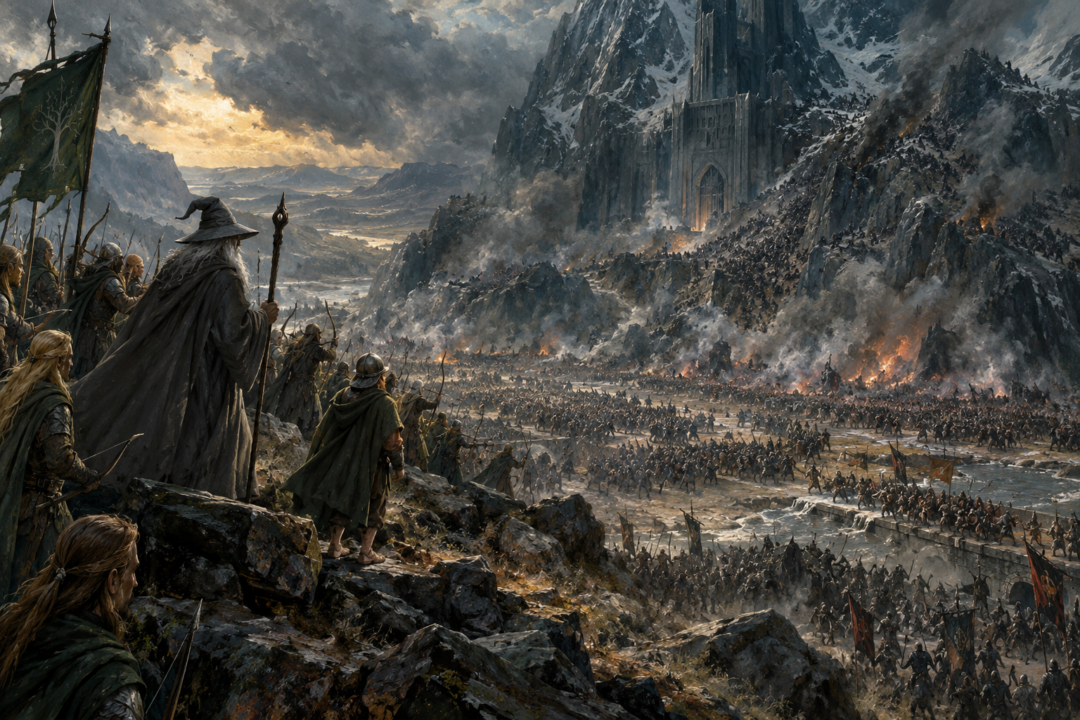
At the Battle of Five Armies, Bilbo Baggins has perhaps the best observation post available to anyone who is not commanding troops.
He is on Ravenhill, above the valley before Erebor. He can see the battle developing below. Gandalf is nearby. The Elvenking’s forces occupy the same part of the battlefield. And because Bilbo is wearing his magic ring, he can remain largely outside the fighting while watching events unfold.
Then the Eagles appear.
Bilbo sees them first. He cries out that the Eagles are coming—and almost immediately a stone hurled from above strikes his helmet. He falls unconscious.
When he wakes, the battle is over.
For Bilbo personally, this is fortunate: he survives a battle in which many others do not. But for anyone trying to reconstruct exactly how the Battle of Five Armies was won, it happens at almost the worst imaginable moment.
The central eyewitness of The Hobbit loses consciousness precisely when the battle enters its decisive phase.
Bilbo Is Our Witness, Not Our General
One of the unusual features of the Battle of Five Armies is how closely the narrative remains tied to Bilbo’s experience.
Bilbo is not a military commander. He does not direct formations, lead a charge, or possess complete knowledge of the battlefield. When the armies prepare for the Goblin assault, he chooses the relative safety of the Elven position on Ravenhill and puts on the ring.
That decision makes sense for Bilbo, but it also gives the story an interesting limitation.
We see the battle largely as an observer sees it.
Bilbo can watch the first stages clearly enough. The Goblins enter the valley between the Mountain’s spurs. Elves, Men, and Dwarves attack them. Then the enemy’s numerical strength and its movement over the Mountain begin to undermine the defenders’ plan.
Bilbo also witnesses Thorin’s dramatic return to the battle.
Thorin and his companions break out from the Gate of Erebor in magnificent armour. His charge temporarily transforms the fighting. Men, Elves, and Dwarves rally around him, and Thorin drives toward Bolg and his bodyguard.
But the attack cannot break through.
Thorin becomes surrounded.
From Bilbo’s perspective, the battle appears to be approaching disaster.
And then something changes in the sky.
The Eagles Arrive—and Bilbo Disappears From History
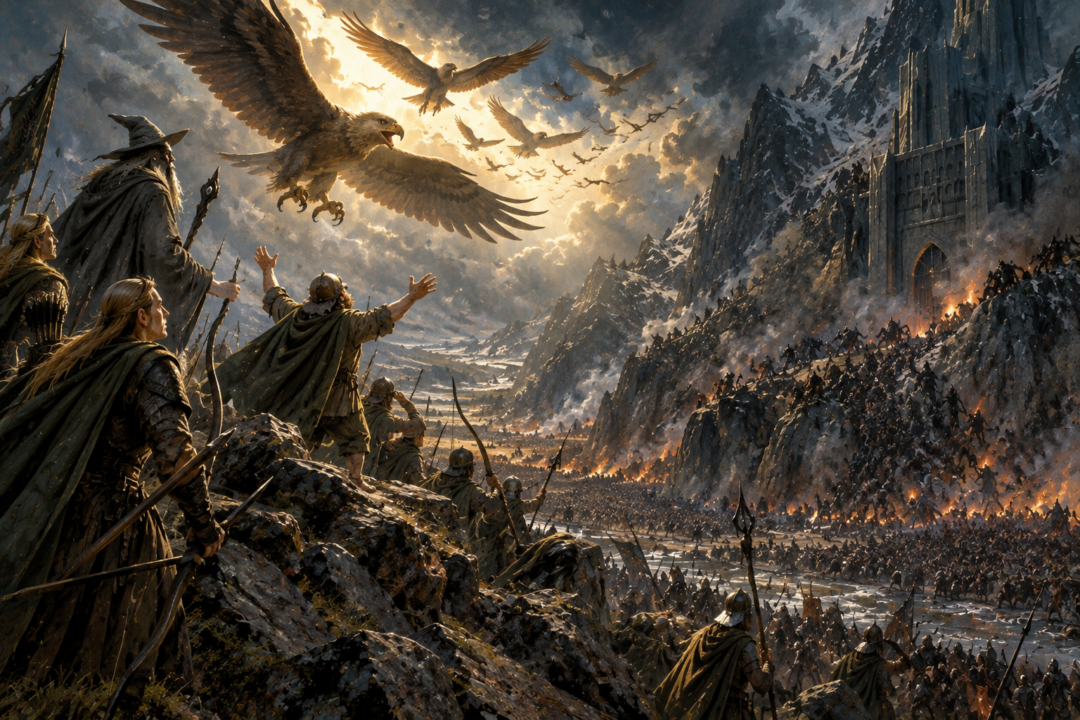
Bilbo is the first to notice the Eagles.
Their arrival is potentially decisive because the Goblins have gained an enormous tactical advantage by climbing over the Mountain. The defenders are no longer simply fighting enemies in the valley; they are being threatened from above and behind.
The Eagles can attack precisely where ordinary ground forces cannot easily respond.
Bilbo understands immediately that their appearance matters. His cry spreads among those around him.
Then his account effectively stops.
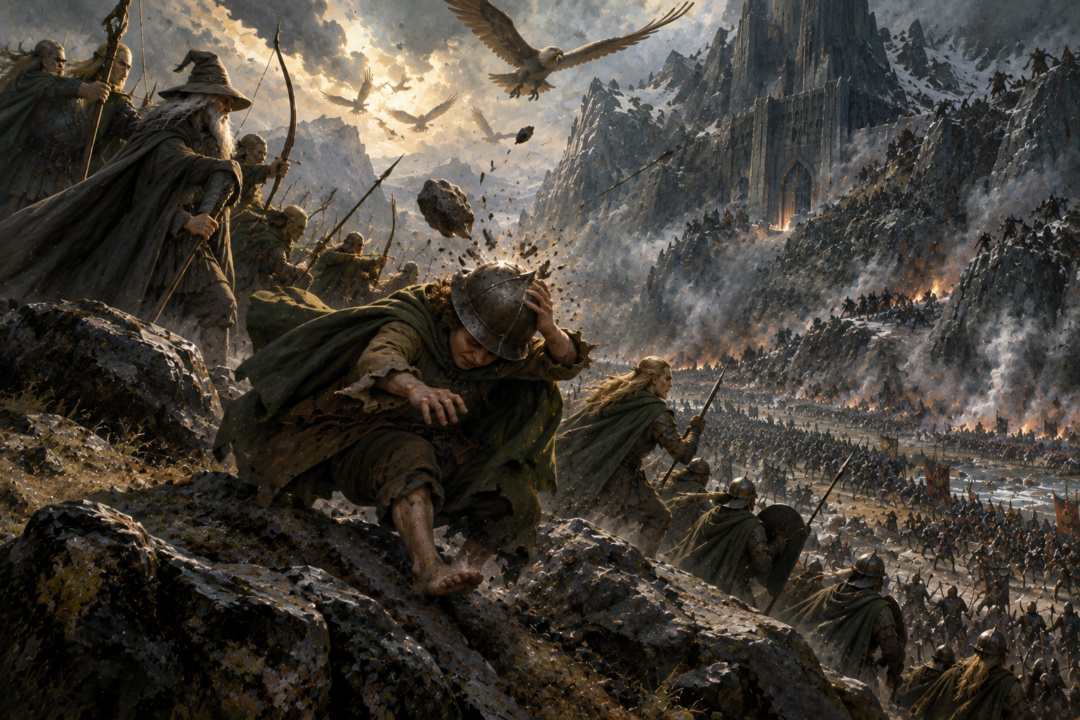
A stone comes hurtling down from above and strikes him. His helmet saves him from something worse, but he collapses unconscious.
This creates a striking narrative break.
Bilbo sees the arrival of the force capable of changing the battle—but not what that force actually accomplishes.
He misses the resolution.
For a historian inside Middle-earth attempting to build an eyewitness account from Bilbo’s recollections, this would be deeply inconvenient. The witness who has watched the battle from a comparatively useful vantage point becomes unavailable exactly when the earlier tactical situation is overturned.
The Most Important Events Happen While Bilbo Is Unconscious
When Bilbo wakes, it is morning.
He does not initially know what happened.
That distinction matters because several crucial facts about the victory are related afterward rather than directly witnessed by him.
The Eagles attack the Goblins occupying the Mountain slopes. Their intervention helps remove the threat from above, but the battle is not presented as ending simply because the Eagles arrive.
The decisive intervention comes from Beorn.
Beorn enters the battle in bear-shape. By the time he appears, Thorin has been mortally wounded. Fíli and Kíli have fallen defending him.
Beorn retrieves Thorin from the fighting.
Then, driven to fury, he returns to the battle, scatters Bolg’s bodyguard and kills Bolg. With their leader dead and the Eagles attacking from above, the Goblin host collapses.
Bilbo sees none of this.
He does not witness Beorn’s arrival.
He does not see Bolg killed.
He does not see Thorin fall.
He does not see Fíli and Kíli die defending their uncle.
He does not witness the exact sequence by which impending defeat becomes victory.
Those are not minor details. They are the climax of the largest military event in the book.
The Gap Makes the Battle Feel More Like History
Paradoxically, Bilbo’s absence makes the Battle of Five Armies feel more like a historical event rather than less.
Real battles are rarely experienced by one person as complete narratives.
A soldier sees one section of the field. A commander receives incomplete reports. Survivors remember different moments. Events occurring only a short distance apart may become known to one another only afterward.
Bilbo experiences the battle in exactly this fragmented way.
He knows what he personally saw.
After waking, he learns what happened while he was unconscious.
The text itself signals this transition. The story must summarize events that occurred after Bilbo lost consciousness, because its principal observer cannot supply them directly.
This produces an important distinction between witnessed experience and reconstructed knowledge.
Bilbo can truthfully say that he saw the Eagles arrive.
He cannot personally describe Beorn killing Bolg.
Someone else must have supplied that information.
The book does not provide a detailed chain of testimony explaining exactly who reported every event to Bilbo, so it would go beyond the text to invent one. The safest conclusion is simply that Bilbo later learned the broad course of the battle from survivors.
The Ring Makes the Problem Even Stranger
Bilbo’s invisibility adds another layer of irony.
He wears the ring because he believes it will improve his chances of surviving the battle.
It does.
But after the stone knocks him unconscious, that same invisibility makes him difficult to find.
When Bilbo wakes the following day, someone is searching for him. The searcher cannot see him until Bilbo remembers that he is still wearing the ring and removes it.
The object that helped protect Bilbo therefore also leaves him lying unnoticed after the battle.
At this point in The Hobbit, the ring has not yet been presented with the full significance it receives in The Lord of the Rings. Within this episode, however, its immediate practical effect is clear: Bilbo becomes an invisible casualty on Ravenhill.
For the historical record, the result is almost comical.
One of the battle’s most useful non-combatant witnesses is present, elevated above part of the battlefield, protected by invisibility—and unconscious during the decisive action.
Bilbo Misses Something More Important Than Strategy
The greatest loss is not military information.
It is personal.
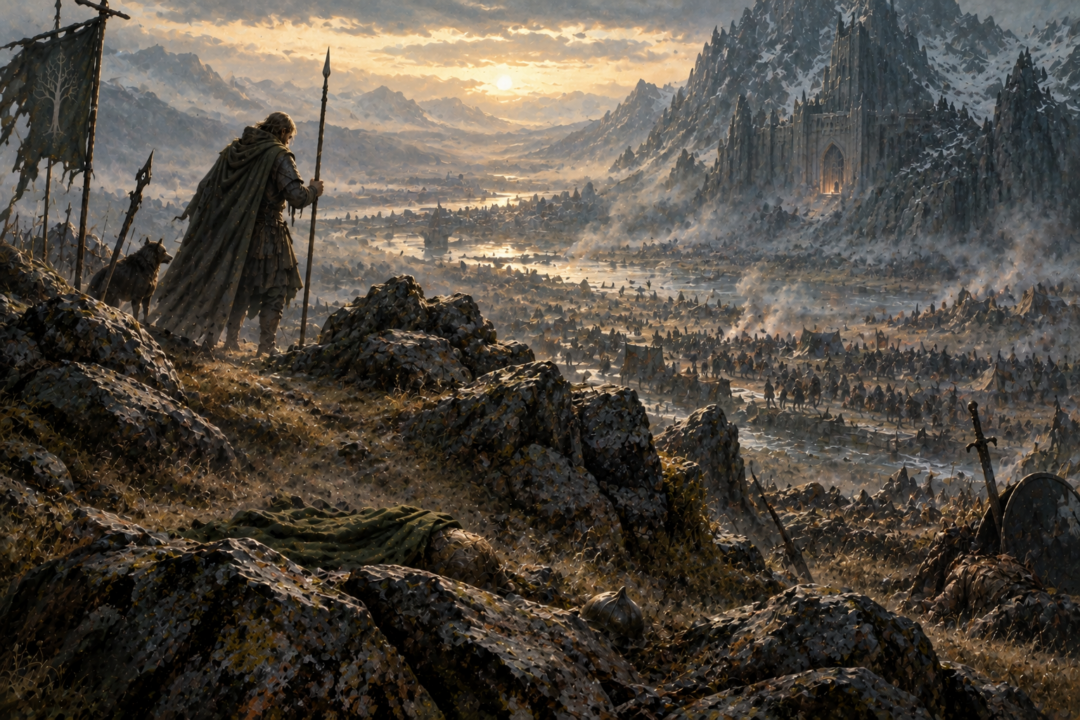
Bilbo misses Thorin’s fall.
Only shortly before the battle, their relationship had broken catastrophically over the Arkenstone. Bilbo had secretly delivered it to Bard in an attempt to prevent bloodshed. When Thorin discovered the betrayal, his anger was terrible, and Bilbo left the Mountain.
Then war arrives before that conflict can truly be resolved.
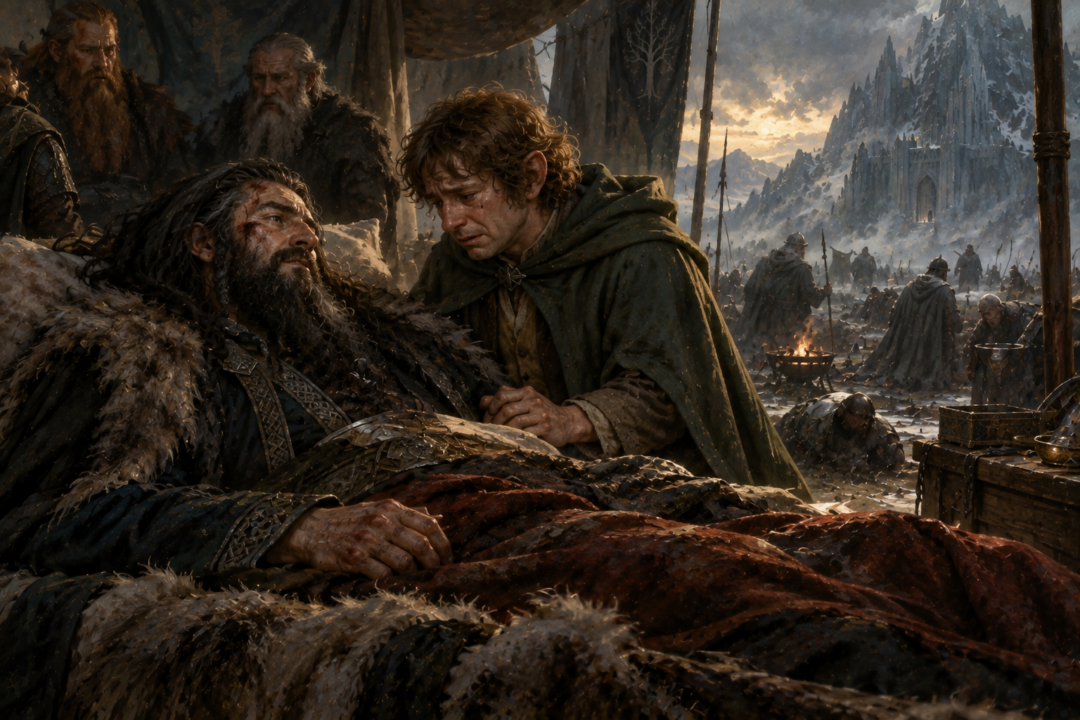
Bilbo therefore wakes not merely to discover that the battle has ended, but that Thorin is dying.
He is brought to Thorin, and their final conversation becomes one of the emotional conclusions of the book. Thorin withdraws the bitter words he had spoken and acknowledges the value of Bilbo’s courage and wisdom. His final reflections contrast simple pleasures—food, cheer, and song—with the destructive desire to hoard wealth.
Bilbo does not need to have witnessed Thorin’s final charge to grieve for him.
In some ways, not seeing it makes the aftermath harsher.
He wakes into consequences.
The fighting is finished. Fíli and Kíli are dead. Thorin is dying. The treasure that nearly caused Elves, Men, and Dwarves to fight one another suddenly seems painfully small beside the lives lost around it.
Bilbo misses the heroic spectacle and receives the cost.
That Is Exactly Where Bilbo Belongs
There is a temptation to imagine that Bilbo ought to have witnessed everything.
After all, he is the central character.
But The Hobbit repeatedly refuses to turn him into the conventional hero of a martial epic.
Bilbo does courageous things, but his greatest acts are rarely acts of violence.
He enters Smaug’s lair.
He rescues the Dwarves from the Elvenking’s halls.
He gives away the Arkenstone because he hopes to prevent a battle.
And during the Battle of Five Armies, his thoughts are not those of someone thrilled by warfare. As defeat seems imminent, he reflects bitterly on the miserable end toward which the struggle over the treasure has led them.
Then the great heroic machinery of battle overwhelms him.
A stone knocks him senseless.
The armies continue without him.
The Missing Hours Are the Point
If we wanted a complete military chronicle of the Battle of Five Armies, Bilbo Baggins would be a frustrating source.
He witnesses the deployment.
He watches the battle turn against the defenders.
He sees Thorin’s charge.
He sees the Eagles arrive.
Then, at precisely the moment when a historian would most want him alert, his testimony ends.
Everything afterward has to be reconstructed.
Yet that gap suits the deeper shape of Bilbo’s story.
The Battle of Five Armies is not ultimately important because Bilbo can tell us exactly how Bolg’s formation collapsed or precisely where Beorn entered the fighting. What matters to Bilbo is what remains when the battle is finished.
Friends are dead.
Old enemies have fought beside one another.
The treasure survives, but those who desired it have been permanently changed by the struggle around it.
And Bilbo, who spent much of the adventure being underestimated because he was small, comfortable, and profoundly unwarriorlike, survives the great battle largely by failing to participate in its glory.
For a historian, his timing is terrible.
For Bilbo Baggins, it is strangely perfect.
Sources & Notes
- The Encyclopedia of Arda — “Battle of Five Armies”: reference account of the battle at Erebor, including the Eagles’ arrival, Beorn’s intervention, Thorin’s mortal wounding, and Bolg’s death. https://www.encyclopedia-of-arda.com/b/battleoffivearmies.php
- The Encyclopedia of Arda — “The Hobbit: The Battle of the Five Armies” viewers’ guide: contrasts the film with the book, where Bilbo becomes invisible, is knocked unconscious, and misses the outcome after announcing the Eagles. https://www.encyclopedia-of-arda.com/the-hobbit-the-battle-of-the-five-armies.html
- The Encyclopedia of Arda — “Beorn”: reference entry on the skin-changer whose bear-form intervention played a major part in victory at the Battle of Five Armies. https://www.encyclopedia-of-arda.com/b/beorn.php
- The Encyclopedia of Arda — “Great Eagle”: account of the Eagle-lord who led his people into the Battle of Five Armies and helped turn the tide against the Orcs. https://www.encyclopedia-of-arda.com/g/greateagle.php
Sources document Bilbo’s position and loss of consciousness at the Battle of Five Armies, the Eagles’ intervention, and Beorn’s decisive rescue of Thorin and defeat of Bolg.