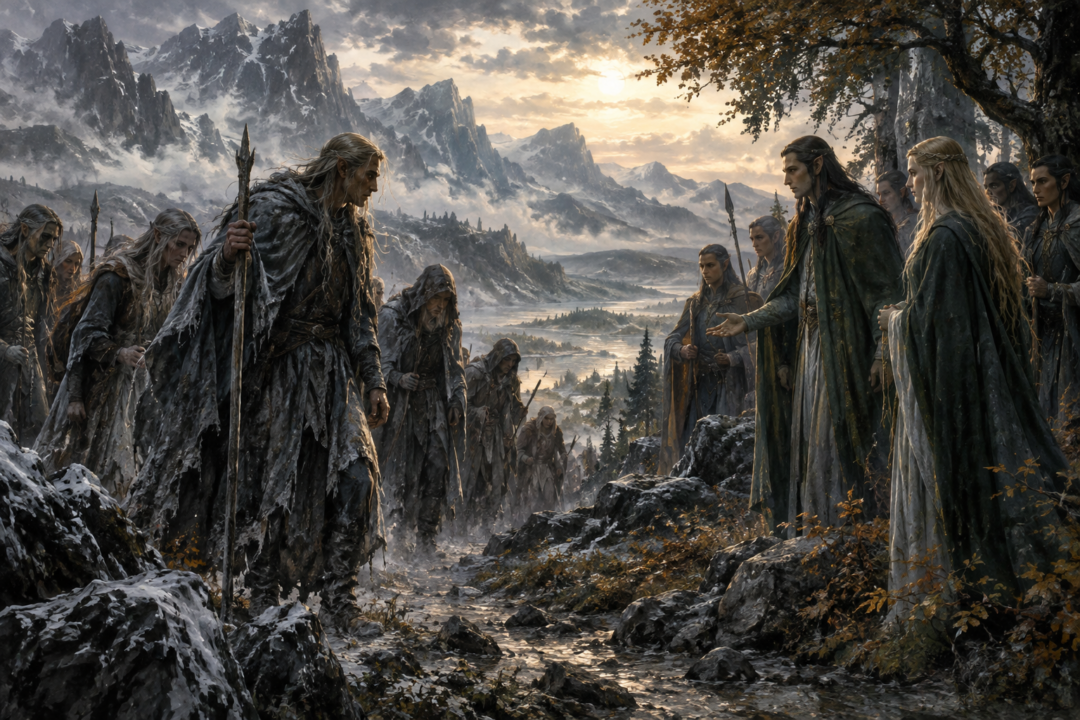
Fingon and Turgon sound so naturally at home beside names such as Thingol, Beleg, and Círdan that it is easy to forget something important: those were not the forms in which the sons of Fingolfin were named in Aman.
Before the Exile, they were Findekáno and Turukáno.
That difference is more than translation. In the late linguistic material associated with “The Shibboleth of Fëanor,” the Sindarin forms Fingon and Turgon preserve evidence of a surprisingly sophisticated process. The Exiled Noldor did not merely replace Quenya words with Sindarin equivalents. In some cases they reshaped their old names according to the historical sound changes that separated the languages.
A name could therefore carry a hidden history. Its sounds could reveal whether it belonged to Aman, whether it had been adapted after the return to Middle-earth, and even whether its bearer lived long enough to acquire a Sindarin form at all.
For the Noldor, exile changed not only where they lived. It changed what the world called them.
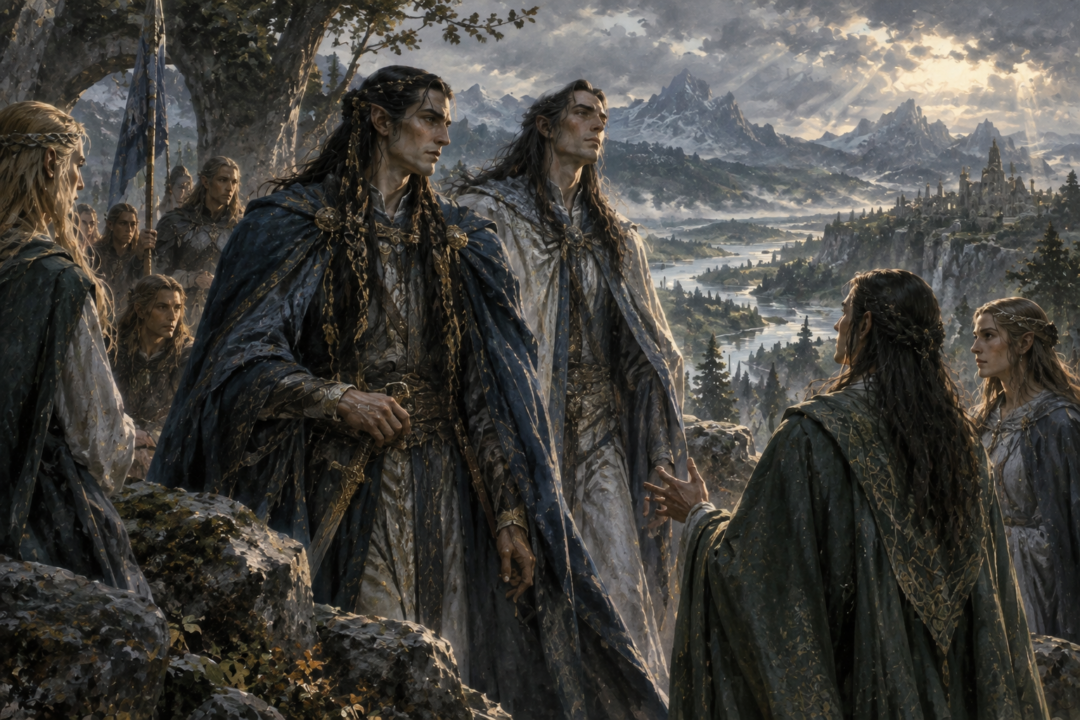
The Exiles Arrived With Quenya Names
The great Noldorin princes who entered Beleriand had already lived for long years in Aman. Their personal names belonged to the naming customs and languages of the Eldar in the West.
Fingolfin’s children, for example, included Findekáno, Turukáno, Arakáno, and Írissë in the later account in “The Shibboleth of Fëanor.” The familiar forms Fingon and Turgon belong to their lives in Middle-earth, not to their original childhood in Valinor.
This distinction matters because the Noldor did not enter an empty land.
Beleriand already had Elvish peoples with their own languages, above all the Sindar. Their speech had developed separately from the languages of the Eldar in Aman for an immense period. Although those languages ultimately shared ancestry, they had undergone different changes.
The returning Noldor therefore encountered something simultaneously foreign and related: a language whose ancient roots could resemble their own, but whose sounds had followed another history.
They learned Sindarin quickly. The published Silmarillion says that after Thingol learned the truth about the Kinslaying at Alqualondë, he forbade the open use of the Noldorin tongue in his realm. Thereafter the Exiles adopted Sindarin for their ordinary speech, while Quenya survived chiefly as a language of lore and among Noldorin lords.
Their names entered that same process of adaptation.
Fingon and Turgon Were Not Simple Translations
Findekáno contains Quenya findë, associated with hair, and káno, meaning a commander or chief of lesser rank. Turukáno likewise contains káno.
Yet the forms Fingon and Turgon were not straightforward Sindarin translations preserving those meanings.
The late linguistic account makes a much stranger point. Their Sindarization reflects knowledge of the sound changes distinguishing Sindarin from Telerin, while effectively disregarding the original semantic construction.
In other words, the adapters treated the names almost as though they were ancient words inherited into Sindarin.
Imagine beginning with an old form and asking not, “What does this mean in Sindarin?” but, “What would this sequence of sounds look like if it had passed through the same centuries of change as native Sindarin?”
That produces a historical disguise.
The resulting names sound as though they could have grown naturally within Sindarin. But if Fingon and Turgon had genuinely been ancient Sindarin formations, their apparent elements would not necessarily preserve the meanings of Findekáno and Turukáno. The linguistic discussion even observes that they might have suggested meanings roughly involving “hair” or “master” combined with “shout.”
That semantic oddity apparently did not matter greatly. Old Sindarin names themselves could become obscured by centuries of sound change until speakers treated them simply as names rather than transparently meaningful compounds.
The Exiles’ adapted names could behave the same way.
Why Telerin Matters
The reference to Telerin is especially revealing.
Sindarin and the Telerin spoken in Aman belonged to closely related branches of the Eldarin linguistic family. The Teleri who reached Aman and the Sindar who remained in Beleriand had shared a linguistic ancestry before their separation.
That relationship becomes particularly important in the House of Finarfin.
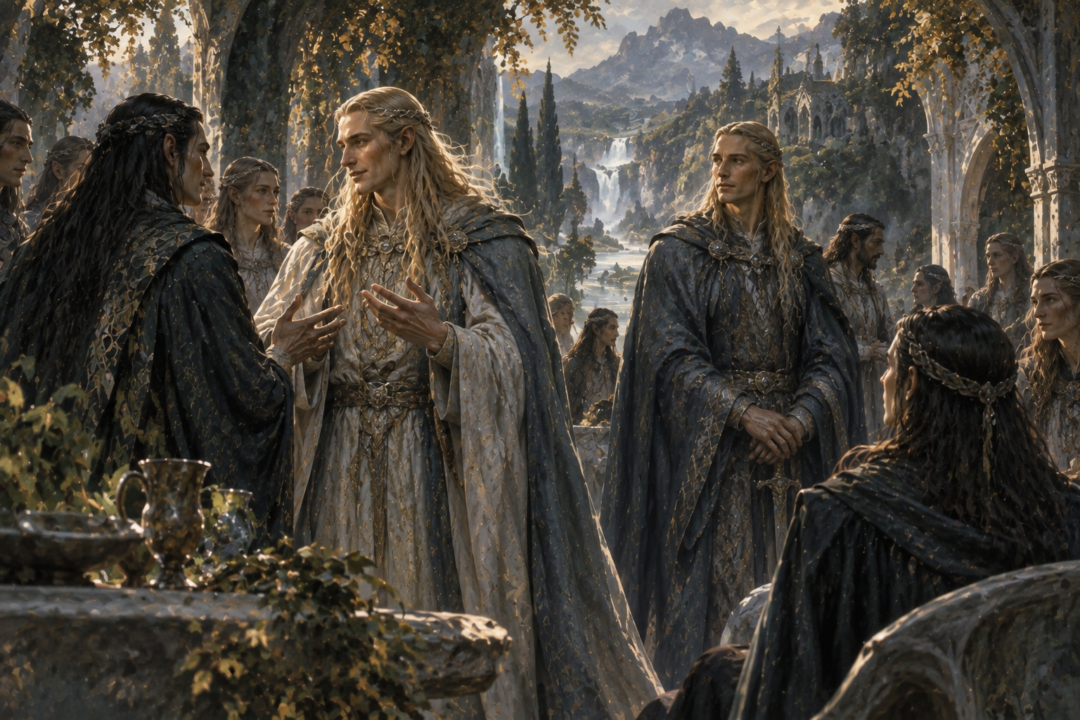
Finarfin married Eärwen, daughter of Olwë of Alqualondë. In the late naming material, names such as Findaráto and Angaráto are described as Telerin in form because Finarfin used the language of his wife’s people.
When these names reached Beleriand, their relationship to Sindarin made them comparatively easy to adapt in both sound and sense.
Findaráto became Finrod.
Angaráto became Angrod.
Here family history is embedded in phonology. These princes came from the Noldorin royal house, yet the forms of their Aman names reflect their Telerin maternal connections. Once in Beleriand, those Telerin forms stood unusually close to the language of the Sindar because the two peoples were related.
The sounds therefore preserve a map of separation and reunion: Teleri in Aman on one side of the Sea, Sindar in Middle-earth on the other, and descendants of both worlds arriving with names that could cross the linguistic divide unusually well.
A Name Could Reveal Whether Its Bearer Reached Beleriand
The most striking evidence may come from names that never changed.
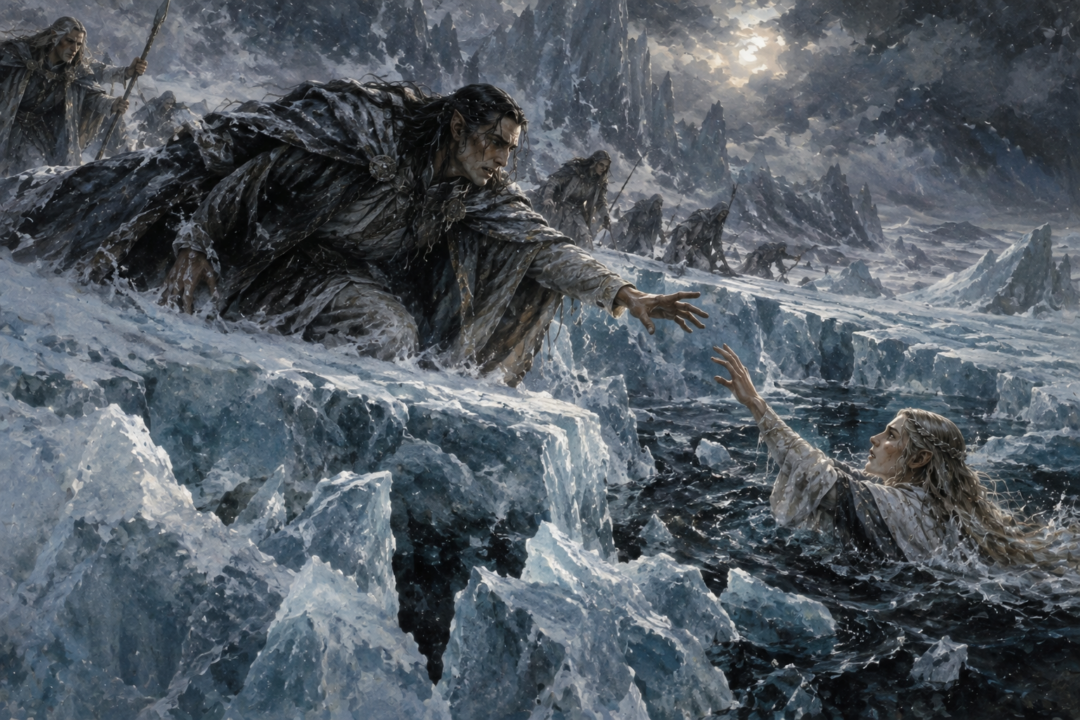
Fingolfin’s son Arakáno provides an especially clear example in the late account. Unlike Findekáno and Turukáno, his name was never given an ordinary Sindarinized form during his lifetime because he died in the first battle fought by Fingolfin’s host after crossing the Grinding Ice, before the Exiles had established themselves in Beleriand.
A Sindarin form, Argon, was later used commemoratively.
The contrast turns naming into chronology.
Findekáno survives into Beleriand and becomes Fingon.
Turukáno survives and becomes Turgon.
Arakáno dies before that cultural adjustment can properly occur, so the original name remains attached to his brief life, while a Sindarin form belongs to later remembrance.
Elenwë, Turgon’s wife, offers another grim boundary. In the same late tradition she dies during the crossing of the Helcaraxë and has no Sindarin name.
That does not establish an absolute rule that every survivor must receive a Sindarinized name. Elvish naming is far too varied for that. But in these particular examples, the presence or absence of a Sindarin form corresponds powerfully with the geography of survival.
Some names crossed the Ice.
Some did not.
The Exiles Chose Which Names to Carry Forward
Noldorin naming was already complex before exile. An Elf might possess father-names, mother-names, later names or epessë, and in some circumstances self-chosen names.
The Exiles therefore did not simply have one immutable label that required conversion.
The later material indicates that an Exile would normally select one of his or her names for adaptation into Sindarin. Preference mattered, but so did whether a name could be translated or fitted naturally into Sindarin style.
This explains why Sindarinization should not be imagined as a mechanical dictionary exercise.
A person’s public identity in Beleriand could be a choice among identities already possessed in Aman.
Finrod offers a revealing case. Another of his names was Ingoldo, a significant name within his family, but it was not the name that became his ordinary Sindarin identity. Findaráto supplied the path to Finrod instead.
The familiar map of First Age names is therefore partly a map of selection. We usually meet these figures through the forms that survived into the historical traditions of Middle-earth, not necessarily through the names most intimate to their earliest lives.
Thingol’s Ban Accelerated a Change Already Underway
It is tempting to imagine that Thingol’s prohibition instantly transformed Quenya-speaking Noldor into Sindarin speakers. The texts suggest a more gradual linguistic encounter followed by a decisive political pressure.
The Noldor were already learning Sindarin. Thingol’s decree then made the public position of Quenya far more difficult. According to The Silmarillion, the Sindar refused to speak the Noldorin tongue, and the Exiles consequently used Sindarin in their daily affairs.
Quenya did not vanish.
Turgon notably retained a powerful attachment to it. His hidden city had the Quenya name Ondolindë, although the Sindarin form Gondolin became the name generally used. Other texts preserve Quenya as a language of learning, ceremony, memory, and particular households.
The Exiles therefore lived between linguistic worlds.
Their Sindarin names did not prove that Aman had been forgotten. Quite the opposite: many of those names were Amanian identities reshaped so they could live in Beleriand.
The Older Sound Change Behind the Exiles
There is another layer to this story.
Even before the Exile, Noldorin Quenya had developed distinctive pronunciations. Most famously, the older sound written þ, like the unvoiced “th” in English “thin,” had generally become s among the Noldor.
This change became emotionally and politically charged because Fëanor resisted it. His mother Míriel’s name Þerindë contained the older sound, and his attachment to its pronunciation became bound up with his memory of her and his hostility toward the house of Indis.
Yet Sindarin itself retained the þ sound.
That creates a remarkable reversal. The Noldor left Aman with a dialect in which most speakers had abandoned a sound that their relatives elsewhere retained. Then in Middle-earth they adopted Sindarin, a language in which that sound was entirely natural.
The Exiles were not carrying a frozen “High Elven” speech untouched through history. Their own Quenya already contained evidence of social preference, linguistic change, and division.
Exile merely added another layer.
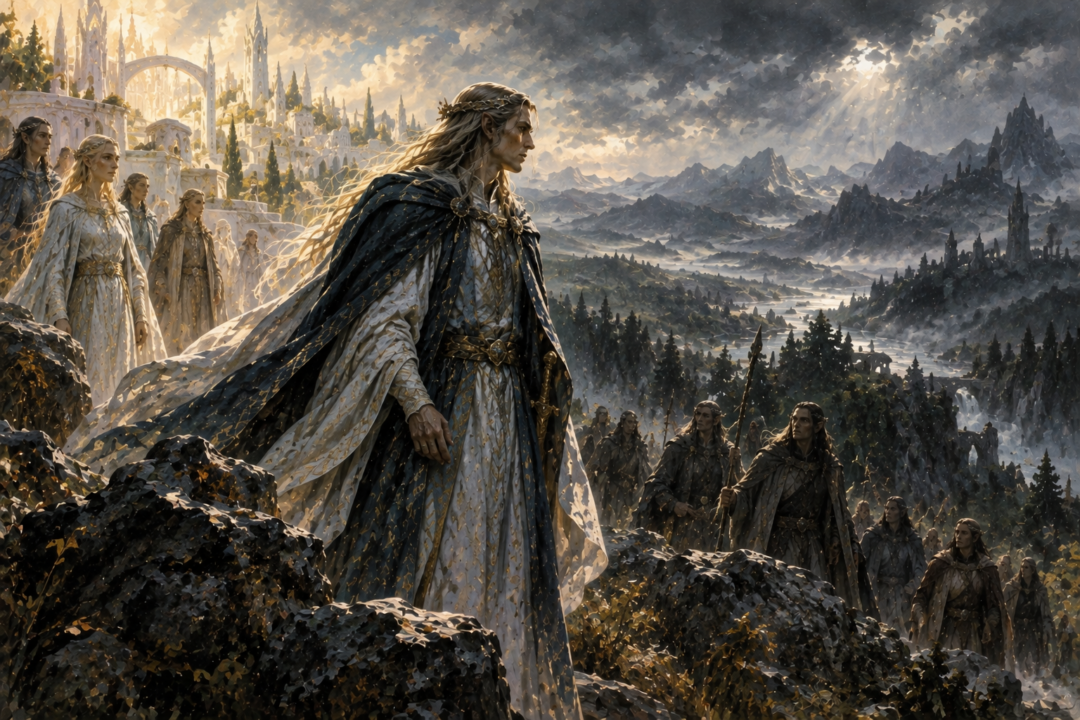
Every Familiar Name Is a Small Piece of History
Fingon, Turgon, Finrod, and Angrod look on the page like stable identities. Linguistically, they are evidence of movement.
Behind Fingon stands Findekáno.
Behind Turgon stands Turukáno.
Behind Finrod stands a name shaped by the Telerin connections of Finarfin’s household.
And beside them stand figures such as Arakáno and Elenwë, whose stories ended before the same transformation could fully become part of their lived identities.
That is why the sound changes matter.
They reveal that the Noldorin Exiles did not merely enter Beleriand and continue speaking exactly as before. Their names encountered another branch of Elvish history. Sometimes meanings were translated. Sometimes related forms made adaptation unusually easy. Sometimes an old name was remodeled according to the sound-history of the language into which it was entering.
And sometimes death came before any new name could be learned.
The result is one of the quietest forms of world-building in Middle-earth: history surviving not only in chronicles, ruins, and genealogies, but inside consonants.
The Exiles carried Aman with them. Beleriand changed the way that inheritance sounded.
Sources & Notes
- Tolkien Gateway — The Shibboleth of Fëanor https://tolkiengateway.net/wiki/The_Shibboleth_of_F%C3%ABanor
- Tolkien Gateway — Quenya https://tolkiengateway.net/wiki/Quenya
- Tolkien Gateway — Sindarin https://tolkiengateway.net/wiki/Sindarin
- Tolkien Gateway — Fingon https://tolkiengateway.net/wiki/Fingon
These reference entries identify Tolkien's late linguistic essay and document the Quenya/Sindarin name forms and language history discussed. The article's synthesis about what those forms imply remains interpretation.