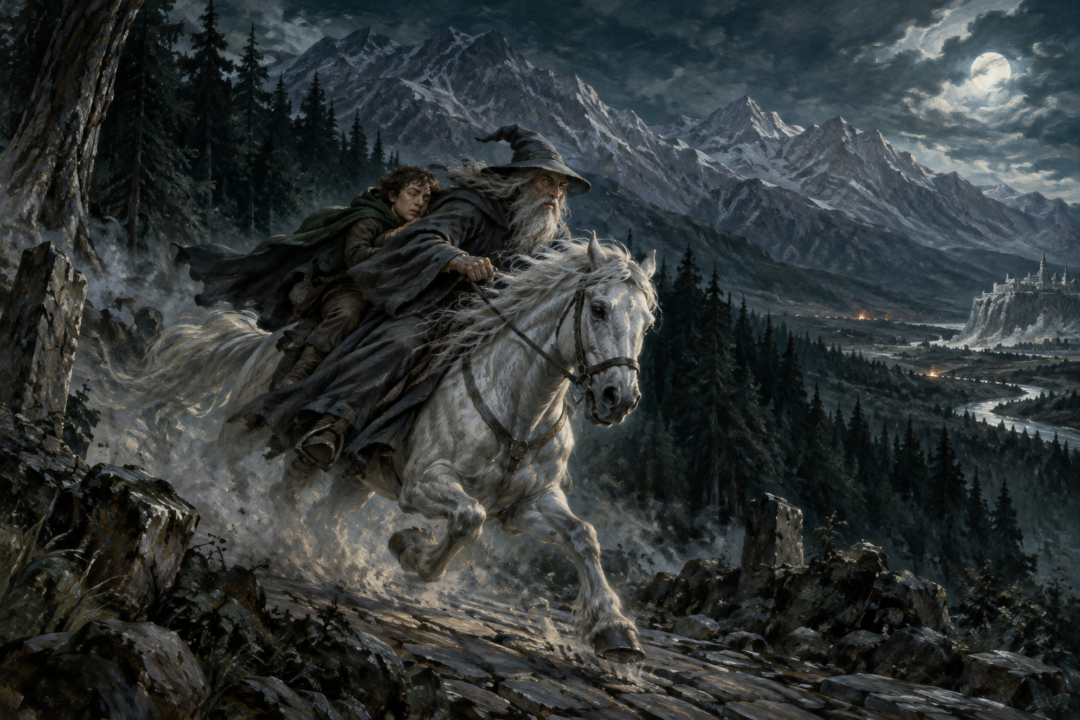
Pippin wakes to darkness, rushing wind, and the relentless movement of Shadowfax beneath him. Somewhere behind lies Isengard and the terrible mistake of looking into the palantír. Somewhere ahead stands Minas Tirith. Between them stretches Anórien, the eastern land of Gondor beneath the White Mountains.
Then fire appears on the hills.
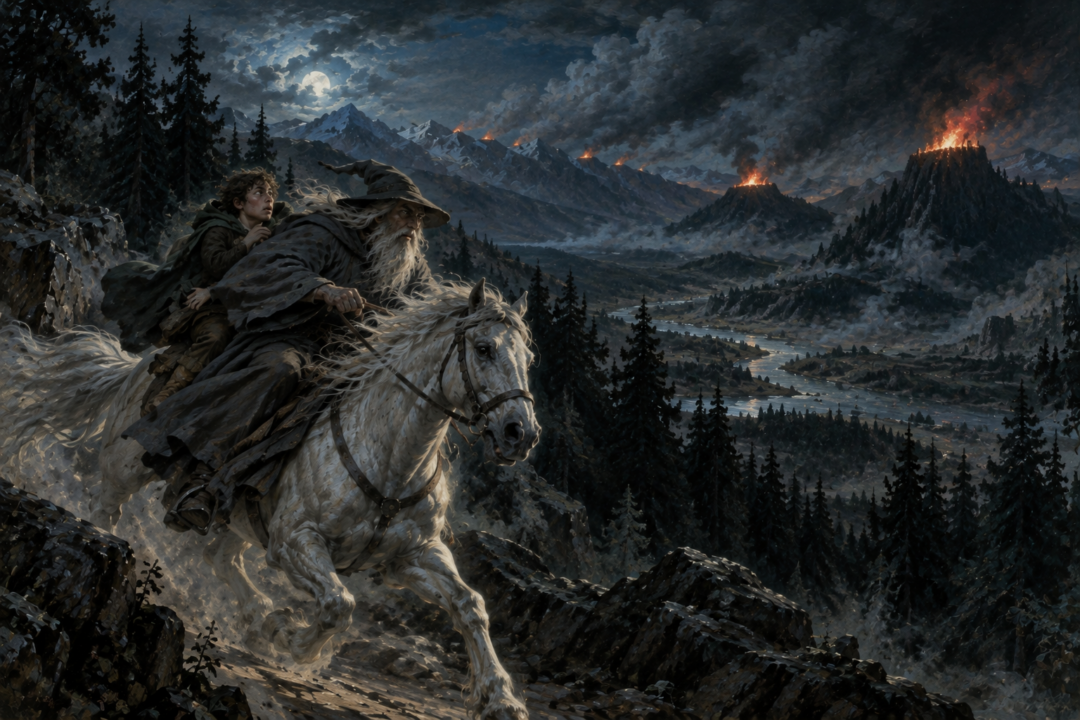
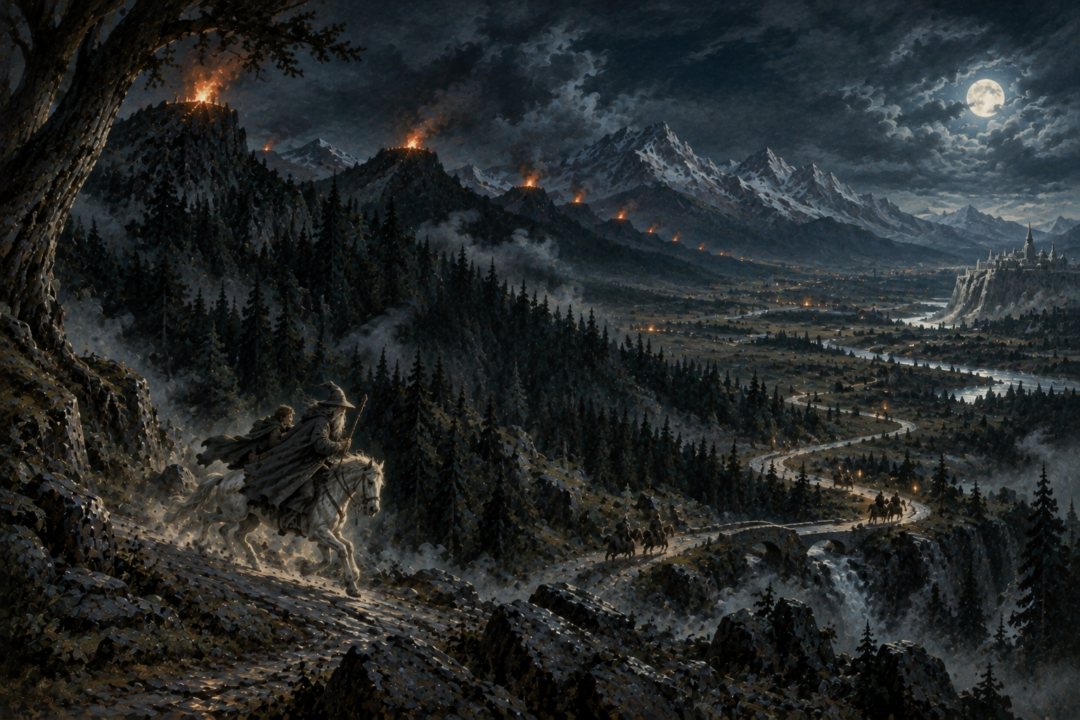
At first Pippin does not understand what he is seeing. But Gandalf does. The beacons of Gondor are burning, carrying the alarm westward toward Rohan.
That moment explains much about why Gandalf and Pippin are racing through this country at night. They are not making an ordinary journey, and Gandalf is not choosing darkness because the road itself possesses some secret nocturnal rule. He is riding against time.
There is also an important geographical distinction. Gandalf and Pippin are travelling through Anórien on the great road toward Minas Tirith, passing the country of the Drúadan Forest and its beacon-hills. They are not taking the hidden route through the forest that later becomes crucial to Théoden and the Rohirrim.
Those two journeys cross the same threatened landscape for very different reasons.
The Ride Begins With the Palantír
The urgency begins before Gondor's beacons ever appear.
At Dol Baran, after the confrontation with Saruman at Isengard, Pippin secretly looks into the palantír of Orthanc. Instead of merely seeing distant places, he encounters Sauron.
The consequences are immediate.
Gandalf understands that Sauron has become aware of Pippin and has drawn false conclusions from what he has seen. Gandalf also recognizes that events are accelerating. Soon afterward a winged Nazgûl passes overhead.
He therefore takes Pippin away on Shadowfax and rides toward Minas Tirith.
This is the essential answer to the question of the night journey: Gandalf cannot afford to travel at an ordinary pace. He has information Denethor needs, Gondor is approaching its great crisis, and the Enemy is already moving.
The text repeatedly emphasizes speed. Shadowfax carries Gandalf and Pippin over enormous distances, while Pippin experiences much of the journey as a confused rhythm of riding, brief shelter, exhaustion, waking, and riding again.
Night is not an obstacle that makes Gandalf stop.
Time is the greater danger.
They Are Passing the Drúadan Forest, Not Using Théoden's Secret Way
The geography matters because this part of the story is easily confused with the later Ride of the Rohirrim.
The Drúadan Forest lies in Anórien, north of the White Mountains. The Great West Road connecting Minas Tirith with the western lands passes around the northern side of the forest. Beacon-hills rise through this region, including Eilenach within the forest, with Nardol to the west and Amon Dîn to the east.
Gandalf and Pippin are approaching Minas Tirith from the west along Gondor's established road system.
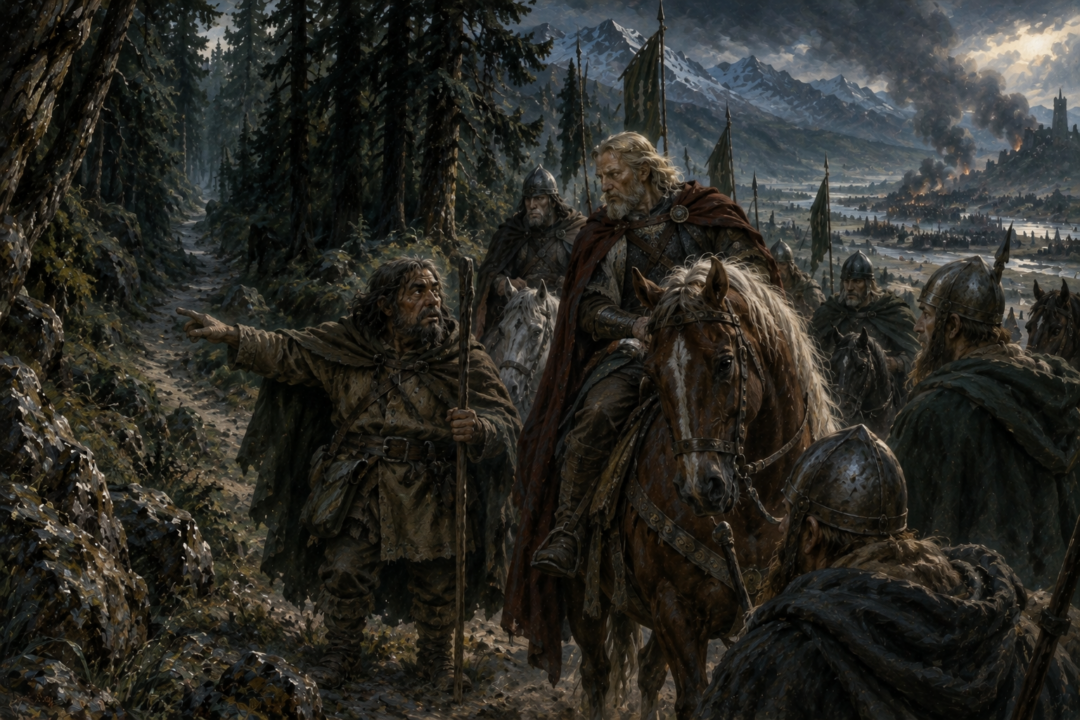
Several days later, Théoden's army reaches the same general region under much worse military conditions. By then enemy forces have obstructed the normal approach to Minas Tirith.
That is when Ghân-buri-Ghân and the Drúedain become decisive.
They guide the Rohirrim by an old, largely forgotten route through the Stonewain Valley, allowing Théoden's host to bypass enemies watching or blocking the main road.
So the two passages should not be merged into one event.
Gandalf and Pippin race east on the main route before the enemy has made that route unusable. Théoden later needs local knowledge to evade the forces that threaten his advance.
The contrast quietly shows how rapidly Gondor's military situation is deteriorating.
Why Gandalf Keeps Riding After Dark
Nothing in the text suggests that Gandalf waits specifically for darkness to pass the Drúadan region.
Quite the opposite: his journey simply continues into the night because stopping unnecessarily would waste time.
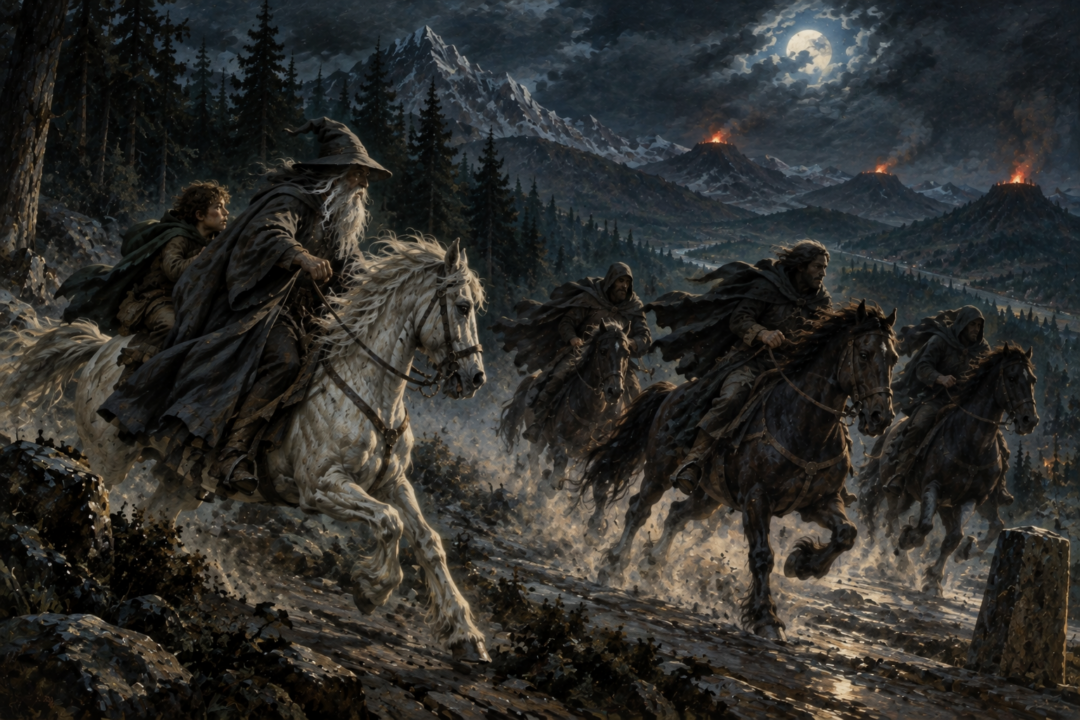
Pippin's experience makes this especially clear. During the third night after his encounter with the palantír, he wakes while they are still travelling through Anórien. The moon is rising, and Gandalf tells him that hours of darkness remain.
The journey is exhausting enough that Pippin repeatedly sleeps while riding with Gandalf.
This is not stealth in the usual sense. Gandalf is not attempting to creep unseen through the Drúadan Forest. Nor does the narrative establish darkness as protection from its inhabitants.
He is exploiting something far more important: Shadowfax's extraordinary endurance and speed.
Ordinary travellers would structure their progress around daylight, rest, food, fresh mounts, and safe stopping places. Gandalf's situation permits very little of that.
The Enemy will not pause for sunrise.
Neither will he.
The Beacons Turn the Night Into a Warning
The most memorable consequence of travelling at night is that Pippin sees Gondor's warning system come alive.
He notices red fire and initially wonders whether dragons are responsible. Gandalf immediately recognizes the meaning.
The beacons are lit.
Amon Dîn burns. Eilenach answers. Then the signal travels westward through Nardol, Erelas, Min-Rimmon, Calenhad, and Halifirien toward Rohan.
The darkness makes the moment visually dramatic, but its real significance is strategic.
Gondor is calling for aid.
Gandalf is therefore witnessing confirmation that the crisis he feared is no longer approaching in some distant future. The machinery of Gondor's emergency communications has been activated.
The beacon system also reveals something important about the landscape they are crossing. These are not empty wilderness hills. Anórien forms part of Gondor's defensive and communications network.
Gandalf even explains to Pippin that Gondor maintains posts and horses for errand-riders. Soon they hear horses approaching, and riders pass them westward through the darkness.
Fire on the heights and riders on the road are doing complementary work: Gondor is sending its alarm across the realm.
The Drúadan Forest Hides Another Kind of Power
There is an irony here that becomes visible only later.
Gondor's organized warning network dominates the night sky: maintained beacon-hills, guarded posts, horses, roads, and messengers.
Yet inside and around the Drúadan Forest lives a people largely outside that political system.
The Drúedain possess something Gondor's roads cannot provide: intimate knowledge of the land.
When Théoden later reaches this region, conventional infrastructure is no longer enough. Enemy forces threaten the horse-road. The Rohirrim need another way forward.
Ghân-buri-Ghân provides it.
He knows the forgotten road through Stonewain Valley and offers to guide the Rohirrim. His people also know where enemies are moving. Their assistance enables Théoden to bypass the obstruction and approach the Pelennor without taking the expected route.
That creates one of the most striking contrasts in this part of The Return of the King.
Gandalf passes through a landscape held together by Gondor's ancient systems.
Théoden later survives the same landscape because of knowledge Gondor's enemies have not controlled.
Roads matter.
Beacons matter.
But so do people whom the great kingdoms have overlooked.
The Road Is About to Become Dangerous
Gandalf and Pippin's passage also gains meaning when read beside what happens only days afterward.
When Gandalf rides through Anórien, the road still carries messengers.
When Théoden arrives, enemy forces have penetrated the region and threaten the route toward Minas Tirith.
The change is dramatic.
A functioning road becomes contested ground.
A communication corridor becomes a potential trap.
A forest on the edge of Gondor's political attention becomes strategically essential.
This is why the night ride feels increasingly ominous even though Gandalf and Pippin themselves are not attacked there. They are moving through the last hours of a landscape that still mostly functions as Gondor intended.
The beacons are perhaps the clearest symbol of that transition.
They demonstrate that Gondor's ancient defenses still work.
They also announce that those defenses are being tested.
Pippin Sees War Before He Understands It
There is another reason the scene works so well through Pippin's eyes.
He does not initially see a military communications network.
He sees mysterious fires.
That difference captures Pippin's position in the larger story. He has suddenly been pulled from the comparatively sheltered world of the Shire into the machinery of kingdoms and war.
The palantír has already shown him Sauron directly. Now the landscape itself seems to answer that encounter.
Fires leap from hill to hill.
Messengers race west.
Gandalf urges Shadowfax onward.
Pippin is travelling toward a city he has never seen, while his thoughts still return to Frodo.
The scale of the War of the Ring is expanding around him faster than he can absorb it.
Why the Night Ride Matters
So Gandalf and Pippin's night passage beside the Drúadan Forest is not the result of a special rule about the forest, nor is it the same hidden crossing later used by the Rohirrim.
It is the consequence of urgency.
After Pippin's encounter with Sauron through the palantír and the appearance of a Nazgûl, Gandalf rides hard for Minas Tirith. Shadowfax allows him to continue through the night, and Pippin's exhaustion shows just how relentless the journey has become.
The darkness then gives them one of the clearest signs that Gandalf's haste is justified.
Gondor's beacons ignite.
Messengers race toward Rohan.
War has reached Anórien.
And only days later, the road beneath those warning fires will become so dangerous that Théoden cannot safely rely upon it. He will need Ghân-buri-Ghân and the hidden knowledge of the Drúedain to find another way.
That is the deeper significance of Gandalf and Pippin's ride.
They are not merely crossing a dark landscape on their way to Minas Tirith.
They are racing through a kingdom in the final moments before its roads, forests, hills, and ancient defenses become a battlefield.
Sources & Notes
- Tolkien Gateway — Drúadan Forest https://tolkiengateway.net/wiki/Dr%C3%BAadan_Forest
- Tolkien Gateway — Gandalf https://tolkiengateway.net/wiki/Gandalf
- Tolkien Gateway — Peregrin Took https://tolkiengateway.net/wiki/Peregrin_Took
- Tolkien Gateway — Siege of Gondor https://tolkiengateway.net/wiki/Siege_of_Gondor
These reference entries document the route, riders, chronology, and military emergency surrounding Gandalf and Pippin's journey. The practical reading of why the road is crossed at night remains interpretation.