When people think of the War of the Ring, they usually think in terms of climactic scenes.
The charge of the Rohirrim.
The siege of Minas Tirith.
Aragorn arriving on the black ships.
The final stand before the Black Gate.
Those are the moments the story makes unforgettable.
But the war is not only fought in those moments.
It is also fought in the spaces between them.
Along roads.
At crossings.
At outer walls.
At river ports.
At the points where one army can still reach another before it is too late.
That matters more than many readers first notice.
Because if you follow the movement of armies through the last part of The Lord of the Rings, a pattern emerges very clearly:
The war for Gondor is not simply a matter of strength against strength.
It is a struggle over access.
Osgiliath Was Not Just a Battlefield
Osgiliath is often remembered as a ruin.
And it is one.
By the end of the Third Age, it is broken, haunted, and dangerous. But the story does not treat it as symbol alone. It treats it as a military necessity.
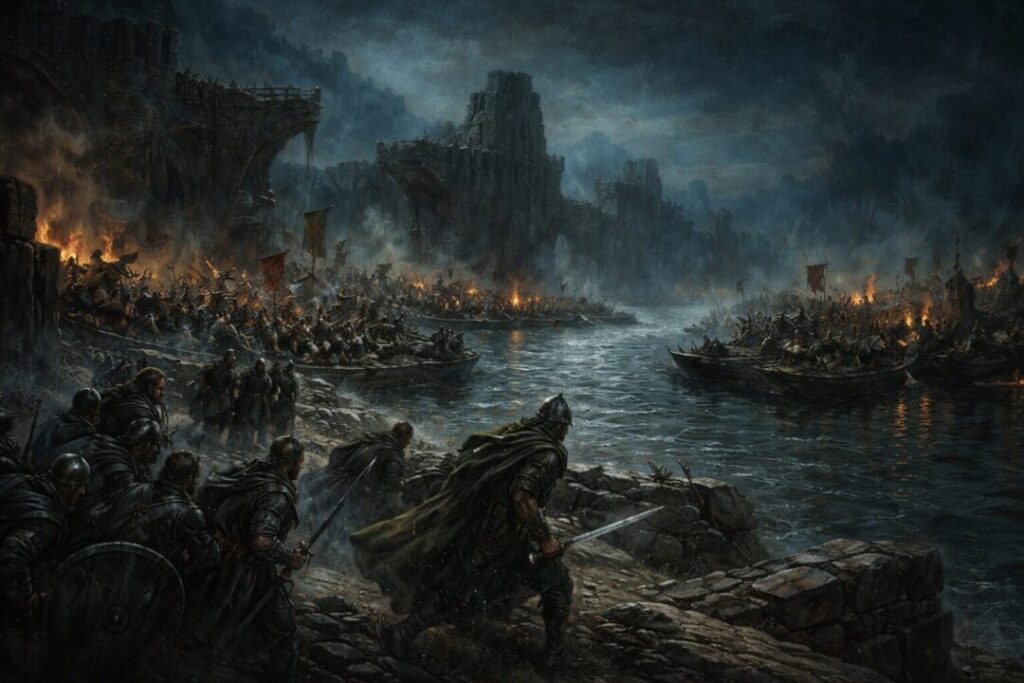
That is because Osgiliath sits on the Anduin at the most immediate eastern approach to Minas Tirith. The road west from Osgiliath runs along the Causeway to the Causeway Forts and then into the Pelennor. When Faramir defends Osgiliath, he is not defending prestige. He is defending the crossing and the road behind it.
This is why the enemy’s preparation matters so much.
The assault is not improvised. The attacking host crosses on floats and barges secretly built in advance on the eastern side of the river. That detail is easy to pass over, but it changes how the battle looks.
This is logistics.
The crossing had been prepared before the great assault began.
And once the crossing is forced, the defenders are compelled into a dangerous retreat back up the Causeway toward the Rammas Echor. The war is already moving inward by stages.
The Rammas Echor Protected More Than Pride
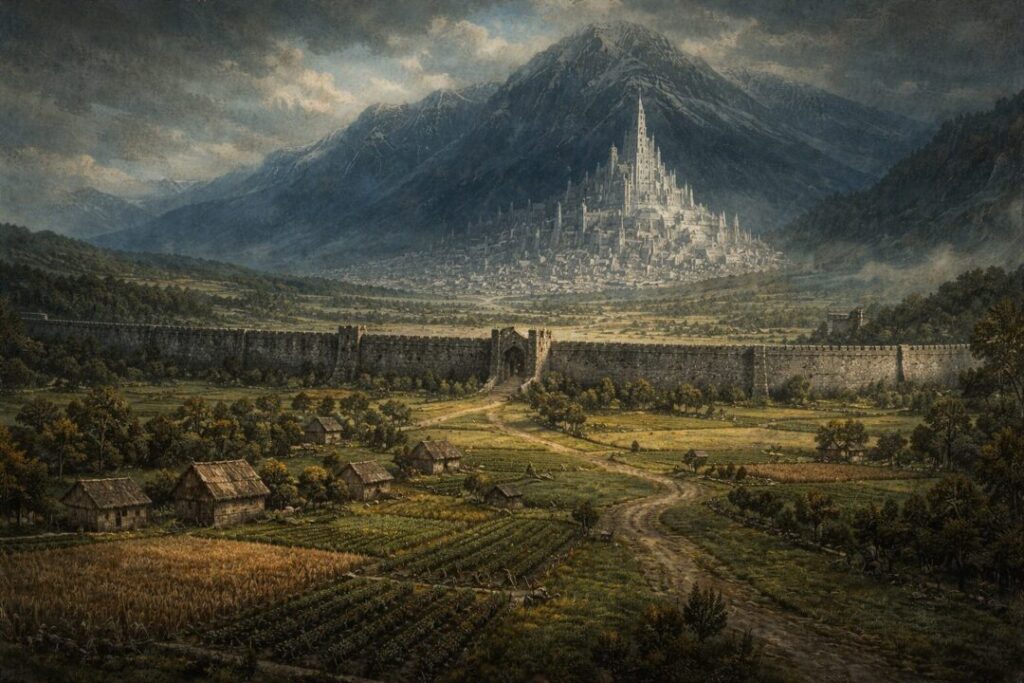
Minas Tirith is not simply a city standing alone on a rock.
It has outer lands.
The Rammas Echor surrounds the Pelennor Fields, and the text explicitly identifies those lands as farmlands and pastures. This is an important detail, because it means the outer defense is protecting not only open ground but the living townlands around the city.
That changes the emotional geometry of the siege.
When the outer wall is broken, the enemy is not merely one wall closer to the main gate. He is inside the defended lands of Minas Tirith itself.
The fields are overrun.
The retreat compresses.
The defenders lose depth.
So when readers imagine the siege as a direct collision between Mordor and the White City, the text is actually describing something more layered.
First the river defense is lost.
Then the Causeway Forts.
Then the Rammas.
Then the Pelennor.
The city is being isolated piece by piece.
Cair Andros Shows the Same Pattern
Cair Andros can seem like one of those place-names readers vaguely remember without dwelling on.
But it is one of the clearest clues that Gondor’s defense depends on controlling movement, not just surviving assaults.
Cair Andros was strategically important because it hindered enemy crossing of the Anduin into Anórien. That is exactly the kind of position a realm values when it knows a direct crossing could open the road into its western lands. Appendix A also notes that it was fortified again to defend Anórien.
That means Gondor’s long war with Mordor is not described as a matter of merely holding a capital.
It is a matter of keeping the enemy from passing key river barriers and entering the spaces from which relief, reinforcement, and maneuver remain possible.
In other words, the defense of Gondor is territorial in a practical sense.
Not every important victory looks like a famous battle.
Sometimes it looks like preventing a crossing.
Rohan’s War Matters for the Same Reason
The same logic appears west of Gondor.
Saruman does not strike Minas Tirith directly. He moves against Rohan.
And where does that pressure fall?
At the Fords of Isen.
That is not an accidental frontier skirmish. The Fords are the main western entrance into Rohan. If Rohan is weakened there, scattered there, or forced backward there, it becomes far harder for it to function as the ally Gondor needs.
This is one reason the wider war feels so coordinated.
Sauron threatens Gondor from the east.
Saruman cripples Rohan from the west.
Even without explicit statements of shared battle plans in every scene, the practical effect is obvious in the text: Gondor’s nearest great ally is under pressure at precisely the moment when Gondor will need mounted relief most desperately.
The war is being shaped not only by frontal attack, but by the narrowing of options. That is a logistical reality before it is a dramatic one.
The Rohirrim Nearly Do Not Arrive
That is why the ride of Rohan becomes even more remarkable when read closely.
The story does not present Théoden’s host as simply riding down an open highway to glory.
Quite the opposite.
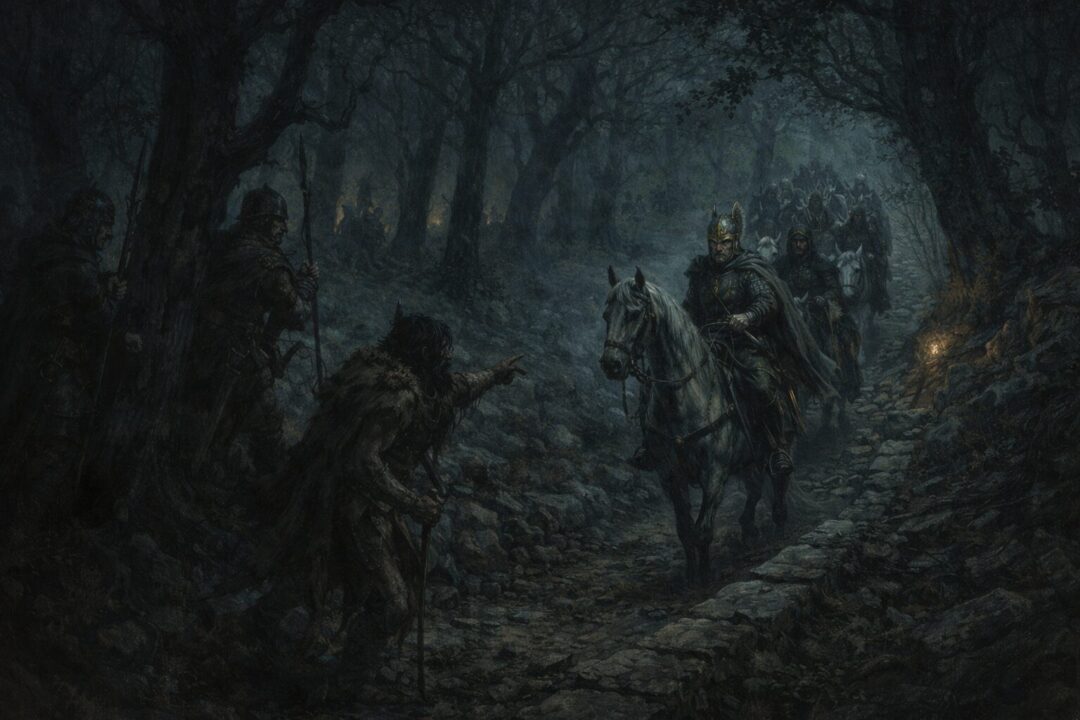
The enemy is watching the expected approaches. Ghân-buri-Ghân tells Théoden that Orcs are on the road, and then leads the Rohirrim by a forgotten road through the Stonewain Valley and the Drúadan Forest. The Rohirrim reach the Pelennor because they evade the enemy’s road control, not because the road was uncontested.
That detail matters enormously.
If the obvious road had remained their only path, their arrival would have been far more doubtful. The text does not say outright that they would certainly have failed to reach the battle otherwise, so it is safest to stop short of that claim.
But it does make one thing unmistakable:
Their successful arrival depends on finding a way around a watched route.
So one of the most celebrated heroic arrivals in the story is also a logistical escape.
The charge happens only because the approach was hidden.
The Corsairs Were Meant to Close the Net
Then there is the southern river.
Aragorn’s arrival at the Pelennor on the black ships is often remembered as a dramatic reversal, and it is.
But before it becomes a rescue, it is first a threat.
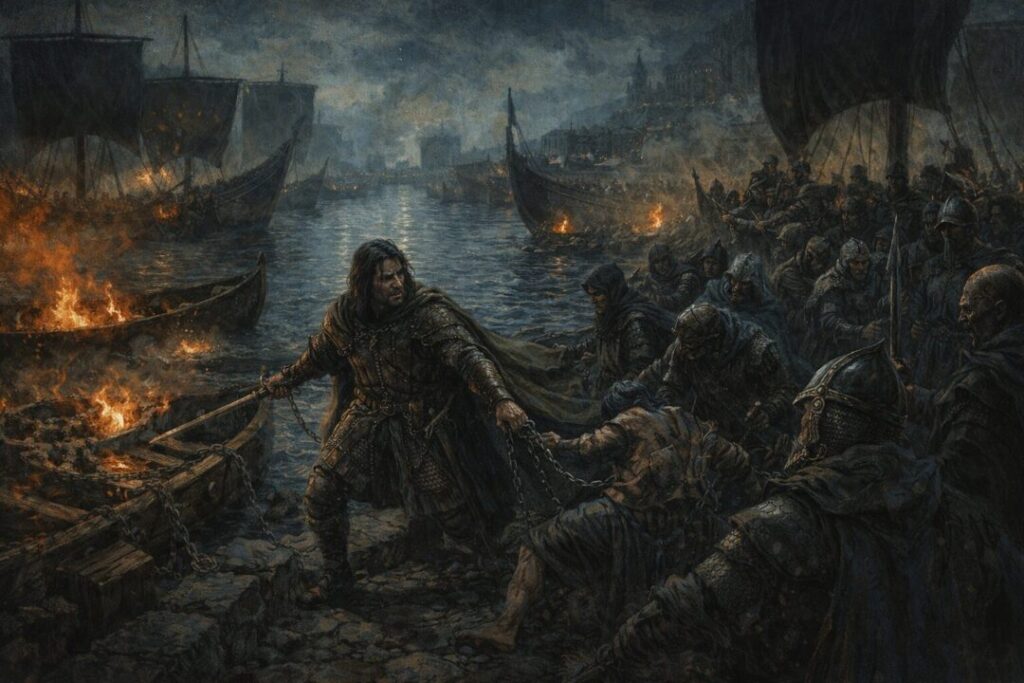
The Corsairs had taken Pelargir, and their fleet was ready to sail to Harlond. Harlond was the port and docks of Minas Tirith, lying south of the city near the outer defenses. That means the danger was not vague. It was immediate and directional. Help or attack could come upriver straight toward Minas Tirith’s southern access.
This is one of the clearest examples in the whole war of how movement matters more than spectacle.
The ships are not important because ships are visually impressive.
They are important because whoever controls them controls who appears where, and when.
Aragorn does not merely win a dramatic entrance. He seizes an enemy line of approach and turns it into relief.
That is a military reversal, not just a theatrical one.
The War Looks Different Once You Follow the Roads
Once all of this is put together, the campaign around Minas Tirith becomes sharper.
Sauron crosses at Osgiliath with prepared craft.
He drives the defenders back along the Causeway.
He breaks the Rammas and overruns the Pelennor.
He watches the roads by which Rohan would come.
His southern allies are positioned to sail to Harlond from Pelargir.
That is not random pressure.
It is encirclement by movement.
Or, more precisely, by the denial of movement to the other side.
And that helps explain why several of the war’s decisive turns feel so sudden in the narrative.
They are sudden because they break isolation.
The Rohirrim appear from an unexpected route.
Aragorn appears from a seized fleet.
The city is not saved by endurance alone, but by the reopening of lines that the enemy was trying to close.
Why This Matters
This does not make the War of the Ring less heroic.
It makes it more convincing.
Courage still matters.
Kings still matter.
Great deeds still matter.
But the story quietly insists that war is also made of roads, provisions, retreat paths, crossings, harbours, and timing.
That is one reason the campaign feels so real.
Not because the book lingers over wagons or inventories in modern military detail. It does not.
But because it repeatedly shows that even the greatest acts of valor can fail if no road remains open behind them.
And it shows the opposite as well.
Sometimes victory begins before the charge.
Sometimes it begins when one road remains unguarded, one crossing still holds, or one fleet changes hands at the last possible hour.
That is why supply lines matter more in the War of the Ring than many readers first realise.
The great battle is not only about who is strongest when swords finally meet.
It is about who can still arrive when the walls are already falling.