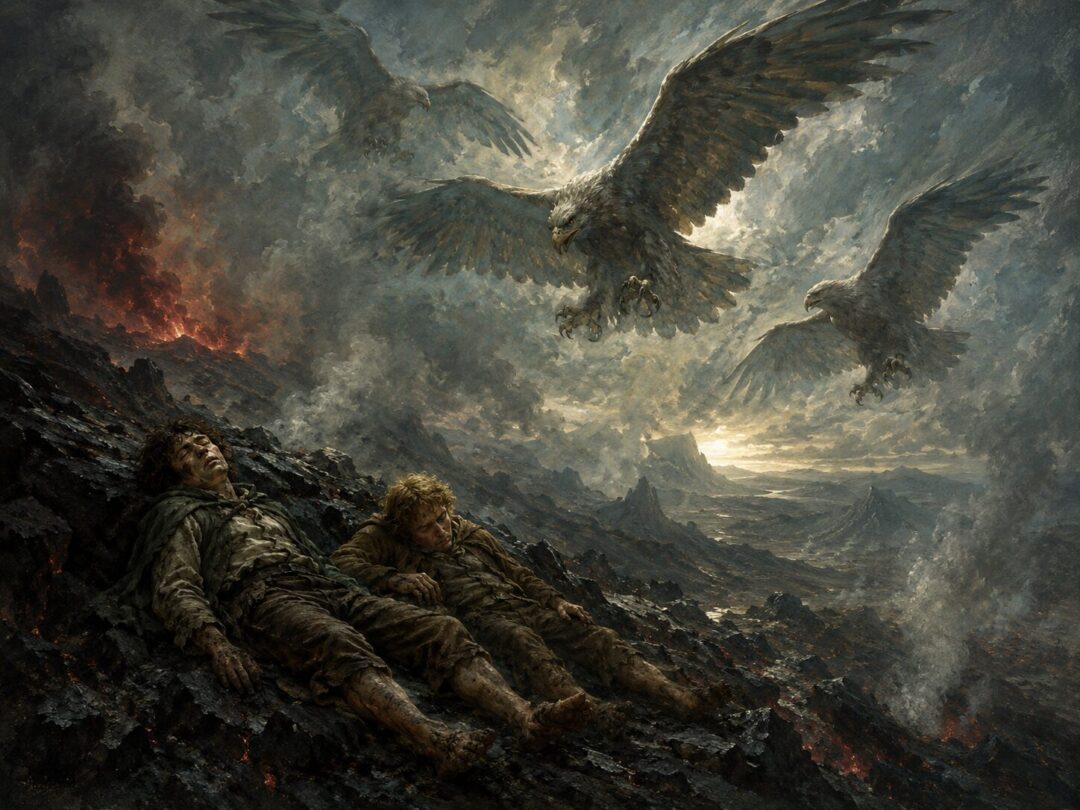
A Great Eagle over Middle-earth feels like the answer to every desperate question. Why cross mountains when wings can clear them? Why crawl through Mordor when the sky lies open? Why should Frodo and Sam almost die on the slopes of Orodruin if Gwaihir and his kind could lift them out afterward?
The contradiction is tempting because it is real. The Eagles do save people. They rescue Thorin’s company from the burning trees in The Hobbit. Gwaihir carries Gandalf away from Orthanc. Eagles arrive at the Battle of Five Armies and at the Black Gate. And after the Ring is destroyed, they bear Frodo and Sam from the ruin of Mount Doom. They are not decorative. They change outcomes.
But they never solve the central task.
That difference matters. In Tolkien’s world, the Eagles can rescue the body when hope has almost failed. They can intervene after courage, mercy, and sacrifice have carried the story to its breaking point. What they cannot do is replace the moral journey that the Ring demands.
The Eagles Are Helpers, Not an Air Force for Hire
The Great Eagles are not ordinary birds, but neither are they presented as obedient servants of the Free Peoples. They are ancient, intelligent, speaking beings associated with Manwë and the high powers of the West. Lore references summarize them as “Great Eagles,” sentient birds connected with Manwë, who appear at crucial moments against Morgoth and Sauron.
That already limits the “why not just use them?” argument. The Eagles are not horses, messengers, or military transports waiting for command. Their appearances are rare, dramatic, and selective. They may help the cause against the Shadow, but they are not under the authority of Elrond, Aragorn, Gandalf, or the Council.
The Hobbit makes this especially clear. When the Eagles save Bilbo, Gandalf, and the Dwarves from wolves and goblins, they do not simply deliver them to the Lonely Mountain. They carry them to safety, feed them, and set them down. They help, but they do not take ownership of the quest. Their aid is real, yet bounded.
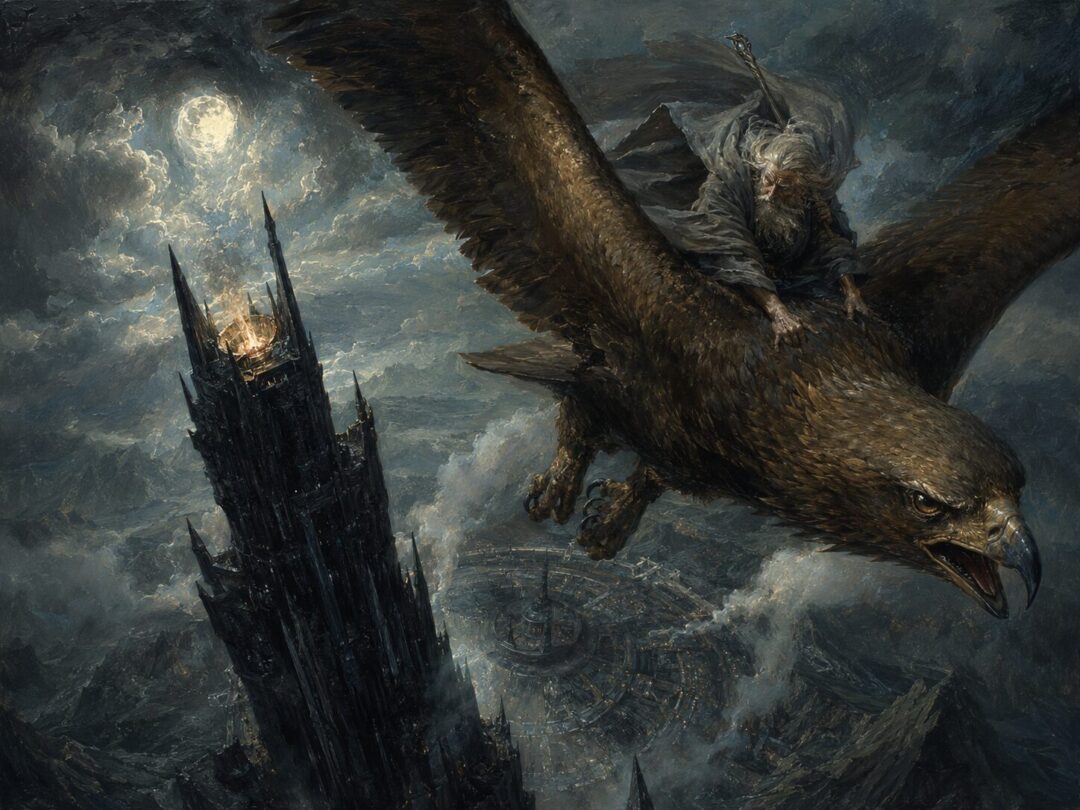
That pattern continues in The Lord of the Rings. Gwaihir carries Gandalf from Orthanc, but that rescue arises from a particular chain of events involving Radagast, Saruman’s deception, and Gandalf’s imprisonment. It is not proof that Gandalf can summon Eagles at will whenever the plot becomes inconvenient. Gwaihir later appears in the war, but again as an ally at a decisive hour, not as a standing transport service.
The Ring Quest Was Built on Secrecy
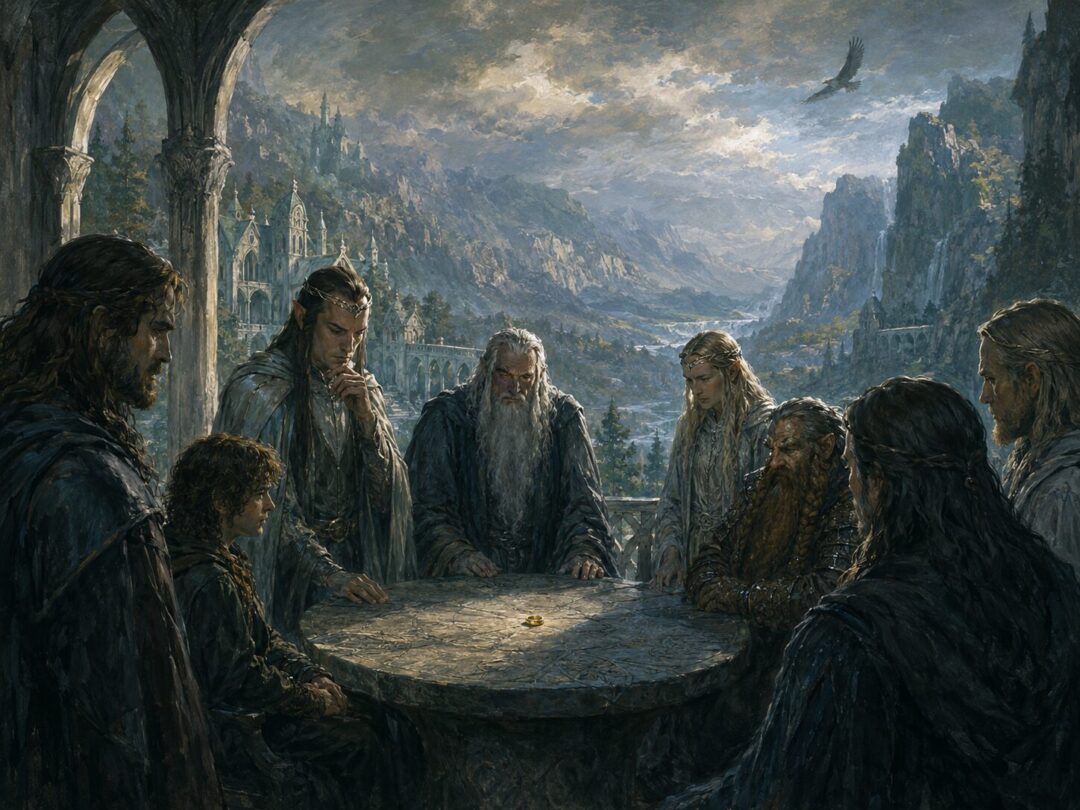
The simplest in-world reason the Eagles could not solve the Ring is that the Ring quest depended on secrecy. The Council of Elrond does not choose open force. It chooses something almost absurdly small: a hidden company, then eventually two hobbits, moving beneath the attention of powers far greater than themselves.
That is not a minor detail. It is the strategy.
Sauron expects strength to be used against him. He watches for armies, captains, heirs, wizards, weapons, and rival claims to power. The Ring’s destruction is possible precisely because Sauron does not imagine that anyone who possesses it would choose to destroy it. His blindness is moral before it is tactical: he understands domination, but not renunciation.
A flight of Great Eagles toward Mordor would announce that something extraordinary was happening. Even if the Eagles could fly high, even if they were swift, the act would turn secrecy into spectacle. The Black Land is not empty air. It is watched by Sauron’s will, guarded by fortresses, patrolled by servants, and defended by creatures of the air by the later stages of the war. The Nazgûl themselves eventually ride winged beasts.
This does not prove that every possible Eagle plan would fail in a mechanical, war-game sense. The books never give us a detailed aerial-defense manual for Mordor. But the narrative makes the governing principle clear: the Ring reaches Orodruin because it is carried in hiddenness, pity, endurance, and misdirection, not because the West finds a faster road.
The Eagles Could Not Bear the Moral Burden for Frodo
The deeper reason is not tactical. It is moral.
The Ring is not simply a dangerous object that must be moved from one location to another. It is a corrupting power that works through desire, fear, pity, pride, and the will to possess. The question is never only, “Can someone physically carry it?” The greater question is, “What happens to the bearer while carrying it?”
That is why the strongest people are often the most dangerous candidates. Gandalf refuses the Ring because he fears what he would become through the desire to do good by force. Galadriel faces the temptation of becoming a queen terrible and beautiful. Boromir falls not because he is stupid or evil, but because he sees the Ring as a weapon for saving his people.
An Eagle might be mighty enough to lift a hobbit, but the story gives no basis for assuming an Eagle would be immune to the Ring. Tolkien never explicitly states what would happen if one of the Great Eagles bore the Ring or knowingly carried its bearer directly to Mount Doom. Therefore the careful answer is not “the Eagles would certainly become corrupted.” It is: the texts give us no safe reason to treat them as exempt from the Ring’s danger.
And if the Ring’s corruption works by magnifying power and desire, then giving the quest to a mighty being would be spiritually perilous. The Ring is most bearable in the hands of someone small, reluctant, and without a grand design of mastery. That does not make Frodo immune. He fails at the very end. But his humility, endurance, and mercy bring the Ring to the one place where its own evil can turn against itself.
The Eagles can carry bodies. They cannot carry that moral burden for him.
Rescue Comes After the Choice, Not Before It
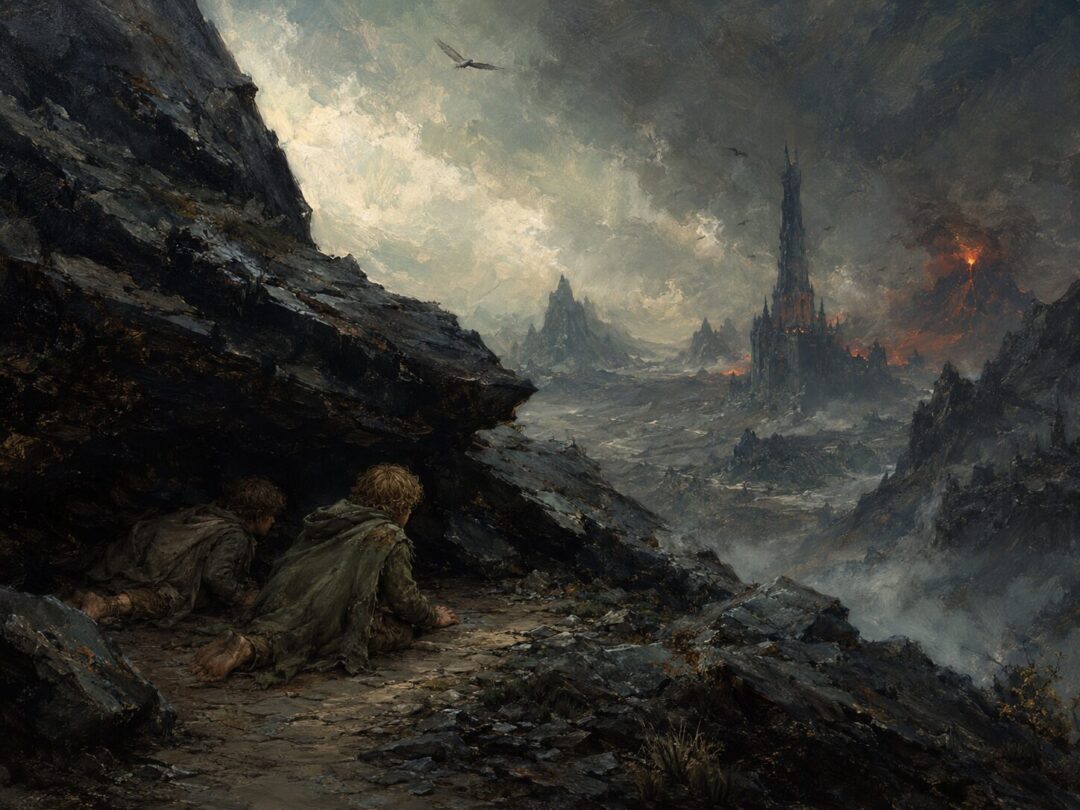
The most important Eagle rescue in The Lord of the Rings happens after the Ring is destroyed. Frodo and Sam do not ride triumphantly into Mordor on the backs of heavenly allies. They crawl through ash, thirst, fear, exhaustion, and despair. They reach the Fire by endurance and by a chain of mercies that began long before: Bilbo sparing Gollum, Frodo sparing Gollum, Sam restraining himself when hatred would have been easy.
Only after the Ring is gone do the Eagles arrive.
That timing is everything. If the Eagles had delivered Frodo to the Fire, they would have replaced the heart of the story. But when they rescue Frodo and Sam afterward, they do something different. They do not cancel the quest. They witness its cost. They do not make the burden unnecessary. They prevent the bearers from being swallowed by the ruin after the burden has done its work.
Gwaihir, often called the Windlord, is associated in lore summaries with the rescue of Frodo and Sam from the rocks of Mount Doom after the destruction of the One Ring. The order is essential: destruction first, rescue second.
That is why the Eagle rescue feels like grace rather than a shortcut. It comes when Frodo and Sam have nothing left to spend. They have not preserved themselves by clever planning. They have spent themselves completely. The Eagles save what remains.
The Shadow Could Not Be Defeated by Skipping the Weak Road
The Ring’s destruction depends on weakness in a way Sauron cannot understand. The final victory is not achieved by the strongest hand taking the shortest route. It comes through hobbits, pity, accidents that are not merely accidents, and the failure of possessive will at the edge of the Fire.
Frodo does not cast the Ring away. At the final moment, he claims it. That is one of the most sobering truths in the book. The quest succeeds not because Frodo is morally flawless, but because earlier acts of mercy have allowed Gollum to remain within the story. Gollum’s last seizure of the Ring destroys both himself and it.
No Eagle could replace that web of consequences. A flying approach to Mount Doom imagines the problem as distance. The book reveals the problem as desire.
This is why the “Eagles solution” misunderstands the Ring. It treats Middle-earth like a map puzzle: find the fastest line from Rivendell to Orodruin. But the Ring is not conquered by speed. It is unmade through renunciation, secrecy, mercy, and the strange providence that works through choices no strategist would design.
Tolkien Knew the Eagles Were Dangerous to the Story
There is also a literary reason, and it supports the lore rather than contradicting it. In a letter criticizing a proposed adaptation, Tolkien described the Eagles as a dangerous “machine” that must be used sparingly, warning that overusing them would damage credibility and weaken their later appearance.
Literature Stack Exchange
That comment matters because it shows a clear awareness of the problem. The Eagles are powerful enough that careless use would break the story’s logic. If they become available whenever needed, danger evaporates. Mountains, prisons, battlefields, and distances lose weight. Gandalf’s imprisonment at Orthanc would feel less serious. The long road would feel artificial.
But this is not merely an author trying to hide a plot hole. The sparing use of the Eagles fits the world itself. They appear at moments of deliverance, not convenience. They are instruments of rescue, warning, battle, and grace — not tools for bypassing the moral architecture of the tale.
The Eagles Belong to Eucatastrophe, Not Efficiency
The Eagles often arrive when ordinary hope has ended. In The Hobbit, they appear above burning trees and wolves. At the Battle of Five Armies, their coming changes the battlefield when the Free Peoples are hard-pressed. In The Lord of the Rings, they come to the Black Gate after the Captains of the West have gambled everything on a hopeless distraction. Then they fly into Mordor after the Ring has been destroyed.
This pattern is not efficiency. It is eucatastrophe: sudden deliverance at the edge of defeat. The Eagles do not remove peril from the tale. They arrive only after peril has revealed the character of those trapped inside it.
That is why they can save bodies but not solve the Ring. Bodies can be lifted from a tower, a battlefield, or a burning mountain. The Ring’s corruption must be endured from within. It must expose the bearer, tempt the powerful, humble the proud, and reveal the meaning of pity.
The Eagles are magnificent because they do not make the road unnecessary. They descend when the road has done its terrible work.
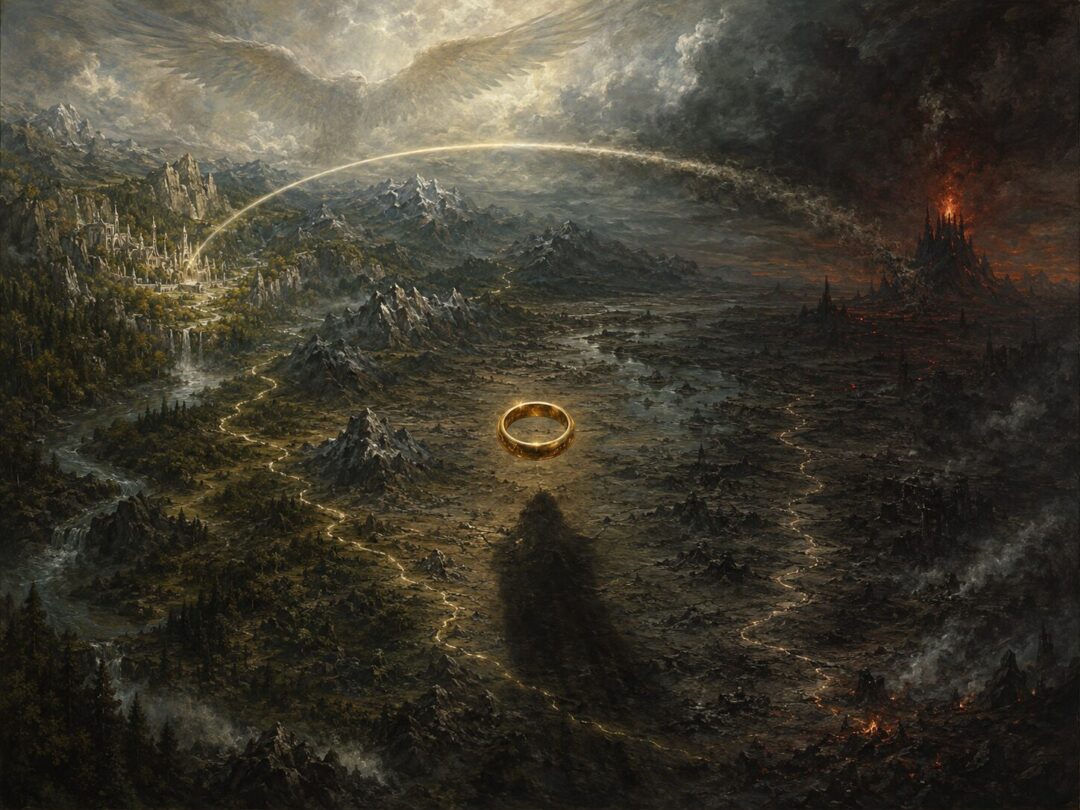
The Sky Was Never the True Road to Mount Doom
The real road to Mount Doom was not the straightest route through the air. It was the hidden path through fear, hunger, mercy, failure, and endurance. It passed through the Shire’s innocence, Rivendell’s wisdom, Moria’s darkness, Lórien’s testing, Boromir’s fall, Gollum’s return, Sam’s loyalty, and Frodo’s breaking point.
An Eagle could cross leagues. It could lift a hobbit from death. It could bear a wizard from imprisonment. But the Ring was never defeated by movement alone.
That is the overlooked truth behind the old question. The Eagles could save Frodo and Sam after the world had changed. They could not change the world for them.
Middle-earth is full of mighty wings, ancient powers, and sudden rescues. Yet the fate of the Third Age turns on something smaller: a burden carried by tired feet, a mercy once given to a miserable creature, and a final failure transformed into deliverance.
The Eagles could descend into the story. They could not replace the story.
Sources & Notes
- Wikipedia overview of the Eagles in Tolkien’s Middle-earth — https://en.wikipedia.org/wiki/Eagle_(Middle-earth%29
- Wikipedia overview of the One Ring and why carrying it is not a simple transport problem — https://en.wikipedia.org/wiki/One_Ring
- Wikipedia overview of Gandalf, who is repeatedly connected with the Eagles’ interventions — https://en.wikipedia.org/wiki/Gandalf
Sources selected for Tolkien-lore context and reader verification.