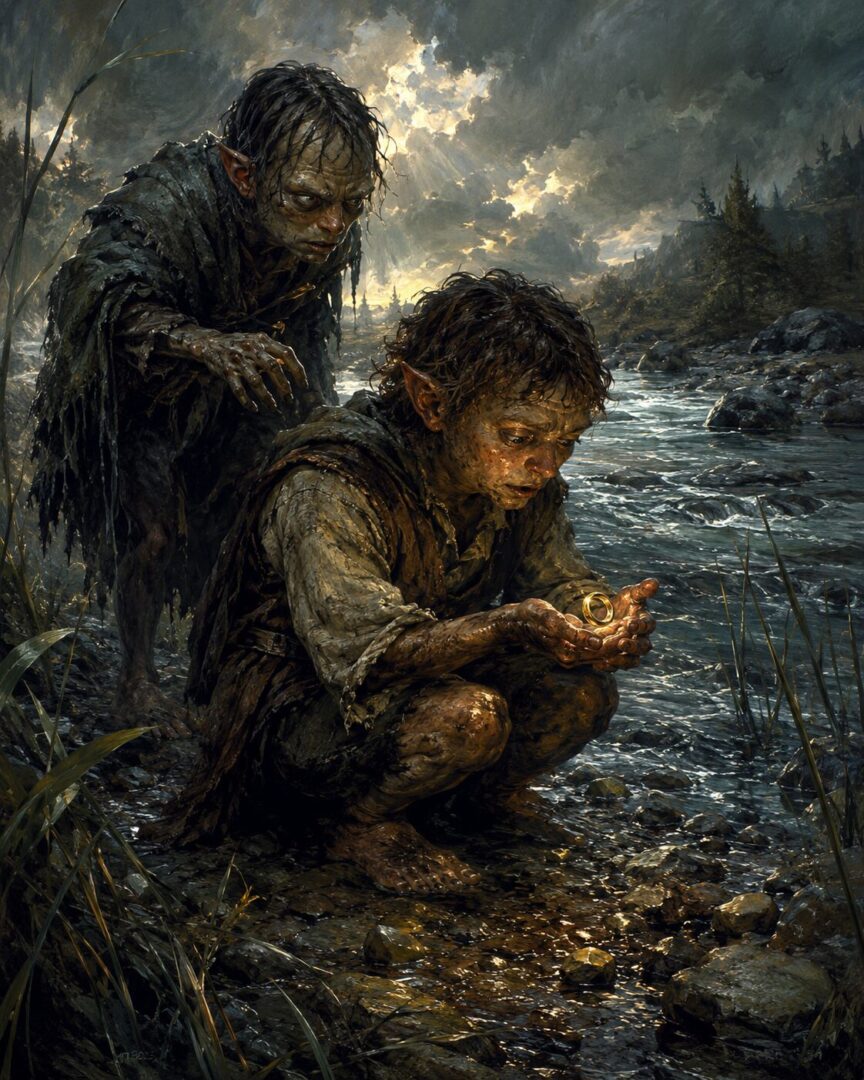
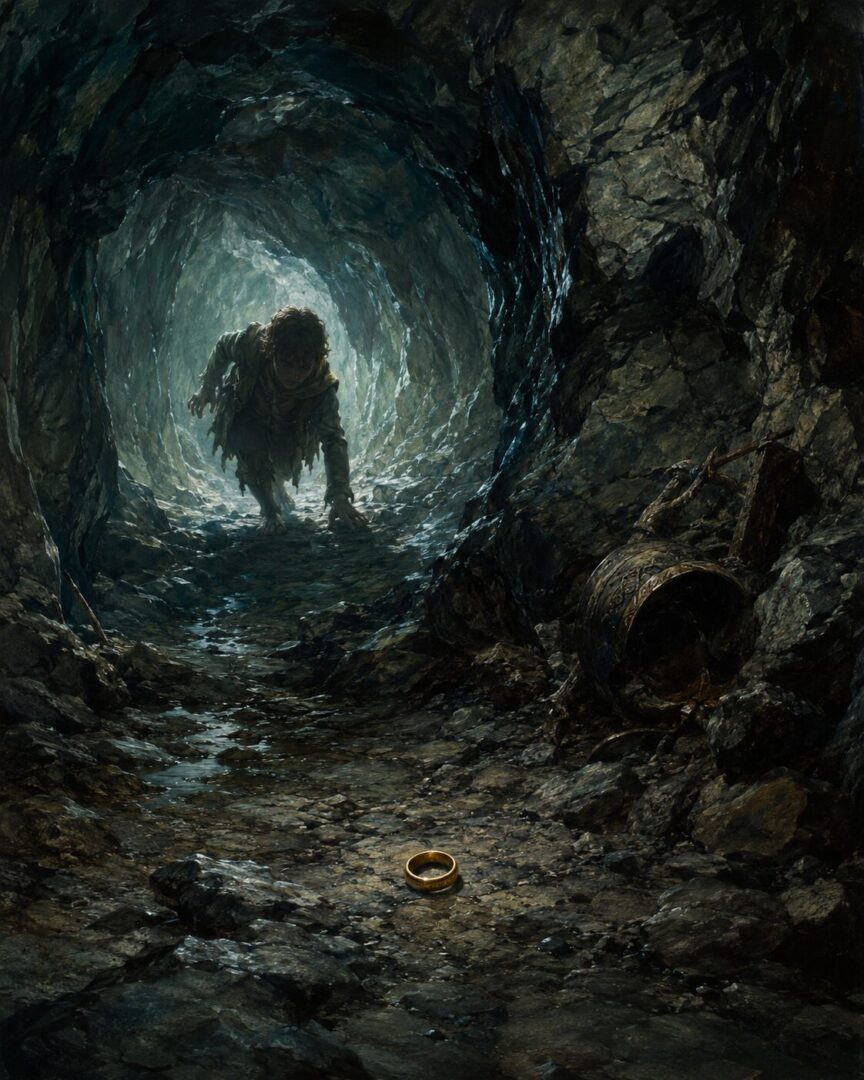
Bilbo Baggins did not find the Ring in a treasure chamber, under dragon-gold, or in some kingly ruin where great things usually wait to be discovered. He found it in the dark, by accident, with his hand on the floor of a goblin tunnel.
That is the first strange thing.
The second is darker: the Ring had already spent nearly five hundred years with another hobbit-kind creature before Bilbo touched it. Sméagol, later called Gollum, was not a lord, sorcerer, warrior, or king. He was small, secretive, hungry, resentful, and soon murderous. On the surface, he seems like an absurd bearer for Sauron’s Ruling Ring. Yet Gandalf’s account in “The Shadow of the Past” makes the matter more disturbing. The Ring did not merely pass from hand to hand. It acted according to its own corrupt purpose, trying to return to its master. Gandalf says it “left” Gollum when it could make no further use of him, and that Bilbo’s arrival at that exact moment was “the strangest event” in the Ring’s history. Matt Civico
So why did the Ring take Gollum before Bilbo?
The answer is not that the Ring saw Gollum as a champion. It saw him, if we may use that word carefully, as something even more useful for a time: a hiding-place with hands.

The Ring Did Not Choose Like a Person
The first mistake is to imagine the Ring choosing as a wise mind chooses. The Ring is not a little Sauron with a complete plan. It carries Sauron’s power and will, but the texts present its agency in flashes: it slips, betrays, tempts, tightens its hold, and seeks its master. It does not calmly arrange every event.
This matters because Gollum’s possession of the Ring begins in a scene of chance and corruption, not a formal selection. Déagol finds the Ring in the Anduin. Sméagol sees it, desires it, demands it as a birthday present, and murders Déagol for it. Gandalf’s summary is severe: when a chance came, the Ring “caught” Déagol; after that came Gollum, whom it “devoured.” Matt Civico
That is the Ring’s first “choice” of Gollum: not a coronation, but a trap. It enters a heart already capable of possessive violence. Sméagol’s first act as Ring-bearer is not heroic resistance, curiosity, or reluctant stewardship. It is murder.
The Ring did not need to invent his darkness from nothing. It amplified what was already there.
Why Gollum Was Useful
Gollum was useful because he was small enough to hide and corrupted enough to keep hiding.
A great lord might have tried to use the Ring openly. A powerful warrior might have drawn attention. A ruler might have become a beacon of ambition. Sméagol did something more pathetic and, for centuries, more effective: he withdrew. Cast out by his people, he crept beneath the Misty Mountains and remained there, guarding the Ring in darkness. Reputable lore summaries agree with the primary narrative: Gollum kept the Ring hidden below the mountains for nearly five hundred years before losing it in T.A. 2941.
This does not mean the Ring wanted to be buried forever. Quite the opposite. But during the long years when Sauron was not yet fully declared again, Gollum’s cave became a grotesque kind of vault. He was not noble enough to surrender it, brave enough to destroy it, or socially connected enough to reveal it. His obsession made him a jailer who thought himself an owner.
That is the tragic irony: Gollum’s weakness preserved the Ring.
He hunted with it. He used its invisibility for small, furtive acts. But he did not bring it to kingdoms, councils, armies, or the Wise. The Ring’s great purpose was delayed, yet it remained safe from many of the powers that might have understood it. In Gollum, the Ring found a bearer too broken to become dangerous to Sauron and too possessive to let anyone else touch it.

Gollum Was Not Strong Enough to Serve the Ring’s Final Need
Gollum could preserve the Ring, but he could not deliver it.
That is the turn. When Sauron’s power began to stir again, the Ring’s needs changed. Secrecy under the mountains was no longer enough. It needed movement. It needed the world. It needed, in Gandalf’s words, to get back to its master. But Gollum would not leave his deep pool while the Ring remained with him. Gandalf says the Ring could make no further use of him because he was “too small and mean.” Matt Civico
This is one of the clearest windows into how the Ring’s malice works. It consumes a bearer until that bearer becomes less useful. Gollum is not strengthened into a servant fit for Mordor. He is reduced. The Ring stretches his life, hollows his identity, and leaves him incapable of any large action except craving.
So it abandons him.
In the simple surface story of The Hobbit, Bilbo finds a ring that Gollum has lost. In the deeper account later given in The Lord of the Rings, the loss is more than accident. The Ring leaves Gollum because the long hiding is over. It slips from him in the goblin tunnels, where another hand may find it. Encyclopedia of Arda summarizes the event plainly: during one of Gollum’s hunts, the Ring slipped from his finger and lay waiting in the tunnels until Bilbo came upon it.
Encyclopedia of Arda
But the hand that found it was exactly the wrong one for the Ring.
Why Bilbo Was the Ring’s Failure
If the Ring wanted to return to Sauron, an Orc would have been better than Bilbo. Frodo says almost this to Gandalf. An Orc in the Misty Mountains might have carried the Ring into the networks of the Enemy far more naturally than a hobbit from the Shire.
Instead, Bilbo finds it blindly in the dark.
This is why Gandalf insists that “more than one power” was at work. The Ring was trying to move toward its maker, but Bilbo’s finding of it belonged to something beyond the Ring-maker’s design. Gandalf can only phrase it as meaning: Bilbo was meant to find the Ring, and not by Sauron. Matt Civico
That sentence is the hinge of the whole matter. The Ring may have chosen to leave Gollum, but it did not choose Bilbo in the same sense. Bilbo was not the Ring’s preferred bearer. He was the interruption of its plan.
Gollum was taken by possessiveness. Bilbo was tested by pity.
That difference changes everything.
The Mercy the Ring Could Not Understand
The greatest contrast between Gollum and Bilbo is not courage, intelligence, or luck. It is mercy.
Sméagol sees the Ring and kills Déagol. Bilbo sees Gollum vulnerable and does not kill him. This is not sentimental softness. Bilbo is lost, afraid, pursued, and wearing a magic ring that gives him a clear advantage. Killing Gollum might seem practical. Instead, pity restrains him.
The Ring’s logic cannot account for that. It works through domination, fear, hunger, and possessive desire. It can turn “mine” into a whole personality. It can make the small-minded smaller and the powerful more dangerous. But mercy is not part of its grammar.
That is why Bilbo is so dangerous to the Ring. Not because he is mighty, but because he can possess it without immediately becoming only possession. He lies about it at first, and the Ring affects him; the text never presents Bilbo as untouched. Yet compared with Gollum, his response is astonishingly resistant. He keeps enough of himself to spare Gollum, return home, and eventually give the Ring up with Gandalf’s help.
Gollum’s first Ring-act is murder. Bilbo’s defining Ring-act is pity.
The future of Middle-earth turns on the difference.
Gollum Was a Warning Before He Became Necessary
Gollum is not merely the Ring’s former owner. He is Bilbo’s shadow and Frodo’s possible future.
Both Bilbo and Frodo are hobbits. Gollum himself came from a hobbit-like people, the Stoors. That kinship matters. Gollum shows what the Ring can do even to the small and unlordly. It does not need a throne to destroy someone. It can turn a riverbank creature into a cave-thing, a name into a noise, a person into an appetite.
When Frodo later encounters Gollum, he sees more than an enemy. He sees a warning. The pity Bilbo showed is extended by Frodo because he understands that Gollum’s ruin is not wholly alien to him. Ring-bearers recognize one another in ways others cannot.
And yet Gollum is not only a warning. He becomes necessary.
The Ring once used him as a hiding-place. Later, through a chain of mercy and misery, Gollum becomes the creature whose final seizure of the Ring leads to its destruction. This does not make his evil good. It means the story refuses to waste even a ruined life. The Ring’s old victim becomes the crack in the Ring’s victory.

The Ring Chose a Prison and Providence Chose a Thief
So did the Ring choose Gollum before Bilbo?
In the strictest lore-grounded sense, Tolkien’s text does not describe the Ring calmly selecting Gollum from among candidates. It says the Ring caught Déagol, devoured Gollum, and later abandoned him when he was no longer useful. “Chose” is best understood as a shorthand for the Ring’s corrupt opportunism.
Gollum suited the Ring’s hidden years because he was possessive, secret, isolated, and incapable of surrender. He kept it safe from history by falling out of history himself. But when the Enemy stirred again, Gollum became a dead end. The Ring needed escape from the dark, and so it left him.
Bilbo was the shock. Bilbo was not the bearer the Ring wanted. He was the bearer the Ring received when another design bent chance against Sauron. He carried the Ring out of the mountains, but not toward Mordor. He used it, but did not become Gollum. Most importantly, he spared the very creature the Ring had ruined.
That is the hidden answer beneath the riddle.
The Ring chose Gollum because corruption could use him. Bilbo found the Ring because mercy had a deeper use still.
Sources & Notes
- Wikipedia overview of Gollum and his possession of the Ring — https://en.wikipedia.org/wiki/Gollum
- Wikipedia overview of Bilbo Baggins and the finding of the Ring — https://en.wikipedia.org/wiki/Bilbo_Baggins
- Wikipedia overview of the One Ring and its corrupting, will-like narrative role — https://en.wikipedia.org/wiki/One_Ring
Sources selected for Tolkien-lore context and reader verification.