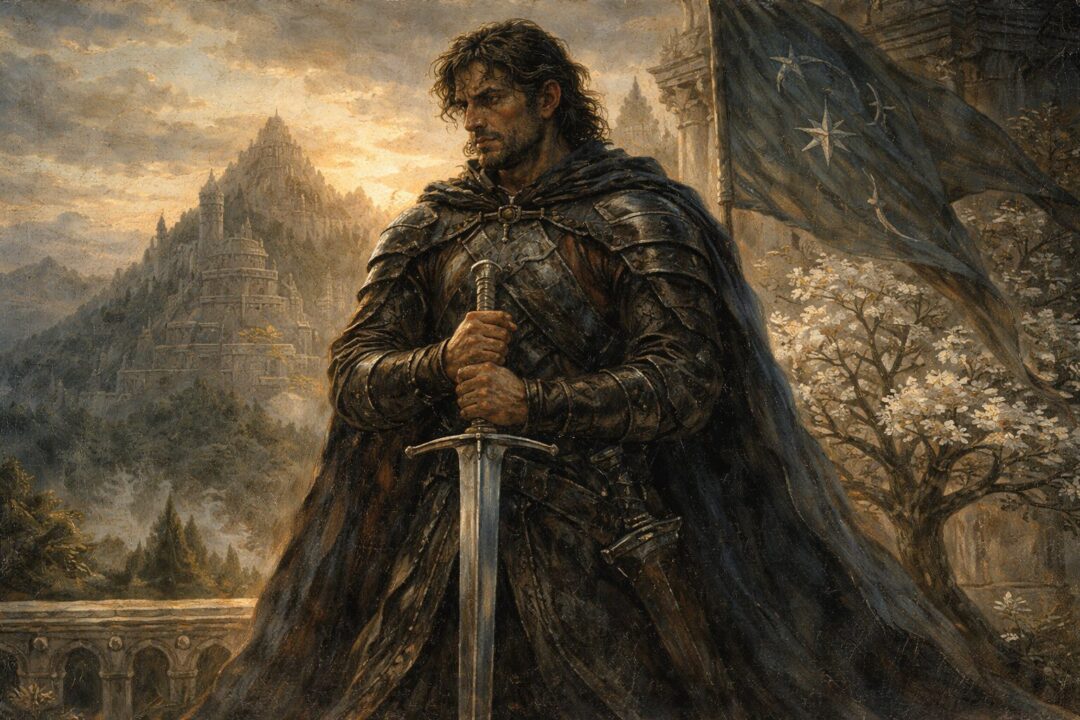
At first glance, the contrast seems obvious.
Aragorn is treated by the Elves with deep esteem. Elrond raises him. Arwen loves him. Elrond’s sons ride beside him. He moves through Rivendell and Lórien not as a stranger to Elven memory, but as someone already measured and, in a profound sense, approved.
Isildur, by contrast, is overshadowed by one choice.
He cut the Ring from Sauron’s hand.
He kept it.
And from that moment onward, his name became inseparable from failure.
That contrast is real. But it is often simplified too much.
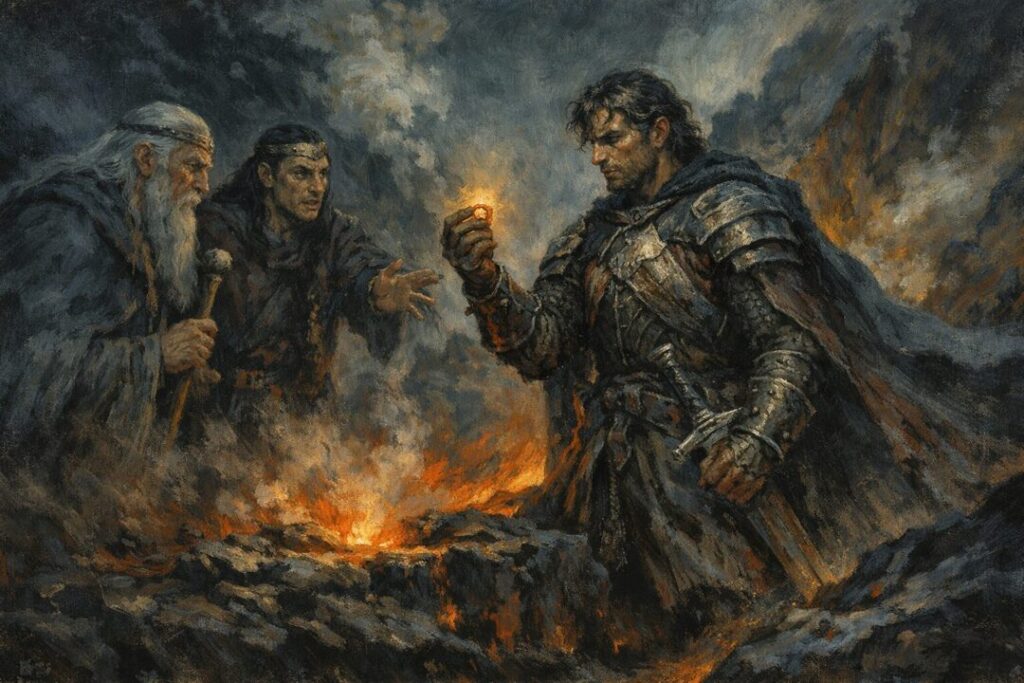
The texts do not present Isildur as a contemptible or cowardly figure. Nor do they suggest that the Elves admired Aragorn merely because he happened to come later and win. The real difference lies somewhere deeper: in what each man did when power and inheritance met in the same hand. Elrond recounts that Isildur would not surrender the Ring when urged to cast it into Orodruin, while Aragorn’s later life is marked by restraint, patience, and an unwillingness to seize power before its rightful time.
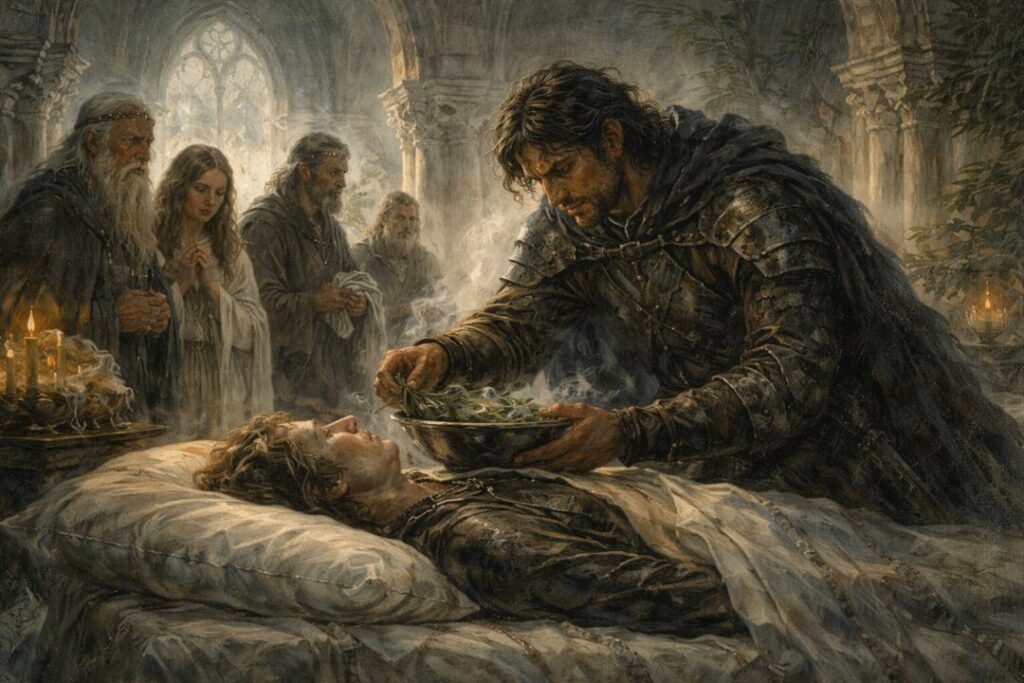
Isildur Was Not Small in Elven Eyes
One of the biggest mistakes in discussing Isildur is to begin with his fall and forget his stature.
Isildur was one of the great Númenórean princes. He survived the Downfall. In earlier history, he also risked much to preserve the line of Nimloth, the White Tree of Númenor, an act that already tied him to memory, continuity, and resistance against corruption. By the end of the Second Age, he stood with Elendil and Gil-galad in the Last Alliance against Sauron.
That matters.
The Elves did not look at Isildur and see a petty or unimpressive man. They saw a man of high lineage, courage, and consequence. Even at the Council of Elrond, the memory of him is tragic rather than mocking. Elrond’s complaint is not that Isildur lacked valor. It is that when the Ring was in his grasp, he would not release it.
That distinction is important because it changes the emotional shape of the question.
If Isildur had been ordinary, his failure would be sad but unsurprising.
Instead, he was great enough that his failure became historical.
The Ring did not expose a weak nobody. It bent a man who had every appearance of strength.
What the Elves Actually Saw in Isildur’s Failure
When Elrond tells the story, the decisive moment is not military, but moral.
Sauron has been overthrown. The immediate war is won. Isildur has every reason to think of loss, justice, and inheritance. His father Elendil is dead. His brother Anárion is dead. In that setting, he claims the Ring as weregild for his father and brother.
That is not the language of a craven man.
It is the language of grief, pride, and possession.
And that is exactly why the moment is so revealing.
The Elves, especially Elrond and Círdan, understand that some things cannot be safely claimed, even under the appearance of justice. Isildur does not merely fail to destroy an enemy’s tool. He interprets it as something he has a right to keep. That is the beginning of the break. Elrond explicitly says that Isildur would not heed their counsel and took the Ring “to treasure it,” and Isildur’s own scroll later calls it “precious,” already showing how quickly possession had become attachment.
That is the kind of failure the Elves would remember.
Not a failure of battlefield courage.
A failure of inner freedom.
And in Middle-earth, that is often the more serious test.
Isildur Was Not Simply Condemned
Even here, however, the picture remains more complex than people often assume.
Later texts make Isildur more tragic, not less. In the account of the Disaster of the Gladden Fields preserved in Unfinished Tales, he comes to understand something of his own insufficiency. He admits that he cannot master the Ring, that he dreads even touching it, and that it “should go to the Keepers of the Three.” In other words, he is not frozen forever in blind arrogance. He begins, too late, to perceive the truth.
That softens the judgment.
It suggests that Isildur’s weakness was real, but not simple. He was not a villain who desired domination in the full, conscious manner of Sauron. He was a great man who took into his hand something greater and darker than he understood, and by the time he knew more clearly, he was already entangled.
This is why it is safest to say that the Elves judged Isildur’s failure, not that they dismissed his entire person.
His memory becomes a warning.
But it also remains noble enough that Aragorn can proudly inherit from him.
Why Aragorn Earned a Different Kind of Esteem
Now the contrast begins to sharpen.
Aragorn is not respected by the Elves simply because he is pleasant, brave, or royal. He is respected because he stands inside the same long inheritance and does not repeat its oldest error.
That starts early.
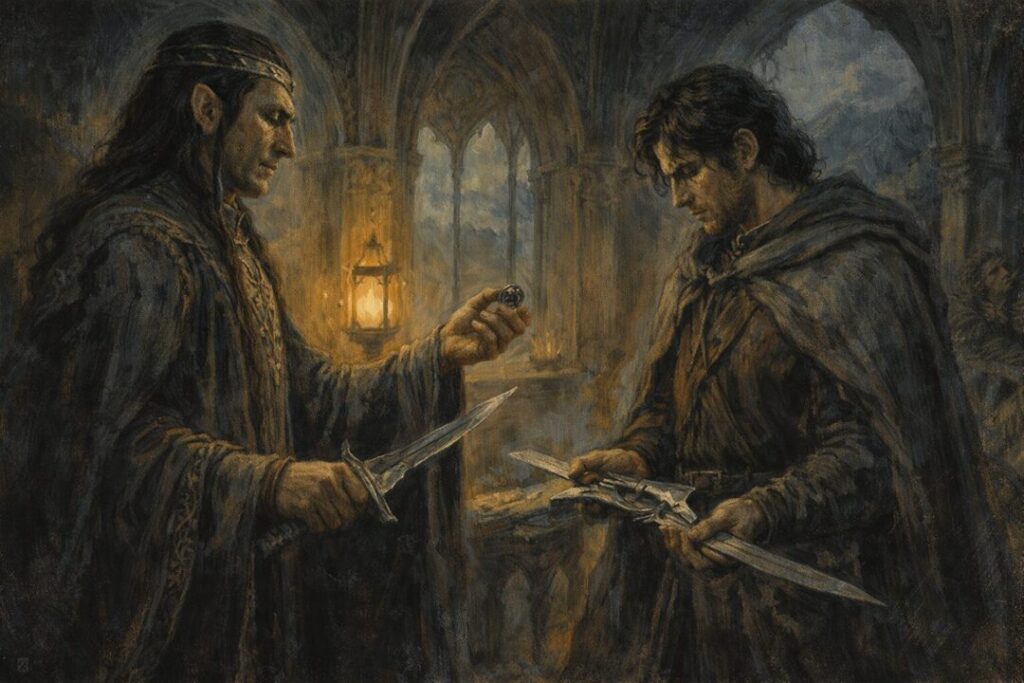
After Arathorn’s death, Elrond takes Aragorn into his house and raises him under the name Estel. This is not a minor courtesy. It is an act of trust and intimate guardianship. Elrond later gives him the heirlooms of his house and sets before him a standard: he must become king of both Arnor and Gondor if he is to wed Arwen. Aragorn is not told to seize his destiny quickly. He is required to grow into it.
That pattern matters.
Unlike Isildur at Orodruin, Aragorn does not equate inheritance with immediate possession.
He waits.
He labors.
He serves in other lands under other names.
He learns rule before he claims it.
From an Elvish perspective, that patience is not weakness. It is one of the clearest signs of maturity.
Aragorn and the Refusal to Grasp
The most important difference between Aragorn and Isildur is not that Aragorn never faces temptation.
It is that he does.
He lives close to the Ring-bearer.
He is the heir of the man who first claimed the Ring after Sauron’s fall.
He has every political reason to desire power strong enough to reunite the kingdoms of Men.
And yet the story consistently presents him as someone who does not grasp at unlawful mastery.
He accepts the burden of leadership, but not domination.
He claims kingship, but only when the hour is right.
He reveals himself openly to Sauron through the palantír, but this is an act of will and strategy, not an attempt to replace Sauron by using the Ring against him. The text tradition surrounding the Orthanc-stone emphasizes that Aragorn had the strength to wrest control of the stone from Sauron’s influence, which sharply contrasts with a lineage so often associated with being overcome by inherited burdens.
That kind of self-command would matter enormously to the Elves.
Because what Isildur lacked at the crucial moment was not royal blood, boldness, or legitimacy.
It was precisely that command over the self when power could be justified as a right.
The Elves Saw More Than a King Returning
There is also a more personal reason Aragorn is received with honor by the Elves.
He is not merely descended from Isildur. He is deeply woven into Elven history and household life. Elrond loves him as a foster-son. Arwen’s bond with him is not incidental. Elladan and Elrohir repeatedly ride with the Dúnedain and finally join him in the War of the Ring. Elrond sends counsel to Aragorn at decisive moments, including the road through the Paths of the Dead.
This means Aragorn is not being judged from a distance.
The Elves know him.
They have watched him over years, not a single hour.
They have seen not just what blood he bears, but what kind of man he has become.
That matters because Elvish respect in these stories is rarely casual. It is usually tied to tested character, memory, and long observation.
Aragorn does not receive esteem because he wears a famous name well.
He receives it because he has been proved.
He Becomes What the House of Isildur Was Meant to Be
One of the most revealing signs comes not from lineage, but from healing.
In Minas Tirith, old lore says that “the hands of the king are the hands of a healer.” Aragorn fulfills that sign in the Houses of Healing, and through it many recognize him as the rightful king. This is crucial because it shows the kind of kingship he embodies. He is not authenticated by conquest alone, but by restoration.
That is the deepest contrast with Isildur.
Isildur, in the defining memory attached to him, takes.
Aragorn, in one of the defining signs attached to him, heals.
Of course this is not the whole of either man. Isildur also preserved, fought, and ruled. Aragorn also wages war and claims a throne. But the symbolic center of their remembered stories is different.
With Isildur, the wound in the line remains visible.
With Aragorn, the line is finally mended.
That, more than simple success, explains why the Elves honor him so readily.
So Did the Elves Think Isildur Was Weak?
In the strictest sense, the answer should be phrased carefully.
The texts do not show the Elves going around reducing Isildur to a weak man.
They do, however, preserve a memory of moral failure at the decisive point where the Ring was concerned.
So the truest answer is this:
The Elves respected Isildur’s greatness, but they remembered that he proved vulnerable where greatness alone was not enough.
They respected Aragorn because he inherited the same claim, the same blood, and the same ancient danger — and showed a different kind of strength.
Not the strength to win a war only.
Not the strength to take what was his.
But the strength not to seize too soon, not to grasp at mastery, and not to confuse right with possession.
That is why Aragorn is more than Isildur’s heir in Elven eyes.
He is the answer to the fear that Isildur left behind.
Sources & Notes
- J.R.R. Tolkien, The Lord of the Rings, Book II, Chapter 2, “The Council of Elrond” — Elrond recalls urging Isildur to cast the Ring into Orodruin, and says Isildur refused and took it as weregild for Elendil and Anárion.
- J.R.R. Tolkien, The Lord of the Rings, Book II, Chapter 2, “The Council of Elrond” — Isildur’s scroll describes the Ring as “precious” to him, supporting the article’s point that possession quickly became attachment.
- J.R.R. Tolkien, Unfinished Tales, “The Disaster of the Gladden Fields” — presents Isildur as a great but tragic figure who came to fear the Ring and meant it to go to the Keepers of the Three, too late to escape it.
- J.R.R. Tolkien, The Lord of the Rings, Appendix A, “The Tale of Aragorn and Arwen” — gives Aragorn’s fostering by Elrond, the name Estel, Elrond’s conditions for Arwen’s hand, and Aragorn’s long years of service before kingship.
- J.R.R. Tolkien, The Lord of the Rings, Book V, Chapter 2, “The Passing of the Grey Company” — Aragorn’s mastery of the palantír and Elrond’s counsel through his sons show a tested heir acting with discipline rather than grasping at the Ring.
- J.R.R. Tolkien, The Lord of the Rings, Book V, Chapter 8, “The Houses of Healing” — Aragorn is recognized by the old saying that “the hands of the king are the hands of a healer,” contrasting restorative kingship with mere possession.