When Gandalf and the Balrog vanish from the Bridge of Khazad-dûm, many readers instinctively treat that moment as the decisive turning point.
The bridge breaks.
The demon falls.
Gandalf is dragged down with it.
It feels like the end of one battle and the beginning of another.
But the text does not present it that way.
When Gandalf later describes what happened, he gives no sense that the fall itself settled anything. Instead, he describes a struggle that continued through water, darkness, tunnels beneath the roots of the world, and finally up to the peak of Celebdil. In other words, the fall did not end the conflict.
It only changed its setting.
The Fall Was Not a Victory
The most important thing to understand is that Gandalf did not cast down a dead or helpless enemy at the bridge.
The Balrog survived the fall.
So did Gandalf.
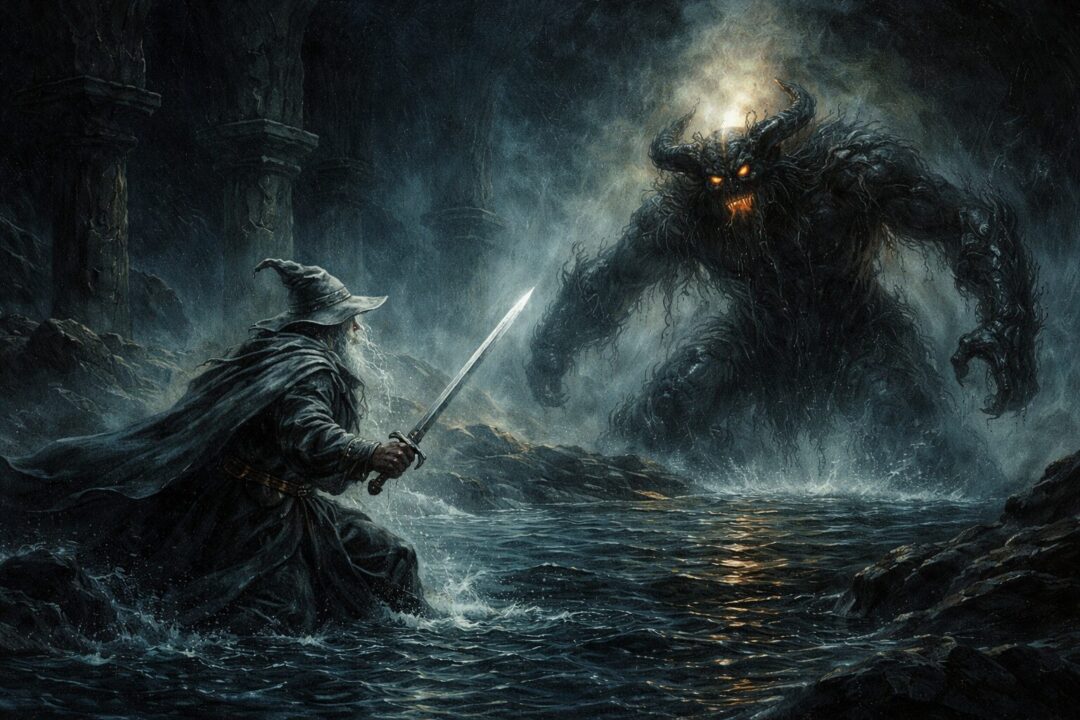
In The Two Towers, Gandalf explains that after they plunged into the abyss, they came at last to deep water far below Moria. There the Balrog’s fire was quenched, and it became “a thing of slime,” but it remained terribly strong. Gandalf says plainly that they fought far under the living earth, and that the Balrog still clutched him while he hewed at it.
That matters because it overturns a common assumption.
Gandalf was not deciding whether to pursue a beaten foe.
He was in the middle of an unfinished fight.
The bridge gave the Fellowship a chance to escape, which was Gandalf’s immediate purpose there. But it did not destroy the Balrog. Once both had survived the plunge, the danger remained fully alive.
And as long as it remained alive, Gandalf could not simply treat the matter as over.
The Text Says the Balrog Fled
One of the most revealing details in Gandalf’s account is easy to miss.
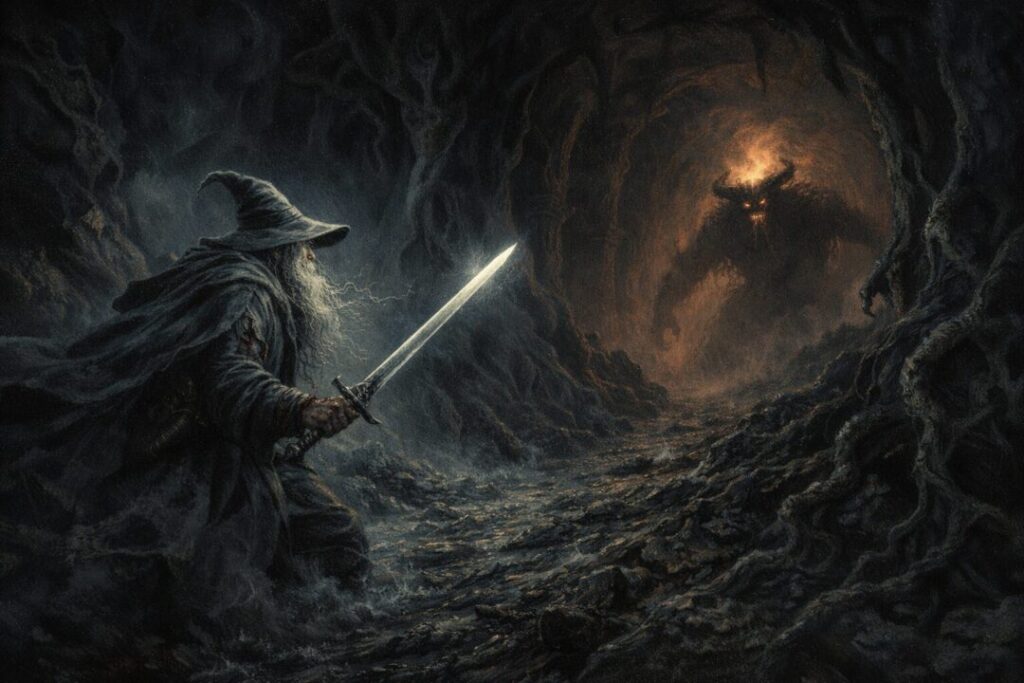
He says that after fighting beneath the earth, “at last he fled into dark tunnels.” Those tunnels, Gandalf adds, were not made by Durin’s folk. They lay far below the deepest delvings of the Dwarves, in places so alien that Gandalf refuses to describe them further in daylight company.
That line tells us something crucial.
The Balrog was not lying broken while Gandalf chose vengeance.
It was retreating.
And Gandalf pursued.
Why does that matter? Because the moment becomes much easier to understand once the order of events is clear. Gandalf is not continuing the fight out of wrath or pride. He is preventing a living Balrog from escaping the confrontation.
The text does not explicitly spell out his inner thoughts here. It never gives a sentence like, “I dared not let it go.” But the sequence strongly implies that this is exactly the practical reality of the moment.
A Balrog of Morgoth was loose beneath Moria.
It had already shattered the Fellowship.
It had already proven itself a mortal threat even to Gandalf.
Letting it disappear into the dark would not have been safety.
It would have been postponement.
Gandalf’s Task Was to Resist Such Evil, Not Evade It
There is also a larger pattern behind the scene.
Gandalf is not merely a wandering wise man caught in an unfortunate duel. He is one of the Istari, sent into Middle-earth to oppose Sauron and to strengthen those who resisted the Shadow. The governing idea behind their mission was not domination or displays of raw power, but it was still a real mission against evil. They were sent to contest Sauron’s power and to unite the Free Peoples against it.
That distinction matters.
The Istari were not meant to rule by fear or simply match Sauron with equal tyranny. But that does not mean Gandalf was forbidden from direct action in every circumstance. The whole story shows otherwise. He fights wolves, defends the Fellowship, withstands the Nazgûl, and stands against the Balrog at the bridge because the road behind him must be held.
Once he and the Balrog have fallen away from the Fellowship, the situation becomes starkly simple.
This is no longer a question of counsel.
It is no longer a question of influence.
It is no longer a contest over hearts and alliances.
It is one deadly being of the ancient world confronting another servant of the West in the dark below the mountains.
At that point, not fighting would itself be a kind of failure.
He Could Not Leave a Balrog Alive Behind Him
This is the deepest practical answer.
Gandalf kept fighting because the Balrog was still alive, still dangerous, and still within reach.
Everything else follows from that.
A Balrog is not an ordinary monster. It is one of the great corrupted spirits of the elder wars, a surviving terror from Morgoth’s dominion. In the Third Age, even one such being is extraordinary. The shock that passes through the Fellowship when Gandalf recognizes it shows how grave the danger is. This is not something to outpace and hope never returns.
If the Balrog had escaped back into hidden darkness, what then?
The texts do not answer directly, so certainty would go too far. But the implication is plain enough: a surviving Balrog beneath the Misty Mountains would remain a profound threat to anything that came within its range, whether Dwarves, Orcs, travelers, or the broader balance of the war.
More immediately, Gandalf himself may not have had the option of disengaging at all. His own words suggest relentless close combat: the Balrog clutched him, and he hewed at it, until it fled. This does not sound like two opponents calmly choosing whether to continue. It sounds like a struggle that allowed no safe separation.
So the clearest lore-accurate answer is also the simplest:
Gandalf kept fighting because the battle had not ended, and because leaving the Balrog alive was not a tolerable outcome.
The Climb Up the Endless Stair Changes the Meaning of the Scene
One of the most haunting details in the whole account is the route the fight takes after the deep tunnels.
The Balrog does not descend farther into secrecy.
It climbs.
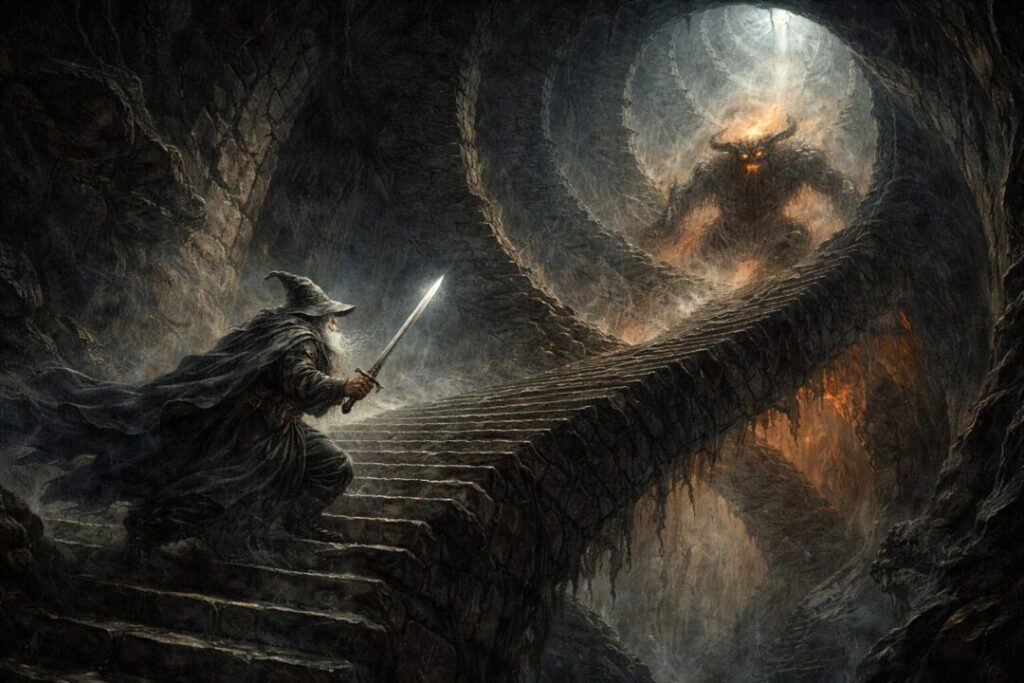
Gandalf says it fled until it came to the Endless Stair, which ran from the deepest dungeon to Durin’s Tower high on Zirakzigil. There the struggle rose from black waters and buried caverns into the open air above the clouds.
This climb matters symbolically, but it matters even more physically.
The Balrog is moving toward the upper world again.
That means the danger is not being sealed away beneath the mountain. It is returning toward the world above. Gandalf’s pursuit is therefore not only persistence. It is containment.
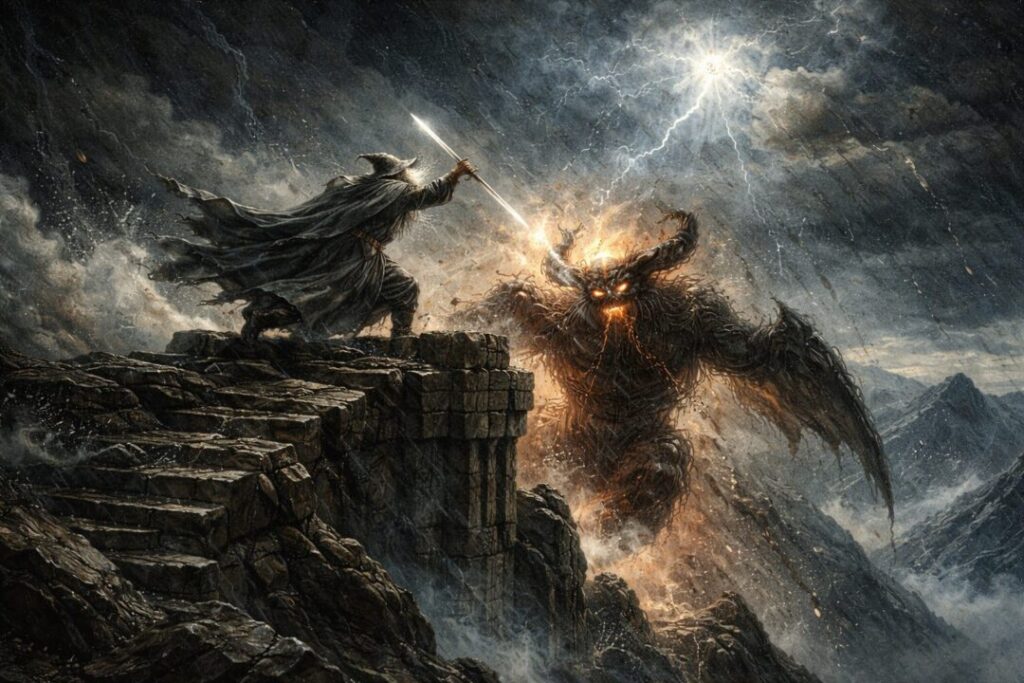
The final battle on the peak makes that unmistakable. From afar, people saw Celebdil crowned with storm. Gandalf describes thunder, lightning, smoke, steam, and ice falling like rain. The fight is not hidden anymore. It has burst out onto the summit of the mountain.
By then, there is no possible interpretation in which Gandalf is chasing a finished enemy.
He is bringing a still-living catastrophe to its last reckoning.
This Was Costlier Than a Heroic Last Stand
It is tempting to frame the whole episode as a straightforward sacrifice scene: Gandalf gives his life so the Fellowship can escape.
That is true, but only partly true.
What follows after the bridge makes the cost much greater than it first appears.
He does not fall, strike one final blow, and die.
He endures an extended ordeal.
He fights through darkness where time is not counted.
He pursues the Balrog up thousands of steps.
He battles for days on the peak.
Then, after destroying his enemy, he himself passes away.
Appendix B is blunt about this: on January 25, 3019, Gandalf casts down the Balrog and passes away; his body lies on the peak. Later Gandalf identifies himself as one who has “returned from death,” and Letter 156 makes clear that this was a real death and a real change, not a symbolic near-death experience.
That helps explain why the scene feels so different once you look closely.
The bridge is not the full sacrifice.
It is the doorway into it.
Why He Kept Going Even When It Meant Death
At the emotional center of the question is this: why continue when the cost was becoming so extreme?
The answer the text gives is not ambition.
Not fury.
Not some private duel of honor.
It is necessity.
Gandalf stands in Middle-earth as a guardian figure whose strength is usually expressed through wisdom, encouragement, warning, and resistance to domination. But when a Balrog bars the road and then survives the fall, necessity strips the moment down to its hardest truth.
Someone has to finish this.
And the only one there who can is Gandalf.
That is why the scene becomes more powerful, not less, when read closely.
He does not keep fighting because he wants the battle.
He keeps fighting because the alternative is to leave unfinished one of the oldest and deadliest evils still walking in Middle-earth.
So why did Gandalf keep fighting the Balrog after they fell?
Because the fall was not the victory.
The Balrog lived.
The danger continued.
The road upward remained open.
And Gandalf, having taken that burden onto himself, carried it all the way from the deepest dungeon to the highest peak until one of them was finally ended.
The real shock is not that he fought on.
It is that the story quietly expects us to understand he could do nothing else.
Sources & Notes
- J.R.R. Tolkien, The Lord of the Rings, Book II, Chapter 5, “The Bridge of Khazad-dûm” — shows Gandalf holding the bridge so the Fellowship can escape and the Balrog falling with him into the abyss.
- J.R.R. Tolkien, The Lord of the Rings, Book III, Chapter 5, “The White Rider” — Gandalf’s own account says the Balrog survived the fall, fought him in deep water, fled through dark tunnels, and climbed the Endless Stair to Durin’s Tower.
- J.R.R. Tolkien, The Lord of the Rings, Appendix B, “The Tale of Years” — dates the final battle on Zirakzigil, where Gandalf casts down the Balrog and then passes away.
- J.R.R. Tolkien, The Silmarillion, “Valaquenta: Of the Enemies” — identifies Balrogs as the terrible spirits who served Morgoth, supporting why a surviving Balrog was no ordinary monster to leave loose.
- J.R.R. Tolkien, Unfinished Tales, “The Istari” — frames Gandalf’s mission as resistance to Sauron and the Shadow, adding context for why he acts as a servant of the West rather than merely a private duelist.