At first, the comparison feels simple.
Bilbo leaves the Shire with Gandalf and Thorin’s company, heading east toward Rivendell, and the journey seems to take a long time. Then in The Fellowship of the Ring, Frodo also heads for Rivendell, under far worse conditions, and yet the journey can feel faster.
That makes it seem as if something does not quite add up.
Why would Bilbo, travelling in peacetime with Gandalf and a well-provisioned group, take longer to reach Rivendell than Frodo, who is hunted, wounded, and carrying the One Ring?
The answer is that the two journeys are not really functioning the same way in the text.
They are not equally urgent.
They are not equally direct in feel.
And they are not being undertaken by comparable companies.
Once those differences are set side by side, the puzzle becomes much clearer.
The Difference Is Real, But Smaller Than It Feels
The first thing to notice is that the gap is not enormous.
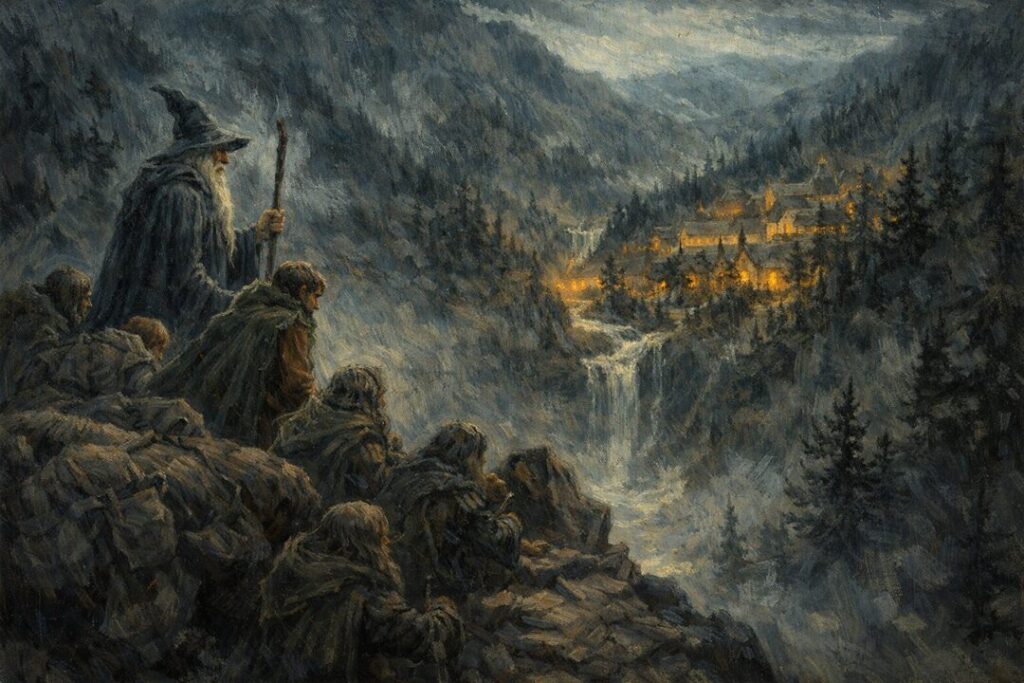
Tolkien Gateway’s chronology for The Hobbit places the departure from Bag End on April 27, 2941, with the party reaching Rivendell around mid-June, and then remaining there for at least fourteen days before leaving on Mid-year’s Day.
For Frodo, the Appendix B chronology and chapter dating place the final approach from Weathertop to the Ford between October 6 and October 20, 3018, with Frodo waking in Rivendell on October 24.
So yes, Bilbo’s approach to Rivendell is longer.
But it is not a case of one journey taking forever while the other happens instantly. The real contrast comes from how each road is travelled, and from how the narrative frames it.
Bilbo’s Company Is Much Slower by Nature
Bilbo is not travelling with three or four companions.
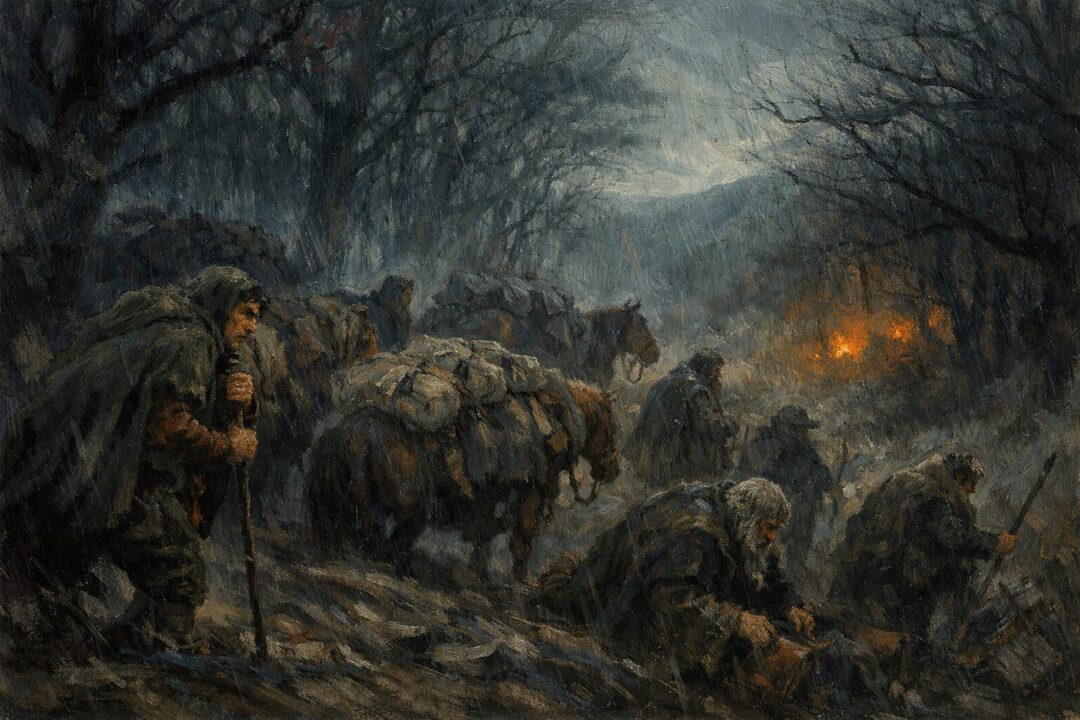
He is moving with Gandalf, Thorin, and twelve Dwarves: a large expedition, carrying gear, food, ponies, and all the usual weight of a long overland journey. Roast Mutton presents the group as travelling east in growing discomfort, with increasingly poor roads, alien country, and rising strain even before the troll episode delays them further.
That matters.
A company that size cannot move like a hunted handful slipping through the wild. It has more mouths to feed, more animals to manage, more chances for fatigue, confusion, and delay. Even when nothing dramatic is happening, the pace is slower simply because the travelling body itself is slower.
Bilbo’s road to Rivendell is not the movement of fugitives.
It is the movement of an expedition.
And expeditions take time.
The Troll Delay Matters More Than People Remember
Before Bilbo ever sees Rivendell, the company loses time in the Trollshaws.
The rain sets in. Gandalf disappears for a while. The party is hungry, tired, and searching for shelter when they stumble into the encounter with the trolls. That episode is not a brief interruption. It derails the journey, leads to the company’s capture, then to the discovery of the cave, the recovery of provisions and weapons, and time spent resting afterward. Tolkien Gateway’s summary even notes that they sleep until the afternoon after the rescue before setting out again.
That is an important part of the answer.
Bilbo’s road is longer not just because the distance is long, but because the journey keeps breaking open into incidents.
The company does not move in one hard unbroken push toward Rivendell. They stop, get lost, suffer bad weather, are captured, recover, and only then continue.
In other words, The Hobbit still treats the road as a place where the story happens.
Frodo’s Journey Changes Once the Pursuit Tightens
Frodo’s road is different in kind.
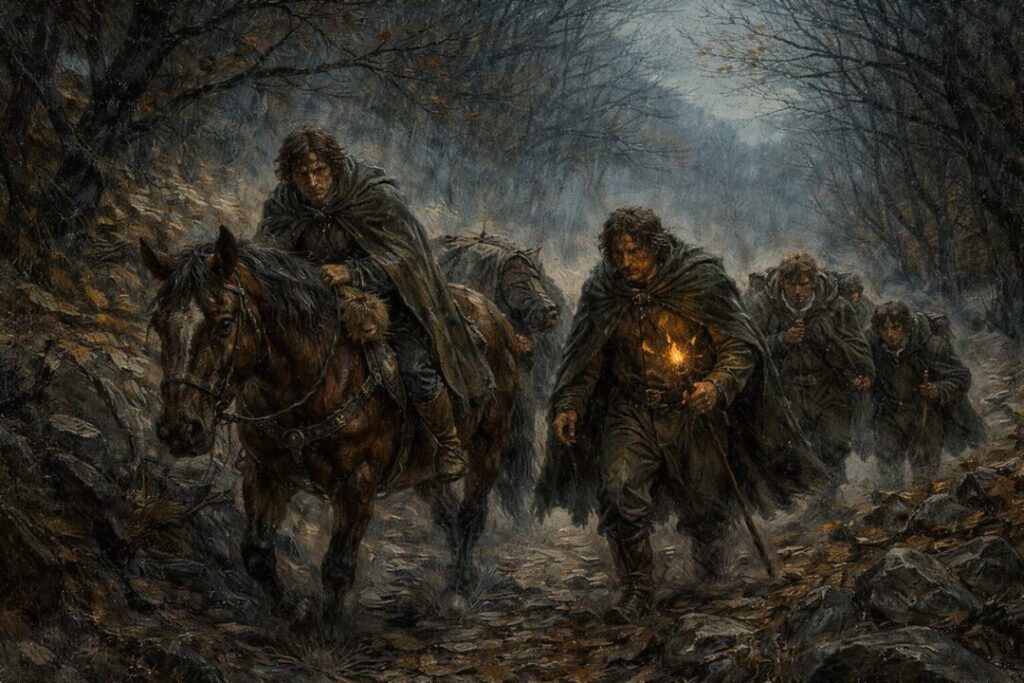
By the time the final approach to Rivendell begins, Frodo has already been stabbed at Weathertop. The Flight to the Fordchapter covers October 6 to October 20 and centers on the worsening of Frodo’s wound, Aragorn’s fear that it may bring him under the power of the Riders, and the urgent attempt to reach Elrond before that happens.
That urgency changes everything.
The company is smaller.
The burden is more focused.
And from Aragorn’s point of view, there is no value in delay.
The text itself emphasizes the danger of Frodo’s injury and the need to get him to Rivendell quickly. Gandalf later explains that he trusted Aragorn to guide Frodo and hoped to reach Rivendell ahead of them in order to send help. He did reach Rivendell first, and help was sent out; Glorfindel meets the travellers before the Ford.
That is one of the clearest reasons Frodo’s road contracts.
Bilbo’s company must find its way.
Frodo’s party is being pulled toward Rivendell as toward a last refuge.
Aragorn and Glorfindel Make a Major Difference
Bilbo has Gandalf, and Gandalf certainly knows where he is going. But Gandalf is also not marching the company in a state of panic. He lets the journey breathe, which is one reason it accumulates so much story on the way.
Frodo, by contrast, is under Aragorn’s care through the wild at exactly the moment when knowledge of the land matters most. Aragorn is not simply accompanying them. He is forcing the pace as far as Frodo’s strength allows, searching for healing plants, reading signs, and choosing the path with survival in view.
Then Glorfindel enters the picture.
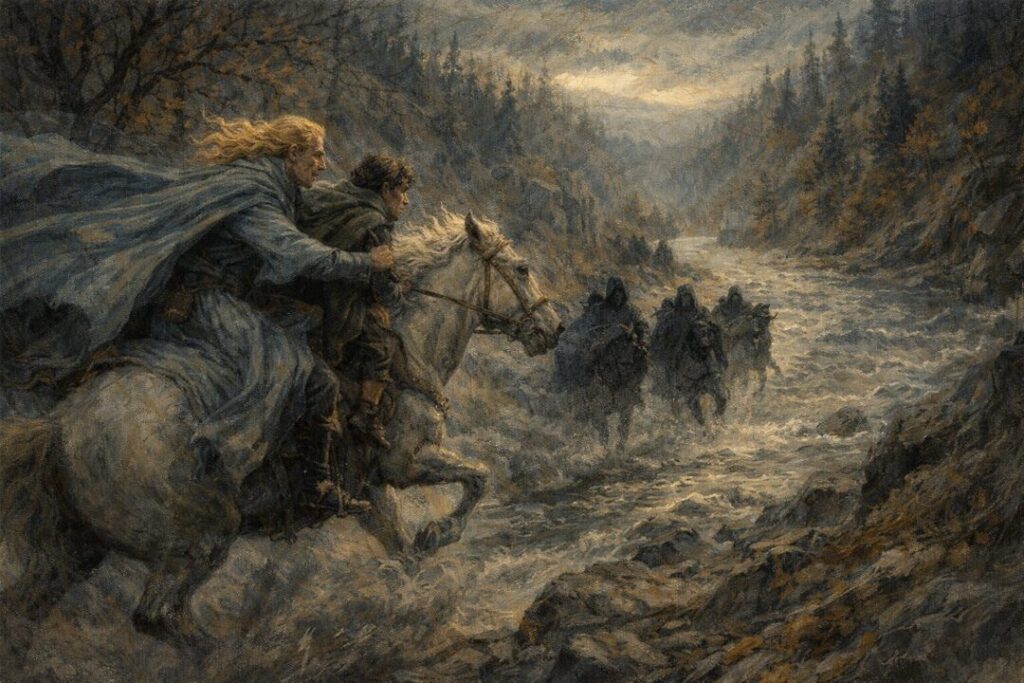
That changes the final stage dramatically. Elrond does not merely wait in Rivendell and hope Frodo arrives. Searchers are sent out, and Glorfindel helps bring the wounded Ring-bearer to the Ford.
Bilbo’s arrival in Rivendell is a welcome discovery.
Frodo’s arrival is an extraction.
That is a very different thing.
Rivendell Serves Different Narrative Purposes in the Two Books
This is where the deeper answer begins.
In The Hobbit, Rivendell appears as relief after a string of road-adventures. It is the first real haven after the company has been gradually stripped of comfort. The narrative wants the approach to feel long enough that the hidden valley arrives like rescue, song, food, laughter, and wisdom after exhaustion. A Short Rest even lingers on the pleasure and safety of the stay, and the company remains there for at least two weeks.
In The Fellowship of the Ring, Rivendell is still a haven, but now it is also a deadline.
Frodo does not need only rest.
He needs healing before the Morgul wound masters him.
So the narrative begins compressing around necessity. Once Weathertop happens, the road to Rivendell is no longer exploratory. It becomes a narrowing corridor of danger leading toward one possible cure.
That is why the same destination feels so different.
In The Hobbit, Rivendell is a pause in the journey.
In The Fellowship, it is almost the only place left to reach in time.
Was Gandalf Timing Bilbo’s Arrival for Elrond’s Help?
One careful point should be made here.
In The Hobbit, Elrond’s reading of the moon-letters is possible during the stay in Rivendell, and that becomes crucial for the later quest to Erebor. The party is there on Midsummer’s Eve, and the revelation matters enormously.
But the texts do not clearly state that Gandalf delayed the company on purpose so that they would arrive at exactly the right season.
That would go beyond what can be safely claimed.
What can be said is more restrained: their stay in Rivendell turns out to be providentially timed, and Rivendell gives them knowledge they would not have had otherwise. Whether every stage of that timing was consciously planned by Gandalf is not directly confirmed in the text.
That distinction matters.
The Road Did Not Change as Much as the Situation Did
If someone asks why it took longer to get to Rivendell in The Hobbit, the cleanest answer is not that the distance was greater or that Tolkien forgot his own geography.
The stronger answer is this:
Bilbo’s party travels as a large, burdened expedition in no immediate mortal haste, suffers significant delays, and reaches Rivendell in the rhythm of adventure.
Frodo’s party, especially after Weathertop, travels as a wounded and hunted group under urgent guidance, with help sent out from Rivendell itself, and reaches it in the rhythm of pursuit.
That is why the second journey feels faster.
Not because the world became smaller.
Not because the road was easier.
But because the need was sharper, the company lighter, the guidance more direct, and the last stage driven by fear of losing Frodo altogether.
Why This Detail Matters
This small question opens onto something larger about Middle-earth.
Roads are never just roads.
They become whatever burden is being carried upon them.
For Bilbo, the way to Rivendell still belongs to a world where danger can interrupt the journey and then be folded into tale, song, and memory. For Frodo, the road has darkened. The same wild country is now threaded with pursuit, fading strength, and the knowledge that sanctuary must be reached before the enemy closes in.
That is why Rivendell in The Hobbit feels far away.
And why in The Fellowship of the Ring, it feels like the last light still within reach.
Sources & Notes
- J.R.R. Tolkien, The Hobbit, ch. 2, “Roast Mutton” — Bilbo, Gandalf, Thorin, and the Dwarves travel east through worsening weather and road conditions before the troll episode interrupts the journey.
- J.R.R. Tolkien, The Hobbit, ch. 3, “A Short Rest” — the company reaches Rivendell after the Trollshaws, rests there for an extended stay, and Elrond reads the moon-letters on Thrór’s map.
- J.R.R. Tolkien, The Lord of the Rings, Appendix B, “The Tale of Years” — gives the 3018 chronology from Frodo’s departure and Weathertop to the Ford of Bruinen and Rivendell.
- J.R.R. Tolkien, The Fellowship of the Ring, book I, ch. 12, “Flight to the Ford” — Aragorn drives the wounded Frodo’s party toward Rivendell, Glorfindel is sent out, and the final stage becomes an urgent rescue rather than a leisurely road-adventure.
- J.R.R. Tolkien, The Fellowship of the Ring, book II, ch. 1, “Many Meetings” — Gandalf explains the pursuit, his own arrival at Rivendell, and the help sent to find Frodo before the wound overcame him.