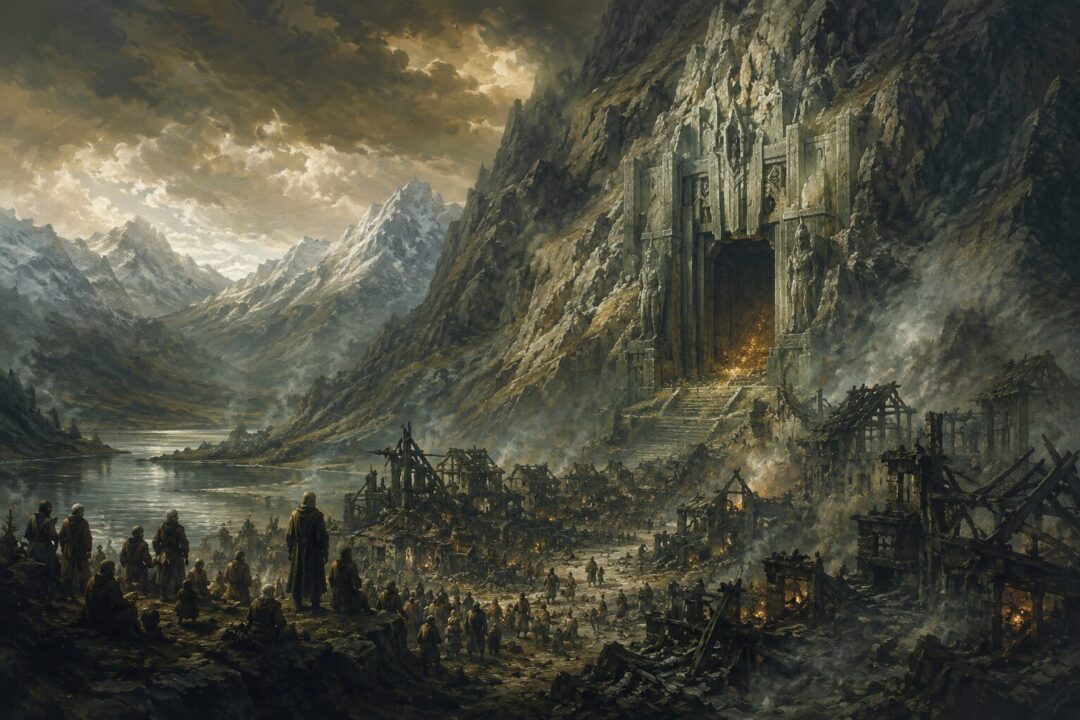
When the dragon Smaug died beneath the arrows of Bard, it seemed as though the greatest prize in northern Middle-earth had suddenly become ownerless. The Lonely Mountain still held unimaginable treasure, the halls of Erebor stood intact, and an ancient kingdom waited to be reclaimed. On the surface, the conflict that followed appears simple: everyone wanted the gold.
Yet The Hobbit tells a more complicated story.
The Battle of Five Armies did not begin because armies rushed to steal dragon treasure. It emerged because wealth, justice, survival, inheritance, pride, and fear all collided in the same place at exactly the wrong moment. Every faction approaching Erebor believed it possessed a legitimate claim—or at least a legitimate reason—to stand before the Mountain.
The dragon's hoard was certainly important. But it was never the whole story.
Smaug Left More Than Treasure Behind
Smaug did not merely accumulate gold. His arrival transformed the political and economic landscape of the North.
Before the dragon's attack, Erebor was one of the greatest centers of Dwarven craftsmanship. Dale prospered beside it through trade, while the nearby Woodland Realm exchanged goods with both kingdoms. Prosperity spread outward because Erebor produced wealth rather than merely storing it.
When Smaug destroyed Erebor and Dale, that entire regional network collapsed.
The Dwarves lost their kingdom.
The Men of Dale lost their homes.
Trade diminished across the North.
Entire generations grew up remembering what had been lost.
By the time Bilbo arrived with Thorin Oakenshield, the question was no longer simply who owned the treasure. The greater question was whether the old order of the North could be restored at all.
Thorin Was Reclaiming an Inheritance
From Thorin's perspective, the case seemed straightforward.
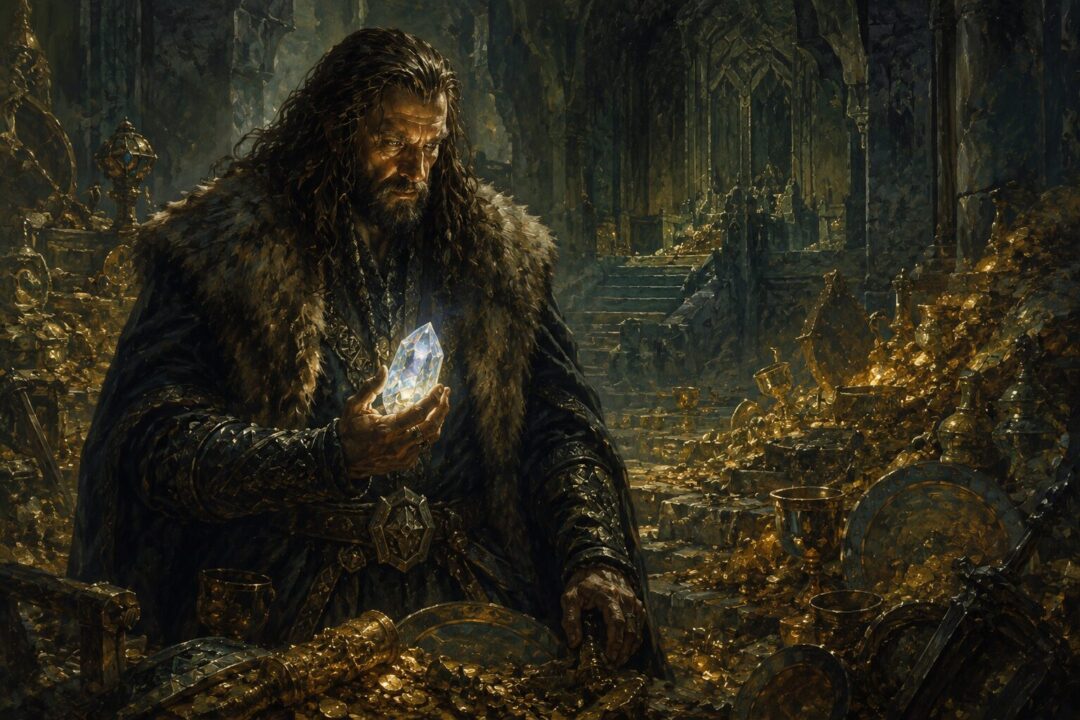
Erebor was the ancestral kingdom of Durin's Folk. The treasure inside had been gathered by generations of Dwarves before Smaug seized it. Although the dragon possessed the gold physically, conquest did not erase lawful inheritance.
After Smaug's death, Thorin believed he was reclaiming what already belonged to his people.
The text consistently portrays his expedition as an attempt to recover a lost homeland rather than to discover new riches. His company endured exile, poverty, and enormous danger for that purpose.
Yet this rightful claim contained a hidden danger.
The immense wealth of the Mountain also awakened an intense possessiveness in Thorin. The Hobbit describes this growing "dragon-sickness," a consuming obsession with the treasure that clouded judgment and strained relationships. The condition is never presented as magical in the same sense as the One Ring's corruption. Instead, the narrative depicts it as a powerful moral and psychological distortion associated with immense wealth and prolonged longing.
Thorin's legal claim remained real.
His ability to exercise that claim wisely became increasingly uncertain.
Bard Represented More Than Personal Loss
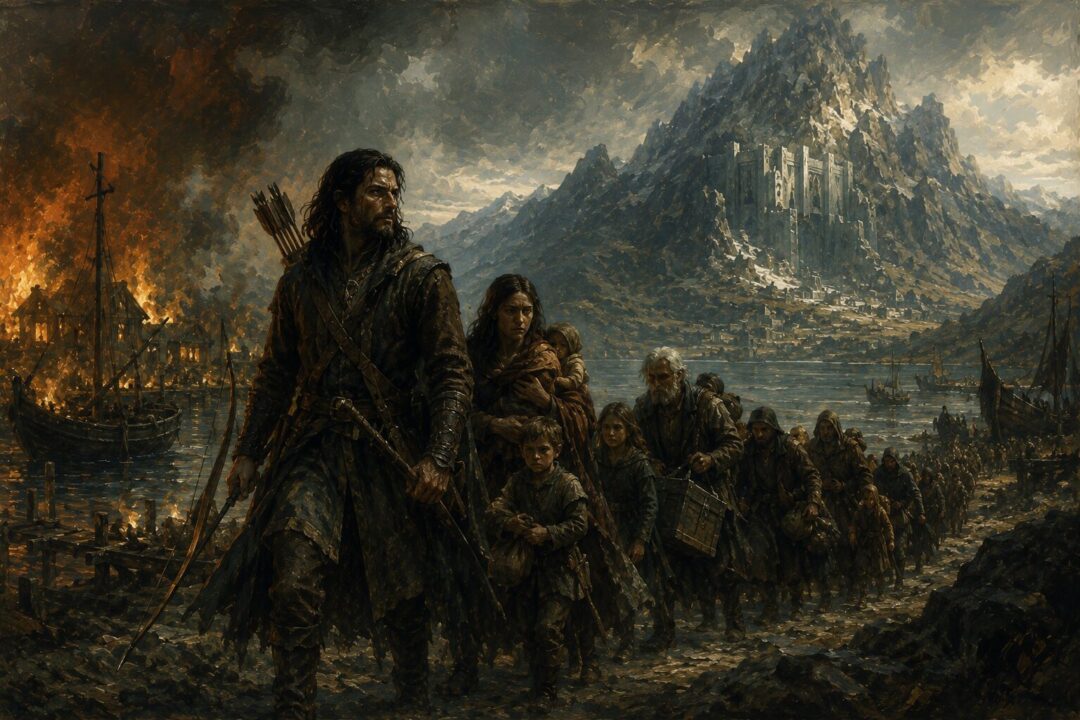
Bard arrived at Erebor not merely as the slayer of Smaug but as the emerging leader of Lake-town's survivors.
The dragon's final attack devastated Esgaroth. Homes burned, livelihoods vanished, and countless people were left with almost nothing. Those refugees required food, shelter, and rebuilding long before they could think about politics.
Bard therefore argued that part of the treasure should aid those whom Smaug had ruined.
His case rested on multiple foundations.
First, Smaug's destruction had directly created the refugees' suffering.
Second, much of the treasure had originally come through trade with Dale or from the wealth of Men before the dragon's conquest.
Third, rebuilding civilization in the North benefited everyone, including Erebor itself.
Importantly, Bard did not initially demand the entire hoard.
He sought compensation that he believed justice required.
From his perspective, refusing all assistance after benefiting from Smaug's death would violate both fairness and practical necessity.
The Elvenking's Motives Were More Complex Than Greed
The arrival of the Elvenking's army sometimes creates the impression that another kingdom simply came seeking riches.
The text presents a subtler picture.
The Elvenking had already marched because refugees from Lake-town needed immediate help. His people supplied food, shelter, and protection before negotiations over treasure fully developed.
Only afterward did he accompany Bard to Erebor.
His kingdom also possessed historical trading relationships with Dale and Erebor, and some portion of the treasure may well have originated through those exchanges. The narrative does not provide a detailed accounting of ownership, but it does establish longstanding economic ties among the northern kingdoms.
The Elvenking certainly did not ignore the value of the treasure.
At the same time, the text repeatedly portrays him as willing to negotiate rather than immediately wage war.
His objective was to secure a fair settlement, not to sack the Mountain.
Dáin Ironfoot Came to Defend a Kingdom
When Thorin summoned reinforcements from the Iron Hills, the situation changed dramatically.
Dáin Ironfoot marched with a substantial Dwarven force.
Their arrival is sometimes misunderstood as a treasure expedition, yet their primary purpose was military support for Erebor.
Thorin believed hostile forces surrounded his newly recovered kingdom.
Dáin answered the call of kinship.
The Dwarves also carried supplies for the defenders inside the Mountain, emphasizing that this was not merely an army expecting immediate plunder. They came prepared to strengthen a siege if necessary.
From their perspective, abandoning Thorin would have meant abandoning the restoration of Durin's kingdom itself.
Pride Turned Negotiation Into Crisis
Perhaps the greatest tragedy before the battle is how close the opposing sides sometimes came to peaceful resolution.
No army initially attacked Erebor outright.
Instead, negotiations stalled.
Messages passed.
Demands hardened.
Distrust deepened.
The turning point came largely through Thorin's refusal to compromise.
His growing attachment to the treasure made every concession feel like surrender. Even reasonable requests became intolerable once viewed through the lens of dragon-sickness.
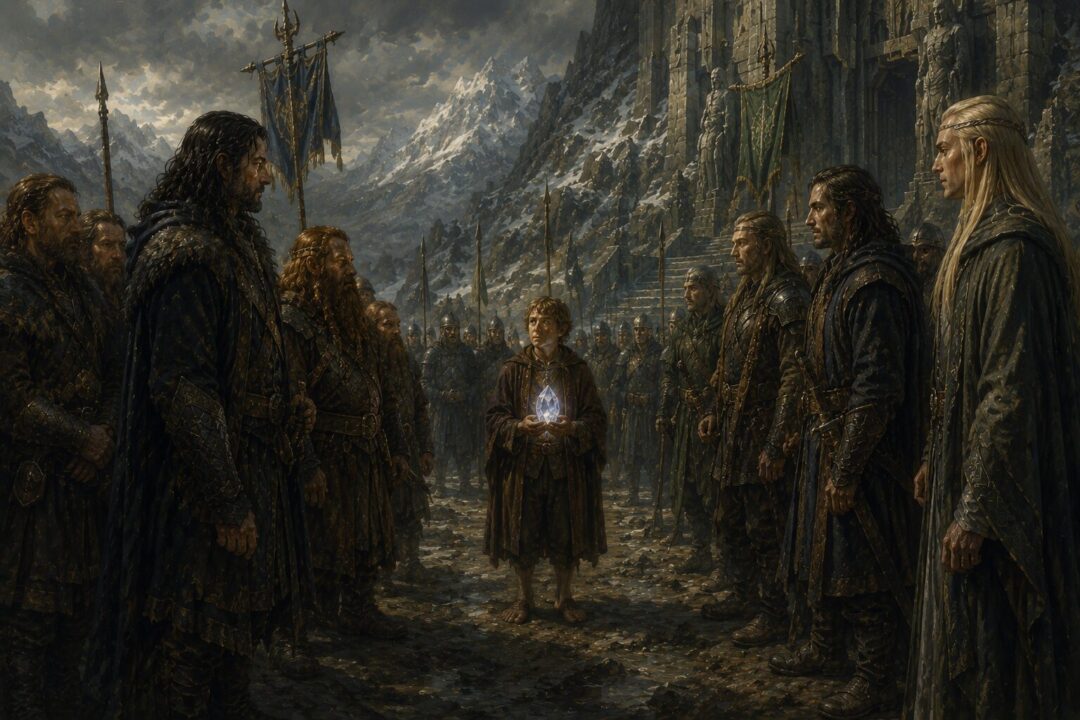
The famous exchange involving the Arkenstone illustrates this perfectly.
Bilbo secretly delivered the stone to Bard and the Elvenking because he believed it could force renewed negotiations. Since Thorin valued the Arkenstone above almost everything else, it represented leverage powerful enough to break the deadlock.
Bilbo did not deny Thorin's inheritance.
Instead, he tried to save everyone from the consequences of pride.
The plan nearly succeeded.
Yet Thorin's anger initially pushed events even closer to war.
The Goblins Changed Everything
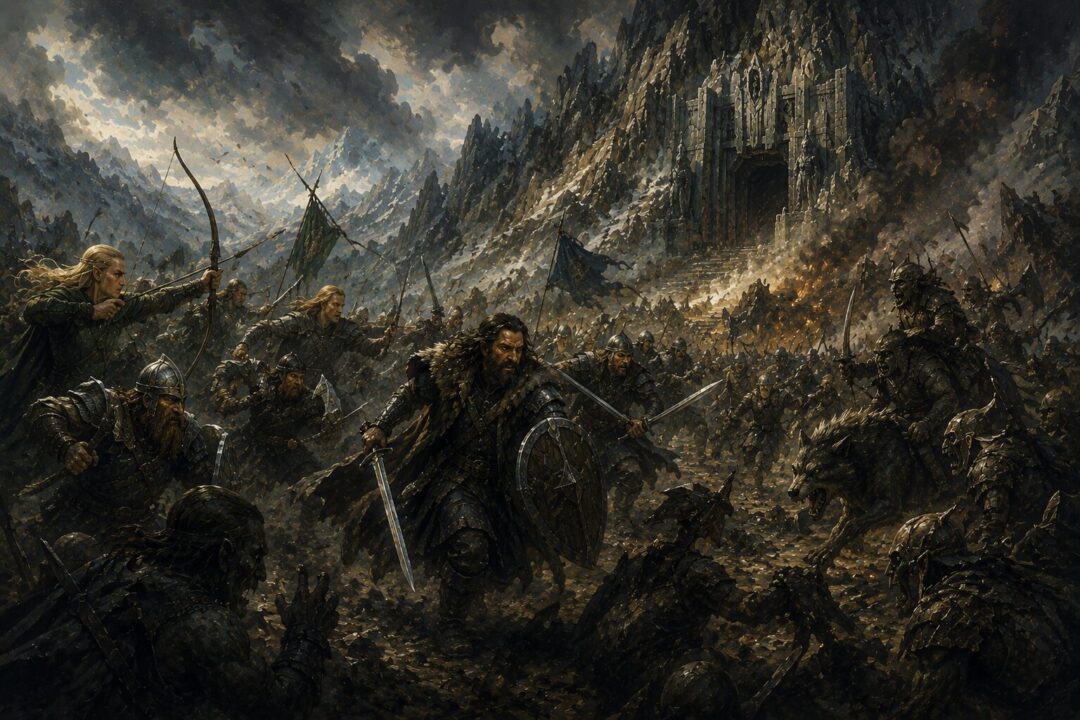
The conflict that readers remember as the Battle of Five Armies almost never became a battle over treasure at all.
Before open war between Dwarves, Men, and Elves could begin, a vastly greater threat appeared.
A large host of Goblins descended from the Misty Mountains, accompanied by Wargs.
This invasion transformed the political situation instantly.
The separate disputes over ownership suddenly became insignificant compared to simple survival.
Former enemies united.
The armies that had stood facing one another now fought shoulder to shoulder.
The title "Battle of Five Armies" therefore refers not to five factions competing against one another throughout the entire engagement, but to the five military forces that ultimately took part in the larger conflict: Goblins, Wargs, Elves, Men, and Dwarves.
The struggle over the treasure effectively ended the moment the greater danger arrived.
Thorin's Change Revealed the Story's True Heart
Thorin's final actions reshape the entire meaning of the conflict.
Mortally wounded after leading a charge against the Goblins, he reconciled with Bilbo.
His famous acknowledgment that kindness and simple pleasures outweigh hoarded wealth becomes the moral center of the narrative.
The importance of this scene lies in what it rejects.
The problem was never that treasure existed.
Nor was it that kingdoms possessed rightful claims.
Instead, the greatest danger emerged when wealth became more important than wisdom, gratitude, or mercy.
Thorin recovered clarity only after sacrificing himself in defense of others rather than in defense of gold.
His redemption does not erase earlier mistakes, but it restores the king readers hoped he might become.
The Treasure Was Eventually Shared
After the battle, the resolution reflected many of the competing claims that had fueled the earlier dispute.
Bard received a substantial portion of the treasure.
He used it to rebuild Dale, restoring the ancient city that had fallen with Smaug.
The surviving people of Lake-town also benefited from the wealth distributed after the conflict.
The Elvenking accepted gifts but did not seize control of Erebor.
Dáin succeeded Thorin as King under the Mountain, continuing the restoration of the Dwarven kingdom.
The final settlement demonstrates that coexistence proved possible once fear and pride no longer dominated events.
The treasure remained valuable.
It simply ceased to be the only consideration.
The Battle Was Really About the Future of the North
It is tempting to remember the Battle of Five Armies as a dispute over an enormous pile of dragon gold.
The deeper story is far richer.
Erebor represented political legitimacy, ancestral memory, economic recovery, justice for survivors, and the possibility of restoring a devastated region. Every major participant arrived carrying losses that predated Smaug's death by generations.
The Dwarves sought their kingdom.
The Men sought restoration after catastrophe.
The Elves sought stability and justice among neighboring peoples.
Only the Goblins came seeking destruction alone.
By the battle's end, the treasure mattered far less than the alliances forged in defending the North together. Old suspicions gave way to renewed friendship between Dwarves, Men, and Elves, allowing trade, rebuilding, and cooperation to flourish once more.
Dragon gold may have drawn every eye toward the Lonely Mountain.
But what was truly at stake was whether the peoples of the North would remain divided by old wounds—or discover that some things were worth more than even the greatest hoard ever gathered beneath a mountain.
Sources & Notes
- https://tolkiengateway.net/wiki/Battle_of_Five_Armies — Tolkien Gateway, ‘Battle of Five Armies’: overview of the armies, causes, alliances, and outcome of the conflict at Erebor after Smaug’s death.
- https://tolkiengateway.net/wiki/Thorin_II_Oakenshield — Tolkien Gateway, ‘Thorin II Oakenshield’: background on Thorin’s claim to Erebor, his treasure-obsession, and his role in the standoff before the battle.
- https://tolkiengateway.net/wiki/Bard — Tolkien Gateway, ‘Bard’: covers Bard’s slaying of Smaug, leadership of Lake-town’s survivors, and claim for aid and compensation from the hoard.
- https://tolkiengateway.net/wiki/Arkenstone — Tolkien Gateway, ‘Arkenstone’: explains the jewel’s symbolic importance to Thorin and its use by Bilbo in the negotiations before the battle.
Sources selected for Erebor’s inheritance, Bard and Lake-town’s claims, the Arkenstone dispute, and the goblin/warg threat behind the Battle of Five Armies.