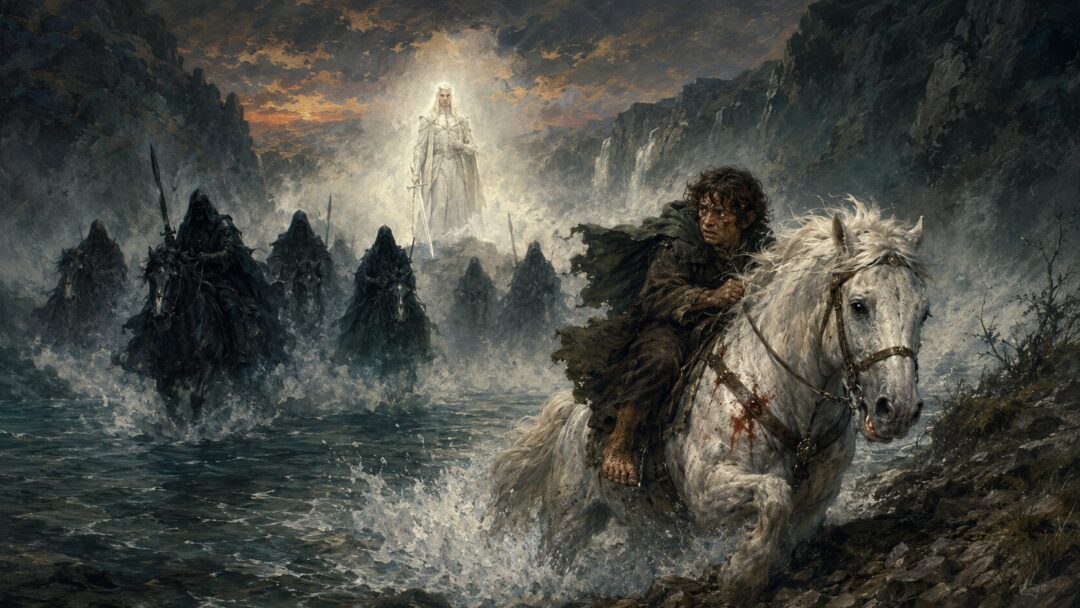
At the Ford of Bruinen, the Nine Riders should have been at the height of their terror. Frodo was wounded, weakening, and already half-drawn into the shadow-world. The river was before him, the Black Riders were behind him, and the Ring was almost within their grasp.
Yet the strange thing about the scene is not only that Frodo is afraid of them.
They are afraid too.
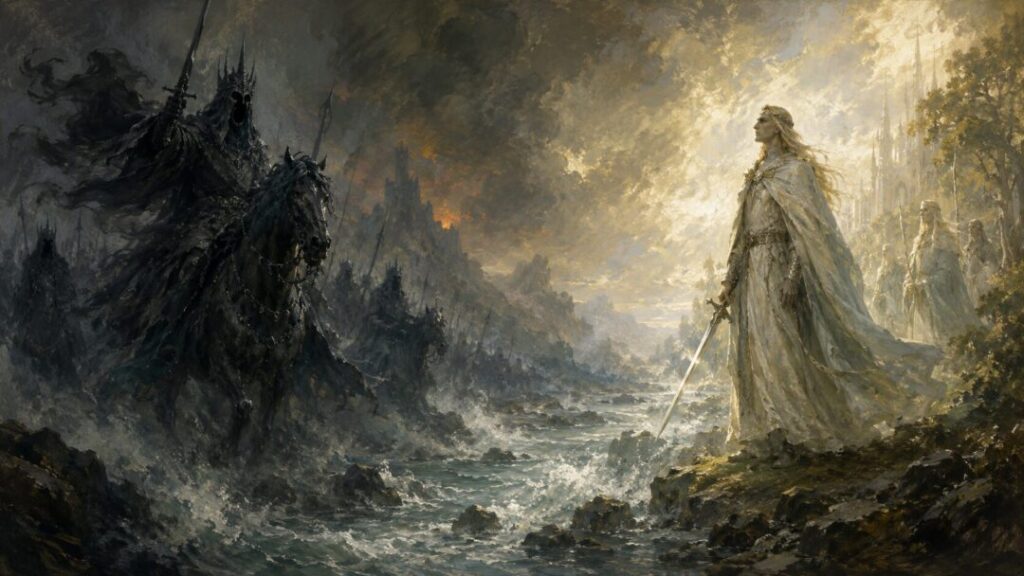
Not in the ordinary way that soldiers fear a stronger enemy. The Nazgûl are not easily frightened by blades, rank, courage, or mortal defiance. Their power depends on fear. They enter the story as hunters whose very presence chills the road, silences the countryside, and bends ordinary people toward panic. But at the Ford, when Frodo looks back from the far bank, he sees something behind them: a white figure shining with power.
That figure is Glorfindel.
The terror of the Nazgûl at the Ford is not a simple matter of “an Elf being strong.” It comes from a collision of several deeper truths: Glorfindel’s spiritual nature, the exposed condition of the Ringwraiths, the power of Rivendell’s borders, the river itself, and the fact that the Nazgûl were facing an enemy who belonged partly to the very world in which they were most dreadful.
The Nazgûl Were Terrifying Because They Belonged to the Unseen
The Black Riders are not merely cloaked men on horses. They are Ringwraiths: Men who accepted Rings of Power and were gradually consumed by Sauron’s domination. Their bodies have faded from ordinary sight, and their chief strength lies in fear, will, and the shadowy realm connected with the Rings.
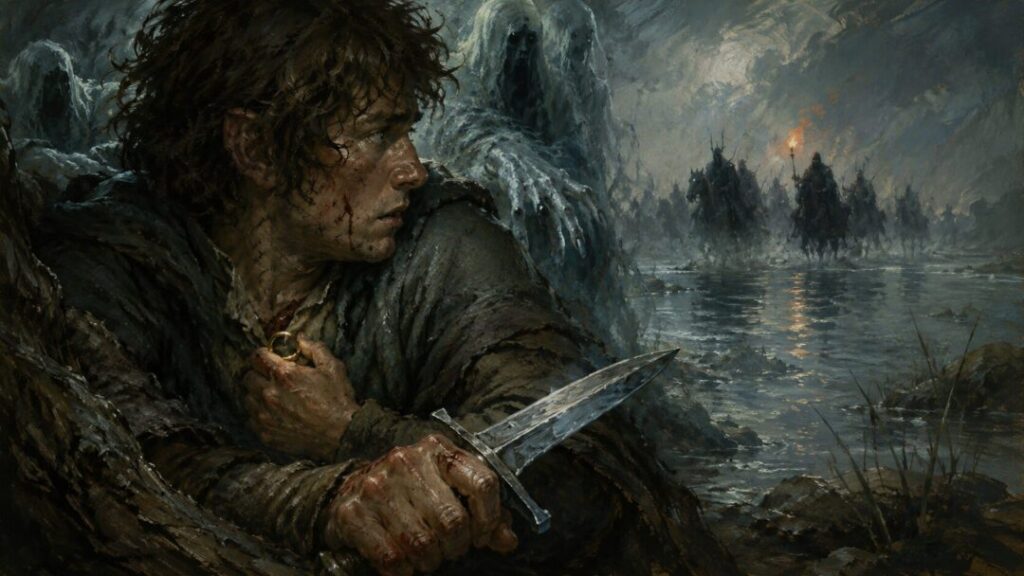
This matters because Frodo’s wound from the Morgul-knife is not just a poisoned injury. It is a spiritual assault. The splinter working toward his heart would have drawn him into the wraith-world and made him subject to the Dark Lord’s servants. That is why the chase to Rivendell is so desperate. Frodo is not only being carried away geographically; he is being pulled inward toward the same condition as his pursuers.
The Nazgûl are strongest when others are weak in body, courage, and spirit. They dominate through dread. They are terrible at night. They are more dreadful to those who can perceive them in their own shadowy mode. Frodo, wounded and bearing the Ring, sees them more clearly than his companions do. At Weathertop and later near the Ford, he becomes dangerously aware of their hidden form.
But this hidden world is not theirs alone.
That is the overlooked weakness. The Nazgûl are terrifying to mortals because they operate partly beyond the ordinary visible world. But some beings of great spiritual power can also stand in relation to that Unseen realm. Glorfindel is one of them.
Glorfindel Was Not Merely “A Strong Elf”
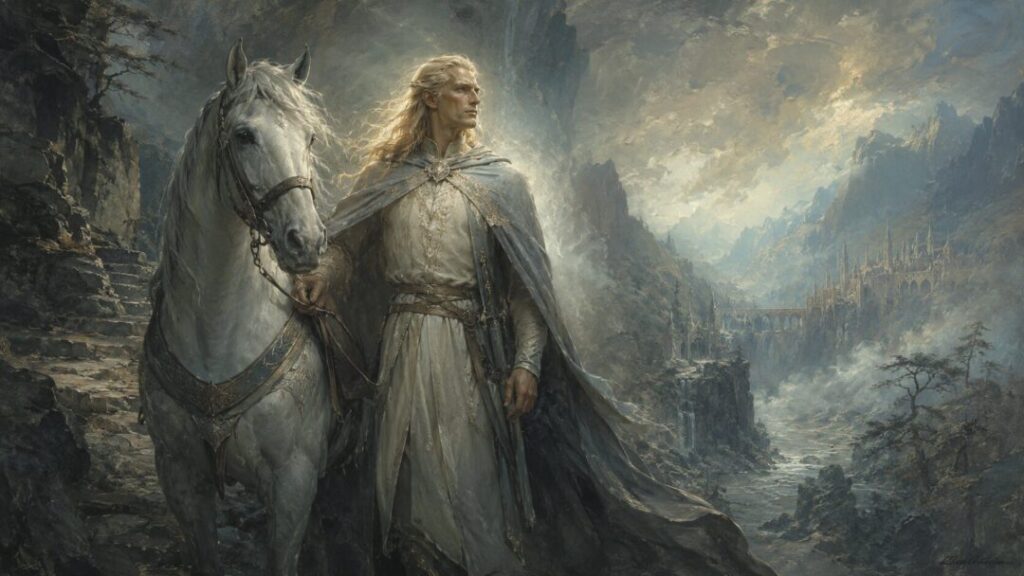
In The Fellowship of the Ring, Glorfindel first appears as a lord of Rivendell, radiant and powerful, riding openly in search of Aragorn and the hobbits. Even before the Ford, his arrival changes the emotional temperature of the story. The wilderness has been full of pursuit, sickness, and uncertainty. Then suddenly there is someone who can ride alone in dangerous country and make even the servants of Sauron cautious.
The deeper explanation becomes clearer after Frodo wakes in Rivendell. Gandalf tells him that the shining figure he glimpsed at the Ford was Glorfindel as he appears “on the other side.” The phrase is crucial. Frodo did not simply see Glorfindel wearing bright clothes or standing in reflected light. In his wounded state, Frodo perceived something of Glorfindel’s spiritual presence.
This does not mean Glorfindel is a Maia, nor should he be treated as equal to Gandalf or the angelic powers. But Tolkien’s later writings connect the Glorfindel of Rivendell with the Glorfindel of Gondolin: the Elf-lord who died in the First Age after battling a Balrog during the fall of that hidden city. In those later explanations, Glorfindel was restored and returned to Middle-earth, his spiritual power enhanced by sacrifice and by his time in the Blessed Realm.
So when the Nazgûl encounter him, they are not facing an ordinary Elf-warrior. They are facing one of the great Eldar, a being of ancient light, one who has passed through death and return, and whose presence is especially formidable in the very realm where wraiths are exposed.
That is why the Ford scene feels so different from a normal pursuit. The Nazgûl are hunters, but Glorfindel is not simply prey defending weaker travelers. He is a light they cannot easily master.
The Ford Was a Trap the Nazgûl Almost Won — Until It Closed on Them
The Nazgûl’s strategy at the Ford was not foolish. In fact, it nearly succeeded.
Rivendell is hidden, but the road to it has limits. The Bruinen must be crossed, and the Ford is a natural choke point. If Frodo can be stopped before crossing, the Riders can seize him. If he crosses but collapses, they may still command him to return. And because Frodo is almost overcome by the wound, the danger is not only physical capture. His will is failing.
This is why the scene is so tense. Frodo reaches the far side, but he does not immediately escape. He turns, defies them, and raises his sword, but his strength is nearly gone. The Riders command him, and the Ring’s world presses on him. Their power is working.
Then the Ford turns against them.
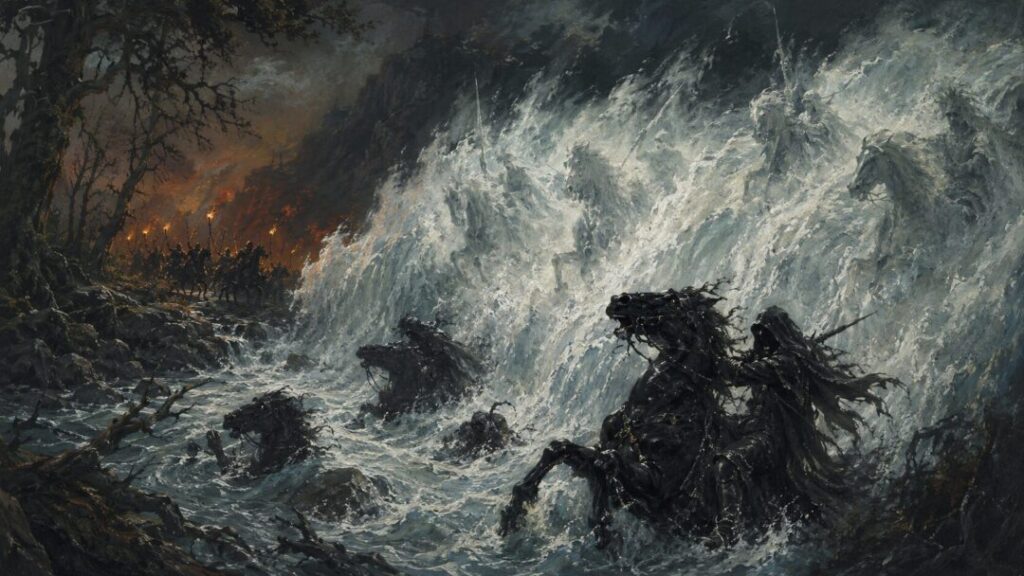
Elrond commands the flood of the Bruinen, and Gandalf later explains that he added the shapes of white horses and riders to the waters. The river is therefore not a random natural accident. It is the defense of Rivendell, released at the right moment. The Nazgûl have reached the border of a sanctuary ruled by one of the Wise, and the land itself rises against them.
But Glorfindel’s role is still essential. He had already placed Frodo on Asfaloth, a horse swift enough to outrun the Black Riders. Behind the Nazgûl, Glorfindel, Aragorn, and the others came with fire. Gandalf later says flaming brands were used to drive the remaining Riders into the flood after the first were caught.
So the Nine were trapped between three kinds of resistance: Frodo’s last act of defiance, the power of Rivendell’s river, and the advance of enemies behind them — especially Glorfindel, revealed in wrath.
Why Fire and Water Matter Against the Riders
The Nazgûl are not destroyed at the Ford. This is important. Their horses are lost, their forms are scattered, and they are forced to return to Mordor empty-handed, but the Ringwraiths themselves endure. Their survival shows that the flood is a defeat, not a final unmaking.
Still, the details matter. The Black Riders depend heavily on their horses during the hunt. Their visible terror is carried through the image of mounted pursuit: hooves on roads, dark figures bending over saddles, sudden speed in the dusk. When the flood destroys their horses, their ability to continue the chase collapses.
Water is also significant because the Nazgûl show discomfort with it. The texts do not present this as a simple rule that they can never cross water under any circumstances, but their hesitation and vulnerability around rivers are repeatedly important in the pursuit. At the Bruinen, that discomfort becomes disaster.
Fire also matters. Aragorn uses fire against them on Weathertop, and at the Ford, the company’s flaming brands help drive them into the river. Fire does not make the Nazgûl harmless, but it is one of the few ordinary-world forces that can check their advance, especially when combined with courage and stronger powers.
Glorfindel’s terror, then, is not isolated from the scene. He is part of a convergence. The Nazgûl meet light, fire, water, Elvish power, and the border of Rivendell all at once.
The Old Fear: Glorfindel and the Witch-king
There is also a wider history behind Glorfindel’s name.
Long before the Ford, after the fall of Angmar, Glorfindel warned Eärnur not to pursue the Witch-king. He declared that the Witch-king’s doom was still far off and that he would not fall by the hand of man. This later becomes one of the great ironies of The Lord of the Rings, fulfilled when Éowyn and Merry bring about the Witch-king’s end.
The prophecy does not mean Glorfindel personally could not have harmed him. Nor does it mean the Witch-king was invincible in every possible sense. It means his final doom lay elsewhere, in a future moment no one at Fornost could fully see. The wording should be handled carefully: the story presents it as a foretelling, not as a magical shield that makes all men useless against him.
Still, the connection matters. Glorfindel had already faced the Witch-king in the great affairs of the North. He was not an unknown wanderer at the Ford. To the Lord of the Nazgûl, Glorfindel was an ancient and dangerous enemy — one associated not with empty boasting, but with true foresight and power.
One reading is that the Nazgûl fear him not only because he is strong, but because he represents a kind of authority they cannot corrupt: ancient Elvish light, memory, sacrifice, and resistance to Sauron’s domination.
Frodo Saw What the Nazgûl Could Not Ignore
The emotional heart of the scene belongs to Frodo. He is small, wounded, and nearly overcome. His defiance at the Ford is brave, but it is not enough by itself to defeat the Nine. That is part of the tragedy and beauty of the moment. Frodo’s courage matters, but he is saved by powers beyond him: Asfaloth’s speed, Glorfindel’s pursuit, Elrond’s river, Gandalf’s aid, Aragorn’s loyalty, and the mercy of reaching Rivendell in time.
Yet Frodo sees something that healthy eyes might miss. Because he is slipping toward the wraith-world, he perceives Glorfindel’s unveiled brightness. This is a frightening gift. The same wound that exposes him to the Nazgûl also lets him glimpse the kind of light that stands against them.
That contrast is one of the most powerful hidden structures in the chapter. On one side are the Ringwraiths: diminished kings, enslaved by rings, reduced to shadows of will. On the other is Glorfindel: an Elf-lord whose death and return are associated with sacrifice, restoration, and light. Both belong, in different ways, to more than the visible world. But they are not equals in meaning. The Nazgûl are what power becomes when it is possessed by domination. Glorfindel is what strength looks like when it has passed through loss and remains uncorrupted.
Why Glorfindel Did Not Simply Join the Fellowship
A common question follows naturally: if Glorfindel was powerful enough to terrify the Nazgûl, why not send him with the Ring?
The Council of Elrond gives the answer in principle. The Quest cannot be won by matching Sauron’s power with obvious power. A mighty Elf-lord moving toward Mordor would draw attention. The Ring itself is the central danger, and the success of the Quest depends on secrecy, humility, endurance, and pity more than open force.
Glorfindel is exactly the kind of figure Sauron’s servants would watch. His strength is real, but it is not the answer to the Ring. At the Ford, power can defend the wounded long enough to bring him to healing. But the road into Mordor requires a different kind of victory.
That is one of the deep moral rules of The Lord of the Rings. Great power has its place. Without Glorfindel, Frodo may never have reached Rivendell. Without Elrond, the river would not have risen. Without Gandalf, the flood would not have taken on its terrifying form. But the Ring cannot be destroyed by sending the brightest warrior to challenge the Dark Lord. The final victory must come through the small, the hidden, the merciful, and the unlooked-for.
The Terror at the Ford Was the Nazgûl Seeing Their Limit
The Nazgûl are terrifying because they make others feel powerless. At the Ford, that pattern reverses.
They are still dangerous. They nearly succeed. Frodo is almost taken. But for one brief moment, the hunters find themselves exposed before powers they cannot command. The river rises. Fire closes behind. The border of Rivendell stands against them. And Glorfindel, shining in wrath, reveals that the Unseen is not only a realm of shadow.
That is why he terrifies them.
Not because he is merely a better fighter. Not because the Nazgûl are suddenly weak. And not because the Ford is a simple battle scene with a stronger hero arriving at the last second.
Glorfindel terrifies the Nazgûl because he is a living contradiction to their power. They are ancient kings emptied by domination; he is an ancient lord strengthened through sacrifice. They are shadows made by Rings; he is light perceived beyond the visible world. They hunt a wounded Ring-bearer toward enslavement; he rides to preserve him for healing and choice.
At the Ford of Bruinen, the Nine come closer than ever to recovering the Ring.
But in that same moment, they are forced to see what still stands against them: not only swords and rivers, but an older light they cannot master.
Sources & Notes
- J.R.R. Tolkien, The Lord of the Rings, Book I, Chapter 12, “Flight to the Ford” — Glorfindel sends Frodo ahead on Asfaloth, the Riders try to command him at the Bruinen, and Frodo sees a white figure shining behind them.
- J.R.R. Tolkien, The Lord of the Rings, Book II, Chapter 1, “Many Meetings” — Gandalf explains that Frodo briefly saw Glorfindel “as he is upon the other side,” while Elrond’s flood and Gandalf’s added horse-shapes overwhelmed the Nine.
- J.R.R. Tolkien, The Lord of the Rings, Book I, Chapter 11, “A Knife in the Dark” — the Morgul-knife wound shows the Riders’ aim to draw Frodo into the wraith-world, clarifying why the Ford is a spiritual crisis as well as a chase.
- J.R.R. Tolkien, The Lord of the Rings, Appendix A, “The North-kingdom and the Dúnedain” — after Fornost, Glorfindel warns Eärnur that the Witch-king’s doom is far off and that he will not fall by the hand of man.
- J.R.R. Tolkien, The Peoples of Middle-earth, “Last Writings: Glorfindel” — Tolkien’s late account identifies the Rivendell Glorfindel with the Balrog-slayer of Gondolin and explains his restoration and heightened spiritual power.
- J.R.R. Tolkien, The Lord of the Rings, Book II, Chapter 2, “The Council of Elrond” — the discussion of why even an Elf-lord such as Glorfindel should not bear the Ring supports the article’s distinction between open power and the hidden Quest.