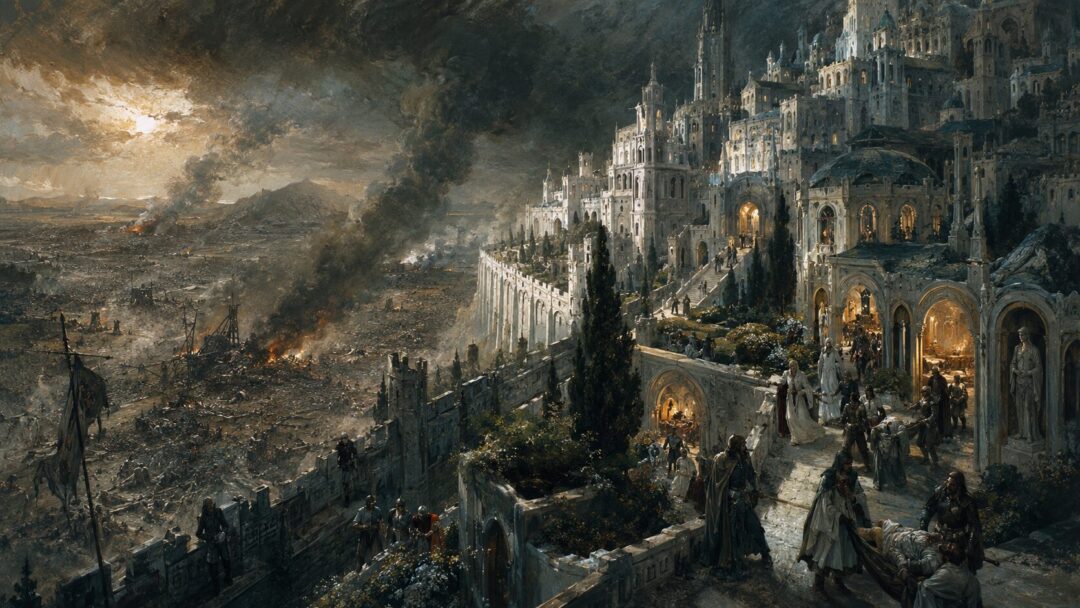
The Battle Is Won, but the Shadow Has Not Left
The Battle of the Pelennor Fields looks, at first glance, like the great turning point before the end: the horns of Rohan have sounded, Théoden has fallen in glory, the Witch-king has been overthrown, and the ships from the south have brought not Corsairs but Aragorn and the banner of Elendil. Minas Tirith survives. Sauron’s army is broken outside its walls.
But Tolkien does not let victory feel clean.
Immediately after the battlefield triumph, the story moves not to a coronation, not to celebration, and not even straight to strategy. It turns instead to the Houses of Healing. That choice matters. The Pelennor has been saved, but the wounds of the war are not only wounds of spear and sword. Some of the most important survivors are not merely injured; they have passed under a power that attacks courage, identity, memory, and hope.
The Houses of Healing show that the War of the Ring is not only decided by who can kill, command, or endure terror. It is also decided by who can restore life after terror has done its work.
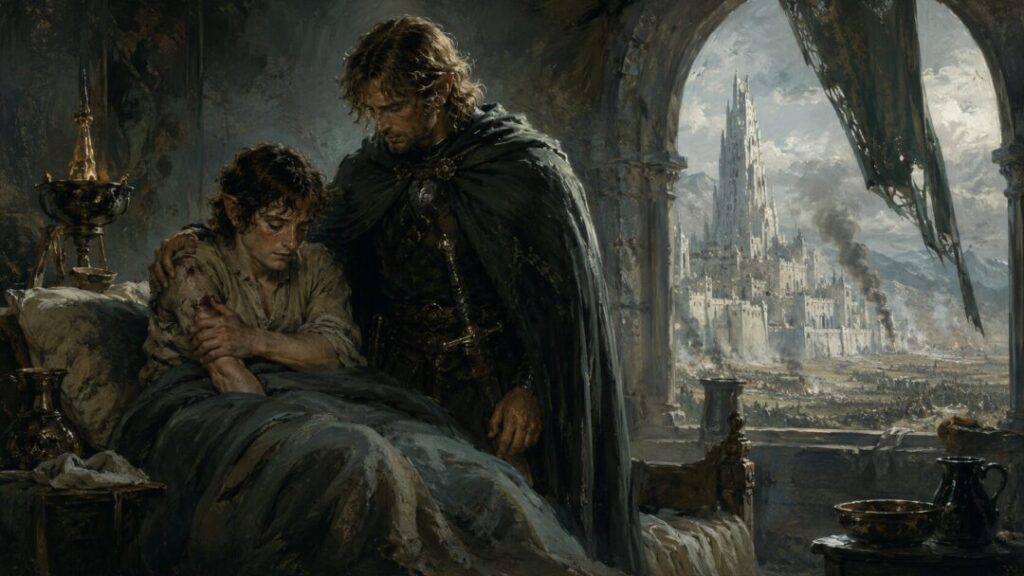
A Quiet Chapter After a Thunderous Battle
The placement of the Houses of Healing is easy to overlook because it follows one of the most dramatic battles in the entire legendarium. The fall of Théoden, Éowyn’s confrontation with the Lord of the Nazgûl, Merry’s hidden strike, and Aragorn’s arrival by ship are all outwardly heroic. They are scenes of noise, flame, banners, and desperate motion.
Then the story narrows into rooms of sickness.
This is not a pause from the real story. It is the consequence of the real story. Faramir, Éowyn, and Merry have each been drawn into the war in a different way, and each has been marked by the Enemy’s shadow. Faramir has been brought back from battle wounded and fevered after his father’s despair has nearly consumed him as well. Éowyn has slain the Witch-king, but her sword-arm is broken and she lies cold, touched by the Black Breath. Merry helped make that victory possible, but his own contact with the Nazgûl’s power leaves him gravely diminished.
The battle’s public victory hides private ruin. The Houses of Healing reveal it.
The Black Breath and the Cost of Coming Near Evil
The Witch-king’s fall is one of the great moments of hope in The Return of the King, but the aftermath reminds us that evil in Middle-earth is not harmless once defeated. Those who stand closest to it may survive and still be deeply wounded.
The texts connect the Nazgûl with a deadly spiritual oppression often called the Black Breath or Black Shadow. Its effects are not described like ordinary infection alone. Victims sink into coldness, dark dreams, weariness, and a loosening hold on life. This is why the healers of Minas Tirith are not enough. Their skill is real, but the hurt before them is more than surgical.
That matters because Tolkien’s war is never only physical. Sauron’s servants work through fear, despair, domination, and the weakening of the will. A blade can cut flesh, but the Shadow aims deeper. Éowyn’s sickness cannot be separated entirely from her long despair. Faramir’s condition follows both a military wound and the spiritual catastrophe of Denethor’s madness. Merry’s hurt comes from striking the Witch-king, a deed of immense courage that still leaves him nearly overcome.
The Houses of Healing therefore become the place where the hidden cost of heroism is finally acknowledged.
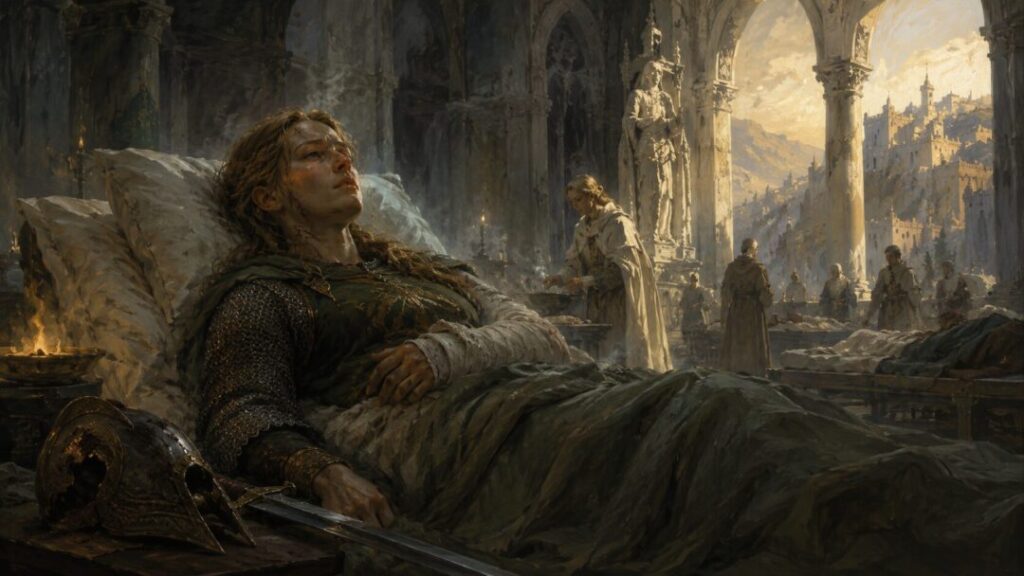
Faramir: Gondor’s Future Almost Lost
Faramir’s place in the Houses is especially important because he represents Gondor’s moral survival. Boromir is dead. Denethor has fallen into despair. If Faramir dies too, Gondor is not merely losing a captain; it is losing the last living son of the ruling Steward and one of the few leaders in the city who has already resisted the temptation of the Ring.
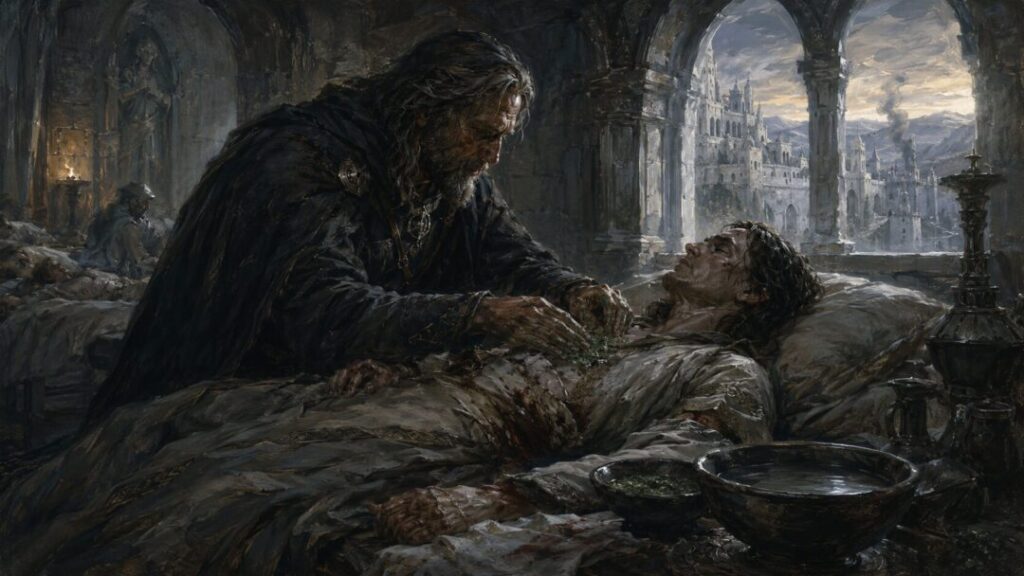
His healing is also the first clear public sign that Aragorn is not just a military claimant. Aragorn does not enter Minas Tirith as a conqueror demanding recognition. He waits outside the city before being summoned. The old saying remembered in Minas Tirith — that the hands of the king are the hands of a healer — becomes the test by which kingship is recognized.
When Faramir awakens and recognizes Aragorn as his king, the moment is politically important, but it is not merely political. Faramir’s recognition has moral weight because Faramir has already been shown to possess discernment. He refused to seize the Ring when it came within his reach. He is not easily dazzled by power. His acceptance of Aragorn helps bridge the old Stewardship and the restored kingship without civil rupture.
In that room, Gondor’s future is healed before it is crowned.
Éowyn: Victory Did Not Cure Despair
Éowyn’s presence in the Houses prevents a simple reading of her triumph over the Witch-king. She has done a deed worthy of lasting renown. Yet the text does not pretend that one heroic act instantly heals the grief, frustration, and death-wish that brought her to the battlefield in disguise.
Aragorn’s words about Éowyn are careful. He honors her courage, but he also sees that her sickness began before the Pelennor. She had felt trapped, unvalued, and denied any path that seemed worthy of her spirit. Her desire for battle was not only bravery; it was also entangled with despair.
This is one reason the Houses of Healing matter so much. They separate honor from healing. Éowyn’s deed is real. Her pain is also real. The story does not reduce her to either.
Her recovery is not completed the moment she wakes. Later, in the chapter “The Steward and the King,” she remains restless and still desires to ride to war. Her healing continues through waiting, conversation, and her growing bond with Faramir. When she eventually turns from seeking death in battle toward becoming a healer, that change should not be read as a denial of her courage. It is a transformation of her desire: from glory through death to life after ruin.
The Houses make that transformation possible.
Merry: The Small Hand That Changed the Great Battle
Merry’s role is easy to miss beside Éowyn’s confrontation with the Witch-king, but the text gives his action enormous significance. His stroke helps make the Witch-king vulnerable at the crucial moment. A hobbit, nearly forgotten on the field, helps bring down a terror that great warriors feared.
Yet Merry too is nearly lost.
His wound is not grand in appearance compared with the devastation around him, but it is spiritually dangerous. He has touched the realm of the Nazgûl’s power. In the Houses of Healing, his smallness becomes part of the point. The war has depended again and again on people whom the proud might overlook: hobbits, servants, the quiet-hearted, those without great titles.
Aragorn’s healing of Merry confirms that the king’s concern is not reserved for princes and captains. Faramir is the heir of the Steward. Éowyn is a noblewoman of Rohan. Merry is a hobbit far from home. All three matter.
The restored king is revealed by his attention to each of them.
Athelas: The Forgotten Leaf and the Return of True Knowledge
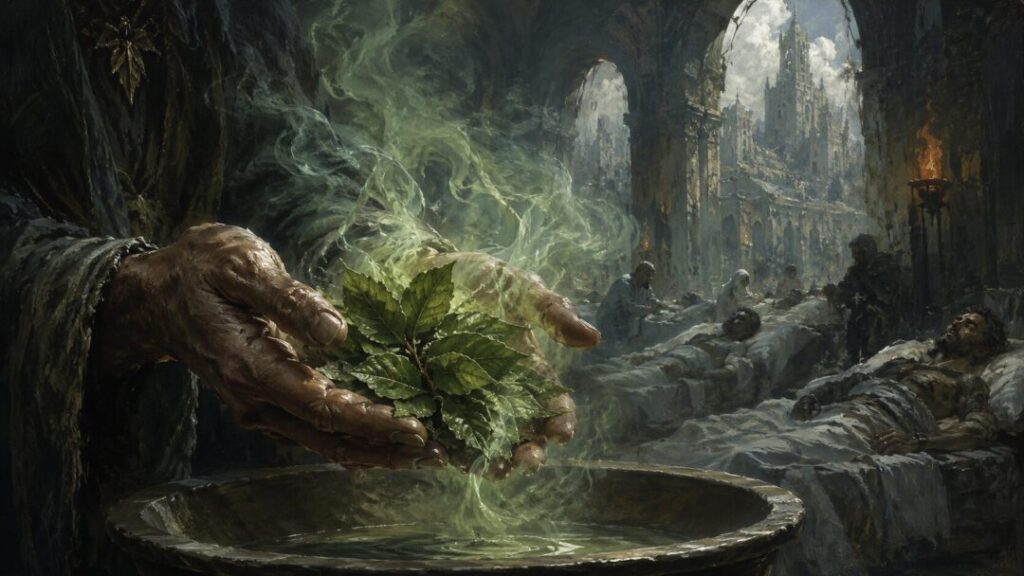
Athelas, or kingsfoil, is one of the most meaningful details in the chapter. In Gondor it is remembered by name, but its deeper use has faded. Some know old sayings about it. The herb still exists, but its virtue is not fully understood by the city’s ordinary healing lore.
That is a quiet image of decline. Gondor has not become evil, but it has forgotten part of its own inheritance. The return of the king is therefore not only the return of a bloodline. It is the return of lost wisdom, rightful service, and healing power.
Aragorn’s use of athelas does not work like a simple medicine in the modern sense. The leaf matters, but so does the healer. The fragrance that fills the room recalls freshness, memory, and the world beyond war. It is not merely a cure; it is a sign of life re-entering a place dominated by shadow.
This is one of the deepest reasons the Houses of Healing matter. They show that restoration in Middle-earth is not only about defeating evil. It is also about recovering good things that were neglected, half-forgotten, or dismissed as old tales.
Aragorn’s Kingship Is Proven by Mercy Before Rule
Aragorn has already proven himself in battle many times before this chapter. He has fought at Helm’s Deep, traveled the Paths of the Dead, mastered the captured ships, and come to Minas Tirith in its hour of need. Yet the city’s recognition of him does not truly begin with a battlefield speech. It begins with healing.
This is crucial. Aragorn’s kingship is not presented as naked power. He does not become king simply because he can command armies or because his ancestry is ancient. Those things matter within the story, but the Houses reveal the character of rightful rule. The true king restores. He enters the city not to seize a throne but to answer suffering.
Even after healing Faramir, Éowyn, and Merry, Aragorn does not turn the moment into personal spectacle. He continues tending others in danger. Word spreads through the city that the king has come again, but it spreads because of what he does, not because he has demanded praise.
The chapter therefore defines kingship as service before sovereignty.
The City Healed Before the World Is Saved
Another important detail is that the Houses of Healing occur before the final march to the Black Gate and before the Ring is destroyed. The war is not over. Sauron still exists. Frodo and Sam are still in Mordor. The Captains of the West still face a desperate decision.
And yet healing happens now.
That timing matters. Hope in Middle-earth is not postponed until everything is safe. It appears in the middle of danger, fragile but real. Faramir wakes. Éowyn breathes again. Merry returns from darkness. The city is still under threat, but life has begun to answer death.
This is not complete restoration. Many wounds remain. Théoden is dead. Denethor is dead. The Pelennor is full of loss. Frodo’s deepest wounds will not be fully healed in Middle-earth. Tolkien is not offering an easy victory where all pain disappears.
But the Houses of Healing show that evil does not get the final word inside the city. Before Sauron falls, his shadow is already being driven back in human hearts.
Why This Chapter Matters More Than It First Appears
The Houses of Healing matter because they gather the central themes of the War of the Ring into one quiet sequence: the cost of courage, the danger of despair, the humility of true kingship, the recovery of forgotten wisdom, and the possibility of renewal after devastation.
Faramir’s healing preserves Gondor’s moral and political future. Éowyn’s healing opens a path beyond death-seeking glory. Merry’s healing honors the hidden bravery of the small. Aragorn’s healing reveals the nature of the king before the crown is ever placed on his head.
After the Pelennor, it would have been easy for the story to move directly from victory to strategy. Instead, it stops among the wounded. That pause is not a delay. It is the meaning of the victory being clarified.
The battle saved Minas Tirith from destruction. The Houses of Healing show what it was saved for.
Not merely survival. Not merely rule. Not merely the defeat of an enemy.
Life restored. Wisdom remembered. Mercy made visible. A king known first by the healing of his hands.
Sources & Notes
- J.R.R. Tolkien, The Lord of the Rings, Book V, Chapter 6, “The Battle of the Pelennor Fields” — Éowyn and Merry’s confrontation with the Lord of the Nazgûl establishes both the victory and the terrible wounds that follow it.
- J.R.R. Tolkien, The Lord of the Rings, Book V, Chapter 8, “The Houses of Healing” — Aragorn heals Faramir, Éowyn, and Merry from the Black Shadow, showing that the battle’s aftermath is spiritual as well as physical.
- J.R.R. Tolkien, The Lord of the Rings, Book V, Chapter 8, “The Houses of Healing” — the saying “the hands of the king are the hands of a healer” and Aragorn’s use of athelas make mercy and restored knowledge signs of rightful kingship.
- J.R.R. Tolkien, The Lord of the Rings, Book IV, Chapter 5, “The Window on the West” — Faramir’s earlier refusal to seize the Ring gives his later recognition of Aragorn moral weight, not merely political convenience.
- J.R.R. Tolkien, The Lord of the Rings, Book VI, Chapter 5, “The Steward and the King” — Éowyn’s continued healing with Faramir turns her from death-seeking battle-glory toward life, renewal, and the work of healing.