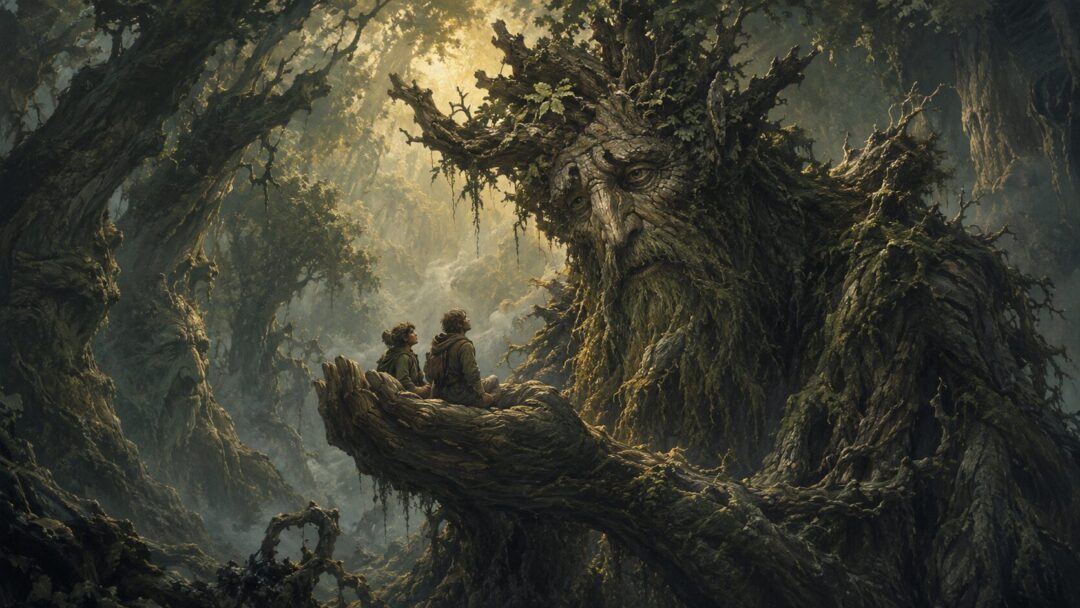
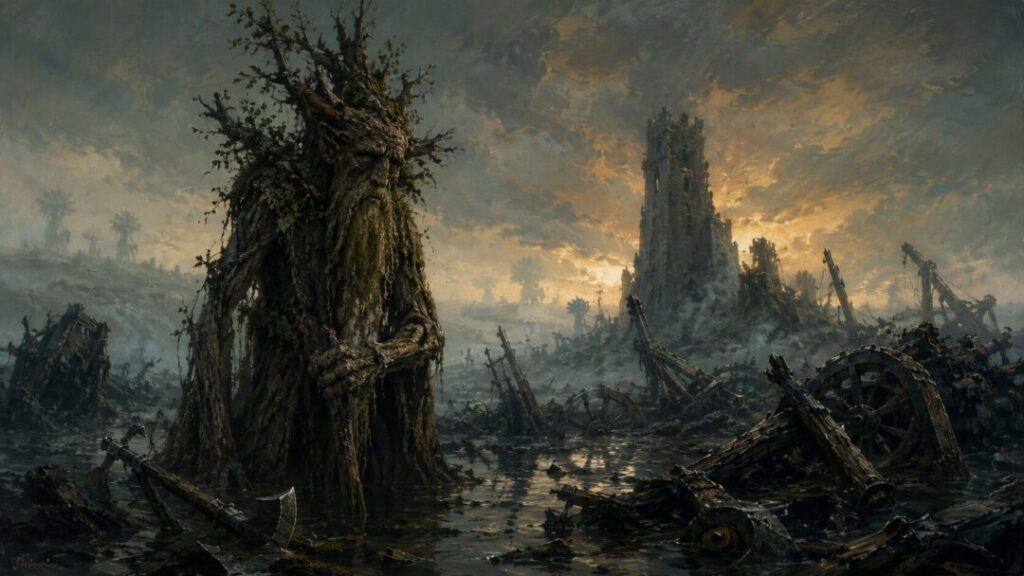
Treebeard’s most famous warning is not a battle cry. It is a restraint: do not be hasty. At first, that can make Fangorn feel like a place where urgency goes to die. Merry and Pippin have escaped Orcs. Rohan is threatened. Saruman is cutting, burning, and breeding war in Isengard. The world outside the forest is moving with terrifying speed.
And then they meet an Ent.
Treebeard listens. He talks. He carries them slowly through the forest. He gives them drink. He thinks. He calls a meeting. The Ents speak for days.
To a reader impatient for the war against Saruman, this can look like delay. To a casual fan shaped by adaptation memory, it may even seem like the Ents have to be persuaded that Saruman’s war matters. But in the book, Treebeard’s delay is not simple indecision. It is the visible form of an older moral order: a creature made for deep memory, communal judgment, and the guarding of living things deciding whether the time has finally come to break his own nature and march to war.
Fangorn’s Slowness Is Not Laziness
Treebeard is not slow because he is foolish. He is slow because he belongs to a kind of life almost opposite to Saruman’s.
The Ents are shepherds of trees. Their speech, memory, and names are rooted in long attention. Treebeard explains that real names in his language grow with the story of the thing named. That means an Entish name is not merely a label. It is a history. To speak fully is to remember fully.
This matters because Treebeard’s delay begins before any council is called. He does not immediately treat Merry and Pippin as battlefield messengers whose only value is information. He asks who they are. He considers what kind of beings hobbits might be. He compares what he sees with the old lists and lore of living creatures. He notices that hobbits do not fit neatly into what he already knows.
That moment is easy to overlook, but it shows the shape of his mind. Treebeard does not respond to the crisis by shrinking the world into strategy. He widens the world by making room for new knowledge.
His slowness is therefore not passivity. It is attention under pressure.
Saruman Represents the Opposite Kind of Time
The conflict between Treebeard and Saruman is not only forest against tower. It is patience against violent acceleration.
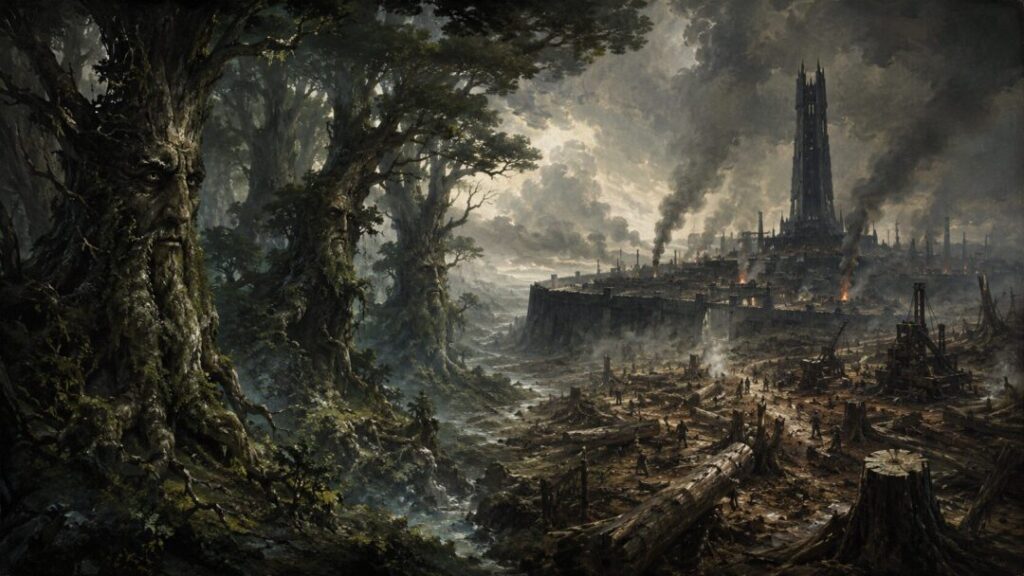
Saruman’s Isengard has become a place of pits, engines, smoke, axes, and organized destruction. He cuts trees not as living neighbors but as material. He burns and uses. He turns the valley of Isengard into a machine for war. His corruption is not merely that he chooses the wrong side. It is that he treats the world as something to be consumed quickly for power.
Treebeard’s delay must be read against that. If he simply reacted in blind fury, he would become more like the haste he opposes. The Ents are capable of terrible strength, but their strength is not supposed to be careless. They are not raiders. They are guardians.
That is why Treebeard’s reluctance has moral weight. The question is not, “Can the Ents smash Isengard?” The later story proves they can. The deeper question is, “When may beings made to preserve life rightly turn themselves into instruments of destruction?”
Treebeard’s answer cannot be instant. If it were instant, it would betray what he is.
He Is Already Troubled by Saruman
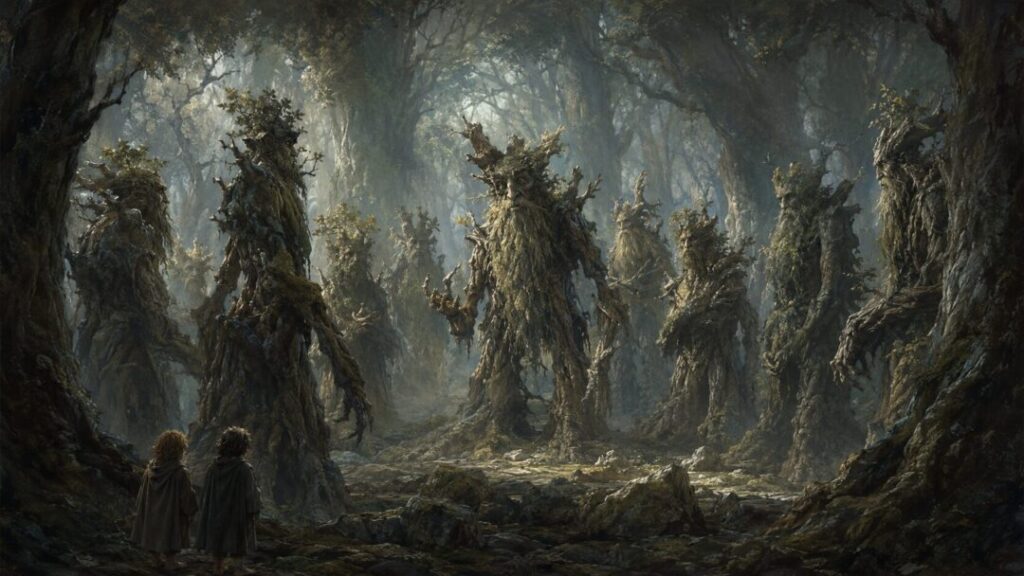
It is important to separate the book’s Treebeard from the simplified idea that he is unaware of Saruman’s danger until the last moment. In the text, Treebeard already knows that Saruman has become a dangerous neighbor. He knows trees have been felled. He knows Orcs have come with axes. His anger is not created out of nothing by the hobbits.
Merry and Pippin matter because they bring the outside crisis into Fangorn in a new way. They connect Saruman’s local violence against the forest with the wider war. They are living evidence that the troubles beyond the trees have entered Fangorn itself. They also bring news that helps Treebeard see the moment as more than another grievance in a long history of losses.
This is not the same as saying the hobbits “convince” the Ents in a shallow sense. Rather, their arrival becomes the spark that forces old knowledge into present decision.
Treebeard has been enduring injury. The hobbits help reveal that endurance has reached its limit.
The Entmoot Is Not Bureaucracy
Once Treebeard decides the matter must be brought to the others, he summons the Entmoot. This is sometimes mistaken for comic delay: ancient tree-people taking too long to hold a meeting while war burns around them. But the Entmoot is not bureaucracy. It is the proper form of Entish responsibility.
Treebeard is mighty, but he is not a tyrant. He does not simply command the Ents into battle. The decision belongs to the Ents together. That matters because the cost will be shared by them together.
The Ents are not a young people with endless generations ahead. They are diminished. The loss of the Entwives hangs over Treebeard’s story like an old wound that has never healed. Their future is uncertain, and the text never gives an easy restoration. When the Ents march, they do so with the sense that this may be one of their final great acts in the history of Middle-earth.
So the Entmoot’s slowness is part of the tragedy. A fading people must decide whether to spend what strength remains on a war they did not seek but can no longer avoid.
That is not indecision. That is consent before sacrifice.
Treebeard Understands the Cost of Rousing the Ents
There is a frightening difference between a sleeping strength and an awakened one. Treebeard knows this.
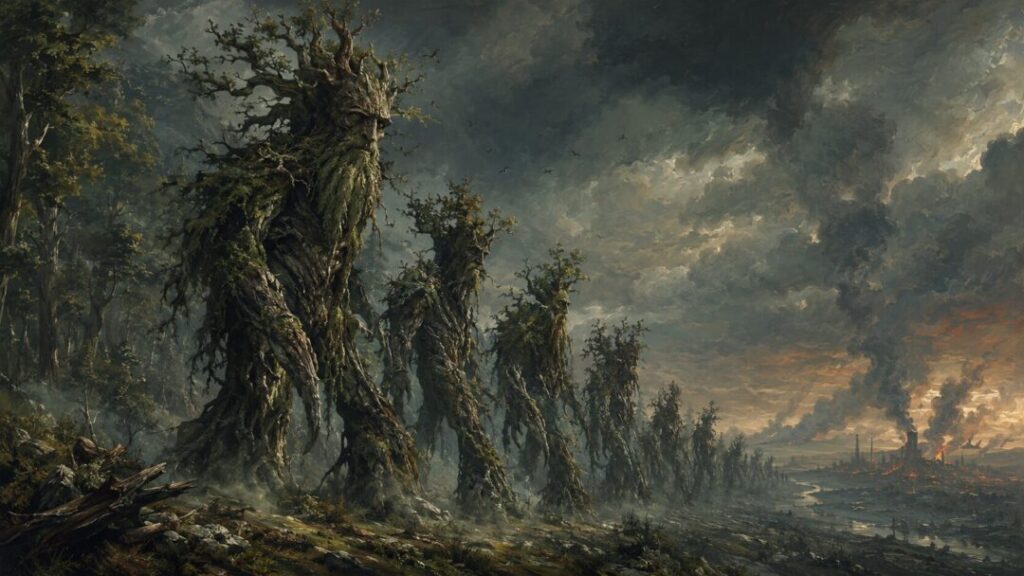
The Ents are not ordinary soldiers. When roused, they become a force of nature with memory and wrath. The assault on Isengard later feels overwhelming because it is not a standard military action. It is the forest itself, long-suffering and long-restrained, finally answering.
But Treebeard’s caution shows that such power should not be awakened lightly. In Middle-earth, power often becomes dangerous when it is separated from pity, wisdom, and restraint. The Ring is the greatest example, but the pattern appears elsewhere too. Strength without moral boundaries becomes domination. Anger without judgment becomes ruin.
Treebeard’s delay protects the Ents from becoming merely another violent power in a violent age. He does not deny anger. He disciplines it until it becomes judgment.
That is why the eventual march feels so solemn. The Ents do not erupt because they are easily provoked. They move because, after long thought, they recognize that not moving would also be a choice — and perhaps the worse one.
The Delay Reveals the Difference Between Fear and Wisdom
Some delays are cowardice. Some are confusion. Some are wisdom.
Treebeard’s delay contains grief, caution, and perhaps a kind of ancient weariness. But the text does not present him as craven. When the Ents finally decide, their action is swift in its own way. The long debate gives way to immediate movement. Once judgment is reached, Treebeard does not hide from its consequences.
This is one of the hidden tensions of his character. He is slow to decide, but not slow to act once the decision is rightly made.
That distinction matters. Many characters in The Lord of the Rings are tested by time. Boromir is tested by the urgent desire to use power now. Denethor is broken by what he thinks he sees of the future. Théoden must awaken from paralysis into action. Frodo must keep going when every step becomes harder. Treebeard’s test is different: he must know when patience stops being faithfulness and becomes surrender.
His greatness lies in recognizing the boundary.
Merry and Pippin Do Not Merely Interrupt History
The hobbits’ role in Fangorn is also easy to underestimate. They are not warriors of great renown. They do not arrive with armies or ancient titles. Yet their presence changes what happens.
This is very Tolkienian in spirit: small people carry news, perspective, and moral urgency into places that might otherwise remain sealed inside their own long sorrow. Merry and Pippin cannot defeat Isengard by strength. They cannot command Treebeard. They cannot out-argue the Entmoot in some formal political sense. What they can do is bear witness.
They show Treebeard that the war is no longer distant. They also awaken in him a kind of tenderness. He is curious about them, protective of them, and moved by them. Their smallness does not make them irrelevant; it makes the violence of Saruman’s world seem even more intolerable.
The Ents go to war for many reasons, but the hobbits help bring those reasons into focus.
The Irony of the Last March
The march of the Ents is triumphant, but it is not simple triumph.
They defeat Saruman’s works in Isengard. They tear down what his machinery has made. They flood the ring of stone and trap the fallen wizard in the tower he thought made him secure. In narrative terms, their arrival is one of the great reversals of The Two Towers: the old forest, dismissed or feared or forgotten, proves stronger than the new industrial fortress.
Yet the victory has an elegiac edge. The Ents are not restored to youth by winning. The Entwives are not found. The long decline of their people is not solved by one magnificent act. Treebeard’s later conversations still carry sadness. His victory over Saruman is real, but it does not undo all loss.
That makes his delay more poignant. He was not postponing an easy victory. He was weighing whether a wounded remnant of an ancient people should spend itself in one necessary act of resistance.
The Ents’ march is glorious because it is costly.
Why the Delay Matters to the Whole Story
Treebeard’s delay teaches one of the central moral rhythms of The Lord of the Rings: haste can be deadly, but endless waiting can also become a failure.
The wise do not act merely because they are angry. They also do not refuse to act merely because action is dangerous. Treebeard stands at that crossing. His slowness allows him to listen, remember, gather counsel, and measure the cost. But when the moment becomes clear, he moves.
That is why his delay is not simple indecision. It is the last deep breath before an ancient power enters history again.
Saruman’s world is built on speed: faster cutting, faster breeding, faster conquest, faster domination. Treebeard’s world is built on rootedness: memory, names, patience, and care. The wonder of Fangorn is that rootedness does not mean helplessness. A tree can wait for a very long time. But when the axe has gone too deep, even the oldest forest may rise.
Treebeard does not delay because he cannot choose.
He delays because the choice is grave enough to deserve the full weight of memory.
Sources & Notes
- J.R.R. Tolkien, The Lord of the Rings, Book III, Chapter 4, “Treebeard” — Treebeard’s long speech, his name-lists, and his refusal to be “hasty” show Entish delay as deep memory and deliberation rather than simple indecision.
- J.R.R. Tolkien, The Lord of the Rings, Book III, Chapter 4, “Treebeard” — the Entmoot takes nearly three days, but the Ents reach a sudden common resolve once Saruman’s tree-killing is judged and the decision becomes morally clear.
- J.R.R. Tolkien, The Lord of the Rings, Book III, Chapter 5, “The White Rider” — Gandalf says the coming of Merry and Pippin to Fangorn was no mere chance, framing Treebeard’s delayed choice as part of a larger turn in the war.
- J.R.R. Tolkien, The Lord of the Rings, Book III, Chapter 8, “The Road to Isengard” — the march of the Ents and the ruin of Isengard show that Treebeard’s slow counsel leads to decisive action once awakened.
- J.R.R. Tolkien, The Silmarillion, “Of Aulë and Yavanna” — the origin of the Ents as shepherds and defenders of trees gives Treebeard’s caution a rooted purpose, not a lack of will.