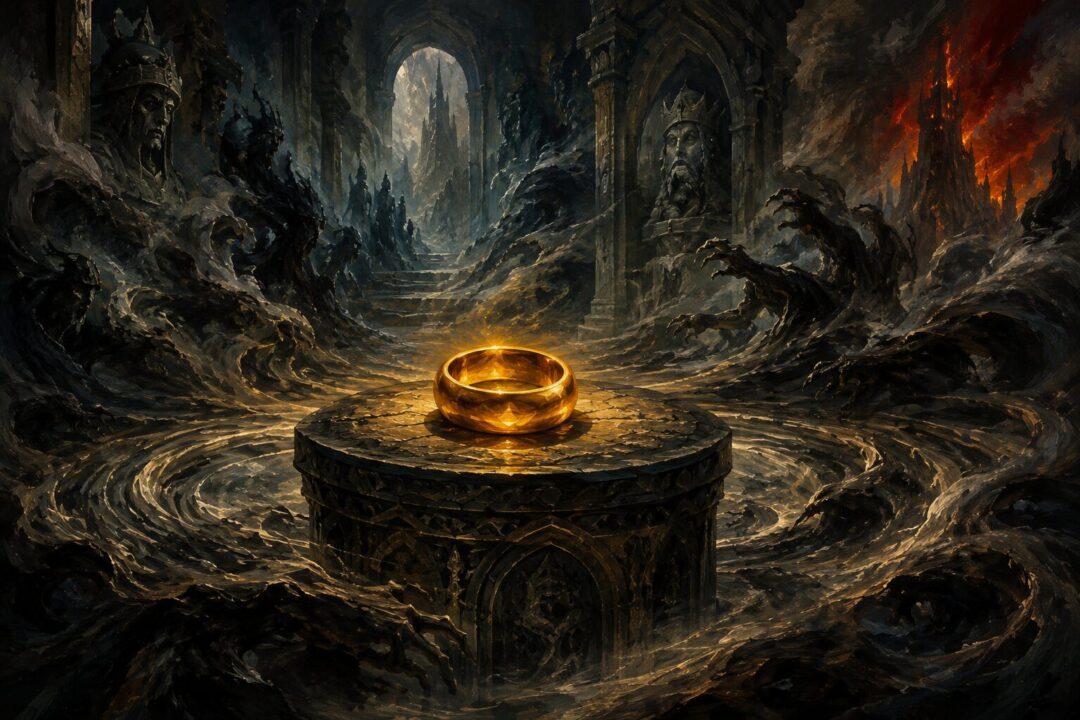
The One Ring is often remembered as the ultimate weapon of evil, a treasure coveted by Dark Lords and hunted by heroes alike. Yet one of the most unsettling truths in Middle-earth is that its greatest danger was never limited to openly wicked people. The Ring was most terrifying when it came into the hands of those who genuinely wished to heal the world.
Again and again, the story presents the same unsettling pattern. The people best suited to resist the Ring are not those with the greatest strength, wisdom, or authority. Instead, they are often those willing to refuse power altogether.
That paradox lies at the heart of the Ring's corruption. It did not simply persuade people to become cruel. It encouraged them to believe that cruelty could become necessary if it achieved a noble end. The desire to protect could become domination. Justice could become control. Mercy could become compulsion. The Ring transformed good intentions into tyranny because it offered power while quietly reshaping the mind that wielded it.
The Ring Was Made to Dominate Wills
The Ring was never a neutral magical artifact. It was forged by Sauron for a specific purpose: to rule the other Rings of Power and extend his own dominion over Middle-earth.
Into it he poured a significant part of his native power, making the Ring inseparable from his own will. As explained in The Lord of the Rings, the Ring sought always to return to its maker whenever possible. Even separated from Sauron, it retained the purpose for which it had been created.
That purpose matters.
The Ring does not merely grant abilities. It embodies domination. Anyone attempting to wield it is attempting to use an instrument whose very nature is mastery over others.
This explains why even well-meaning individuals are placed in extraordinary danger. They are not simply picking up a weapon. They are trying to command a force designed to bend minds toward a single ruler.
Corruption Began With Virtue, Not Vice
Perhaps the most remarkable feature of the Ring is that it rarely begins its temptation with selfish desires.
Instead, it identifies what someone already values.
A ruler wishes to protect a kingdom.
A wizard hopes to preserve peace.
A healer longs to end suffering.
A warrior seeks victory over evil.
None of these desires are inherently corrupt.
The danger comes when unlimited power appears to make those worthy goals finally achievable.
Rather than asking someone to abandon goodness, the Ring encourages them to redefine goodness as absolute control.
That gradual shift is what makes the temptation so persuasive.
Gandalf Feared Becoming Exactly What He Opposed
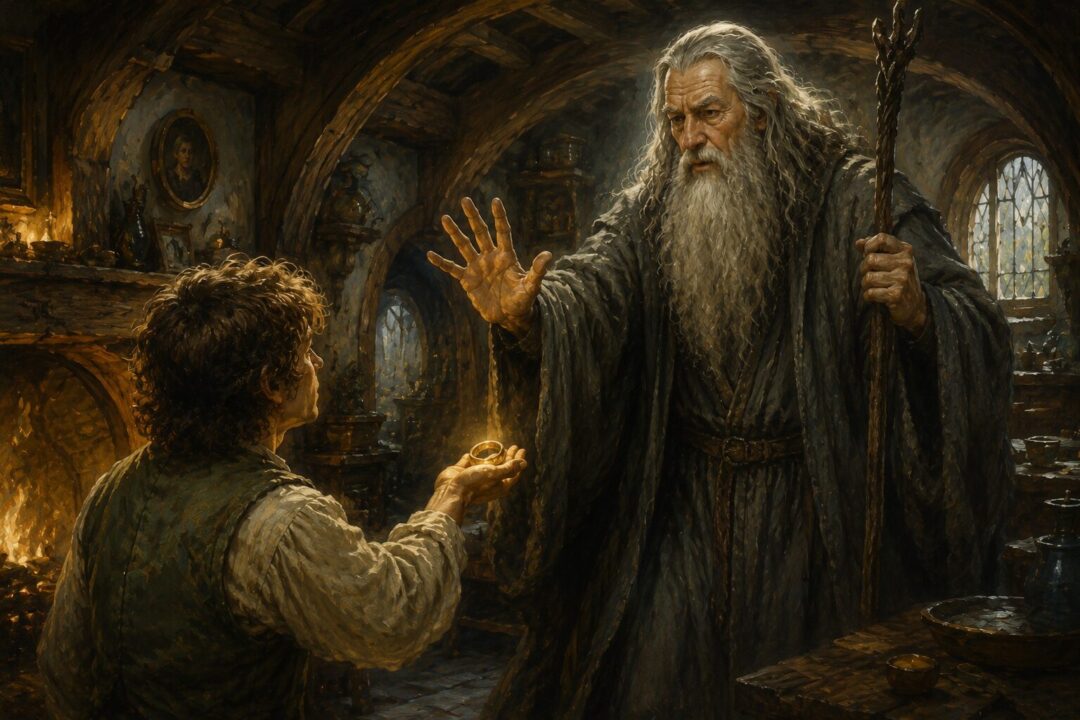
One of the clearest explanations comes when Frodo offers the Ring to Gandalf.
The wizard refuses immediately, declaring that he would use it from a desire to do good. Yet he recognizes that through him it would wield "a power too great and terrible to imagine."
This is one of the defining moments of The Fellowship of the Ring.
Gandalf does not fear suddenly becoming another servant of Sauron. He fears something subtler.
He understands that possessing overwhelming power would eventually convince him that he alone knew what was best for everyone else.
His compassion would remain real.
His wisdom would remain real.
But both would become instruments of command rather than guidance.
The tragedy is that Gandalf's greatest strengths would become the very channels through which the Ring could corrupt him.
Galadriel Imagines a Beautiful Tyrant
Galadriel's temptation offers perhaps the most vivid image of benevolent tyranny in the legendarium.
When Frodo freely offers her the Ring in Lothlórien, she envisions herself transformed.

She imagines becoming "beautiful and terrible as the Morning and the Night."
She would be admired.
She would be loved.
She declares that all would love her and despair.
Those words reveal the true danger.
Galadriel does not imagine rivers of blood or endless destruction.
She imagines universal obedience.
The vision is majestic rather than monstrous.
Her imagined rule would appear glorious, yet freedom itself would quietly disappear beneath overwhelming authority.
Only after rejecting the Ring does she recognize that passing this test means remaining herself instead of becoming a magnificent tyrant.
Boromir Shows How Urgency Accelerates Corruption
Boromir's fall illustrates another aspect of the Ring's influence.
Unlike Gollum, Boromir is not driven by greed.
His homeland stands on the front line against Mordor.
He has watched Gondor bleed for generations.
When he argues that the Ring should be used against Sauron, his reasoning is understandable.
Destroying such a weapon appears wasteful when defeat could mean the end of everything.
Yet the Ring gradually narrows his thinking.
Every alternative begins to seem irresponsible.
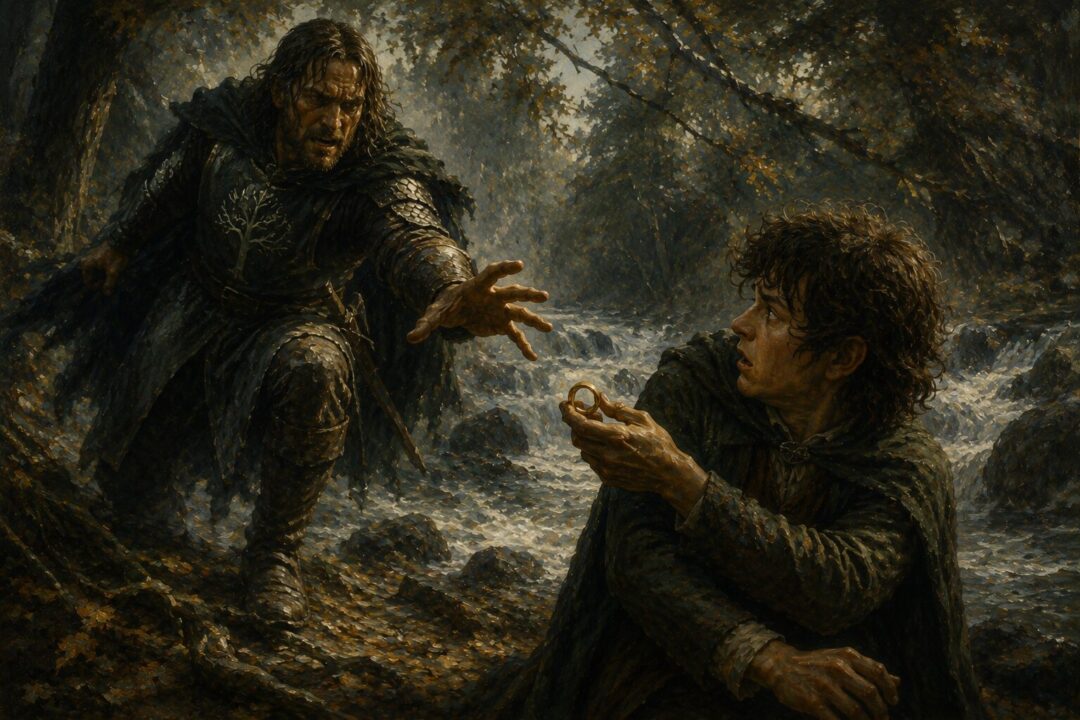
Eventually he convinces himself that taking the Ring from Frodo is not theft but necessity.
The moment reveals how fear can combine with noble purpose to justify acts previously considered unthinkable.
Importantly, Boromir repents almost immediately after his failure, sacrificing his life to defend Merry and Pippin. His story demonstrates both the Ring's power and the possibility of moral recovery after falling into temptation.
Aragorn Wins by Refusing the Shortcut
Many readers expect Aragorn, as the rightful king, to seize the Ring as the ultimate weapon.
Instead, he consistently rejects that path.
His claim to kingship rests not on possessing irresistible force but on serving the people of Gondor and Arnor according to justice.
The contrast matters.
Throughout the story, Aragorn repeatedly chooses leadership over domination.
He inspires loyalty rather than compelling it.
The texts never suggest that Aragorn could safely master the Ring indefinitely. On the contrary, Elrond's Council concludes that no one can use it without eventually falling under its influence.
His strength lies precisely in refusing the apparent shortcut to victory.
Why Hobbits Resist Longer
The remarkable resilience of Bilbo, Frodo, and Sam has often led readers to wonder whether Hobbits possess some special immunity.
The texts never state this.
Instead, several factors seem to reduce the Ring's immediate hold over them.
Hobbits generally seek quiet lives rather than dominion over kingdoms.
Their ambitions are modest.
They possess little interest in ruling others.
As Gandalf observes, Bilbo's pity and mercy help preserve him far longer than might otherwise be expected.
Even so, resistance has limits.
Bilbo becomes increasingly possessive after decades of ownership.
Frodo ultimately claims the Ring at the Crack of Doom.
Sam briefly imagines transforming Mordor into a vast garden under his command before rejecting the fantasy.
The Ring reaches each of them through different hopes, proving that no one is entirely beyond its influence.
The Ring Never Offered True Freedom
One misconception is that a powerful enough individual might eventually master the Ring without cost.
The Council of Elrond rejects this possibility.
Elrond explains that using the Ring against Sauron would simply replace one Dark Lord with another.
Elsewhere in The Lord of the Rings, Gandalf suggests that someone of extraordinary stature might overthrow Sauron using the Ring, but only to become another tyrant in his place.
The Ring cannot become an instrument of lasting justice because its essential nature remains unchanged.
Its victories always depend upon domination.
Its methods reshape the one who employs them.
Even apparent success carries the seeds of future oppression.
Power Changed the Means, Then the Ends
One of the deepest insights of the story is that corruption rarely arrives all at once.
The Ring first changes methods.
"If only this once."
"If only until the danger passes."
"If only because no better option exists."
Over time, repeated reliance upon overwhelming power begins altering the goals themselves.
Protection becomes permanent supervision.
Order becomes enforced conformity.
Peace becomes unquestioning obedience.
The ruler who once sought to defend freedom eventually concludes that freedom itself has become too dangerous.
This progression explains why the Ring corrupts even without overt lies.
Its logic appears reasonable at every stage.
Only in hindsight does the transformation become unmistakable.
Mercy, Not Power, Ultimately Saves Middle-earth
The destruction of the Ring comes about through choices that appear weak by conventional standards.
Bilbo spares Gollum.
Frodo repeatedly refuses to kill him.
Sam also shows mercy when given the chance.
These acts are not strategic calculations.
They are moral decisions made despite uncertainty.
At the Crack of Doom, Frodo finally fails to surrender the Ring voluntarily. The Quest succeeds not because its bearer proves morally flawless, but because earlier acts of mercy preserve Gollum's life, allowing him to seize the Ring and inadvertently destroy it.
Victory therefore comes through compassion rather than domination.
This ending reinforces the central message of the Ring's corruption.
No amount of righteous force could safely wield it.
Only the willingness to reject absolute power—and the unexpected consequences of mercy—made its destruction possible.
The Ring's Greatest Lie
The One Ring's greatest deception was never that evil was attractive.
Its greatest deception was convincing good people that they alone could safely wield absolute power.
Every major temptation in The Lord of the Rings follows that pattern. The individual believes they can remain morally unchanged while employing an instrument created solely for domination. Yet the Ring gradually reshapes judgment itself until tyranny seems indistinguishable from responsibility.
The lasting power of this idea extends far beyond Middle-earth. The story suggests that evil rarely announces itself openly. More often, it arrives wearing the language of necessity, security, justice, or peace.
The Ring did not create every desire within those who encountered it. It magnified existing virtues, detached them from humility, and redirected them toward control. That is why its temptation proved so dangerous.
The heroes who endured were not those capable of mastering absolute power.
They were those wise enough to refuse it.
Sources & Notes
- Wikipedia overview of the One Ring and its corrupting influence — https://en.wikipedia.org/wiki/One_Ring
- Wikipedia overview of Boromir, one of the clearest examples of good intention twisted by the Ring — https://en.wikipedia.org/wiki/Boromir
- Wikipedia overview of Galadriel and her rejection of the Ring’s temptation — https://en.wikipedia.org/wiki/Galadriel
Sources selected for Tolkien-lore context and reader verification.