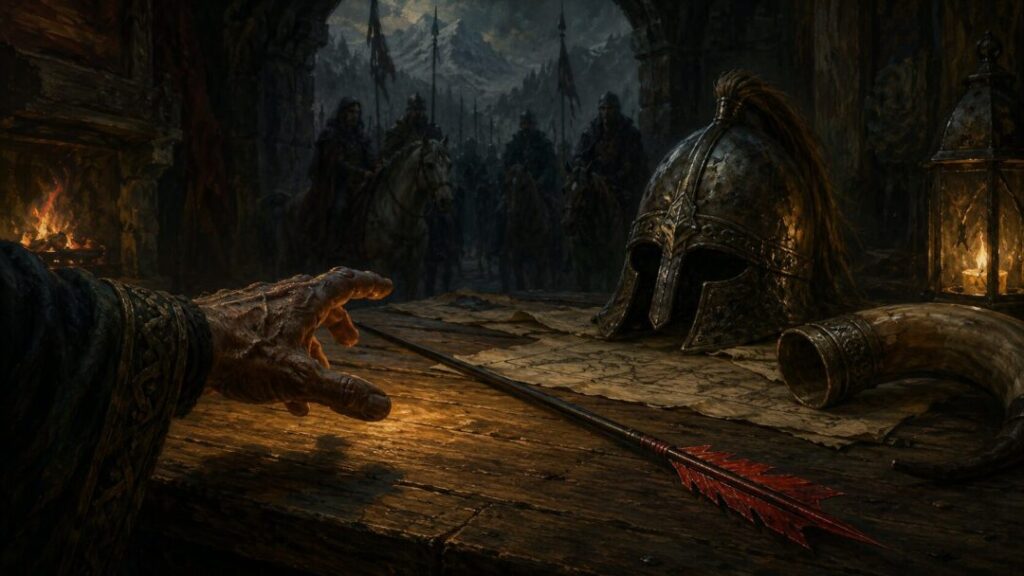
The Red Arrow is one of the smallest objects in The Lord of the Rings, yet it carries the weight of kingdoms. When it comes to Théoden at Dunharrow, it is not a weapon, not a jewel, not a Ring of Power, but a token of desperate need: Gondor is calling for aid. Minas Tirith is under shadow. The Steward’s realm is looking northward and westward, hoping the horse-lords will come.
But the crucial thing is that Rohan could not answer that call merely by having horses, spears, and brave men. It needed a restored king.
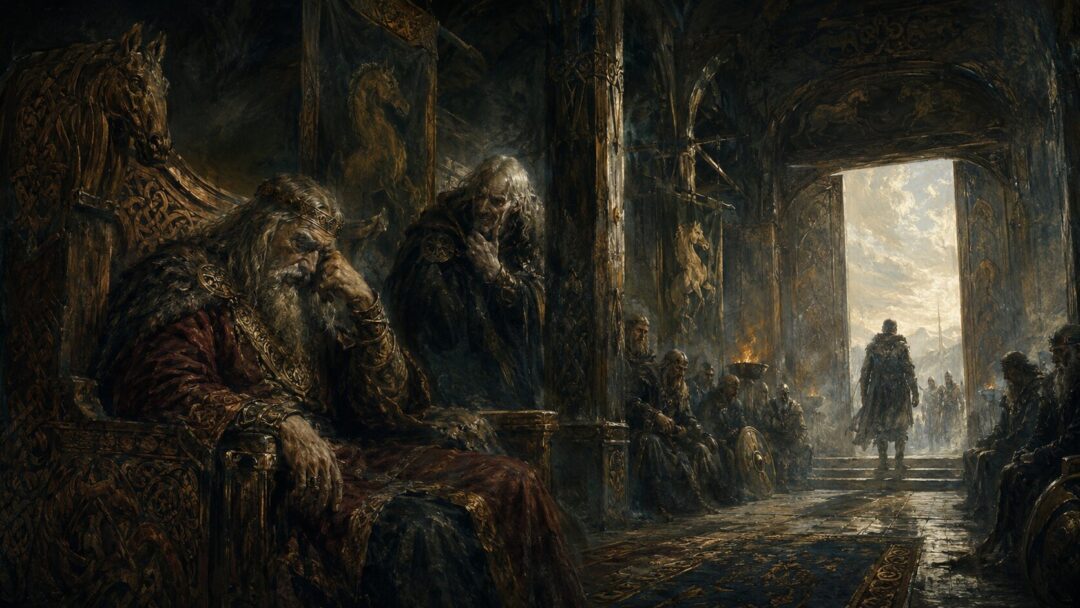
That is easy to miss because the Rohirrim are often remembered as a people of sudden motion: horns, hooves, banners, and the thunder of cavalry. Yet before they can become the great rescuing force on the Pelennor Fields, they must first be rescued from inward paralysis. The real turning point does not begin at dawn outside Minas Tirith. It begins earlier, in the Golden Hall of Meduseld, where Théoden sits aged, diminished, and surrounded by counsel that has taught him to despair.
Rohan saves Gondor because Théoden is restored before the summons comes. Without that restoration, the Red Arrow might have arrived in a kingdom unable to move.
A Kingdom Held Back From Within
When Gandalf, Aragorn, Legolas, and Gimli come to Edoras, Rohan is not defeated in open battle. It is being slowly disabled. Saruman’s war is already active, but his danger is not only military. His influence has reached the king’s hall through Gríma Wormtongue, who has become Théoden’s counsellor.
The texts do not present Théoden as a mindless puppet. That distinction matters. In the book, his restoration is not simply a magical “awakening” from total possession. He speaks, remembers, questions, grieves, and makes choices. But his will has been bent downward. He has been fed fear, suspicion, and hopelessness until he sees the ruin of his house as nearly inevitable.
This is why Rohan’s crisis is moral and political before it is military. A nation can have warriors and still be useless if its judgment is poisoned. Théoden’s son Théodred has already been slain at the Fords of Isen. Éomer, one of Rohan’s strongest captains, has been imprisoned after defying the king’s command and threatening Gríma. The king’s own sword, Herugrim, has been kept away from him and is later found in Wormtongue’s possession. These are not random details. They show a kingdom whose strength has been separated from its rightful center.
The king is alive, but kingship has been hollowed out.
Gríma’s Victory Was Delay
Gríma’s power does not depend on conquering Rohan in a single dramatic stroke. His method is delay, division, and discouragement. He does not need to make the Rohirrim cowardly. He needs to keep their courage unused.
That is one of the most dangerous forms of corruption in Middle-earth: not the open worship of evil, but the quiet argument that action is pointless. Théoden is urged toward caution that has become paralysis. Éomer is treated as a rebel rather than a loyal warrior. Gandalf is dismissed as a bringer of ill news. The danger from Isengard is minimized until it is nearly too late.
This is why Théoden’s restoration is not merely personal healing. It is the breaking of a political spell. Once he can see clearly again, the lines of loyalty become visible. Éomer is not the danger. Gríma is. Gandalf is not the enemy. Saruman is. The king’s weakness is not wisdom. It is the condition that has allowed Rohan to be weakened from inside.
The restoration of Théoden restores the proper order of the realm. The king listens again to true counsel. He takes up his sword again. He chooses action. That choice immediately changes what Rohan is capable of becoming.
Gandalf Restores More Than Strength
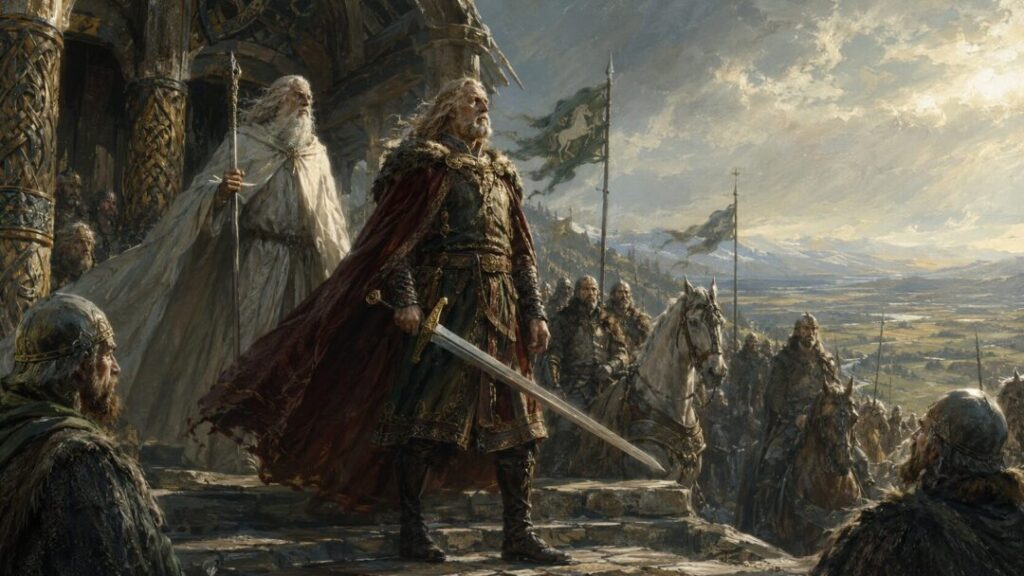
Gandalf’s confrontation in Meduseld is often remembered as a healing scene, but it is also a scene of truth. He exposes Gríma’s counsel for what it is. He draws Théoden out of the darkened hall and into the open air. The movement itself matters: from enclosure to clarity, from whispers to daylight, from seated decay to standing command.
The text is careful not to reduce this to simple physical rejuvenation. Théoden remains an old man. His death is not far away. But after Gandalf’s intervention, age is no longer the same as defeat. Théoden does not become young; he becomes kingly again.
This distinction is central. Rohan does not need Théoden to become invincible. It needs him to become free enough to choose rightly.
His first great choice is not the ride to Gondor, but the decision to ride against Saruman’s forces. He does not hide behind the walls of Edoras. He gathers what strength he can and goes to war. The victory at Helm’s Deep follows, not because Rohan has suddenly become safe, but because its king has stopped surrendering the future in advance.
Only after that can Rohan become the ally Gondor needs.
Rohan Had to Survive Isengard First
The road to Minas Tirith runs through the crisis of Isengard. This is another point easily overlooked. Rohan cannot ride to Gondor while Saruman remains an immediate threat in its rear. If Théoden had not been restored in time to confront Saruman’s assault, the Mark might have been shattered or pinned down before Gondor’s need became most desperate.
The Battle of the Hornburg therefore matters not only as Rohan’s own defense, but as preparation for Gondor’s deliverance. Théoden’s renewed leadership helps Rohan survive the blow designed to break it. The Ents’ destruction of Isengard removes Saruman’s power as a strategic threat, but Théoden still has to make the choices that bring his people through the danger.
By the time the Red Arrow reaches him, Rohan is wounded but not leaderless. Its king has already returned to command. Its captains are no longer trapped in internal mistrust. Its people have been gathered. Its movement toward war is already underway.
Gondor’s summons does not create Théoden’s courage. It reveals it.
The Red Arrow Needed a King Who Could Answer
When Hirgon brings the Red Arrow to Théoden, the request is grave: Gondor needs aid, and the enemy is pressing hard. The beacons and the Red Arrow belong to the old bond between the realms, but a summons is only meaningful if someone has the authority and will to respond.
A weakened Théoden under Gríma’s counsel might have delayed. He might have found reasons to preserve what remained of Rohan. He might have mistrusted Gondor’s need, or judged the ride impossible, or waited until the moment had passed. The texts do not show this alternate history directly, so it should be treated as implication rather than stated fact. But the pattern before Gandalf’s arrival makes the danger clear: Wormtongue’s influence had already turned necessary action into hesitation.
The restored Théoden does not treat Gondor’s plea as a convenient burden to avoid. He accepts the moral weight of alliance. He knows Rohan has suffered. He knows he cannot bring as many riders as Gondor hopes. He knows the road is perilous. Yet he chooses to go.
That is the difference restoration makes. It does not remove fear. It restores the capacity to act faithfully despite fear.
Théoden’s Ride Is Not Just Strategy
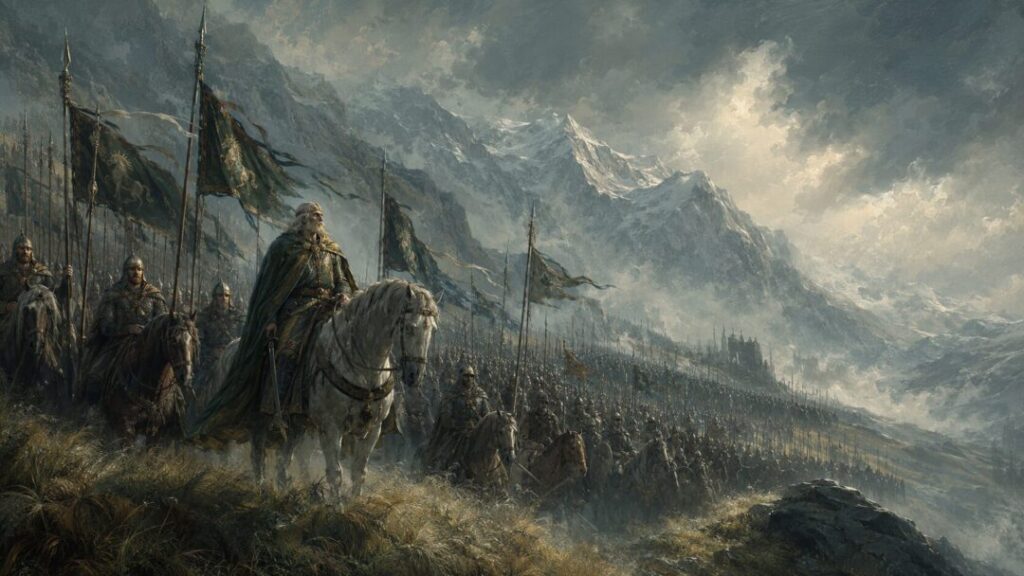
The ride of the Rohirrim is militarily crucial, but its deeper power is sacrificial. Théoden is not riding because victory is guaranteed. In fact, much of the atmosphere before the Pelennor is darkened by uncertainty. The riders pass through secret ways with the help of the Wild Men of the Woods. They come upon signs that Gondor’s messengers have been slain. The road is dangerous, and the hour is late.
Yet Théoden continues.
This is where his restoration reaches its fullest meaning. In Meduseld, he is a king being taught to expect the end. On the Pelennor, he becomes a king who rides into what may indeed be the end, but does so freely, with honor and purpose. The difference is not whether death is possible. The difference is whether death is allowed to dictate the soul before it comes.
That is why his charge feels like more than reinforcement arriving at the correct time. It is the answer of a healed will to a world under shadow.
Gondor Needed Hope From Outside Its Walls
Minas Tirith is a city under siege, but it is also a city under the pressure of despair. Denethor’s tragedy unfolds in the same war that restores Théoden. Both are rulers facing overwhelming darkness, but they respond differently. Denethor’s despair narrows inward. Théoden’s restored courage moves outward.
This contrast should not be made too simplistic. Denethor is not without wisdom, and Théoden is not without fear. But narratively, their paths diverge sharply. Denethor becomes consumed by the belief that defeat is inevitable. Théoden, once freed from similar hopelessness, rides even when success is uncertain.
Gondor therefore needs more than troops. It needs the visible arrival of hope from beyond itself. When the horns of Rohan sound on the Pelennor, the effect is not merely tactical. The besieged city is no longer alone. The old alliance has not failed. The world has not entirely withdrawn into self-preservation.
That hope could only arrive because Théoden had first received it.
The Mercy Hidden in Restoration
There is also a quiet mercy in Théoden’s restoration: he is given time to become himself again before he dies. He does not perish as a diminished king in a dark hall, with his son dead, his captain imprisoned, and his realm manipulated by a traitor. He dies in battle after leading his people to the aid of their allies.
This does not make his death less tragic. Éowyn’s grief beside him remains one of the most piercing moments in the story. But it changes the shape of the tragedy. Théoden’s end is not a waste engineered by Wormtongue. It is a costly completion of restored kingship.
He is allowed to spend his final strength in service rather than confusion.
That is one of the great moral patterns of The Lord of the Rings. Restoration does not always mean long life, safety, or escape from sorrow. Sometimes it means being made whole enough to give oneself rightly.
Why Rohan Could Save Gondor
Rohan saves Gondor because horses arrived at dawn. But beneath that unforgettable image lies a chain of earlier restorations.
Théoden had to be brought out of despair. Gríma had to be exposed. Éomer had to be released back into loyalty and command. Herugrim had to return to the king’s hand. Rohan had to survive Saruman. The king had to choose alliance over self-preservation. The riders had to follow not a figurehead, but a lord whose courage had been rekindled.
The rescue of Gondor therefore begins before Gondor’s walls. It begins when a king who has been made old before his time stands again in the light and accepts the burden of action.
That is the hidden rule behind the Ride of the Rohirrim: a kingdom cannot bring hope to another realm while its own heart is enthralled to despair. Théoden needed to be restored because Rohan’s strength was never merely in its cavalry. It was in rightly ordered courage, loyal counsel, remembered oaths, and a king willing to spend his last days in defense of something greater than survival.
Before Rohan could save Gondor, Théoden had to become Théoden again.
Sources & Notes
- J.R.R. Tolkien, The Lord of the Rings, Book III, Chapter 6, “The King of the Golden Hall” — Gandalf exposes Wormtongue’s counsel, Théoden takes up Herugrim again, and Éomer is restored to the king’s service.
- J.R.R. Tolkien, The Lord of the Rings, Book III, Chapter 7, “Helm’s Deep” — Théoden’s renewed kingship becomes action as he rides out in battle rather than surrendering Rohan to Saruman’s war.
- J.R.R. Tolkien, The Lord of the Rings, Book III, Chapter 8, “The Road to Isengard” — the aftermath of Helm’s Deep shows Rohan’s order re-centered around Théoden, Gandalf, and true counsel after Saruman’s designs fail.
- J.R.R. Tolkien, The Lord of the Rings, Book V, Chapter 3, “The Muster of Rohan” — the Red Arrow reaches Théoden, and the restored king must decide whether Rohan will answer Gondor’s desperate summons.
- J.R.R. Tolkien, The Lord of the Rings, Book V, Chapter 5, “The Ride of the Rohirrim” — Théoden leads the Rohirrim to Minas Tirith, turning the earlier restoration of Rohan into the rescue of Gondor.