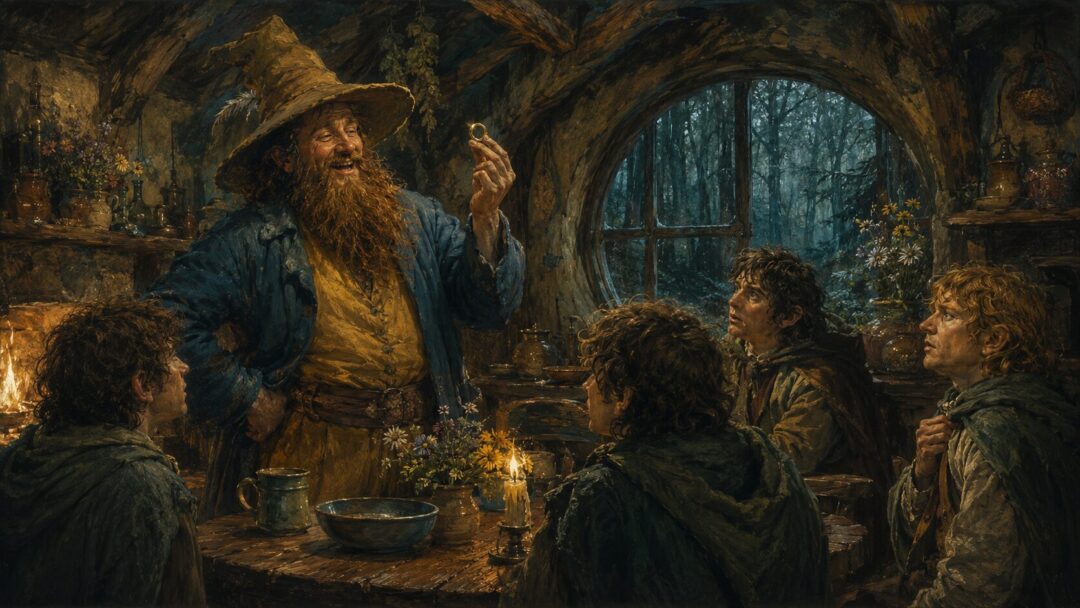
The strangest thing about the One Ring is not that it made kings afraid, Elves cautious, and wizards refuse it. It is that, for one bright moment in the Old Forest, it became a toy.
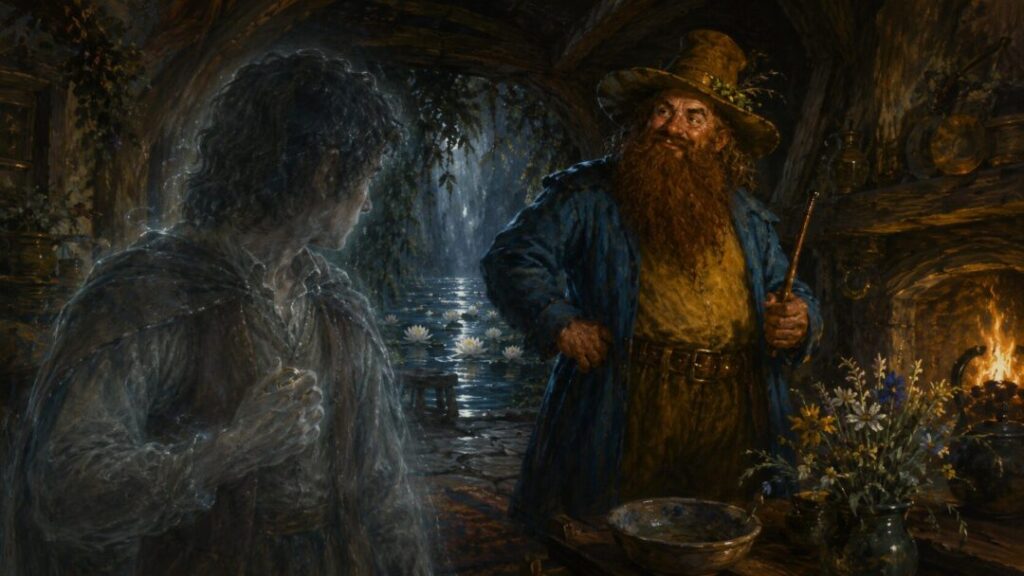
Frodo placed the Ring in Tom Bombadil’s hand, and the whole logic of Middle-earth seemed to bend. This was the Ring of Sauron, the hidden engine of the Third Age’s terror, the object Gandalf would not dare to take and Boromir could not stop imagining as a weapon. Yet Tom looked at it, played with it, put it on, and did not vanish. He even saw Frodo after Frodo used it.
For many readers, that raises the obvious question: if Tom Bombadil could laugh at the Ring, why not give it to him? Why send frightened Hobbits into Mordor when there was someone in Middle-earth whom the Ring could not corrupt?
The answer is one of the most overlooked moral rules in The Lord of the Rings: freedom from temptation is not the same as fitness for a burden.
The Ring Could Not Command What Tom Did Not Desire
The Ring works by reaching into desire. It does not simply whisper, “be evil.” It offers a version of power that matches the bearer. To Boromir, it appears as a way to defend Gondor. To Galadriel, it opens the terrible possibility of becoming a radiant queen. To Gandalf, it would tempt him through pity and the desire to do good by force.
That is why the Ring is so dangerous. It does not need crude greed. It can corrupt noble motives by turning them toward domination.
Tom Bombadil is different because he does not appear to want dominion. In his own land, he is called “Master,” but the text carefully distinguishes that from ownership or control in the usual sense. Goldberry’s answer to Frodo implies that the trees, grasses, and creatures are not Tom’s possessions. He is master because he is himself, not because he has made the world submit to him.
That distinction matters. Tom’s mastery is not Sauron’s mastery in miniature. He sings, names, commands, and rescues, but he is not building an empire, gathering servants, or bending others into instruments of his will. His authority feels local, personal, and mysterious. It is not political power. It is not military power. It is not the desire to reshape the world.
So when the Ring comes to him, it has little to fasten onto. It is a tool of domination offered to someone who does not seem interested in dominating.
That is why Tom can laugh at it. Not because he is simply “stronger than Sauron” in the ordinary sense. The Council of Elrond does not treat him as a secret weapon. Gandalf’s explanation is more precise: the Ring has no power over him. That is not the same as saying Tom has power over the Ring.
Tom’s Immunity Is Also His Limitation
The temptation is to treat Tom Bombadil’s immunity as the greatest possible qualification. If the Ring cannot corrupt him, surely he is the safest bearer.
But The Lord of the Rings quietly reverses that assumption. The very quality that makes Tom safe from the Ring also makes him unreliable for the Quest.
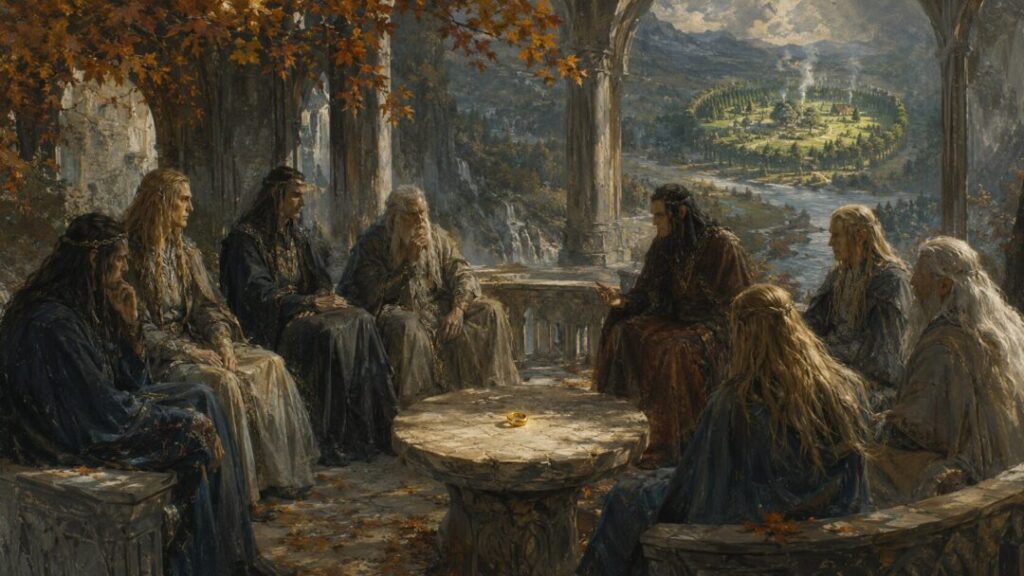
At the Council of Elrond, the idea of entrusting the Ring to Bombadil is considered and rejected. The reason is not that Tom would secretly fall. It is almost the opposite: he would not take the Ring seriously enough. Gandalf says, in effect, that Tom might accept it if everyone begged him, but he would not understand the need. He might forget it, mislay it, or throw it aside.
That is not foolishness in the simple sense. Tom is not stupid. He knows ancient things, remembers deeply, and speaks with an authority that unsettles the Hobbits’ sense of history. But his attention belongs to his own mode of being: the Old Forest, the Withywindle, Goldberry, songs, weather, lilies, names, and the life of things as they are.
The Quest requires a different kind of attention. It requires fear, discipline, secrecy, endurance, and a terrible awareness of consequence. Frodo must remember the Ring every waking hour. Sam must remember Frodo. Aragorn, Gandalf, and the others must shape their choices around a burden they cannot directly control.
Tom’s freedom from the Ring is therefore not enough. The Ring-bearer must not only avoid corruption; he must carry the Ring toward its destruction. Tom can ignore the Ring’s lure, but the Quest cannot be completed by indifference.
The Quest Needed a Bearer Who Felt the Weight
Frodo’s greatness lies partly in the fact that he is vulnerable. That sounds backwards, but it is central to the story.
Frodo is not immune. He is wounded by the Morgul-knife. He is hunted by the Nazgûl. He feels the Ring grow heavier as he approaches Mordor. He suffers fear, pity, exhaustion, and finally failure at the very edge of success. His heroism is not that he floats above the Ring’s danger. His heroism is that he keeps going while the danger works on him.
Tom Bombadil could hold the Ring without being inwardly claimed by it, but Frodo can represent the moral drama of the Ring in a way Tom cannot. Frodo knows what it costs. He understands, more and more painfully, that the Ring is not a trinket. He carries not only an object but a responsibility.
That responsibility is inseparable from the pity and mercy that shape the end of the Quest. Frodo’s mercy toward Gollum, Bilbo’s earlier pity, and Sam’s final endurance all matter. The Ring is destroyed not by a pure being strolling untouched through evil, but through a chain of wounded, limited people making choices under pressure.
This is one reason Tom cannot simply replace Frodo. A story in which the Ring is carried by someone beyond its reach would not be the same moral story. More importantly within the world itself, such a bearer might not stay on the road long enough to reach Orodruin. The Quest required someone small enough to go unnoticed, humble enough not to claim lordship, and burdened enough to understand the danger.
Tom is too free for that burden.
His Power Has Borders
Tom’s land feels like a pocket of another kind of reality. Old Man Willow cannot defeat him. The Barrow-wight cannot withstand him. The Hobbits, who have been swallowed by the terrors of old places, find in Tom a rescuer whose songs break fear apart.
But the text does not present Tom’s power as a solution for the War of the Ring. It is bounded. The Council’s discussion makes clear that Tom has withdrawn into a small country of his own. His power is immense within that sphere, but it does not become a strategy for saving Gondor, breaking Mordor, or overthrowing Sauron.
This is crucial. Tolkien’s world contains many kinds of power, and they are not interchangeable. Elrond’s wisdom cannot simply march as an army. Galadriel’s beauty cannot be used like a sword without becoming perilous. Gandalf’s authority is bound by restraint. Aragorn’s kingship must arrive through service before command.
Tom’s power belongs to presence, delight, and unpossessive mastery. It is real, but it is not a campaign. He can save the Hobbits from the Old Forest and the Barrow-downs; he cannot become the answer to Mordor.
The Council even suggests that if Sauron conquered everything else, Tom would eventually fall, “last” as he had been “first.” That line is often missed. It means Tom is not an ultimate rival to Sauron. He is not the hidden god of Middle-earth waiting to reveal himself. He is ancient and astonishing, but not the final defense of the world.

The Ring Was Not Merely a Dangerous Object
Another mistake is to imagine the Ring as if it were a cursed jewel that only needed a safe hiding place. If that were true, Tom might seem ideal. Put the Ring in his house, let Goldberry set flowers beside it, and forget Sauron forever.
But the Ring is tied to Sauron’s continuing power. As long as it exists, the danger remains. Hiding it may delay disaster, but it cannot heal the world. The Ring must be unmade in the fire where it was made.
This is why several easier answers fail. The Wise cannot use it. They cannot simply send it over the Sea. They cannot hide it forever in Rivendell. They cannot entrust it to someone who does not grasp its urgency. The Ring is not defeated by being ignored. It is defeated only by destruction.
Tom’s laughter reveals something true: the Ring’s power is not absolute over every being in every circumstance. But that truth does not solve the central problem. The question is not only, “Who can resist it?” The deeper question is, “Who can bear it along the road appointed for it?”
Tom can resist it because it is almost nothing to him. But because it is almost nothing to him, he is the wrong guardian for the one thing that must never be forgotten.
Tom Shows What Sauron Cannot Understand
Tom Bombadil’s presence still matters deeply. He is not a plot hole. He is a contradiction placed near the beginning of the journey to widen the reader’s understanding of Middle-earth.
Sauron thinks in terms of possession, surveillance, command, and fear. The Ring itself embodies that logic. It is power concentrated into an object: the will to rule made portable. Nearly everyone who encounters it must define themselves against that temptation.
Tom stands outside that logic. He does not defeat the Ring by counter-force. He makes it look small. For a moment, the most feared object in the story is placed in the hands of someone who has no use for it.
That moment is not a mistake. It shows that Sauron’s worldview is not the whole truth. Domination is terrifying, but it is not ultimate. There are forms of life that do not answer to it in the expected way: delight, rootedness, naming, song, hospitality, and love of things for themselves.
Yet the story is not naïve enough to say that such innocence can carry the war for everyone else. Bombadil’s world is beautiful, but it is not enough. The Shire also is beautiful, and it must be defended. Lothlórien is beautiful, and it is fading. Rivendell is wise, and it cannot remain untouched forever. Good things may be outside Sauron’s spirit, but they are still threatened by Sauron’s victory.
Tom reveals the poverty of evil’s imagination. He does not provide the military answer to evil’s advance.
The Paradox of Bombadil
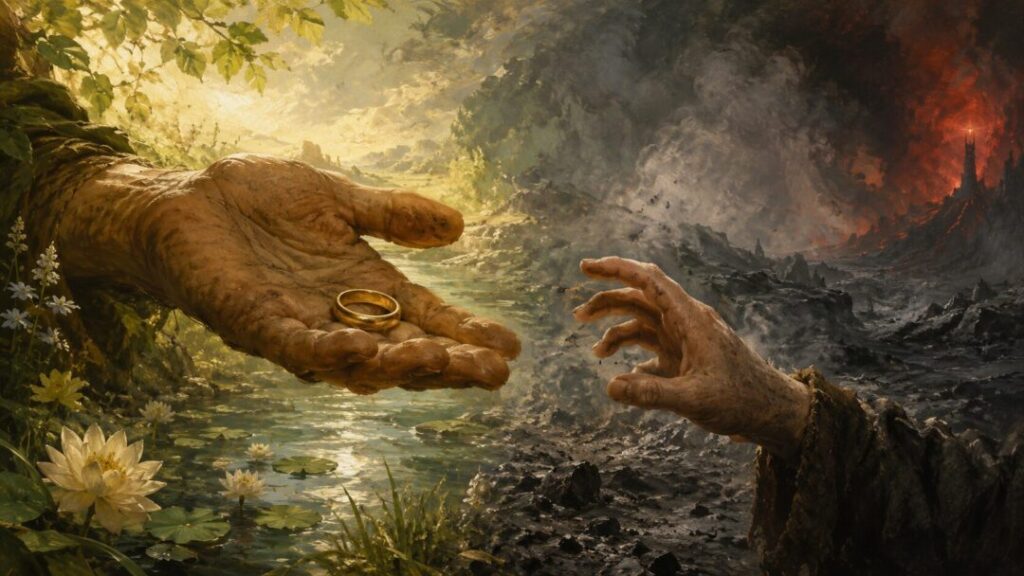
So why could Tom Bombadil laugh at the Ring but not carry the Quest?
Because the Quest was not simply about finding someone incorruptible. It was about destroying the instrument of domination through humility, endurance, mercy, and sacrifice. Tom’s immunity made him safe from the Ring’s seduction, but not faithful to the Ring’s necessary destruction. He could hold it lightly because it meant little to him. The Quest required someone to hold it heavily and still keep walking.
Frodo could not laugh at the Ring. That is why his burden matters. Sam could not dismiss it as a bauble. That is why his loyalty matters. Gollum could not let it go. That is why pity, in the end, becomes part of providence.
Tom Bombadil remains one of Middle-earth’s great mysteries, but the Council of Elrond gives a clear enough answer to this question. He is not excluded because he is weak in the ordinary way. He is excluded because his strange freedom is not the kind of strength the Quest demands.
The Ring could not master him.
But neither could the Quest claim him.
Sources & Notes
- J.R.R. Tolkien, The Lord of the Rings, Book I, Chapter 6, “The Old Forest” — Tom Bombadil’s command over Old Man Willow first shows his local, song-bound mastery rather than ordinary political power.
- J.R.R. Tolkien, The Lord of the Rings, Book I, Chapter 7, “In the House of Tom Bombadil” — Tom handles the Ring, puts it on without vanishing, and sees Frodo while Frodo is wearing it, showing that the Ring has no normal power over him.
- J.R.R. Tolkien, The Lord of the Rings, Book II, Chapter 2, “The Council of Elrond” — the Council rejects giving the Ring to Bombadil because he would not understand the need, might forget it, and could not withstand Sauron if all else fell.
- J.R.R. Tolkien, The Lord of the Rings, Book I, Chapter 2, “The Shadow of the Past” — Gandalf explains the Ring’s corrupting pull through power, pity, and Gollum’s part in the wider design of the Quest.
- J.R.R. Tolkien, The Lord of the Rings, Book VI, Chapter 3, “Mount Doom” — the Ring is destroyed through Frodo’s burden, Gollum’s seizure, and the mercy that kept Gollum alive, not by an untouched bearer simply ignoring it.