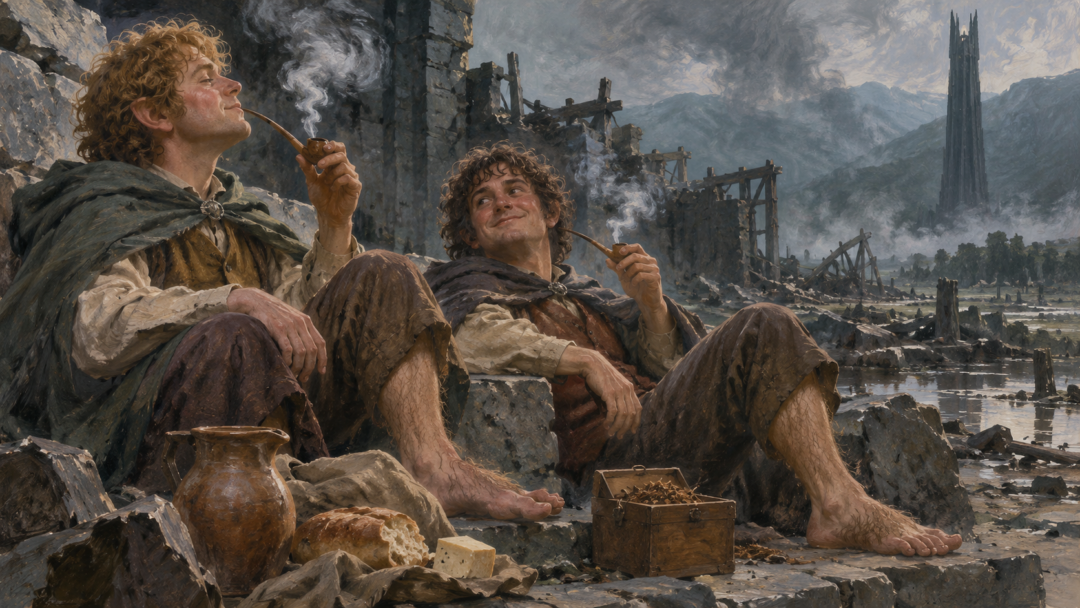
Among the wreckage of Isengard, Merry and Pippin find time for their pipes. They have discovered Longbottom Leaf among Saruman's stores, and the pleasures of home seem startlingly close amid the ruins of a wizard's power. For hobbits, pipe-weed belongs to everyday life, not to the grand machinery of kings and wars. Yet another variety of that familiar leaf carries a surprisingly luminous name: Southern Star.
Why would hobbits choose a name that sounds almost celestial? The most economical explanation is wonderfully down to earth. Southern Star was grown in the Shire's Southfarthing, while star may refer to the star-shaped flowers associated with pipe-weed. [Tolkien Gateway](https://tolkiengateway.net/wiki/Southern_Star) offers the floral reading as a presumption, not as a recorded explanation from whoever first used the name. Its namer's intention remains unknown.
A name that begins in the Southfarthing
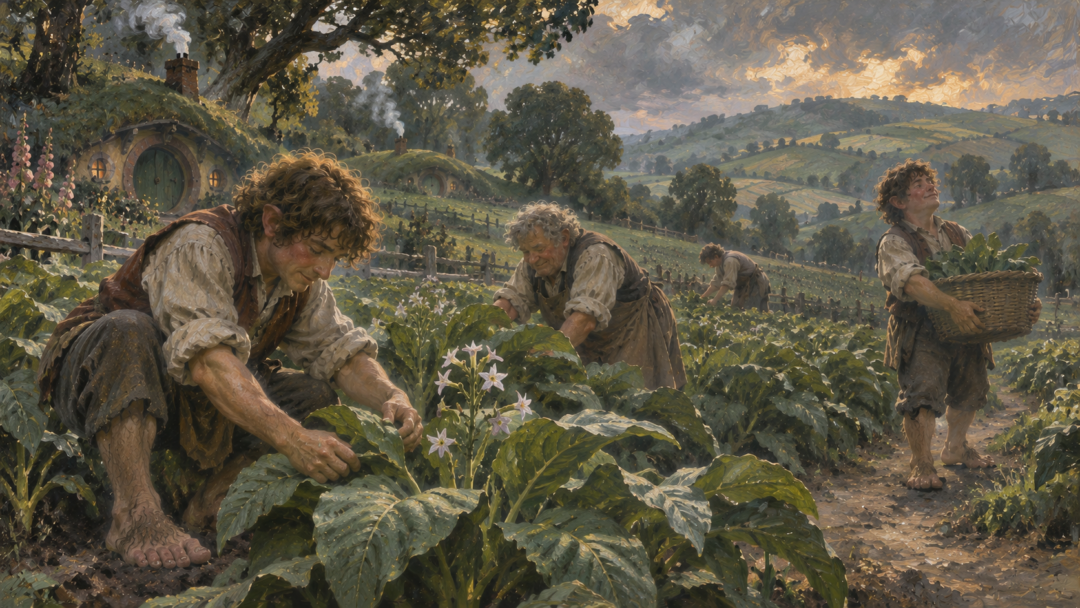
The Shire is divided into four Farthings, and the Southfarthing is especially associated with growing pipe-weed. Tolkien's account of the herb names Longbottom Leaf, Old Toby, and Southern Star as notable varieties cultivated there. That makes southern a fairly direct geographical clue: it can point to one part of the hobbits' own country without requiring a voyage across Middle-earth.
Longbottom gives this geography a more particular focus. Tolkien Gateway describes Southern Star as apparently originating in the district around Longbottom. Apparently deserves attention: that is a qualified identification, not an exact address for a first planting or a record of who selected its name. The Shire's familiar place-names sometimes create an illusion of complete local knowledge. In this case, the surviving explanation is brief, and the details remain open.
The district also carries an important agricultural memory. In the Prologue to The Lord of the Rings, Tobold Hornblower, known as Old Toby, is credited with first cultivating true pipe-weed in his gardens at Longbottom around the year 1070 in Shire-reckoning. That makes him an early grower of a celebrated crop, not demonstrably the inventor of smoking and certainly not a documented inventor of Southern Star. His history does not explain every variety's name.
A farmer, customer, or traveller might have understood a southern variety as a leaf associated with a particular growing district. That inference needs no invented label or marketplace conversation.
The star might have grown on the plant
The second half of the name is the real puzzle. Modern readers meeting star in Tolkien may immediately think of the night sky, Elvish songs, or ancient light. But stars are not confined to astronomy. Flowers can have radiating petals, and the shape of a blossom offers a simpler, more local explanation for a plant's name.
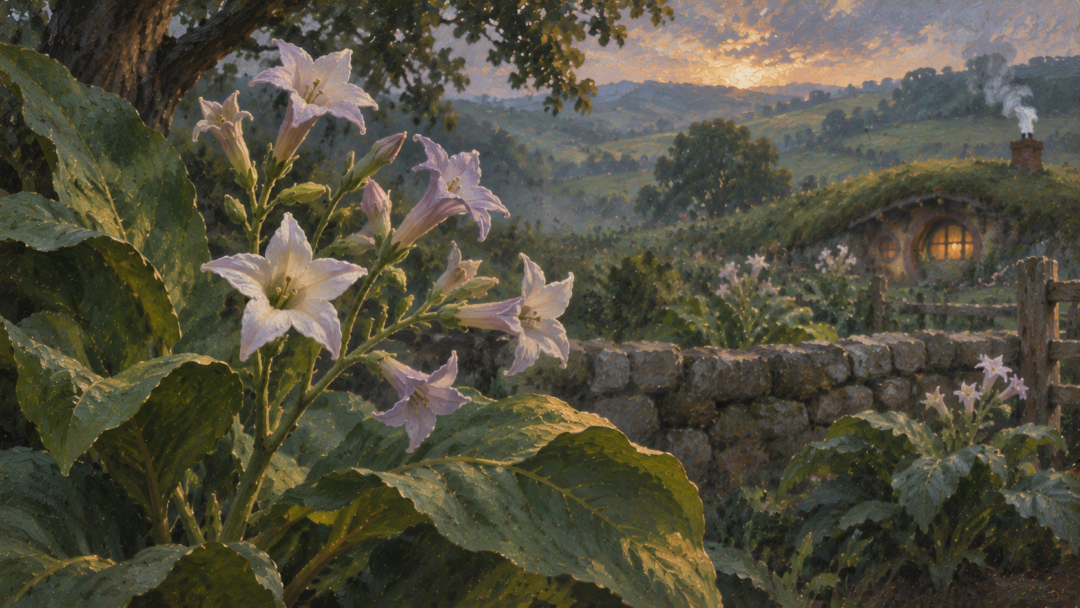
Tolkien Gateway suggests that the star probably refers to pipe-weed's star-shaped flowers. This does not establish the shape, colour, or size of the blossoms on Southern Star in particular, nor does it report a statement by Tolkien explaining his choice. It is an interpretation, plausible partly because the fictional herb is associated with the real tobacco-plant group, Nicotiana.
The [Royal Horticultural Society](https://www.rhs.org.uk/plants/nicotiana) describes Nicotiana as producing long, tubular flowers that open into a broad star. The image is easy to picture: a narrow blossom widening at its mouth into a pointed, radiating form. A person growing or gathering the plant could notice that shape long before thinking about its dried leaves. Some real nicotianas have fragrant flowers that open in the evening, too, although that botanical fact should not be turned into a claim about the exact habits of Southern Star.
The comparison has limits. Tolkien's pipe-weed is probably a variety of Nicotiana in the fictional account, but no definitive modern species is assigned to Southern Star. Real flowers cannot prove a fictional bloom or naming event. An imagined picture of pale, starry flowers in a Southfarthing field is an illustration of the idea, not an authenticated botanical portrait.
One detail from the Prologue gives flowers a place in the herb's history. The people of Gondor are said to value the plant for the fragrance of its flowers rather than for the hobbits' habit of smoking its leaves. The contrast widens our view of pipe-weed. It is not merely something stored in barrels or packed into pipes: within Middle-earth, it is also a growing herb with a scent, a flowering season, and a life before harvest.
What the other names tell us
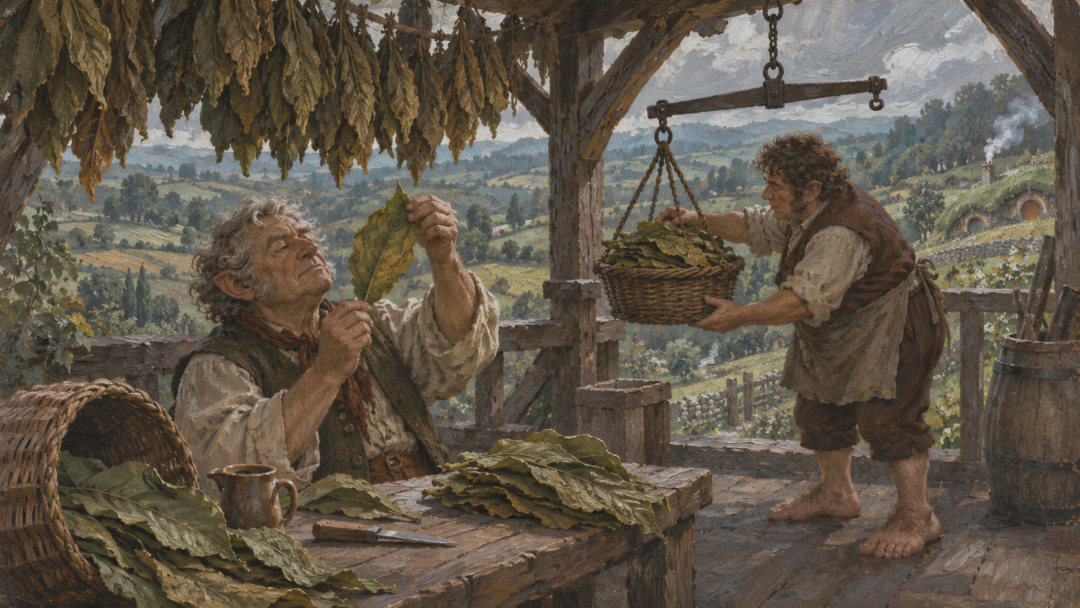
Southern Star stands beside two better-known names in the Prologue's list of Southfarthing varieties: Longbottom Leaf and Old Toby. One identifies a place; the other recalls a grower. Neither needs a hidden mythology.
Old Toby shows how a crop name can preserve a person's reputation. Longbottom Leaf shows how closely a leaf can be associated with where it was grown. Southern Star could combine those familiar naming instincts: southern locating the leaf in the Shire, star describing an appealing feature of the plant. It is poetic yet compatible with rural speech.
We should not go further than that. These three examples do not establish a formal Shire system of cultivar naming, and nothing in their names ranks their strength, quality, rarity, or cost. Nor can we identify a particular farmer, blender, or seller who introduced Southern Star. The names tell us something about the world in which a variety could be remembered; they do not provide a commercial history.
Tolkien gives Southern Star a name, not a dossier of seeds, harvest methods, flavour, or appearance. Supplying those facts would falsify the level of detail in the fiction.
Merry's history is careful about beginnings
The Prologue to The Lord of the Rings includes a section called "Concerning Pipe-weed," drawing on the herb-lore associated with Meriadoc Brandybuck. It is one of those passages where Tolkien treats apparently small hobbit customs with the seriousness usually reserved for dynasties. The effect is affectionate, but the history is also full of distinctions that readers can easily blur.
The custom of smoking and the cultivation of leaf in the Shire are not identical stories. The hobbits of Bree claim an early place in the smoking tradition, and the Prancing Pony matters to its spread. Tobold Hornblower's achievement concerns growing true pipe-weed in Longbottom. That does not make him the inventor of pipes or every variety.
The account also gestures toward a much wider movement of the plant. It was known farther south and appears to have reached northern regions along old routes, with the Greenway figuring in the story of its spread. Yet this does not overturn Southern Star's Southfarthing association. The history of an herb moving between lands and the reason for a particular Shire name are separate questions.
That separation matters because southern can operate at different scales. In a discussion of the plant's travels, the south could mean lands far beyond the Shire. On a list of local varieties, the Southfarthing is the closer and better-attested referent. A grander reading lacks direct evidence.
Before Southern Star, there was Hornpipe Twist
The name has another history: the history of Tolkien's writing. Tolkien Gateway reports that in the second of seven drafts of the Prologue, the variety was called Hornpipe Twist instead. Its entry points to The Peoples of Middle-earth, in the material on the Prologue. This is evidence of a drafting change, not evidence that hobbits within the completed story used two names for the same leaf.
The difference in sound is striking. Hornpipe Twist suggests music, dance, or a turn of movement; Southern Star offers a place and, perhaps, a flower. Either could belong on a list of rustic names, but they bring different associations to the page. It may sit more comfortably beside Longbottom Leaf, though Tolkien's motive is unrecorded.
There is no need to invent a decisive moment in which the author rejected a joke for a botanical image. The drafts show a change, not its cause. Likewise, it would be misleading to describe Hornpipe Twist as an extra canonical variety available to Shire smokers; it belongs to the development of the text, not a separately established agricultural tradition.
Must the star be in the sky?
Tolkien's world encourages readers to search for significance in stars. Light in the heavens can carry memory, hope, and stories far older than the Shire. The Quenya word elen means "star," as the lexical reference [Eldamo](https://eldamo.org/content/words/word-1319998893.html) records. But that fact does not make Southern Star a translation from Quenya. The name appears in English, and no supplied text connects this variety with elen, a constellation, or a particular star of the legendarium.
The temptation grows when we recall that the plant had connections with lands to the south. Gondor and Númenor have their own profound histories, and the broader legendarium has ample celestial imagery. Yet the existence of those stories is not proof that a Shire grower borrowed one for a pipe-weed variety. An allusion is most convincing when the text gives readers some specific connection, rather than only two words that can be made to echo other themes.
The name can still work on both levels for a reader. It may refer to fields and flowers while carrying an accidental grandeur when spoken in the context of Middle-earth. That double effect is a response to the writing, not a statement about a hobbit's private intentions or Tolkien's undocumented motive. The charm survives without unsupported mythology.
A modest mystery worth keeping
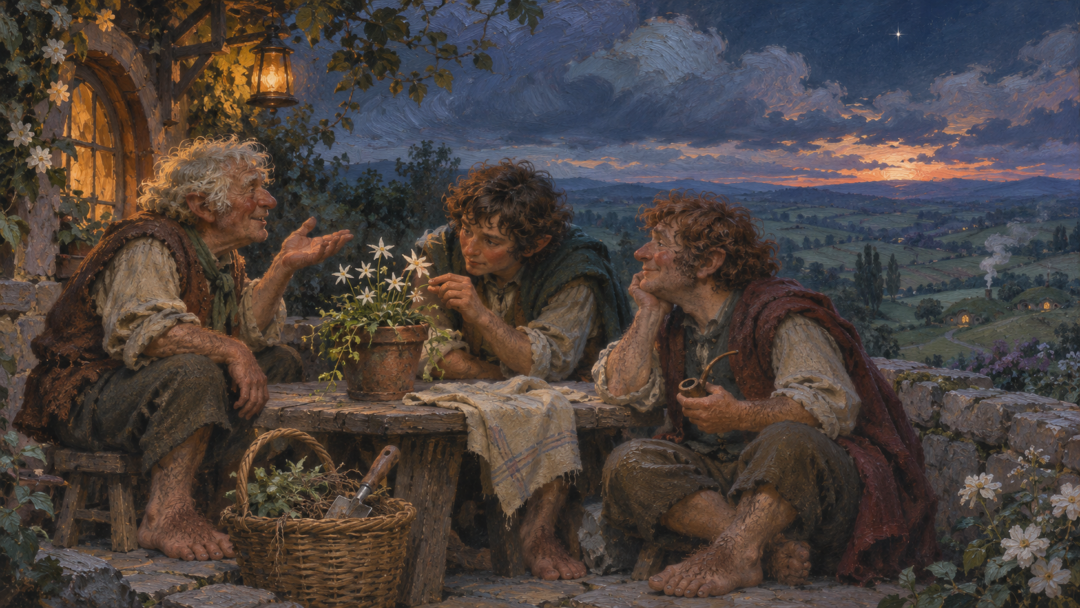
Imagine a Southfarthing grower bending over a flowering plant, its open petals forming a small star above the leaves. That is an invented editorial scene, not an event recorded in hobbit history; even the bloom's precise appearance is uncertain. Yet it illustrates why the floral reading has appeal. It joins the two parts of the name without asking for lost royal symbols or secret Elvish translations.
So why would hobbits have named a pipe-weed variety Southern Star? The strongest answer is that southern fits its attested Southfarthing home and star plausibly evokes a flower. We cannot say who coined the name, whether flowers were actually the reason, or why Tolkien preferred it to the draft's Hornpipe Twist. What we can say is that a name with a hint of the heavens belongs comfortably to an herb grown in the earth: the kind that brings Merry and Pippin, even in ruined Isengard, a little closer to home.
Sources & Notes
This article is based on close reading and interpretation of Tolkien's published works and related source material where relevant.