At first, the question sounds almost like a confrontation.
Gandalf returns into the West after the War of the Ring. Sauron has been overthrown. Saruman has been unmasked, diminished, and finally killed in the Shire. The long work of the Istari is finished.
And somewhere beyond the circles of Middle-earth stands Aulë.
The great maker.
The lord of substances, metals, stone, and craft.
The Vala under whose instruction or association both Sauron and Saruman had once belonged.
It is a detail that is easy to pass over. Sauron was not always the Dark Lord. Saruman was not always the betrayer of the White Council. Before either became a name of ruin, both were spirits of a higher order, connected with the world of making, skill, knowledge, and order.
And that makes the question sharper.
Would Gandalf have words with Aulë?
Would he ask how two beings so closely linked with craft became two of the greatest examples of corrupted wisdom in Middle-earth?
The texts never show such a conversation.
But they give us enough to understand why the question matters.
Aulë Was Not the Source of Their Evil
The first thing to make clear is this:
Aulë is not presented as corrupt.
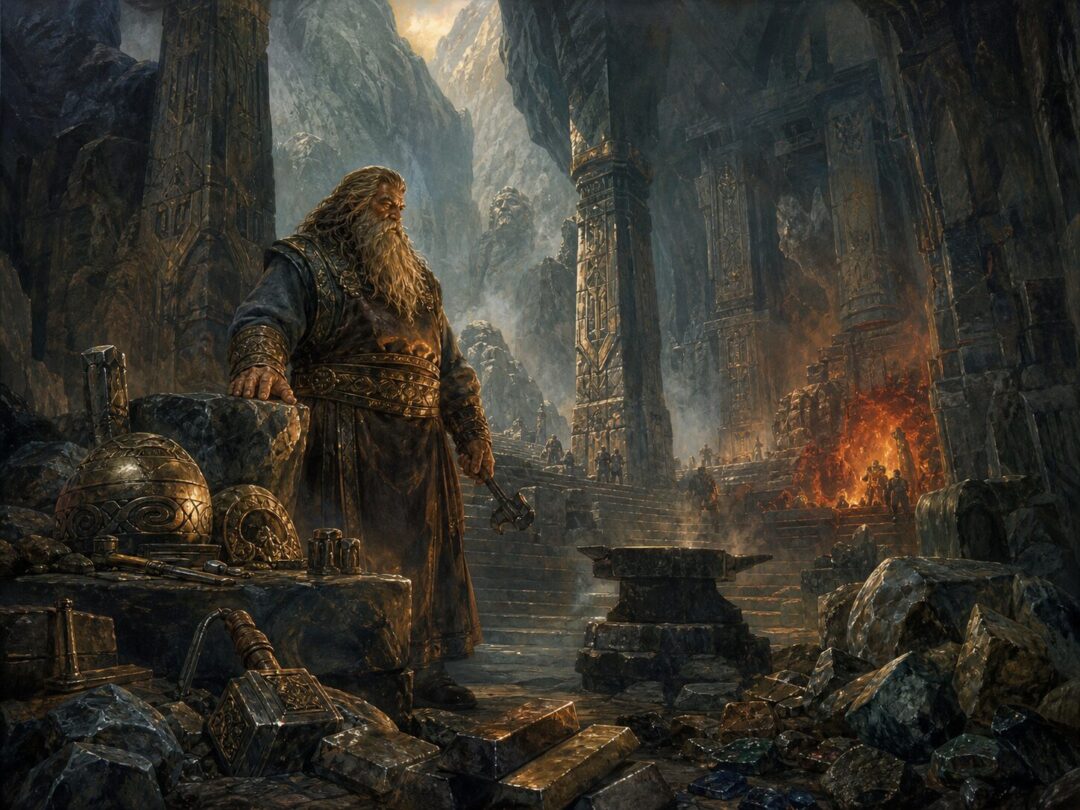
He is one of the Valar, one of the great Powers who entered the world after its beginning. His domain is making: the shaping of earth, stone, metal, minerals, and crafted things. His delight is in the deed of making itself, not in possessing or mastering what he has made.
That distinction matters enormously.
Aulë loves craft.
Sauron and Saruman come to love mastery.
Those are not the same thing.
The texts do not suggest that Aulë taught evil to Sauron or Saruman. They do not suggest that he desired domination, or that his instruction naturally led to tyranny. Aulë’s craft is not wicked. The created world itself depends on shaping, building, ordering, and bringing form out of raw matter.
But there is a peril close to Aulë’s gifts.
Not because the gifts are evil.
Because they are powerful.
The one who knows how things are made can be tempted to decide how they ought to be ruled. The one who loves order can begin to hate freedom. The one who has skill can start to see living wills as materials to be arranged.
This is where Sauron and Saruman fall.
Not by loving craft too much in its proper form.
But by twisting craft into control.
Sauron: Order Turned Into Domination
Sauron’s origin is one of the most revealing parts of his character.
He was a Maia associated with Aulë, skilled in craft and making. Before his full corruption, his nature was not simply chaos or destruction. In fact, the deeper danger in Sauron is almost the opposite.
He loved order.
He desired coordination.
He hated waste, confusion, and disorder.
That may sound almost reasonable at first. And that is precisely what makes him so dangerous.
Sauron is not merely a destroyer like a beast raging through the world. He is a maker of systems. He wants things arranged according to a single will. His own.
This is why his evil becomes so complete.
He does not merely want to break Middle-earth. He wants to organize it beneath himself. Kingdoms, peoples, languages, wills, fear, labour, war, craft, and even the Rings themselves become instruments in a vast design.
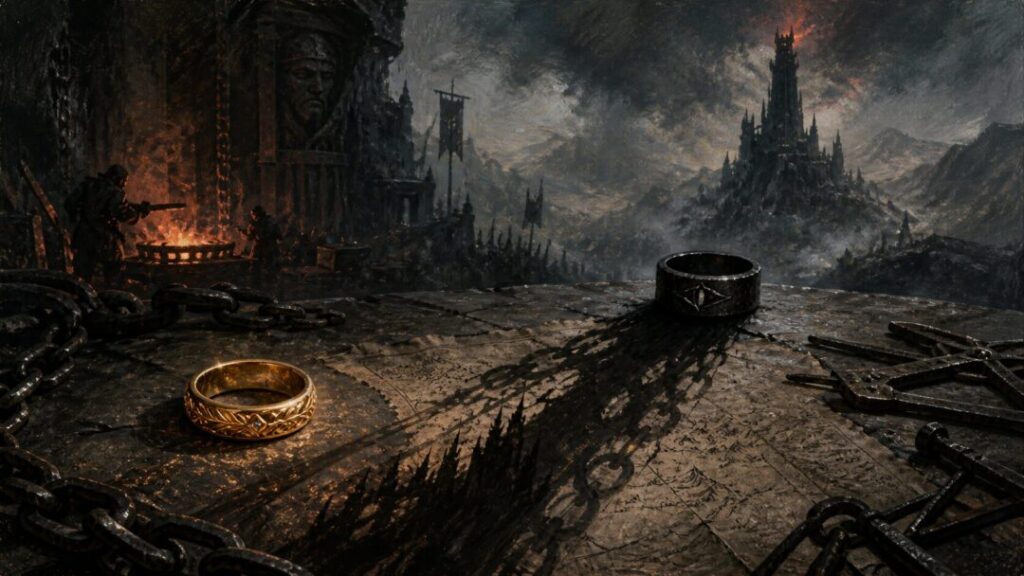
The One Ring is the perfect symbol of this corruption.
It is a work of craft.
But it is craft made for domination.
It does not merely adorn. It rules. It binds the other Rings. It extends Sauron’s will beyond himself and seeks to bring other wills under his command.
That is Aulë’s world turned inside out.
Making becomes possession.
Order becomes tyranny.
Skill becomes enslavement.
Saruman: The Smaller Echo
Saruman’s fall is different from Sauron’s, but it echoes it in disturbing ways.
Curumo, later known as Saruman, was also associated with Aulë. He came to Middle-earth as one of the Istari, sent not to rule the Free Peoples, but to aid them against Sauron. The Wizards were not supposed to conquer Sauron by matching him with open displays of power. Their work was guidance, counsel, resistance, and encouragement.
Saruman begins in honour.
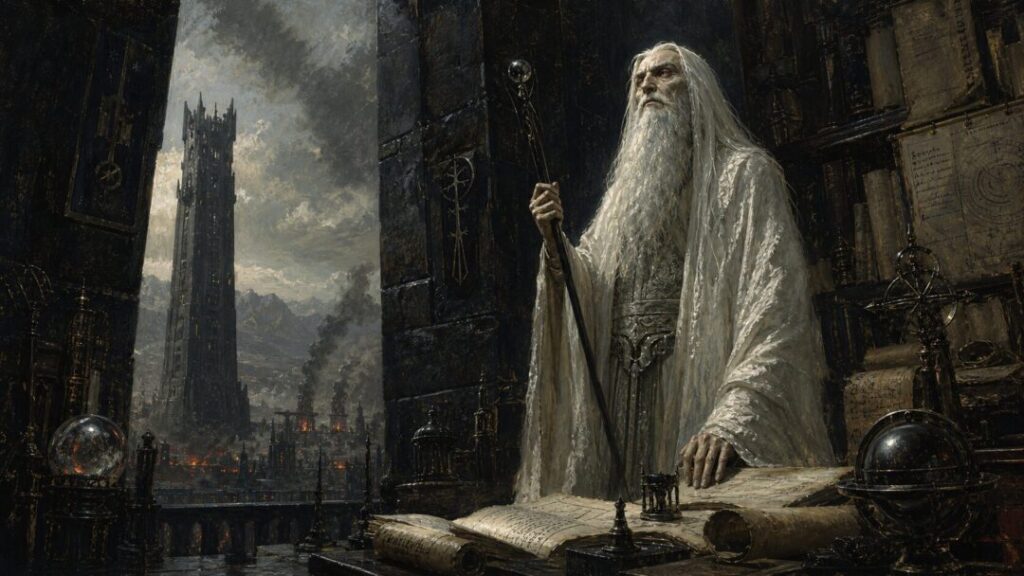
He is the White Wizard. He becomes head of the White Council. He studies the devices of the Enemy. He becomes learned in Ring-lore. He understands much that others do not.
But knowledge becomes dangerous when humility leaves it.
By the time Gandalf comes to Orthanc, Saruman has already shifted. He no longer speaks as one who serves the mission. He speaks as one who has decided he knows better than the mission.
He calls himself Ring-maker.
He casts aside the simplicity of white for “many colours.”
He speaks of power, order, and the supposed wisdom of joining or replacing Sauron.
It is not the same fall as Sauron’s ancient rebellion.
But it is the same pattern in miniature.
Saruman studies the Enemy so long that he begins to think like him. He believes he can use the logic of domination without being consumed by it.
And that is exactly the mistake Gandalf refuses to make.
Gandalf’s Difference
Gandalf is not a spirit of Aulë in the same way Saruman is described to be.
Before coming to Middle-earth, he was known as Olórin. The traditions around the Istari connect him especially with wisdom, pity, patience, and the strengthening of others. He does not win by forging a greater Ring. He does not build a rival empire. He does not seize command of Gondor, Rohan, or the Shire.
He kindles courage.
That is his great work.
Gandalf’s power is real, but he rarely uses it as domination. He persuades, warns, counsels, rebukes, laughs, comforts, and guides. Even when he becomes Gandalf the White, he does not become a king.
This is why his opposition to Saruman is so precise.
At Orthanc, Gandalf does not simply defeat Saruman physically. He exposes him. He reveals the emptiness beneath the voice, the robes, the authority, and the claim to wisdom.
Saruman has become what Gandalf refuses to be.
A guide who wants to rule.
A servant who wants to possess.
A wise one who has forgotten humility.
If Gandalf ever stood before Aulë after all this, he would understand the difference between the giver of skill and the one who corrupts skill.
He would not need to accuse Aulë of Saruman’s choices.
But he might well grieve over them.
Aulë’s Own Test
There is one reason Aulë cannot be treated as merely distant from the theme of corruption.
He too once made something before its appointed time.
In the story of the Dwarves, Aulë creates them in secret because he longs for beings whom he can teach. He is impatient for the Children of Ilúvatar to awaken. His desire is not hatred, and it is not tyranny. But it is still an overreach.
He makes what he does not have the final authority to give true independent life.
And when confronted, Aulë does the one thing Sauron and Saruman do not.
He submits.
He confesses his fault. He does not cling to his work as possession. He is even willing to destroy what he has made, rather than rebel against the One who has authority over life.
That moment defines him.
Aulë stands near the edge of the same danger: the maker’s temptation to claim ownership over what is made.
But he turns back.
Sauron does not.
Saruman does not.
That is the dividing line.
Not craft versus no craft.
Not knowledge versus ignorance.
Humility versus possession.
Would Gandalf Blame Him?
Probably not.
At least, the texts give no reason to think Gandalf would blame Aulë directly for Sauron or Saruman.
In Middle-earth, moral responsibility rests heavily on the will. Sauron chooses rebellion and domination. Saruman chooses betrayal, pride, and imitation of the Enemy. Their association with Aulë helps explain the shape of their temptation, but it does not remove their responsibility.
Aulë’s domain gave them skill.
It did not force them to become tyrants.
This distinction is important because Middle-earth does not treat gifts as evil merely because they can be misused. Beauty can lead to possessiveness. Wisdom can lead to pride. Kingship can become tyranny. Craft can become domination.
But the answer is not to hate beauty, wisdom, kingship, or craft.
The answer is to keep them rightly ordered.
Gandalf would know this better than anyone.
He carried Narya, the Ring of Fire, yet did not use it to enslave. He possessed deep power, yet worked through encouragement. He had authority, yet did not make himself lord of the Westlands.
He is the answer to Saruman not because he lacks power.
But because he refuses the wrong use of it.
What Would the Conversation Be?
If we imagine such a meeting, it must be clearly called interpretation. The texts do not record Gandalf confronting Aulë, nor do they tell us what passed between them after Gandalf sailed West.
But if there were words, they would not likely be the words of accusation.
They would be the words of sorrow.
Gandalf had seen what became of Saruman’s mind. He had seen Isengard stripped, ordered, smoked, and made into a machine of war. He had seen the Shire wounded by Saruman’s last petty malice. He had spent the whole end of the Third Age resisting the final design of Sauron, the greatest corruption of order into absolute rule.
Aulë, more than most, would understand the tragedy.
Not because he caused it.
Because he knew how close making stands to pride.
Aulë’s own story proves that the maker must surrender possession. The Dwarves are spared because Aulë does not insist on owning them. He gives up his claim, and by that surrender his work is granted a place in the world.
Sauron’s Ring is the opposite.
It is a thing into which its maker pours power in order to bind others to himself.
Saruman’s machinery is the same pattern reduced: not creation in wonder, but industry in service of control.
Aulë makes and releases.
Sauron makes and binds.
Saruman learns to make in the shadow of binding.
Gandalf would see that.
The Real Answer
So would Gandalf have words with Aulë over Saruman and Sauron?
Not as a prosecutor.
Not as someone demanding that Aulë answer for their evil.
But perhaps as one servant of the good speaking to another about the ruin of gifts.
Because that is the heart of the matter.
Sauron and Saruman are not frightening because they were ignorant. They are frightening because they were wise. They knew craft, order, speech, persuasion, lore, and power. Their evil did not come from emptiness. It came from gifts turned inward until everything became an instrument of self-will.
Aulë shows what should have happened.
Gandalf shows what still can happen.
Sauron and Saruman show what happens when the maker forgets that the world is not his to possess.
And that may be why the connection between them feels so haunting.
The tragedy is not that Aulë’s craft was evil.
The tragedy is that two of his greatest kindred spirits looked upon the beauty of making and chose mastery instead.
Gandalf would not need to ask Aulë, “Why did you make them this way?”
The better question would be quieter.
“How did gifts so bright become so dark?”
And in Middle-earth, the answer is almost always the same.
Not because the gift was wicked.
Because the will that held it would not let go.
Sources & Notes
- J.R.R. Tolkien, The Silmarillion, “Valaquenta” — places Aulë among the Valar of earth, substances, craft, and making, and notes Sauron’s original connection with him before turning to Melkor.
- J.R.R. Tolkien, The Silmarillion, “Of Aulë and Yavanna” — Aulë’s making of the Dwarves shows the maker’s temptation, but also his humility and willingness to surrender possession of his work.
- J.R.R. Tolkien, Unfinished Tales, “The Istari” — identifies Curumo/Saruman as specially connected with Aulë and frames the Wizards’ mission as counsel and encouragement, not domination by force.
- J.R.R. Tolkien, The Lord of the Rings, Book II, Chapter 2, “The Council of Elrond” — Saruman’s “Ring-maker” speech and many-coloured robe reveal his slide from wisdom into power-politics and imitation of Sauron.
- J.R.R. Tolkien, Letters, no. 131 — describes Sauron’s original desire for order and coordination becoming a lust for domination, directly supporting the article’s craft/order/control distinction.