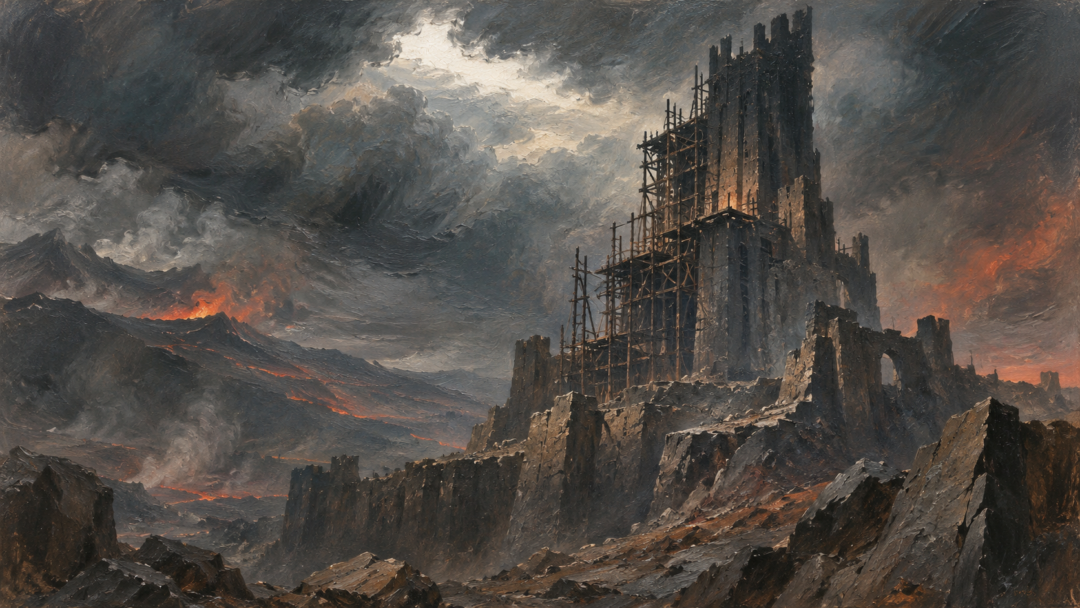
When Isildur cut the One Ring from Sauron's hand, the Dark Lord vanished from the battlefield, but not from Middle-earth. Ages later, his shadow spread through Mirkwood, and the same enemy ruled again from Mordor. If destroying Sauron's body did not kill him, did it accomplish anything lasting?
Yes. Each great defeat left a different wound. Númenor took away his ability to appear fair; the Last Alliance stripped him of his body and possession of the Ring, after which recovery was painfully slow; and the Ring's destruction made recovery impossible. The losses were cumulative, not like a warrior losing a fixed portion of strength after each battle. Sauron could remain formidable while becoming less able to restore what he had been.
Númenor Destroyed More Than a Disguise
Before he became the dark presence feared in the Third Age, Sauron could present himself as trustworthy. He approached the Elven smiths of Eregion in a pleasing guise and instructed them in making Rings of Power. His appearance was part of his power: he could work through apparent wisdom and generosity rather than simply demanding obedience. That deception eventually failed, but it shows what he could do before the sea swallowed Númenor.
That catastrophe began with a different kind of deception. Ar-Pharazôn, the mighty king of Númenor, brought Sauron to his island kingdom as a captive. Sauron turned that captivity into influence, becoming a counsellor and leading the king toward the disastrous attempt to seize immortality by force. When Ar-Pharazôn sailed west in defiance of the Ban, Númenor was overwhelmed. Sauron was in his temple when the destruction came, and his physical form perished with the island.
The Akallabêth in The Silmarillion describes what escaped: Sauron's spirit passed over the sea like a dark wind and returned to Mordor. But he could “never again appear fair to the eyes of Men.” That is a specific penalty. He had not lost the ability to think, command or take physical shape. He had lost the persuasive appearance with which he had deceived others, and no later reconstruction gave it back.
Back in Barad-dûr, he took up the One Ring again and eventually fashioned another visible form. The same account calls it an “image of malice and hatred made visible.” His terrible appearance suited open domination, and his power could still overwhelm even great opponents. Yet the contrast with Eregion is sharp: the being who once approached the Elves as a helpful teacher could no longer repeat that particular deception. His defeat had narrowed his possibilities without making him harmless.
The Last Alliance Left Him Waiting in the Shadows
Sauron's next great overthrow came at the end of the Second Age. After years of siege, he emerged from Barad-dûr and fought Gil-galad and Elendil. Both leaders were killed, but Sauron was thrown down. Isildur used the broken sword Narsil to cut the Ring from his hand. In Of the Rings of Power and the Third Age, the aftermath is explicit: Sauron abandoned his body, and his spirit fled into hiding. He would not take visible shape again for many years.
This time he also lost physical possession of the object into which he had placed so much of his strength. Isildur refused to destroy it, keeping it as compensation for his father and brother. After Isildur was killed, the Ring disappeared into the waters of Anduin. It remained beyond Sauron's reach for most of the Third Age. That distinction is crucial: the Ring was lost, not unmade. Its continued existence left open a future that its destruction would have closed.
Sauron's servants scattered, and Barad-dûr fell, although its foundations survived. Centuries passed before a shadow crept into Greenwood the Great and an unknown sorcerer occupied Dol Guldur. The Silmarillion says Sauron slowly grew and took shape there again. Even the Wise did not initially recognize him. Gandalf later entered Dol Guldur and discovered that the Necromancer was Sauron himself. In The Fellowship of the Ring, he tells the Council of Elrond that their ancient enemy had been taking shape and power again.
Letter 200 provides an unusually direct explanation for the delay. Sauron took longer to rebuild after the battle with Gil-galad and Elendil than after Númenor, and Tolkien suggests that “each building-up used up some of the inherent energy of the spirit.” He presents this as a possible explanation, not a measured law. Still, it answers the question: making a new body was not free. A spirit could survive its body's destruction while spending something of itself to return.
Why Losing the Ring Was Not the Same as Destroying It
Sauron had forged the One Ring in Mount Doom to dominate the other Rings of Power. To do it, he invested a great part of his own native might in a physical object. Gandalf explains this to Frodo in “The Shadow of the Past”: the Ring is Sauron's own making, and its power is bound up with his. What looks like an instrument of control is also a dangerous commitment. Sauron made himself extraordinarily powerful through the Ring while creating a way for his enemies to strike at his very being.
Still, it would be misleading to imagine that every year without the Ring drained him further. Letter 131 makes the subtler point that, so long as the Ring existed and was not mastered by another, the power invested in it remained connected to Sauron even when he did not wear it. The letter says he was not, in that sense, diminished merely by its absence. His defeat had robbed him of possession and cost him time and effort rebuilding; it had not yet erased all the might he had put into the Ring.
His actions in the Third Age demonstrate the difference. Without recovering the Ring, he gathered armies, directed the Nazgûl, restored his fortress and launched the War of the Ring. The danger was real enough that Gandalf did not believe Gondor could win a straightforward military contest. And the Eye familiar from the films should not be mistaken for proof that Sauron existed only as a floating gaze. In The Two Towers, Gollum refers to the four fingers of his Black Hand: a small, chilling hint of a bodily form rebuilt after the Last Alliance.
A broader parallel appears in Morgoth's Ring: Morgoth poured his power into the substance of Arda, whereas Sauron concentrated much of his in a single object. Both sought dominion by investing something of themselves beyond themselves. But Morgoth's power was dispersed through the world, while Sauron's remained linked to a Ring that could be destroyed. Neither case gives a numerical account of what a new body cost.
The Ring's End Made Another Return Impossible
At the Cracks of Doom, no champion physically struck Sauron down as Gil-galad and Elendil had done. Frodo claimed the Ring for himself, Gollum seized it by biting off Frodo's finger, and then fell into the fire with his prize. The Ring was unmade in the place where it had been forged. Just before that, Sauron realized the danger and turned all his attention toward the Mountain. The terrible irony was that the enemy who had prepared so many ways to defeat armies had left the fate of his power resting on something small enough to vanish into the fire.
The destruction reached far beyond a lost piece of jewellery. Barad-dûr collapsed because the works founded upon the Ring's power could no longer endure. Creatures held under Sauron's will scattered, and the Ringwraiths met their end. These are consequences of the removal of his sustaining power, not simply the effects of an absent commander. The Ring's existence had allowed his previous recovery; its unmaking cut away the power on which another return would depend.
Gandalf had already described the outcome in “The Last Debate” in The Return of the King. Destroying the Ring would leave Sauron “maimed for ever,” unable to grow or take shape again. That is stronger than saying he would need another long rest. Sauron's spirit would not cease to exist, but it would be reduced to impotent malice, without the power to make itself a ruling presence in the world once more.
The book gives that fate a memorable image after the Ring is destroyed. In “The Field of Cormallen,” the Captains of the West see a vast shadow rise above Mordor, crowned with lightning and reaching toward them like an enormous threatening figure. But the apparition cannot act. A wind disperses it, and silence follows. It is a final display of menace without mastery: the shape of a tyrant, briefly visible, with nothing left that can hold it together.
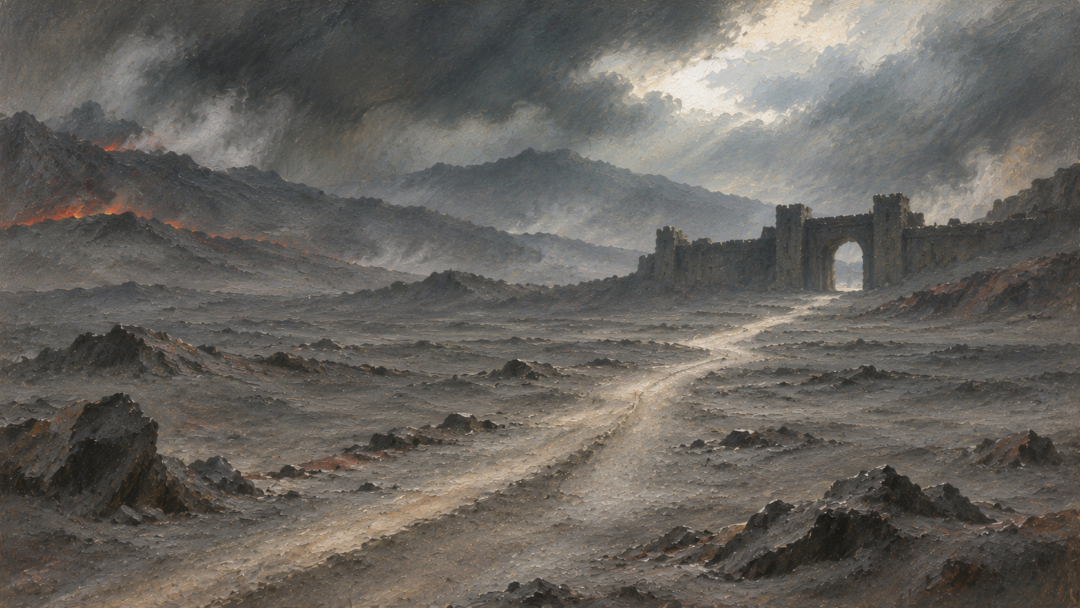
A Progressive Wound, Not a Countdown
Letter 200 explains why Sauron's bodies were more than illusions. A spirit such as his could assume a physical form, but a form made real in the world could be destroyed like another living body. In the First Age, Huan pinned down Sauron in wolf-form. Sauron tried shifting shapes, but could only flee as a vampire after yielding to Lúthien; his body was not destroyed. Rebuilding after a true defeat required time and apparently some of his effective strength. We cannot know how many more returns were possible had the Ring survived, or calculate their cost.
That leaves the last shadow over Mordor as something more unsettling than a villain simply dying. Sauron had survived the drowning of a kingdom and the fall of his own tower. At the end, he could still stretch a threatening hand across the sky, and for an instant it seemed that terror itself had returned. He just could not make the hand close.
Sources & Notes
- Tolkien Gateway — Letter 200 (to Major R. Bowen, 25 June 1957): Sauron was always de-bodied when vanquished, and after Gil-galad and Elendil he took "a long while to re-build, longer than after the Downfall of Númenor (each re-building used up some of the inherent energy of the spirit)"; rebuilding after the Ring's destruction was impossible https://tolkiengateway.net/wiki/Letter_200
- Tolkien Gateway — Sauron: the cumulative defeats — destruction of his body in Númenor's fall, the Last Alliance overthrow, and the end of the Ring; Gandalf's judgment that he was "maimed for ever, becoming a mere spirit of malice that gnaws itself in the shadows, but cannot again grow or take shape" https://tolkiengateway.net/wiki/Sauron
- Tolkien Gateway — Downfall of Númenor: Sauron's body perished with the island, and the destruction "robbed him his ability to assume fair and charming forms", so the persuasive guise he had used with the Elven-smiths was lost for good https://tolkiengateway.net/wiki/Downfall_of_N%C3%BAmenor
- Tolkien Gateway — Letter 131 (to Milton Waldman, late 1951): the One Ring was imbued with a great part of Sauron's own power, so that his strength was bound up with its existence and its unmaking would leave him largely diminished https://tolkiengateway.net/wiki/Letter_131
- Tolkien Gateway — Morgoth's Ring: the essay behind the volume's title, distinguishing Morgoth, who dispersed his power into the matter of Arda, from Sauron, who concentrated his power in the One Ring https://tolkiengateway.net/wiki/Morgoth%27s_Ring
- Tolkien Gateway — The Shadow of the Past: Gandalf's account of how Sauron's own power passed into the Ring he forged, and of the Ring's own will to return to its maker https://tolkiengateway.net/wiki/The_Shadow_of_the_Past
The core distinction the article draws — cumulative loss of capacity rather than a fixed quantity of strength — rests on Letter 200, which states that each re-building consumed some of the spirit's inherent energy and that Sauron could not re-build after the Ring's destruction. The Sauron entry supplies Gandalf's "maimed for ever" verdict and the sequence of defeats; the Downfall of Númenor entry documents the permanent loss of his fair form; Letter 131 and Morgoth's Ring explain why the power stored in the Ring remained his while it existed, and "The Shadow of the Past" gives Gandalf's in-story account of that investment.