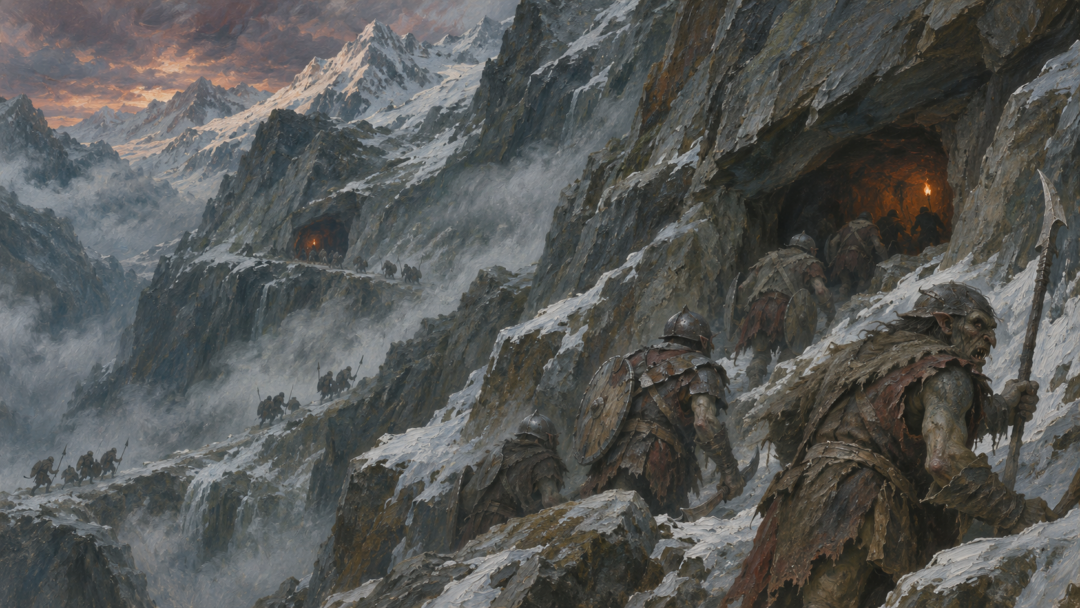
When Bilbo and Thorin’s company shelter from a storm in the Misty Mountains, a hidden opening delivers them into the goblins’ underground world. Armed guards lead them through tunnels to the Great Goblin, who questions his prisoners. This is no solitary monster’s lair. It is an established mountain society, capable of sending pursuers after escaping travellers.
How did the mountains come to hold enough goblins to threaten roads, Dwarven halls, and eventually the Lonely Mountain? Sauron was genuinely involved: the chronology in The Lord of the Rings explicitly credits him with filling Moria with his creatures. Yet northern Orcs had settlements, leaders, and campaigns of their own. Without Sauron, their military reach might have been smaller or less coordinated. How many fewer goblins would have existed is a question the books cannot answer.
Two dates, and two kinds of growth
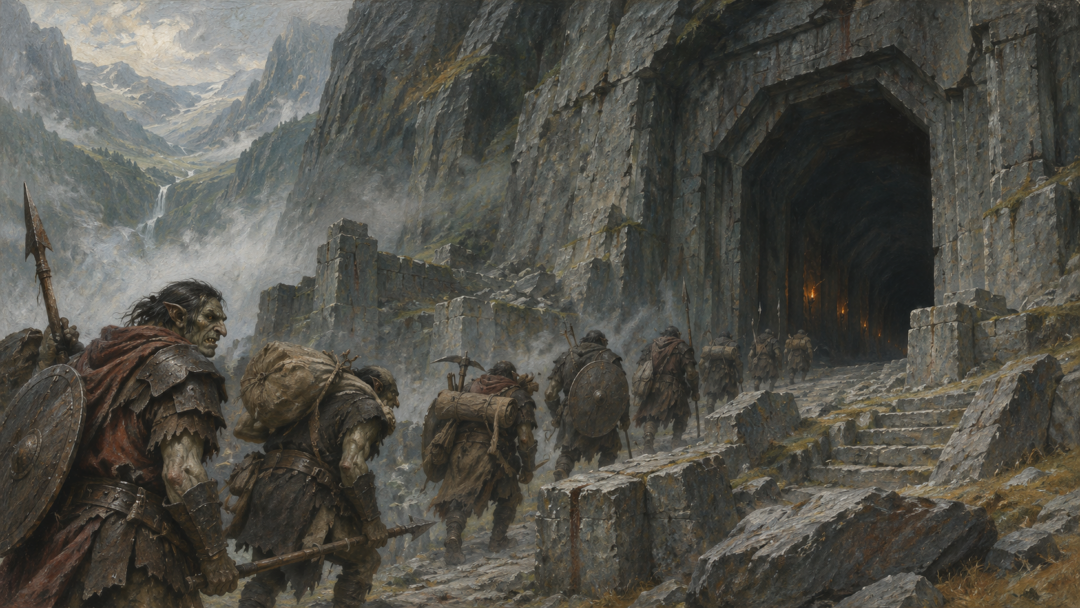
The earliest useful marker is around Third Age 1300. Tolkien Gateway’s entry for that approximate date, referencing Appendix B, records increasing Orc activity in the Misty Mountains and attacks on the Dwarves. It does not describe their first arrival, the founding of a particular fortress, or an exact count. It establishes a growing menace long before Bilbo crossed the High Pass. In the same period, evil stirred elsewhere, and the chief of the Nazgûl came north to Angmar.
That surrounding darkness invites speculation about encouragement from greater powers, but cannot identify who directed individual raids. A group can become more threatening because it gains allies, returns to old territory, or gathers scattered bands. Actual population growth is another possibility, but the entry cannot separate these processes. The approximate date marks a development in a long history, not the beginning of a measured rise.
The stronger evidence comes at Third Age 2480. The Tolkien Gateway account of that entry, again pointing to Appendix B, preserves an unusually direct statement: “Sauron begins to people Moria with his creatures.” It also records Orcs establishing secret strongholds in the Misty Mountains to bar the passes into Eriador. These mountains divide regions, and possession of their hidden approaches could make travel between the east and west far more dangerous.
Still, the entry names Moria specifically as the place Sauron populated. It does not say he invented the mountain Orcs, established every settlement, or personally commanded every chieftain. Nor is it a census of the entire range. One explicitly attributed act of peopling an important stronghold sits alongside a wider pattern of fortification. That is substantial influence without making every goblin seen afterward a new arrival from Sauron’s own ranks.
Why Moria was worth occupying
Moria had already lost its Dwarven kingdom before 2480. Durin’s Bane, the Balrog hidden beneath Khazad-dûm, drove the Dwarves out in 1981. Orcs subsequently occupied parts of the abandoned realm. Sauron’s later peopling was therefore not the first Orc occupation. It can be understood as a further strengthening of a place whose former rulers had been forced away, rather than the instant creation of a population where none existed.
The setting offered an immense system of halls and passages, with approaches to both sides of the range. Whoever held its accessible ways could threaten travellers and obstruct movement in the absence of Dwarven power. The adjoining passes mattered as much as the great gate itself. To bar a crossing is to affect not merely battles but the ordinary business of messengers, merchants, and neighbours reaching one another.
This is where Sauron’s role looks most consequential. A force that raids when opportunity appears is troublesome; strongholds positioned to obstruct routes can pressure a whole region. The text does not explain exactly how Moria’s occupants cooperated with other mountain holds, but attention to the passes shows why reinforcing this geography served a larger contest for Middle-earth. The question is not only how many Orcs lived beneath the peaks, but what their presence allowed them to prevent.
A devastating war that did not empty the mountains forever
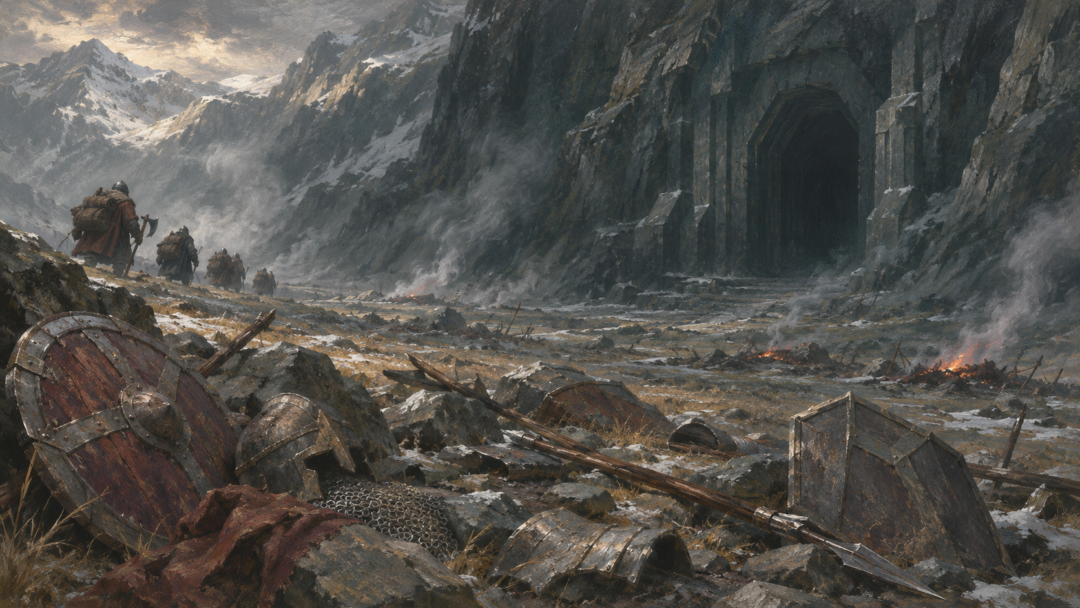
There is another reason later goblin armies seem astonishingly large: the Dwarves had dealt them a terrible defeat. After Azog killed Thrór inside Moria, the Dwarven houses gathered for war. Beginning in 2793, they attacked Orc holds across the Misty Mountains, from Gundabad in the north toward the Gladden region in the south. Much of the struggle was fought in the subterranean refuges and fortresses the Orcs inhabited.
The war culminated in 2799 at Azanulbizar, in the Dimrill Dale outside Moria’s East-gate. Dáin Ironfoot killed Azog, and the Dwarves won a desperately costly victory. The regional history describes Orc military power as broken so severely that the mountain tribes ceased, for a considerable time, to present their former threat to Eriador and Wilderland. When a great northern host appears again in The Hobbit, readers are therefore seeing resurgence after defeat, not uninterrupted expansion from Sauron’s intervention centuries earlier.
But the victorious Dwarves did not retake Khazad-dûm. Dáin perceived a greater terror still within, and the survivors turned away. Winning a battle was not the same as reclaiming a homeland. Orc forces could be scattered and their strongholds battered while the ancient city remained beyond Dwarven control. The stories do not describe every chamber cleared, every inhabitant destroyed, or a permanent occupation established by the victors.
Rebuilding fighting strength after such losses need not mean every later warrior was born locally. Survivors could regroup; fighters from other northern holds could assemble; old sites could become usable again. These are possibilities, not documented headcounts or a secret recovery programme. The war establishes a low point in Orc military power followed much later by the ability to field another army. It does not tell us the speed or biological mechanism of that change.
Gundabad shows the goblins making their own decisions
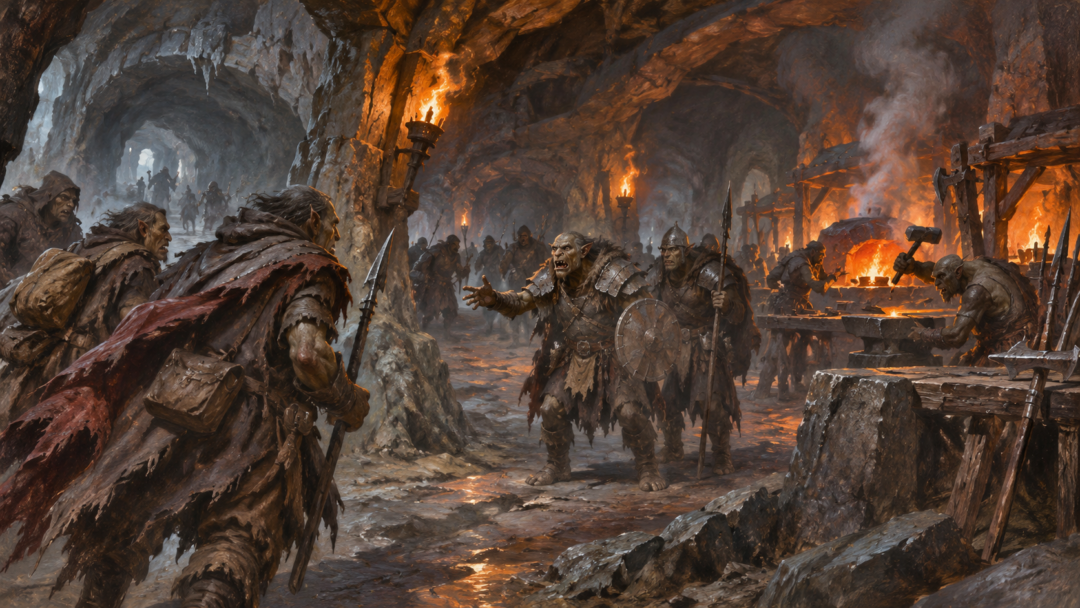
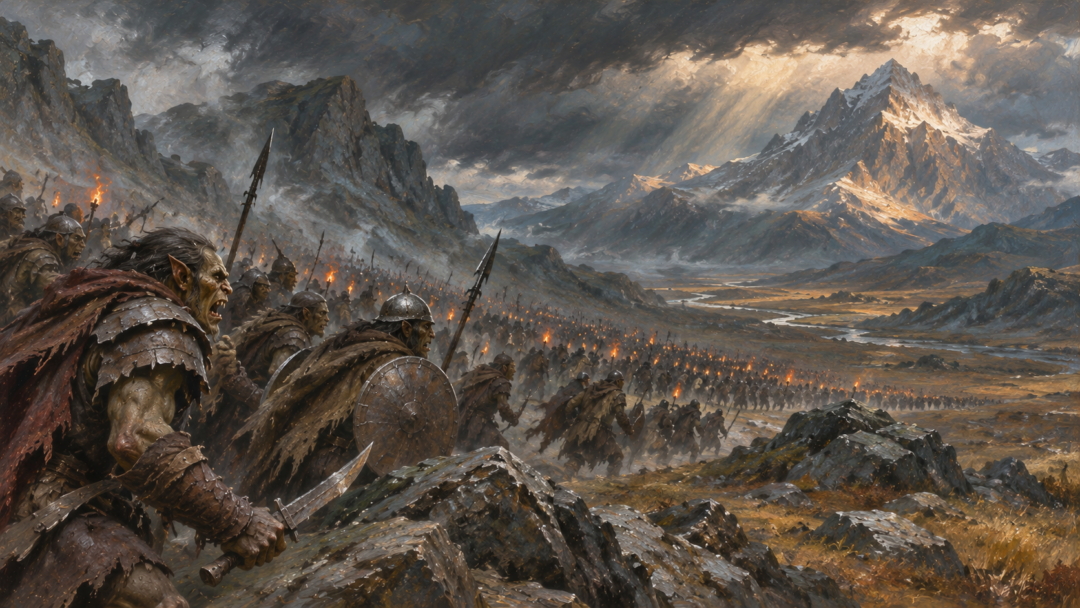
The clearest view of northern Orc organisation comes from The Hobbit, Chapter 17, as armies gather near Erebor in 2941. After the Great Goblin is killed during Thorin’s journey, resentment against the Dwarves intensifies. Messengers move between goblin cities, colonies, and strongholds, while weapons are prepared across the mountains. Bands converge beneath Mount Gundabad, their northern capital. Here is communication across several communities, not merely a mob appearing from nowhere.
Their purpose is also stated in recognisably local terms. They want revenge and dominion over the North. Bolg, their commander, is Azog’s son, so the memory of the Dwarves’ earlier victory adds another connection between old wars and new mobilisation. The Great Goblin’s death gives them an immediate grievance, but their gathering is broader than a pursuit of Bilbo’s companions. They are preparing to seize an advantage across the region, an ambition the chapter attributes to the goblins themselves.
Then the news arrives that Smaug is dead. The northern host has already been gathering; the dragon’s fall suddenly changes the opportunity at the Lonely Mountain. Moving by night and through the mountains, the goblins descend on Erebor just as Men, Elves, and Dwarves are dangerously close to fighting one another. The chapter supplies a sequence of information, decisions, and action that makes sense within the goblins’ own politics.
The absence of a named Sauron order in this scene cannot prove that he had no influence behind the wider situation. His documented work at Moria is part of the world these communities inhabit. But the narrator explains Gundabad’s mobilisation without requiring an unseen command. Political service to a dark power, military encouragement, movement between strongholds, and biological reproduction are distinct things. The chapter depicts northern organisation and ambition; it provides no population accounting or chain of orders back to Sauron.
What the defeats cannot tell us about population
The Battle of Five Armies ends in catastrophe for Bolg’s host. Beorn kills Bolg, the Eagles help turn the battle, and the defeated goblins are pursued into the surrounding lands. In The Hobbit‘s account of the return journey, the narrator says that songs reported the loss of three parts of the northern goblin warriors, after which the mountains enjoyed peace for years. The report concerns warriors, not every resident of the mountains.
Some descriptions of the battle turn this reported loss into a claim about three-quarters of the entire Orc population. The book supplies no such denominator. It does not count noncombatants, identify every survivor, or show where all northern warriors lived. Even accepting the song’s fraction literally for those warriors would not tell us how quickly the mountains were repopulated afterward. Military defeat and demographic extinction are not interchangeable.
There is also a chronological trap. Increasing danger around 1300, the occupation and reinforcement of Moria, the collapse of Orc strength after the Dwarves’ war, and Bolg’s mobilisation are different developments. Calling them all repopulation blurs the evidence. A passage guarded by Orcs might reflect a new outpost, an old stronghold restored, a temporary concentration of fighters, or inhabitants who never left. Each changes the answer to how the mountains became so crowded.
The strongest counterfactual is modest. Without Sauron’s intervention, Moria would lack the specific reinforcement attributed to him, and the wider pattern of fortified passes might have been different. It is reasonable to infer that northern Orc power might then have been less formidable or less effectively positioned. It would be unreasonable to assign a percentage to the difference, or assume the local settlements and rivalries with the Dwarves would vanish.
The enduring image is not of a single hand moving identical pieces across a mountain map. It is of dark gates, hidden roads, and communities capable of carrying old grudges into new wars, while a greater power strengthens a place that matters to them all. Sauron could make the Misty Mountains more dangerous. What the mountains would have held without him remains beyond the count of any chronicle.
Sources & Notes
This article is based on close reading and interpretation of Tolkien's published works and related source material where relevant.