When Boromir rode north toward Rivendell in Third Age 3018, he came to a crossing that had once joined two kingdoms. At Tharbad, the great bridge over the Greyflood had become ruins, and the ford among those ruins was dangerous enough to cost him his horse. It is a striking fate for a place once served by ships, soldiers and a royal road. How could an inland city lose so much with the decay of a crossing?
Tharbad’s bridge was never simply a span over water. It belonged to a maintained network of causeways, drained ground, fortified approaches and river facilities linking the North-South Road to navigable water. That network gave the settlement its purpose. When kingdoms and populations could no longer sustain it, the bridge’s location ceased to be an advantage and became a formidable obstacle.
Where the road met a river from the sea
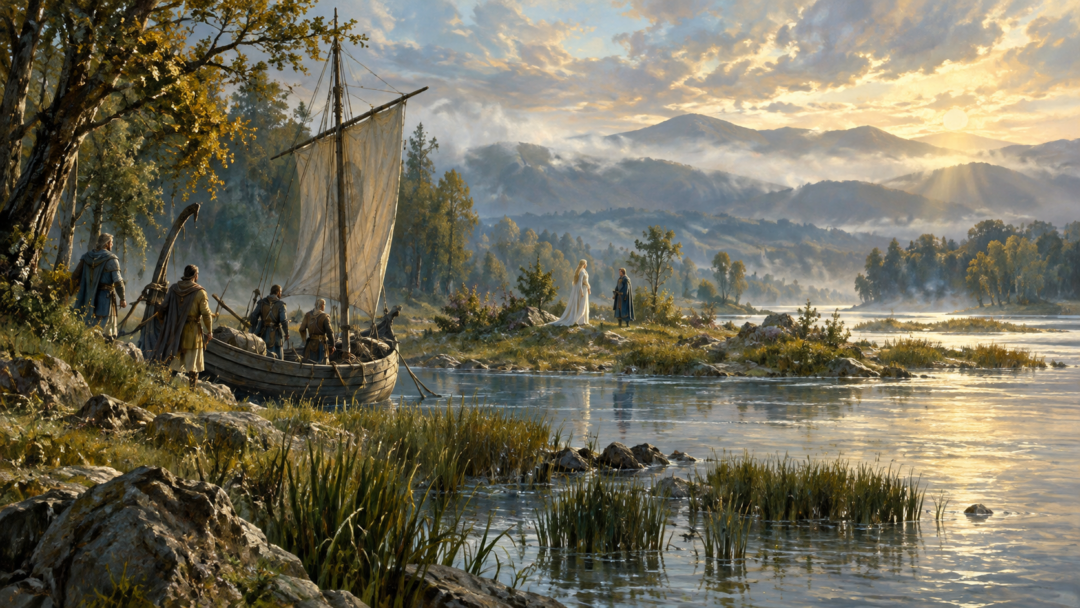
Tharbad stood near the southern edge of Eriador, a few miles below the meeting of the Mitheithel, or Hoarwell, and the Glanduin. Their waters formed the Gwathló, the Greyflood, which ran southwest to the sea. The lower Glanduin spread through the marshes of Swanfleet; the upper Greyflood near Tharbad was naturally broad, slow and surrounded by wet ground. This was no narrow mountain stream inviting an easy crossing.
Yet the same river made the site valuable. Shallow-draught vessels could travel or be rowed upstream to Tharbad, giving a place far from the coast access to waterborne movement. Farther downriver stood Lond Daer, the Númenórean haven associated with timber gathering and seafaring. Tharbad was not another coastal harbour: it was the point where river traffic could connect with a long overland route. Once the port was developed, seagoing vessels could also be accommodated there through extensive works.
A bridge needed a landscape engineered around it
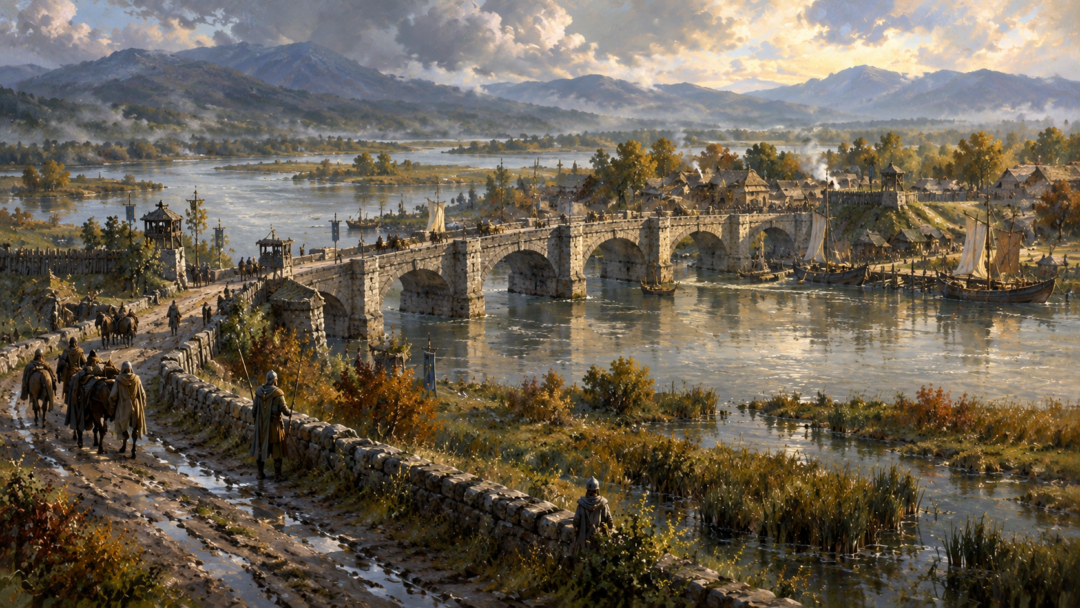
The obstacle was larger than the river channel. On either side lay fens in Minhiriath and Enedwaith, and the route also had to negotiate the watery country around the Mitheithel. A bridge might carry travellers above the main current while leaving them stranded in mud before they reached it. The great causeways therefore mattered as much as the crossing itself: they carried the North-South Road across low, saturated ground toward the bridge.
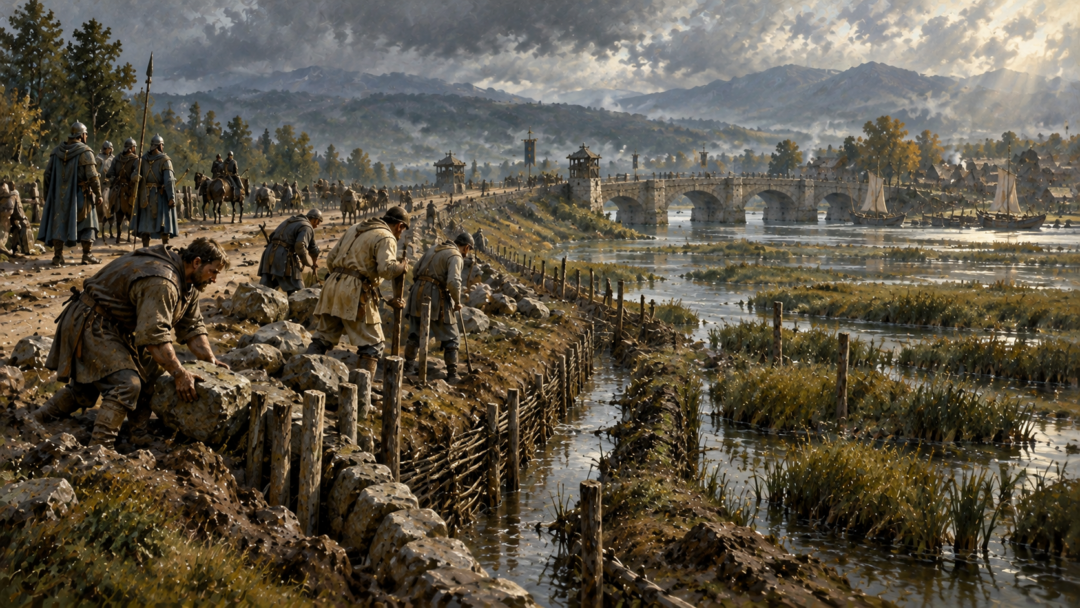
This was not an isolated construction project. The surrounding land was drained, dykes were made, and riverbanks were strengthened. Those measures allowed the port and its approaches to function in country whose natural tendency was to become marsh again. The result was an engineered corridor through a floodplain. Roads, landing places and inhabited ground were being held in a condition that the local landscape would not necessarily preserve without continued attention.
Fortification was another part of the same design. Great earthworks and forts stood on both sides of the Greyflood to protect the bridge. Their position makes practical sense: guarding only the middle of a river crossing would do little if either approach could be cut off. For travellers, the protected route offered something far more reliable than an uncertain passage through wetland. For the powers that maintained it, the bridge concentrated movement at a place that could be watched and defended.
Why Arnor and Gondor kept the crossing alive
After the downfall of Númenor, Arnor in the north and Gondor in the south inherited a strong reason to preserve contact. Their North-South Road ran through Tharbad, providing the chief land connection between the kingdoms apart from travel by sea. In the early days of those realms, they built and maintained the bridge and its long causeways together. A fortified town at the crossing was therefore part of a much larger political geography.
The personnel stationed there reveal how varied that task was. Accounts mention a considerable garrison of soldiers, mariners and engineers, as well as river-wardens. Soldiers could secure the passage; mariners belonged to its river-going life; engineers were essential to works exposed to water and shifting ground. Their presence shows why a bridge-town could not be understood solely as a road junction. It was also a river port and a guarded piece of infrastructure.
There was a further reason to concentrate these resources at Tharbad. Beyond it, Enedwaith was not filled with permanent Númenórean settlements. The kingdoms’ interest in the region was largely directed toward maintaining and patrolling the route. Tharbad was a conspicuous exception: an enduring base where royal communications and physical geography intersected. Its importance did not require a dense chain of towns around it; instead, the maintained crossing helped make movement through sparsely settled country possible.
The crossing was older than the two kingdoms
Tharbad’s story reaches back before Arnor and Gondor existed, but its earliest history needs care. In the Second Age, the Númenórean king Aldarion travelled up the Gwathló as far as Tharbad and met Galadriel there. This tells us that the location was known and accessible by river early on. It does not establish that the later fortified town, great bridge and causeways were already standing in their familiar form.
Aldarion had founded a haven farther downstream, and it is tempting to credit him with founding Tharbad too. That remains an inference, not a recorded act or a secure foundation date. The name itself is associated with a crossing or road-crossing, suggesting a place defined by passage rather than by a royal founder. What became a major bridge-city under the later kingdoms may have begun as a ford or less developed stopping place.
Decline arrived long before the final flood
Arnor’s division into successor kingdoms in Third Age 861 changed the northern political setting. The lands of Minhiriath belonged to Cardolan, one of those successor realms, and Tharbad probably came within its territory. The north’s diminishing strength gradually altered the balance of responsibility for maintaining the road. Gondor continued to concern itself with the road through Enedwaith, but the old shared commitment could no longer be assumed to last unchanged.
Then came the Great Plague of 1636. It struck Gondor and spread north, devastating Cardolan and especially Minhiriath. This was a demographic blow as well as a political one: fewer inhabitants meant fewer hands and weaker support for a road passing through increasingly empty country. Yet Tharbad was not abandoned in 1636. Survivors remained there, and the route continued to matter for trade for centuries. Treating the plague as the moment the bridge fell would erase that long, uneasy aftermath.
What deteriorated was the wider capacity to keep the crossing serviceable. With the northern kingdom receding and Gondor’s own power and reach changing, sustained care of the North-South Road became harder to preserve. The road in Enedwaith eventually ceased to be maintained, and the bridge became ruinous. The surrounding country reverted toward wild fenland. Such descriptions point to a cumulative process, not to one witnessed accident in which a perfectly functioning system suddenly vanished.
The sequence matters because wet ground can undo a road from its edges inward. If drains go uncleared or embankments are no longer kept sound, approaches become harder to use; if fewer travellers and guards are present, the reason and capacity to repair them diminish. That is an explanation of the mechanism, not a record of particular repair crews leaving on a named day. The remains of Tharbad suggest what happens when a route designed for continuous stewardship outlives the institutions behind it.
The floods and Boromir’s dangerous ford
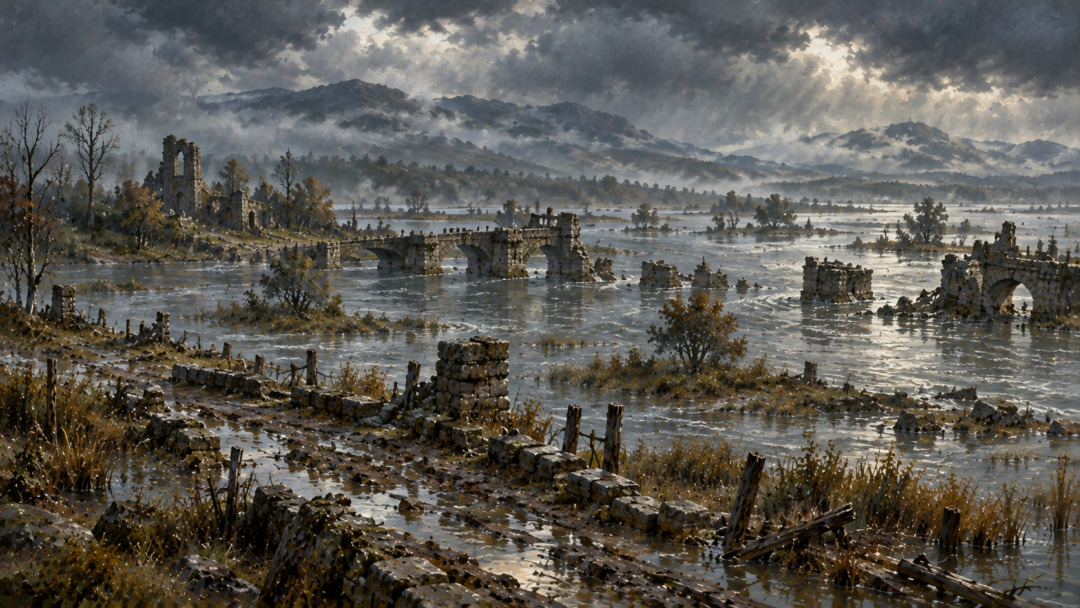
The final disaster recorded for the town came in Third Age 2912, after the Fell Winter of 2911. Great floods ravaged Enedwaith and Minhiriath, and Tharbad was ruined and deserted. The date marks the city’s abandonment, not necessarily the first damage to its bridge. By then the long weakening of roads, population and protective works had already changed what the floodwater encountered.
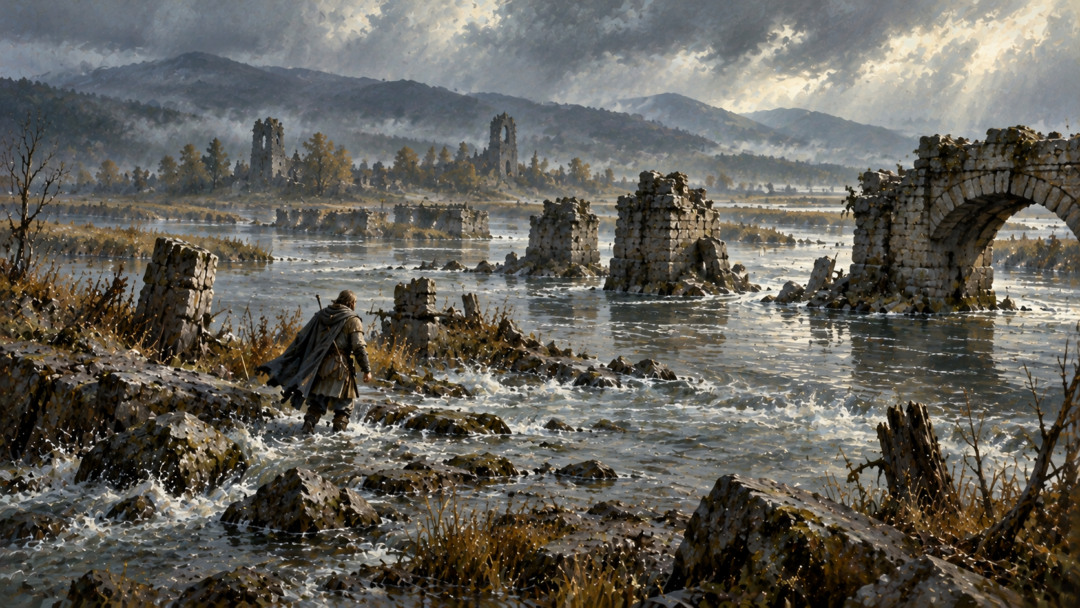
More than a century later, in 3018, Boromir travelled from Gondor toward Rivendell. Where the North-South Road had once offered a maintained passage, there were crumbling remnants of causeways. At Tharbad he had to cross the Greyflood by a perilous ford formed among the remains of the bridge. He lost his horse during that crossing and continued his journey on foot. A member of Gondor’s ruling house could still follow the old route, but no longer enjoy what his predecessors had maintained.
Boromir’s experience also marks the difference between an abandoned city and an utterly forgotten place. The crossing still existed on maps and in the practical knowledge of travellers; others also passed through that region in the years around the War of the Ring. But a passage that could be attempted at personal risk was not the same as a working link between kingdoms. The ruined bridge still directed movement toward Tharbad, while no longer protecting those who arrived.
Could the old road return?
After the War of the Ring, Aragorn restored the northern kingdom and ruled a reunited realm. Gandalf spoke of the Greenway, the overgrown remnant of the old road, being opened again and of people returning to lands that had become wilderness. That offers a credible prospect of renewed connection. It does not provide a narrated Fourth Age rebuilding of Tharbad or a confirmed date for a replacement bridge.
Reopening the road would have meant more than finding the old line on a map. It would have required making passage dependable once again, across the fens as well as the Greyflood. At Tharbad, the road still led toward the water, its battered causeways pointing to the place where a city had once made the crossing seem an ordinary part of a journey.
Sources & Notes
- Tolkien Gateway — Tharbad: referenced account of the port, drainage works, causeways, joint royal maintenance, plague, floods and Boromir’s crossing — https://tolkiengateway.net/wiki/Tharbad
- The Encyclopedia of Arda — Bridge of Tharbad: the marshland crossing, its garrison, loss of maintenance and Boromir’s horse — https://www.encyclopedia-of-arda.com/b/bridgeoftharbad.html
- The Encyclopedia of Arda — Tharbad: the river-road junction, abandonment after the Fell Winter floods, and explicitly conjectural foundation history — https://www.encyclopedia-of-arda.com/t/tharbad.php
The linked secondary references provide reading guides to Tolkien’s published texts, notably Unfinished Tales, ‘The History of Galadriel and Celeborn’, Appendix D (‘The Port of Lond Daer’), and ‘The Battles of the Fords of Isen’, Appendix (ii); The Fellowship of the Ring, ‘Farewell to Lórien’; and The Lord of the Rings, Appendix B. Aldarion’s founding of the town and an early bridge date are conjectural. The 2912 floods mark the town’s abandonment, not a securely dated first bridge failure. The maintenance feedback mechanism and possible Fourth Age restoration are interpretation, not narrated events.