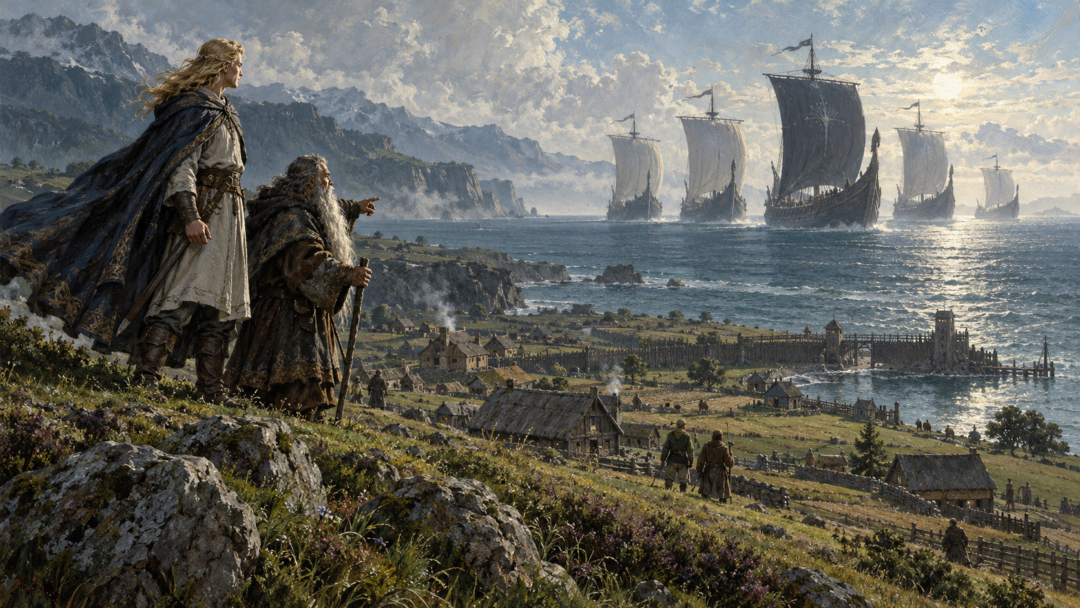
The great ships of Númenor usually enter Middle-earth as wonders.
They bring tall mariners from beyond the Sea, heirs of the Edain who once fought beside the Elves. In the wider histories of the Second Age, their arrival can mean renewed friendship, exploration, havens, trade, war against Sauron, and eventually the rise of kingdoms whose ruins still shape the world of The Lord of the Rings.
But in the unfinished tale of Tal-Elmar, a ship on the horizon means something very different.
Tal-Elmar and his father look from the green hills of Agar and see four vessels approaching the coast. One bears black sails. They do not wonder what gifts the newcomers might bring. They hurry home with dreadful news.
The strangers are the Go-hilleg: the High Men of the Sea.
And among the people of Agar, stories say those High Men raid the coast, seize captives, and carry them onto the terrible Ship of the Dark. What happens there grows monstrous in the telling. The captives, people fear, may be slaughtered, eaten, or offered to the Dark.
The tale never establishes those horrors as Númenórean practice. That distinction matters. What it gives us instead is the fear of people who believe such things could happen.
For once, the ships of Númenor are not being watched from the deck.
They are being watched from the shore.
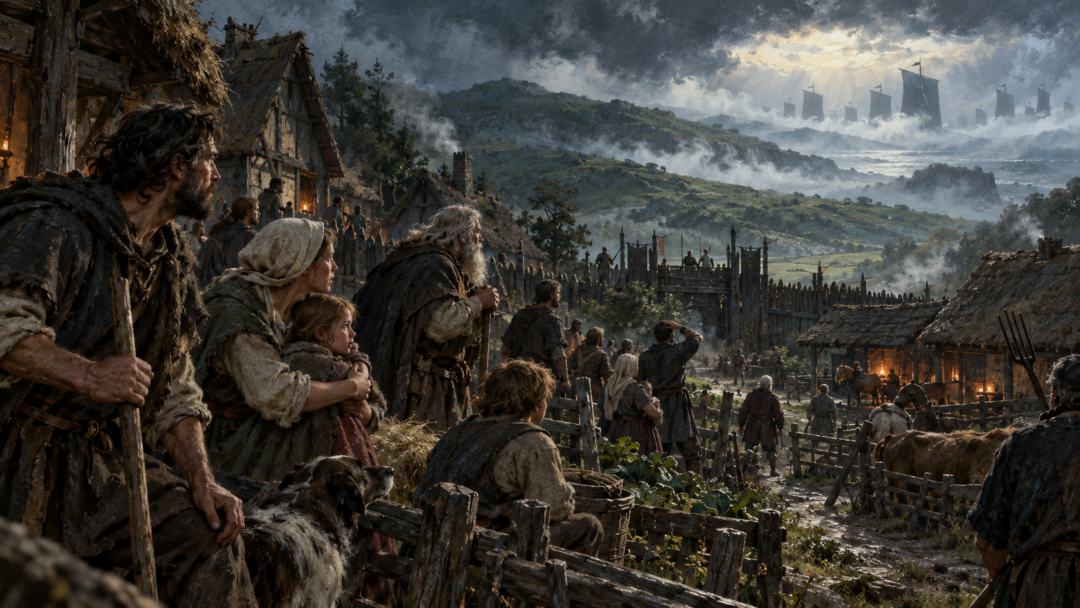
The Go-hilleg are Númenor seen through frightened eyes
That shift in viewpoint changes almost everything.
The people of Agar do not possess the historical framework available to readers of the wider legendarium. They do not know the long story of the Edain, Elros, Númenor, the friendship of the Eldar, or the complicated stages by which Númenórean voyages to Middle-earth changed over the Second Age.
They know what reaches them as memory and rumor.
The Go-hilleg are powerful outsiders from the Sea. They possess ships beyond anything Agar can match. They have a reputation for violence along the coast. Their arrival is not interpreted as an episode in the destiny of Númenor. It is an immediate question of survival.
That is what makes Tal-Elmar so unusual.
Elsewhere, Númenórean expansion is often described at the scale of centuries. The histories tell how the Men of Westernesse returned to Middle-earth, established havens, sought resources, fought Sauron, and in darker generations increasingly treated the inhabitants of Middle-earth as subjects rather than equals.
Tal-Elmar compresses that enormous process into a human sensation.
A man sees sails.
A community remembers stories.
Fear arrives before the sailors do.
Even the name Go-hilleg matters because it reminds us that the inhabitants of the coast do not encounter these newcomers primarily through Númenor’s own titles and traditions. They have their own word for them. Their own understanding. Their own inherited dread.
Imperial power looks very different when its subjects are allowed to name it.
The horror stories may be false, but the fear is real
The most disturbing element is the tale of the Ship of the Dark.
The people of Agar believe captives taken by the Sea-men may be carried aboard it and eventually slaughtered, eaten, or sacrificed. Nothing in the surviving fragment confirms that the Númenóreans actually practice cannibalism or such sacrifice. Treating the rumor as straightforward fact would go beyond the text.
But dismissing it as merely false would miss the point.
Communities living under the threat of raids rarely possess perfect information about the people coming over the horizon. Power creates rumor as easily as it creates tribute. A ship that can appear suddenly, carry armed strangers ashore, seize people, and disappear across an unknown sea does not need to contain literal monsters in order to become monstrous in local memory.
That is the brilliance of the perspective.
A Númenórean chronicler might record an expedition.
A person in Agar experiences the possibility that someone will come from beyond the known world and take his family away.
The difference is not merely factual. It is psychological.
Tal-Elmar therefore supplies something the grand Second Age histories rarely linger over: the knowledge available to the people being approached, displaced, or conquered was fragmentary. They did not necessarily know which Númenórean faction had arrived, what policy motivated it, whether its leaders considered themselves benevolent, or how its expedition fitted into some larger struggle against Sauron.
They saw the ships.
Sometimes that was enough.
The unfinished form of the story matters
There is an important limit to everything we can say about Tal-Elmar: the narrative was never completed.
The surviving material belongs to an abandoned and developing conception. Notes consider different geographical and historical placements. One possibility associated the region with the Isen or Morthond; a much later note instead considered fitting the story to the mouths of Anduin and the Langstrand.
That later thinking also raises an especially intriguing possibility: the arriving Númenóreans could belong to the period when the Elf-friends were establishing permanent havens before the Downfall.
That possibility prevents a simple reading in which these must be late King’s Men at the absolute moral nadir of Númenórean imperialism.
The contradiction may actually make the fragment more interesting.
The men aboard the ships may understand themselves through one story — perhaps as enemies of Sauron, settlers, or bearers of a greater civilization — while the people on land experience them through another: armed foreigners who can take territory and decide who remains upon it.
The notes indicate an intention to occupy the country and make a settlement connected with resistance to a hostile king, apparently Sauron in one conception. Yet a strategically useful settlement for the Númenóreans can still be dispossession to those already living there.
Those two truths do not cancel each other.
Tal-Elmar lets them collide.
Mogru shows how conquest begins before the invader speaks
The Sea-men are not the only source of danger.
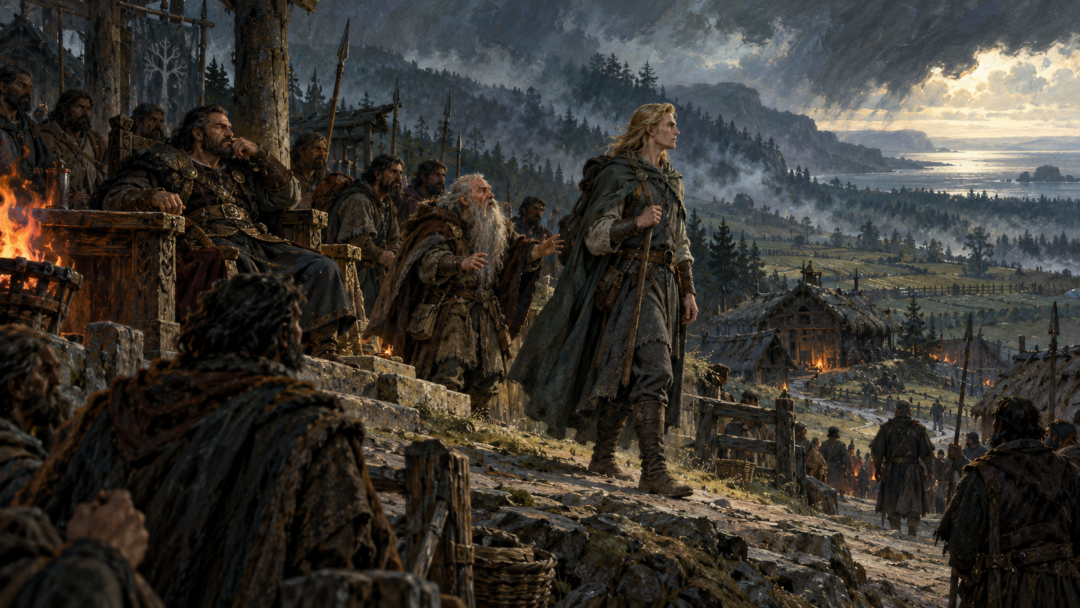
When Tal-Elmar and his father Hazad return to Agar with their warning, much of the community is away in the fields. They bring the news to Mogru, the town-master.
Mogru already dislikes Tal-Elmar.
Tal-Elmar does not respond to his authority with the submission Mogru expects, and the young man’s independence has made him dangerous in the ruler’s eyes. At first Mogru mocks the warning. The ships have not come in his lifetime, and the report is easy to dismiss.
Then the possibility becomes harder to ignore.
Mogru sends Tal-Elmar toward the shore as a scout.
The text makes his hostility significant: sending Tal-Elmar into danger provides an opportunity to be rid of someone he resents.
This is not formal cooperation between Mogru and the Númenóreans. He has not negotiated with them, and they have not recruited him. But the episode exposes a darker mechanism that often accompanies outside power.
A community threatened from beyond can still be divided from within.
Before the Númenórean captain has spoken a word to Agar, the possibility of Númenórean violence has already become useful to a local ruler. Mogru can turn the approaching ships into a weapon against an inconvenient man.
That detail keeps Tal-Elmar from becoming a simple story of innocent villagers versus foreign conquerors.
Agar has its own hierarchy, cruelties, memories, and old violence.
The shore is not morally pure merely because something stronger is approaching it.
Agar itself was built on an older conquest
Tal-Elmar’s family history makes that point even sharper.
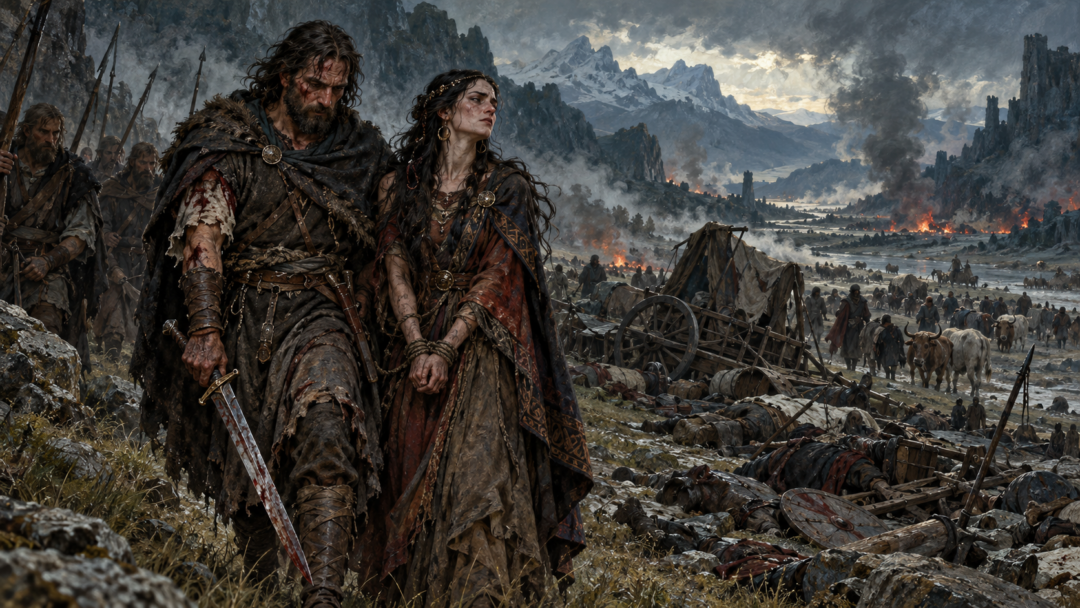
His grandfather Buldar fought in a battle against people described as the Fell Folk of the East. From that conflict he returned with a wound, a sword, and a captive woman named Elmar, whom he took as wife largely against her will.
Elmar never accepted the violence that had brought her into Buldar’s household.
She foretold vengeance through his own descendants: someone would arise within his kin whose coming would be bound to the end of Buldar’s people and the downfall of their king.
Tal-Elmar appears to stand somewhere inside that unresolved prophecy.
He is different from the people around him in appearance and temperament. His father names him for Elmar, and the story repeatedly marks him as someone who does not fit comfortably inside Agar’s society.
This creates a powerful reversal.
The people who fear being displaced by the Go-hilleg are themselves heirs to older acts of conquest.
The threatened have also threatened.
The conquered have also taken captives.
That does not excuse anything the Númenóreans may do. It complicates the moral landscape. Tal-Elmar is not presenting history as a neat sequence in which one innocent people is suddenly introduced to violence by outsiders.
Violence is already buried inside families.
The arrival of Númenor brings another, vastly greater power into that existing chain.
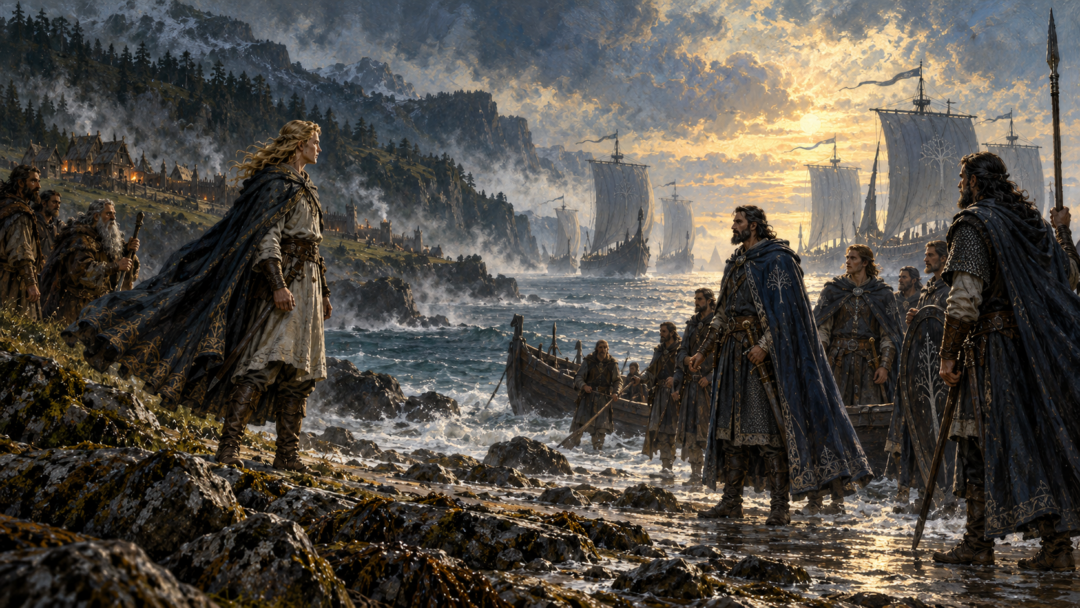
Tal-Elmar belongs to both sides — and fully to neither
Eventually Tal-Elmar reaches the coast and approaches the newcomers.
His appearance initially complicates the encounter, and the Númenóreans perceive something unusual in him. The surviving material also connects him mysteriously with their language: what he hears seems tied to the language of his dreams.
The fragment ends before these discoveries can become a completed fate.
We therefore cannot say with confidence what Tal-Elmar would ultimately choose, whom he would join, or exactly how Elmar’s prophecy would be fulfilled.
That incompleteness is frustrating, but strangely appropriate.
Tal-Elmar stands between identities just as the story stands between historical perspectives.
He comes from Agar, but does not entirely resemble or belong to its people. His ancestry carries the memory of a conquered woman. He walks toward invaders his neighbors consider monsters, only to discover signs that he may possess an unexpected connection to them.
Behind him is a society capable of cruelty.
Before him is a civilization capable of greatness and domination alike.
And offshore are the ships.
Most histories of Númenor ask what its mariners did when they returned to Middle-earth.
Tal-Elmar asks a rarer question.
What did their return look like to the person standing on the beach?
From there, Númenor is not first a lost kingdom, a line of kings, or the ancestral glory behind Gondor.
It is a sail on the horizon.
And someone has already started running home.
Sources & Notes
This article is based on close reading and interpretation of Tolkien's published works and related source material where relevant.