When Gandalf and his companions climb towards the golden hall at Edoras, the welcome is not exactly warm. Armed guards stand between the visitors and the ruler of Rohan, and Gandalf must heed the customs of the royal household. Amid the tension, a small detail in the guard’s speech catches the eye: the king’s title comes after his name.
Why does Rohan reverse the usual English order? The answer lies in how the Rohirrim are represented. Their speech and names are presented through forms of Old English, and older Germanic traditions could place a royal title after the personal name. It is a deliberate historical flavour in the English telling, not a mistake or proof that the people of Rohan literally spoke Anglo-Saxon English.
A royal title at the doors of Meduseld
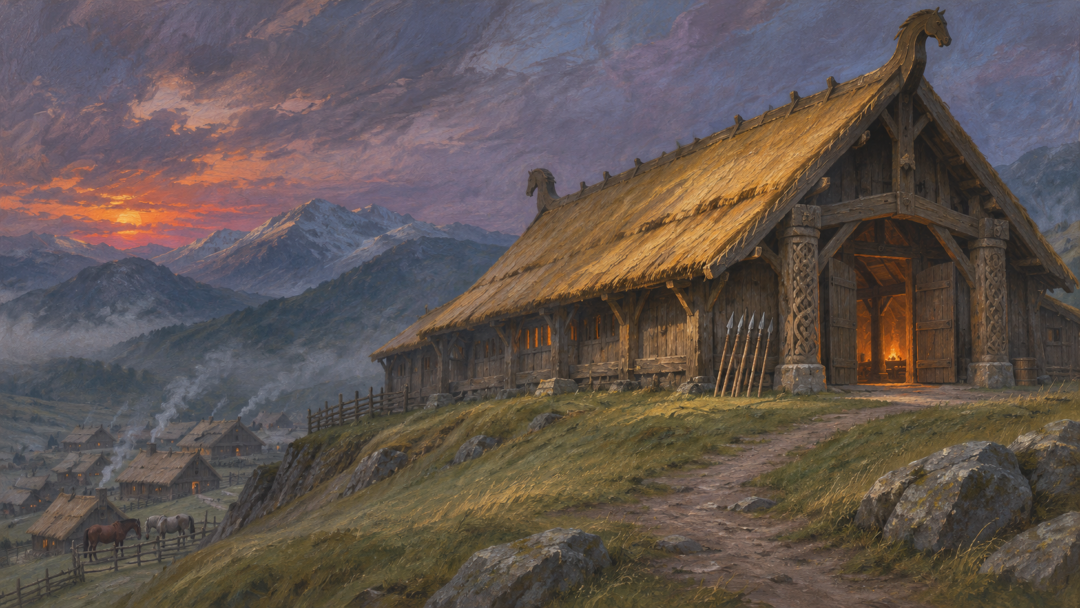
The clearest example comes in The Two Towers, in the chapter The King of the Golden Hall. A guard warns the arriving travellers: “It is the will of Théoden King that none should enter his gates”. The travellers have reached the heart of the Mark, and the guards act under royal authority. The title accompanies a command controlling access to the hall.
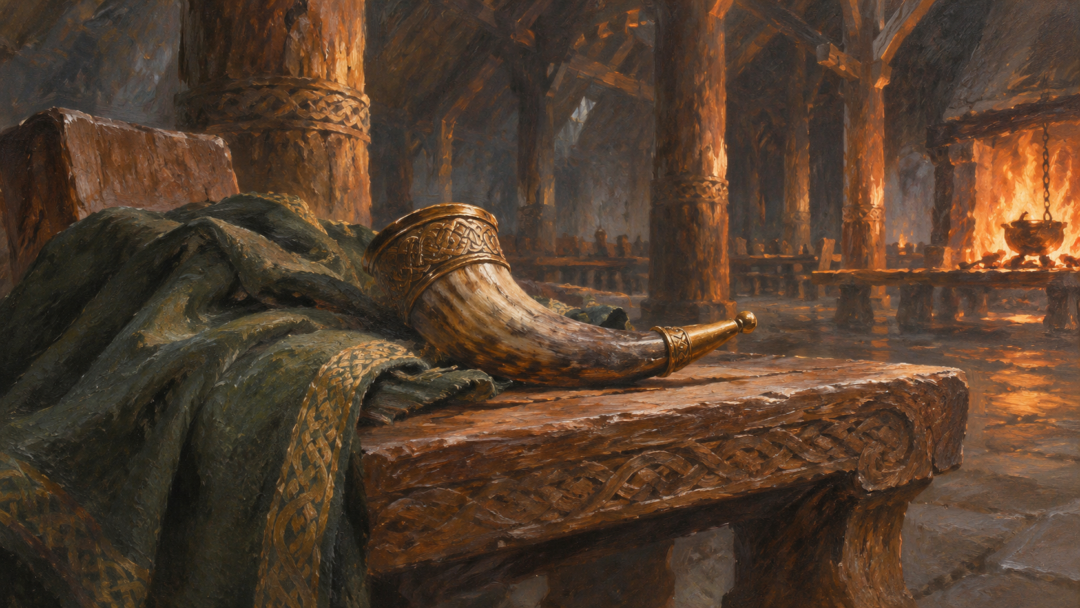
The setting reinforces the effect. Meduseld stands above Edoras, its roof shining from a distance, and its entrance is guarded according to the rules of Théoden’s house. Legolas points it out with the words “Meduseld is that golden hall”. Within, the royal seat, hearth and decorations preserve the Riders’ history. Authority here belongs to a household and a people as well as a single ruler.
Another form in the same chapter is “Théoden son of Thengel, King of the Mark of Rohan”. It gives the ruler a father, a kingdom and a formal title in one sequence. It shows how easily a formal identification can build around the personal name. Nor does the question mean that King Théoden never occurs elsewhere in The Lord of the Rings. The interesting point is why the less familiar order sounds so appropriate in Rohan.
Why Middle-earth has more than one layer of language
There is a trick behind the apparent simplicity of the dialogue. The characters are not supposed to be speaking modern English as their native language. Much of Middle-earth communicates through Westron, the Common Speech, which the narrative renders in English for its readers. The English on the page is a translation convention, not a transcript of sounds heard on the road to Edoras.
The people of Rohan also have their own tongue, related to the languages of northern peoples and connected in its history to the wider family of Mannish speech. The book represents it with Old English or Old-English-like forms, setting familiar Common Speech beside a more archaic-sounding language. In Letter 144, Tolkien explains that the names of the Rohirrim were turned into forms resembling, but not identical with, Old English.
That arrangement explains why a place called Edoras and a hall called Meduseld can stand amid otherwise readable English prose. Meduseld is built from Old English elements associated with a mead hall; it is more than an exotic label attached to a building. The name evokes feasting, a lord’s household and gatherings in which loyalty is public. Its sound belongs with the timber and guarded doors before anyone investigates its etymology.
There is a limit to the analogy. Old English is an ancestor of modern English, whereas the language of Rohan was not simply an earlier historical stage of Westron. The correspondence is a literary way to represent kinship, distance and antiquity, not a one-to-one family tree. The Rohirrim did not inherit their words from medieval England. We hear them through a linguistic lens chosen for the book.
Why the title comes after the name
In present-day English, King Théoden sounds immediately ordinary. Yet names and titles have not always been arranged that way across Germanic languages. Older usage could attach a designation for king after the person’s name. Old English used cyning for king, while Old Norse used konungr. A Norse example is Hervarðar konungr, with the royal designation following the name. That example is Norse, not an Old English sentence, but it helps illustrate the broader naming pattern.
The distinction is about convention, not rank. A title following the name can sound like an established designation rather than an introductory label. Neither position grants more power. Théoden’s authority comes from his kingship and the allegiance of the Mark, not from the order of two words. The phrasing works because it belongs to the same older linguistic atmosphere as the names of his people.
Old English also permitted more flexibility in word order than modern English, although that general fact by itself does not prove a specific rule about royal titles. We should not imagine a law of grammar that required every Anglo-Saxon king to be named in precisely one way. The safer explanation is a recognizable historical naming habit reflected in the narration. The guard at Meduseld speaks intelligible English, but the title makes it feel older.
Théoden is already a royal word
There is another pleasing detail hidden in the name itself. Théoden comes from Old English þeoden, a word for a lord, chief, prince or ruler of a people. It is related to þeod, meaning a people or nation. Within the fictional language, the corresponding name is given as Tûrac, a Rohanese word associated with kingship: the Old English name is a rendering, not the original sound. So the name and the title overlap in meaning to modern eyes once the older vocabulary is unpacked. The apparent repetition is part of how the name belongs to Rohan.
That root also runs through the names around him. Théoden’s son is Théodred, whose name combines the element for people with one associated with counsel. The ancestors of the Riders were called the Éothéod, a name bringing together the ideas of horse and people. These connections reveal shared naming elements, not predictions of personal destiny.
The people call themselves the Eorlingas, the followers or descendants of Eorl, their first king. That name has an Old English form too, and it defines a people through their remembered founder. Beside it, Théoden King belongs to a consistent naming world. His rule is part of a lineage, and his subjects understand themselves as belonging to a history larger than a single reign.
The sound of Rohan beside Gondor and the Shire
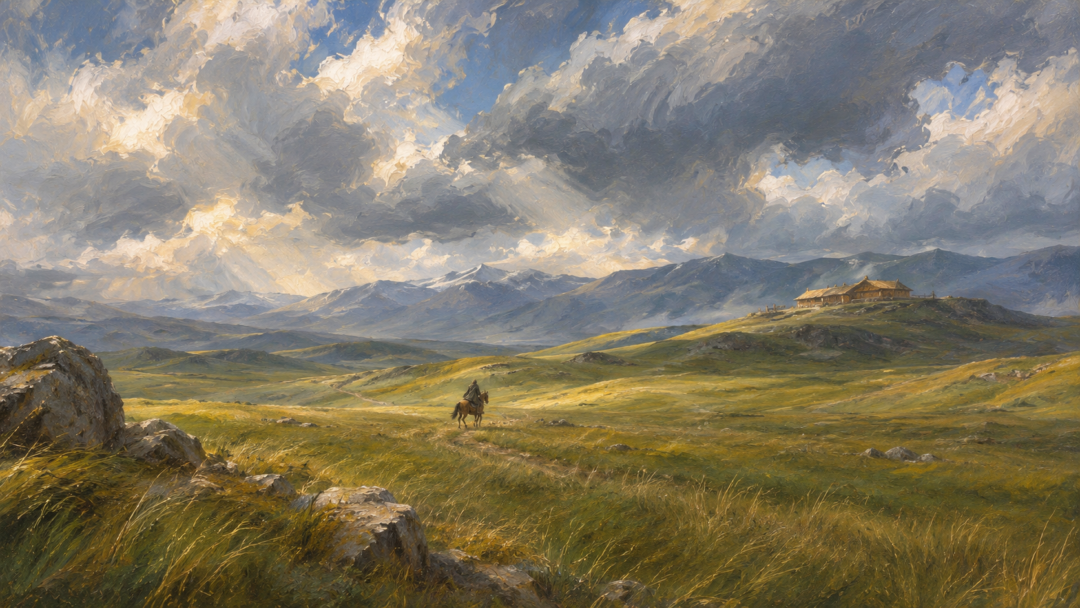
Compare Rohan with Gondor. Gondor’s political world carries Númenórean memory, great stone cities and names shaped by Elvish languages. Edoras offers a very different royal centre: a hall on a hill, horses on the surrounding plains and a household gathered around its lord. Language distinguishes the allies before their histories are explained. The reader can hear that they come from different traditions.
The contrast does not make Rohan a simple copy of Anglo-Saxon England. The Rohirrim are famous as horsemen, while the literary resemblance to early English halls and poetry is only one ingredient of their imagined culture. Tolkien’s translation explanation should not be stretched into an assertion that their weapons, customs and warfare exactly reproduce a particular real society. Their language has a historical echo, but their country exists inside Middle-earth, with its own alliances, migrations and enemies.
There is also an unexpected bridge to the Shire. The ancestors of some Hobbits lived nearer the northern peoples from whom the Rohirrim descended, and traces of that contact survive in words and names. This helps explain why the Riders do not feel entirely alien to the Hobbits, even when their hall and manners seem ancient. The book’s language choices can suggest degrees of familiarity without stopping the journey to deliver a lecture on historical linguistics.
That matters most when the story moves between scales. On one page, Rohan is a kingdom making decisions that affect the fate of the West; on another, it is a guard trying to obey instructions at a doorway. The same cultural identity reaches both moments. A form of address can carry the weight of a people just as surely as the names of rivers, horses or halls. No one needs to decipher every word to sense the pattern.
What the wording can, and cannot, tell us
The evidence has limits. The explanation that postposed royal titles reflect older Germanic usage is a sound reading supported by specialist lore references and illustrated by Scandinavian naming practice. But the particular claim about Théoden King is an explanatory observation, not a known, separately published instruction from Tolkien insisting on that exact order. His stated translation method gives the larger framework; the historical comparison helps account for this particular phrase.
Nor should the English wording be treated as a surviving specimen of Rohirric grammar. We do not have enough of the language to reconstruct how a guard would have placed the king’s title in an original Rohanese sentence. What remains is a readable exchange and a royal designation suited to the Mark. That is enough to appreciate the choice without pretending to know more than the text reveals.
At the entrance to Meduseld, a guard stands between travellers and a king whose hall holds the memories of his people. His words need only do their immediate job: keep strangers outside until permission is granted. Yet the title he uses lets another age sound briefly through familiar English. The doors of the golden hall have not opened, and already the language has carried us inside Rohan.
Sources & Notes
- Tolkien Gateway, Théoden — the Old English meaning of the king's name — https://tolkiengateway.net/wiki/Th%C3%A9oden
- Tolkien Gateway, Rohirric — Old English as a representation of Rohan's language, not its literal identity — https://tolkiengateway.net/wiki/Rohirric
- Bosworth–Toller, An Anglo-Saxon Dictionary, page 1048 — þeóden as a word for a lord or ruler, with historical examples — https://www.germanic-lexicon-project.org/html/oe_bosworthtoller/b1048.html
Reading references: The Two Towers, The King of the Golden Hall; The Return of the King, Appendix F, On Translation. Older title placement explains the historical flavor of the English wording; it does not reconstruct otherwise unattested Rohirric grammar.