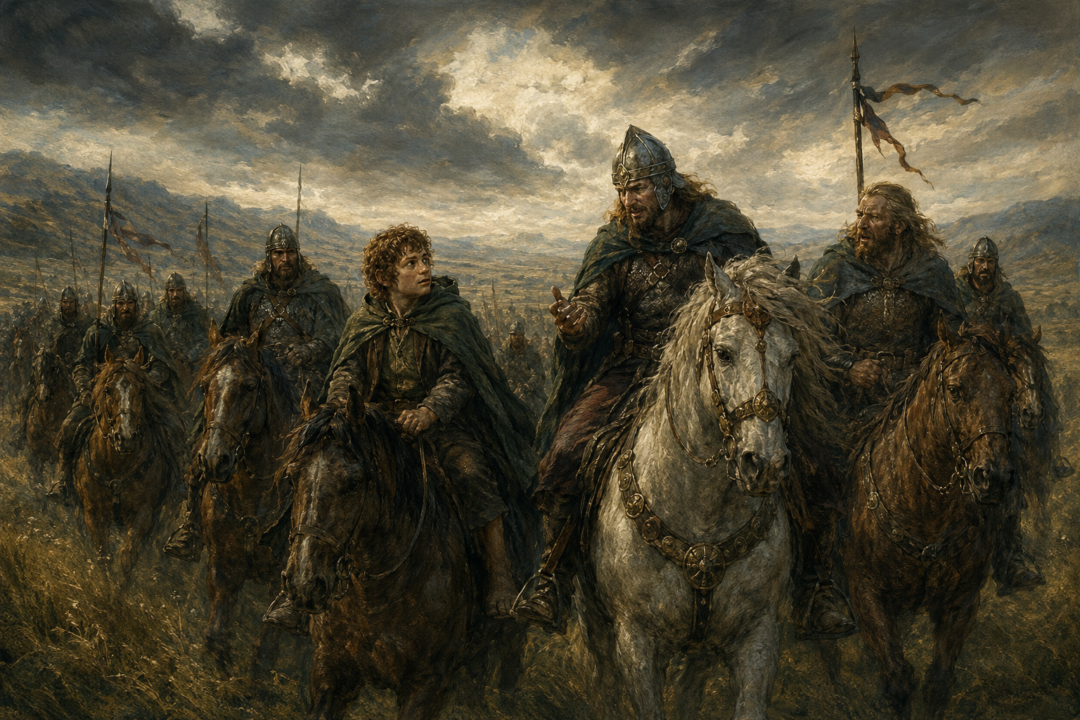
When Merry rides among the Rohirrim, he hears something strangely unsettling in their speech. He cannot properly understand it, yet individual words seem familiar. The language sounds richer and stronger than the speech of the Shire, as though something half-forgotten has suddenly returned from a much older world.
That moment reveals one of the most important linguistic tricks in The Lord of the Rings.
The Rohirrim are not literally speaking Old English. Their actual language belongs to Middle-earth. Old English is being used to represent it. And once that is understood, an even stranger conclusion follows:
The characters are not literally speaking modern English either.
Most of the English we read represents Westron, the Common Speech of northwestern Middle-earth. English and Old English therefore function as a carefully constructed analogy for relationships between languages inside the story.
But the analogy has limits—and those limits tell us something fascinating about what the English of The Lord of the Rings actually means.
The English on the Page Is Westron in Disguise
Within the linguistic framework explained in Appendix F of The Lord of the Rings, the familiar English of the narrative generally stands for Westron.
Westron, or the Common Speech, had become enormously widespread by the end of the Third Age. Its ultimate history lay in the speech associated with the Númenóreans and their dealings with the peoples of Middle-earth. By the time of the War of the Ring, it was the native language of many inhabitants of the lands associated with the old realms of Arnor and Gondor and served much more widely as a common means of communication.
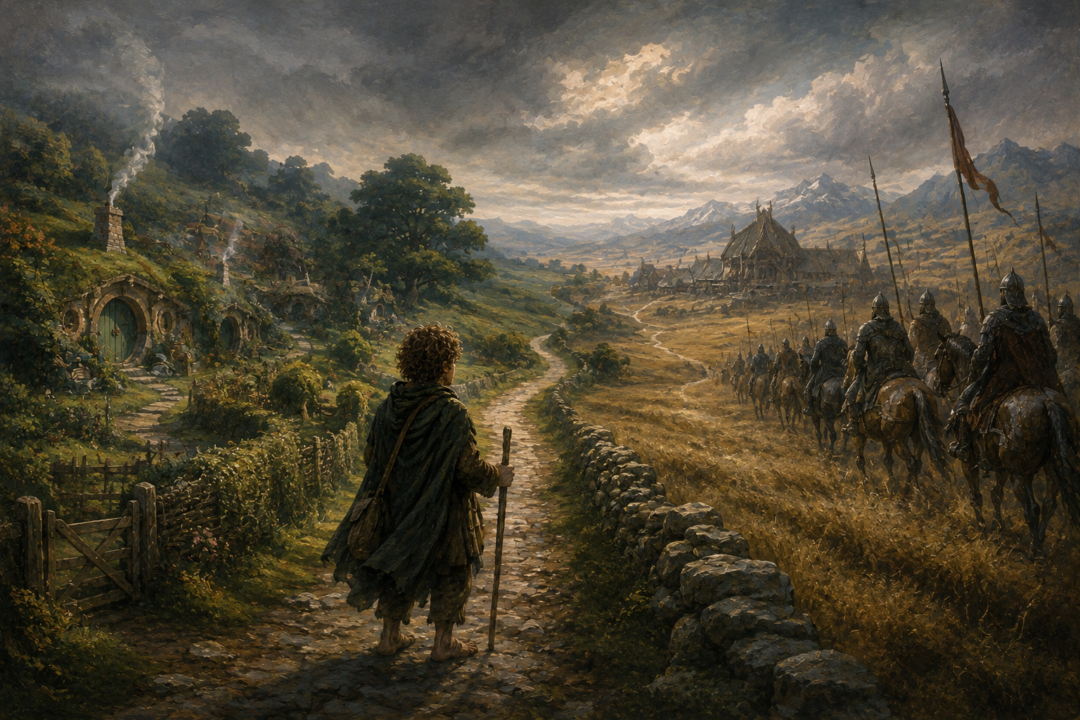
The Hobbits of the Shire spoke Westron too, though naturally in their own fashion.
That means Frodo, Sam, Merry, Pippin, Aragorn, Boromir and many of the Men they encounter are not normally having conversations in English inside the imagined world.
Their conversations have been rendered into English.
This distinction matters because the translation does much more than replace one vocabulary with another. It attempts to preserve relationships between languages, dialects and names.
And Rohan provides the clearest example.
Why Rohan Sounds Like Old England
The language of the Rohirrim is represented by forms resembling Old English because of its position relative to Westron.
Appendix F explains the crucial relationships: the speech of Rohan was more distantly related to the Common Speech, very closely related to the former language of the northern Hobbits, and archaic when compared with contemporary Westron.
So if ordinary Westron becomes modern English for the reader, the Rohirrim require something that feels related to English but noticeably older.
Old English provides precisely that effect.
Names such as Éomer, Éowyn, Théoden and Éothéod therefore should not be mistaken for proof that Anglo-Saxons somehow exist in Middle-earth. These are translated representations of Rohirric names.
The same applies to recognizable Old English elements associated with Rohan.
The translation is reproducing linguistic relationships rather than revealing the literal vocabulary spoken by the Riders.
This is also why the resemblance should not be pushed into a claim that Rohan simply “is Anglo-Saxon England.” Appendix F explicitly cautions that the linguistic representation is not intended to establish identity in culture, weapons or methods of warfare.
Rohan has its own history inside Middle-earth.
Old English is the reader’s window into its language.
The Important Catch: Rohirric Is Not Westron’s Old English
Here lies the most easily missed point.
Because Rohirric is represented by Old English and Westron by modern English, it is tempting to assume that Rohirric developed into Westron just as Old English eventually developed into modern English.
That is not what the fictional linguistic history says.
Westron ultimately derives from Adûnaic, the language of Númenor, though its development in Middle-earth involved extensive contact with other peoples and tongues. Rohirric belongs instead to the languages of the Northmen.
The two were related within the broader linguistic landscape of Men, but Rohirric was not simply an earlier historical stage of Westron.
So the equation is not:
Rohirric → Westron
Old English → Modern English
Instead, the translation uses the real historical relationship between Old and modern English to approximate several qualities of the fictional relationship: kinship, familiarity and especially the archaic character of Rohirric from a Westron-speaking perspective.
It is an analogy, not a linguistic family tree reproduced exactly.
That distinction prevents one of the most common misunderstandings about the languages of Middle-earth.
Merry Hears the Relationship
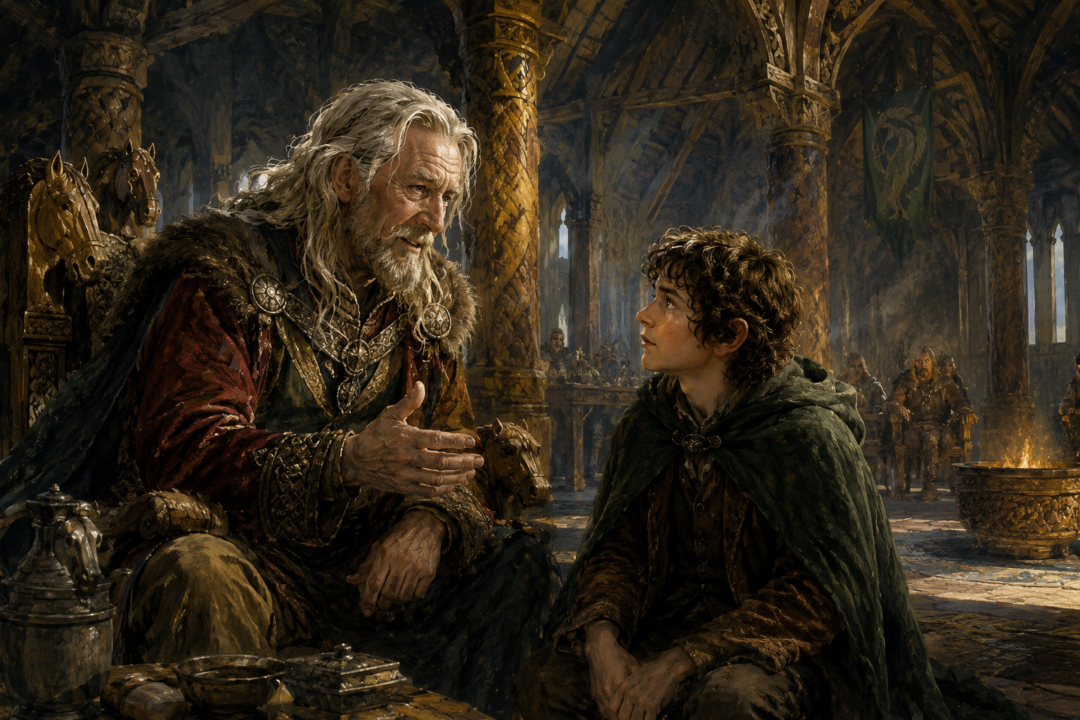
The translation system becomes more than an appendix when Merry travels with the Riders of Rohan.
He listens to their speech and recognizes many words without being able to understand the whole. The experience is simultaneously foreign and familiar.
That is exactly what the translation scheme is designed to communicate to the reader.
A modern English speaker looking at Old English can encounter a similar sensation. Certain forms appear recognizable while entire passages remain opaque.
The correspondence is not mathematically exact, and it is not supposed to be. What matters is the experience of linguistic kinship.
Merry has an additional reason to sense it.
The ancestors of the Hobbits had lived much farther east before eventually settling in Eriador, and the earlier speech of the northern Hobbits was closely related to the language ancestral to that spoken in Rohan. Although the Hobbits later adopted Westron, traces of their older linguistic inheritance survived.
Rohan therefore confronts Merry with something resembling a distant relative of a linguistic past his own people have largely lost.
The recognition is not merely clever world-building. It gives history an audible presence.
“Hobbit” Is One of the Best Clues
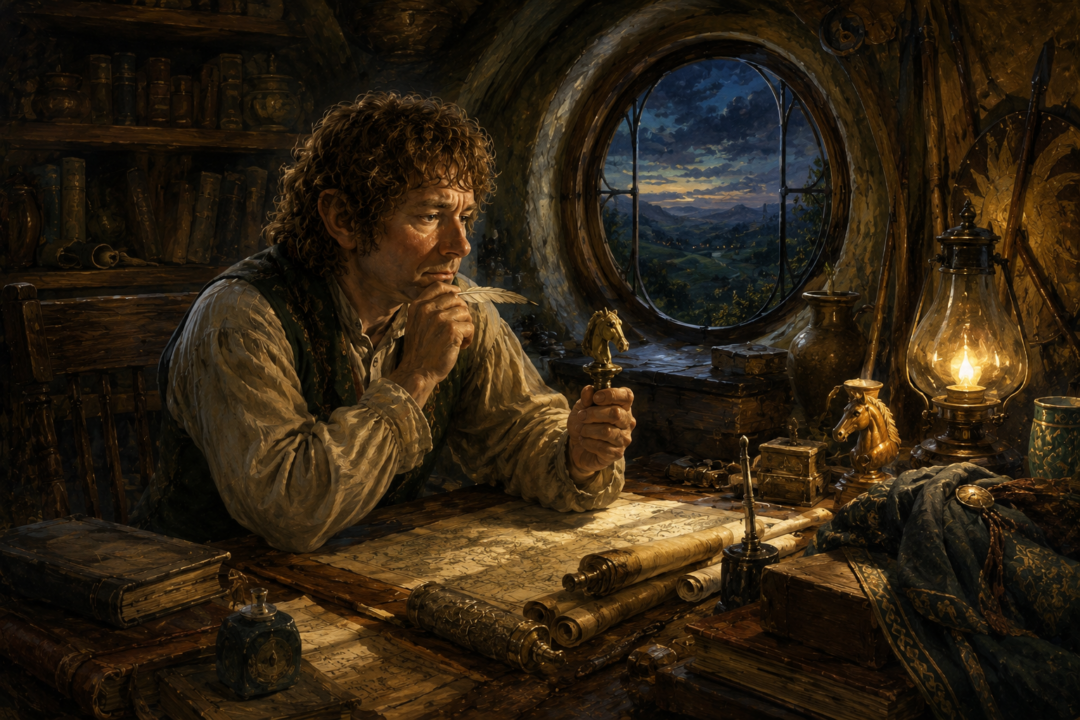
The word hobbit itself illustrates the method brilliantly.
Appendix F gives kuduk as the actual Shire form represented by hobbit. It connects this with Rohirric kûd-dûkan, meaning “hole-dweller,” a term Merry heard used by Théoden.
The English representation creates a corresponding relationship through hobbit and the Old English-style holbytla.
The point is not that the inhabitants of Rohan literally said holbytla.
They did not.
The Old English form represents a Rohirric word, just as hobbit represents a Hobbitish Westron form.
What survives through translation is the relationship between them.
This gives the familiar word hobbit a fictional history beneath its English surface. It is not merely a convenient English label imposed on an exotic people. Within the translation framework, it stands in for a word whose development belongs to Middle-earth itself.
The English has been engineered to preserve the echo.
Samwise Was Not Literally Samwise
Hobbit names make the same principle even clearer.
Appendix F reveals that many names appearing perfectly ordinary or quaintly English are translations or adaptations of Westron originals.
Samwise Gamgee, for example, was not literally called “Samwise” in the underlying Westron. His personal name was Banazîr, shortened to Ban. Its meaning allowed it to be represented by Samwise, built from an old English word conveying a comparable sense of being half-wise or simple.
His father Hamfast likewise represents Westron Ranugad, shortened to Ran, with a corresponding meaning associated with staying at home.
Even familiar Shire geography participates in this system. The Shire represents Westron Sûza.
These examples prove that English is not meant to describe the literal sound of Westron.
If it were, Frodo’s companions would actually be saying names such as Samwise and Hamfast.
Instead, the English reproduces meanings, social associations, linguistic relationships and degrees of familiarity wherever possible.
We are reading a translated Shire.
Translation Preserves What Literal Transcription Would Destroy
Why go to such trouble?
Imagine that every Westron and Rohirric name had simply been left in its fictional original form.
A reader encountering kuduk and kûd-dûkan would probably perceive both as equally foreign.
But they were not equally foreign to the people within the story.
For Merry, the speech of Rohan contains recognizable echoes. For a Westron speaker, some names are ordinary words while Sindarin, Quenya or Khuzdul forms may belong unmistakably to another linguistic tradition.
A literal transcription could therefore make Middle-earth less accurate from the reader’s perspective.
It would preserve sound while destroying relationships.
The translation does the opposite.
Rivendell feels immediately meaningful to an English-speaking reader, whereas Imladris feels Elvish. That difference helps approximate the distinction between a familiar Westron name and a Sindarin one.
Similarly, the Englishness of the Shire and the archaic Germanic texture of Rohan allow the reader to feel linguistic distance without needing to learn the actual languages involved.
The translation is therefore part of the world-building rather than merely packaging around it.
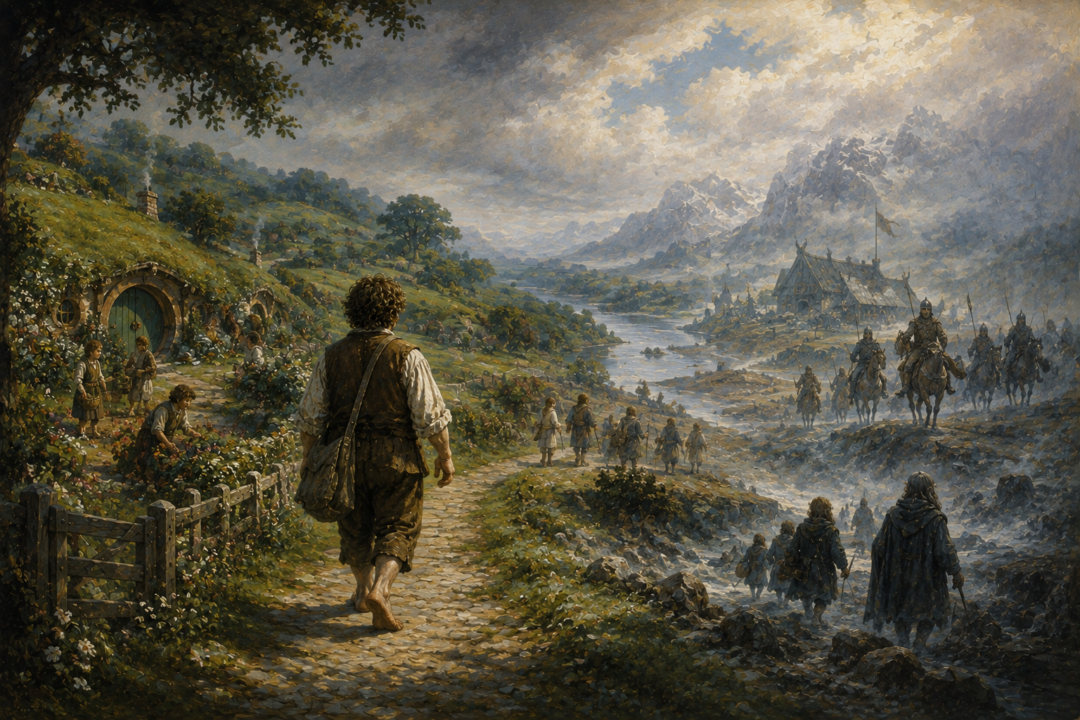
English Is a Map, Not the Territory
The safest way to understand Westron’s relationship to English is that English serves as its principal representational equivalent.
Westron is not secretly English.
Middle-earth’s internal history does not require medieval English speakers to produce the Common Speech, and Rohirric is not literally Old English.
Instead, real languages are used as a map of fictional linguistic relationships.
Modern English represents the familiar linguistic present of the Hobbits and much of the western world they encounter.
Old English represents a related but more archaic Mannish tongue in Rohan.
Other translation choices extend the same broad principle elsewhere, including the Northern forms associated with Dale and the names by which outsiders know many Dwarves.
Once this is recognized, the apparent Englishness of The Lord of the Rings becomes something stranger.
Bag End is an English name, but beneath it lies a Westron world.
Samwise is an English name, but beneath it lies Banazîr.
The Shire is an English name, but beneath it lies Sûza.
And when Merry hears the Riders speaking around him, he is not hearing the remote ancestor of his everyday Westron. He is hearing a related northern language whose ancient connections reach toward the forgotten linguistic inheritance of the Hobbits.
That is why Rohan sounds old.
The archaic English is not telling us what Middle-earth literally sounded like.
It is telling us what its languages sounded like to one another.
And that may be the most important distinction of all.
Sources & Notes
- https://www.encyclopedia-of-arda.com/w/westron.php — The Encyclopedia of Arda: Westron (the Common Speech represented by English in Tolkien’s translated narrative framework).
- https://www.encyclopedia-of-arda.com/r/rohirric.php — The Encyclopedia of Arda: Rohirric (the language of Rohan and its representation through Old English forms).
- https://www.encyclopedia-of-arda.com/a/adunaic.php — The Encyclopedia of Arda: Adûnaic (the Númenórean language from which Westron developed).
- https://www.encyclopedia-of-arda.com/e/eotheod.php — The Encyclopedia of Arda: Éothéod (the Northman ancestors of the Rohirrim and the linguistic-historical setting behind their speech).
Sources checked for relevance and availability.