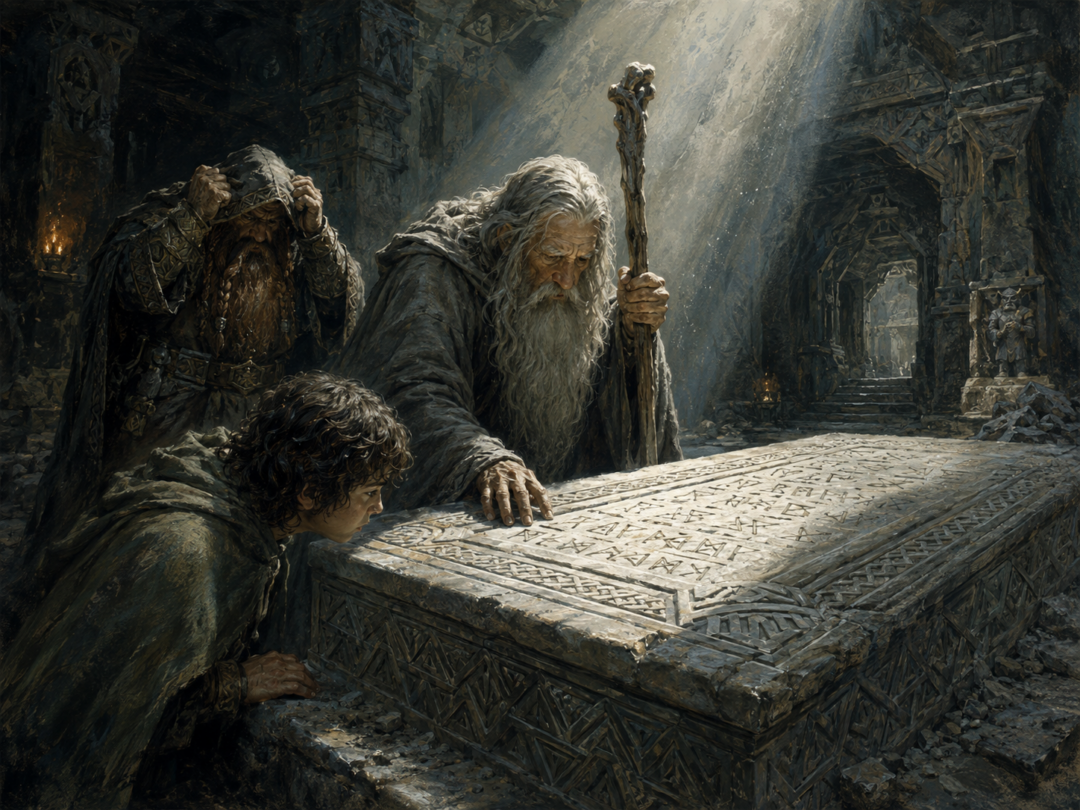
One of Moria’s most memorable revelations happens before Gandalf reads a single surviving line from the Book of Mazarbul.
The Fellowship enters a dim chamber, sees a white stone slab illuminated by a shaft of daylight, and almost immediately learns that Balin is dead. Only afterward do they discover the battered record that explains what happened to his colony.
That order matters. The book does not identify the tomb. The tomb identifies itself.
The distinction is easy to overlook because the two discoveries occur almost back-to-back in The Fellowship of the Ring. Yet the sequence reveals something important about how information survives in Middle-earth. Balin’s followers left behind two different kinds of testimony: a permanent memorial cut into stone and a fragile written history already half-destroyed by fire, blood, and time.
The Fellowship learns the fact of Balin’s death from the first. They learn the tragedy behind it from the second.
Frodo Recognizes a Tomb Before Anyone Knows Whose It Is
Near the end of “A Journey in the Dark,” the Fellowship has reached the Twenty-first Hall of Moria. They have spent days underground and still found no living Dwarves. Gimli’s hope of discovering Balin’s colony has steadily weakened.
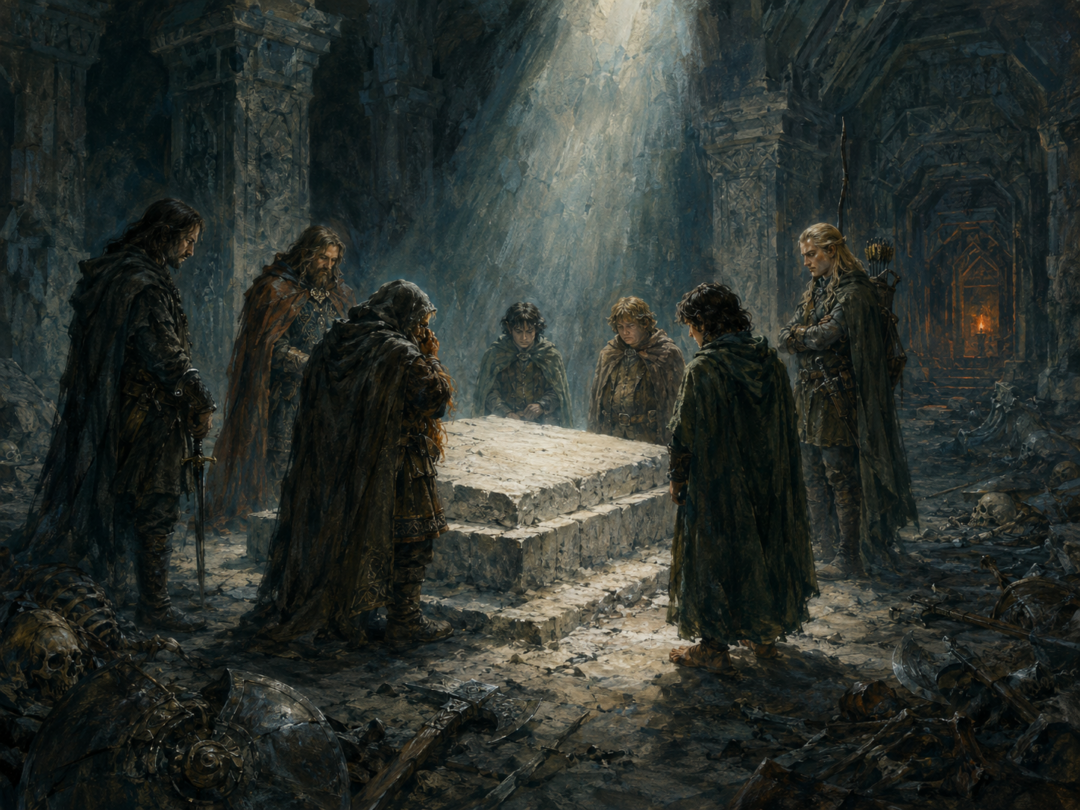
Gandalf notices light coming from the north and leads the Company toward it. They enter a large square chamber where daylight descends through a shaft high in the eastern wall.
In the middle stands an oblong block roughly two feet high with a large slab of white stone laid upon it.
Frodo is the first to say what its appearance suggests: it looks like a tomb.
At this point, however, he has identified only the function of the monument. Nothing about its shape alone tells him whose remains lie there.
That answer is carved directly into the stone.
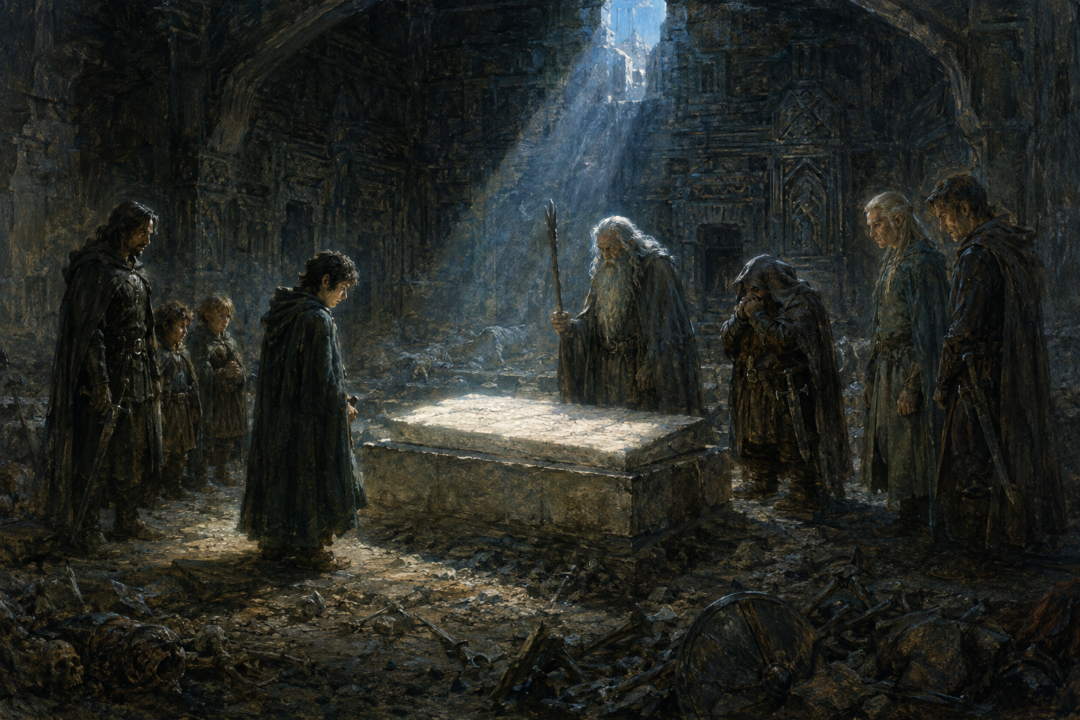
Gandalf approaches and examines the deeply engraved runes. He recognizes them as the runic tradition formerly used in Moria and reads the inscription for the Company.
Its meaning is unmistakable: the monument belongs to Balin, son of Fundin, Lord of Moria.
Only then does Frodo acknowledge what they have feared. Balin is dead.
So there are really two stages of recognition. Frodo recognizes a funerary monument from its physical form. Gandalf identifies the dead Dwarf by reading the inscription.
The Book of Mazarbul has not yet entered the story.
The Inscription Is the First Definitive Evidence of Balin’s Fate
Before entering Moria, the Fellowship already has reason to worry about Balin.
At the Council of Elrond, Glóin explains that Balin had left Erebor many years earlier with a company of Dwarves and entered Moria. For a time messages had come from the colony. Then they stopped.
No certain news followed.
Gimli therefore enters Khazad-dûm carrying both hope and anxiety. He is not travelling toward a colony known to have survived. He is searching for people whose fate has become unknown.
As the Company moves through the abandoned halls, the absence of any welcoming Dwarves becomes increasingly ominous. Yet silence is not proof. The colony might have moved elsewhere within the immense underground realm, retreated, or met some other fate.
Balin’s tomb changes uncertainty into certainty.
The inscription gives the Fellowship something they did not possess before entering the chamber: direct material evidence that Balin reached Moria, claimed lordship there, and died there.
This is why Frodo’s reaction follows immediately upon Gandalf’s translation. The inscription answers the central question they have carried through Moria.
But it answers only part of it.
They know Balin is dead.
They still do not know how he died, when he died, or what became of the Dwarves who followed him.
Why Gandalf Can Read the Tomb
The inscription is not an unexplained magical revelation. Gandalf simply knows how to read the writing.
He identifies the characters as Daeron’s Runes, a form of the Cirth associated historically with the Elves and later extensively adopted and developed by the Dwarves. Appendix E of The Lord of the Rings gives much more detail about the history of these runic systems, including the form associated with Moria.
The tomb inscription uses the languages of both Dwarves and Men. Its well-known meaning is Balin’s name and descent followed by his title as Lord of Moria.
This also explains why the recognition does not depend specifically upon Gimli.
Gimli knows Balin personally through family and people, but Gandalf is the one who reads the inscription aloud. His linguistic knowledge allows the entire Fellowship to understand the monument.
That is especially important because the Dwarves are not portrayed as casually revealing every aspect of their own language to outsiders. Khuzdul was traditionally guarded. Yet Dwarven monuments and writing could employ scripts readable by those with sufficient learning, and Balin’s tomb contains enough information for Gandalf to identify it without needing the colony’s chronicle.
The stone itself is therefore functioning exactly as a tomb inscription should: it preserves identity even after everyone who could speak for the dead has vanished.
The Book of Mazarbul Answers a Different Question
After the Fellowship has stood silently beside Balin’s tomb, they begin searching the chamber for further information.
This sequence is crucial.
They search because the tomb has already told them Balin died, but not what happened.
Among the ruined contents of the chamber Gandalf discovers a damaged book. Its pages are burned, slashed, stained, and partly missing. He concludes that it is a record of Balin’s people.
The surviving entries gradually reconstruct the colony’s story.
They describe the Dwarves’ arrival and early successes. They record their occupation of halls within Moria and Balin’s establishment in the Chamber of Mazarbul. Later entries reveal the disaster: Balin was killed in Dimrill Dale, enemies attacked the colony, escape routes failed, and the survivors were driven into a final desperate defence.
Thus the Book of Mazarbul does not reveal whose tomb the Fellowship has found.
It explains why the tomb is there.
That difference creates one of the most effective transitions in the Moria chapters. The inscription gives a simple statement of death. The book transforms that statement into a narrative of collapse.
The Chamber Itself Becomes Part of the Evidence
Even before Gandalf reads the book, the room already suggests catastrophe.
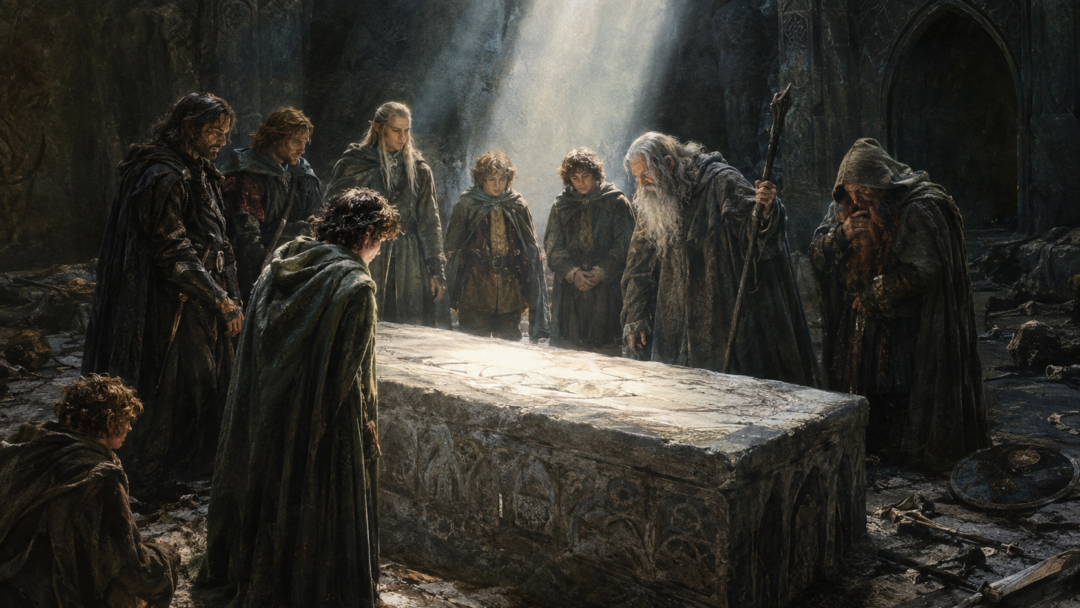
Once the Company’s eyes adjust, they notice bones near the doors along with broken weapons, damaged shields, and other remains of battle. Recesses in the chamber have been disturbed, and old possessions lie scattered.
Nothing about this scene suggests an orderly abandonment.
Still, the physical evidence alone cannot reconstruct the chronology. Bones cannot explain who attacked first. Broken weapons cannot tell the Fellowship that Balin was killed outside the East-gate. The ruins cannot describe the loss of the Bridge or the failure of the western escape.
The Book of Mazarbul supplies those details because someone continued recording events while the colony was dying.
The chamber therefore contains several layers of evidence at once.
The tomb preserves Balin’s identity.
The battlefield remains reveal violent destruction.
The book preserves the sequence of events.
Together they turn the Chamber of Mazarbul into something more than a burial place. It is effectively the last surviving archive of Balin’s failed attempt to restore Dwarven rule in Khazad-dûm.
Why Balin Is Called “Lord of Moria”
The inscription also confirms another important point before the chronicle does.
Balin is named not merely as Balin son of Fundin, but as Lord of Moria.
That title reflects the ambition of his expedition. Balin had not entered the ancient halls simply as an explorer. His company intended to re-establish a Dwarven presence in Khazad-dûm, the ancestral realm of Durin’s Folk.
The Book of Mazarbul later confirms that Balin established his seat in the Chamber of Mazarbul and was regarded by the colonists as lord there.
But the tomb already preserves that claim.
There is tragic irony in it. The title sounds permanent when carved in stone, yet Balin’s restored lordship lasted only a few years before the colony was destroyed.
The inscription announces a restored kingdom.
The room surrounding it proves how completely that restoration failed.
Stone Survives Where Memory Fails
The contrast between tomb and book is especially fitting for Moria.
The Book of Mazarbul has nearly been destroyed. Parts are unreadable. Pages are missing. Fire and violence have eaten away at the record, and Gandalf must piece together fragments.
The tomb inscription is different.
Its runes are deeply carved into stone.
That difference is not merely aesthetic. It explains why the first fact the Fellowship can recover with certainty is Balin’s identity. The longer and more detailed history is much more vulnerable.
Stone preserves a name and title.
Writing preserves a story, but only barely.
The Fellowship consequently experiences Balin’s fate in the reverse order from which history normally unfolds. They first encounter the final monument. Then they recover the events that led to it.
They see the ending before they learn the story.
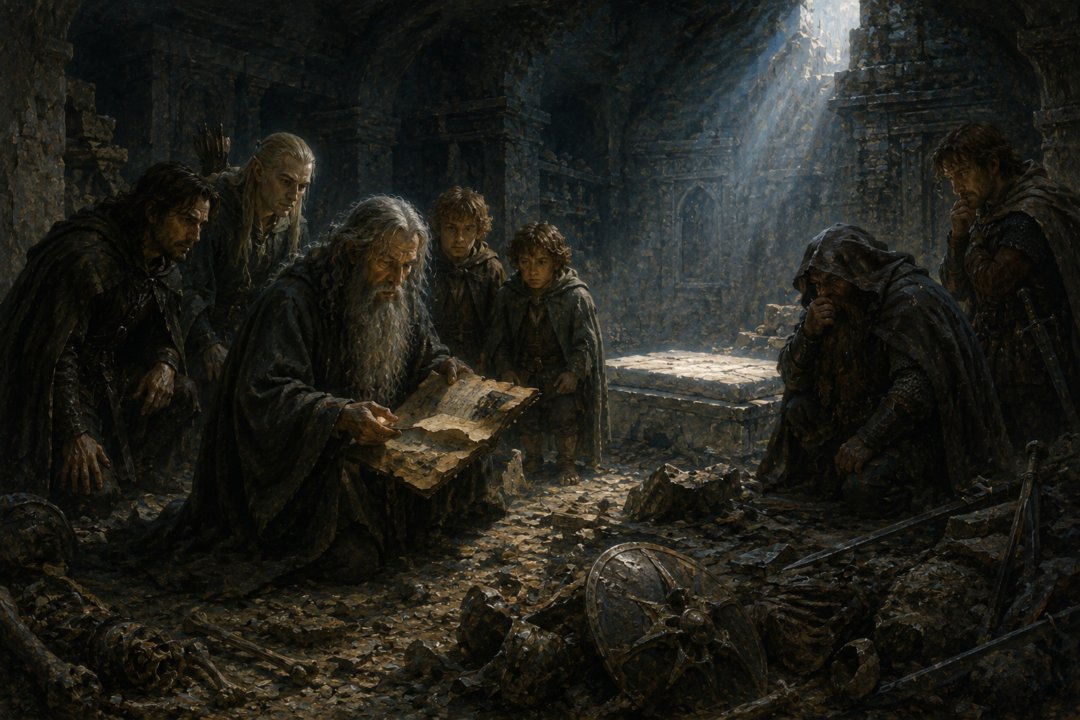
The Discovery Is More Personal Than a Historical Puzzle
For Frodo and Gimli, Balin is not simply a name from Moria’s past.
Balin was one of Thorin Oakenshield’s companions during the Quest of Erebor and had known Bilbo personally. Frodo remembers that connection while standing at the tomb.
For Gimli the loss is closer still. Balin belonged to his own people and family circle, and Gimli had entered Moria hoping for news of the colony. When Gandalf reads the inscription, Gimli covers his face.
That reaction comes before the Book of Mazarbul explains anything.
The grief does not require the chronicle.
The name on the stone is enough.
Only afterward does grief become understanding as the surviving record reveals how Balin and his followers were overwhelmed.
That is the real answer to the apparent mystery of how the Fellowship identifies Balin’s tomb before reading the Book of Mazarbul.
They do not deduce it from the book at all.
Frodo recognizes the object as a tomb. Gandalf reads the deeply carved inscription naming Balin. The Company then searches the chamber precisely because they already know Balin is dead and want to discover what happened to him and his people.
The Book of Mazarbul does not identify the dead.
It gives the dead a history.
Sources & Notes
- https://www.encyclopedia-of-arda.com/b/balin.php — The Encyclopedia of Arda: Balin (his Moria colony, death, and tomb as Lord of Moria).
- https://www.encyclopedia-of-arda.com/c/chamberofmazarbul.php — The Encyclopedia of Arda: Chamber of Mazarbul (the room containing Balin’s inscribed tomb and the colony’s record).
- https://www.encyclopedia-of-arda.com/b/bookofmazarbul.php — The Encyclopedia of Arda: Book of Mazarbul (the damaged chronicle read only after the tomb inscription reveals Balin’s death).
- https://www.encyclopedia-of-arda.com/c/cirth.php — The Encyclopedia of Arda: Cirth (the runic writing tradition used by the Dwarves and read by Gandalf on the memorial).
Sources checked for relevance and availability.