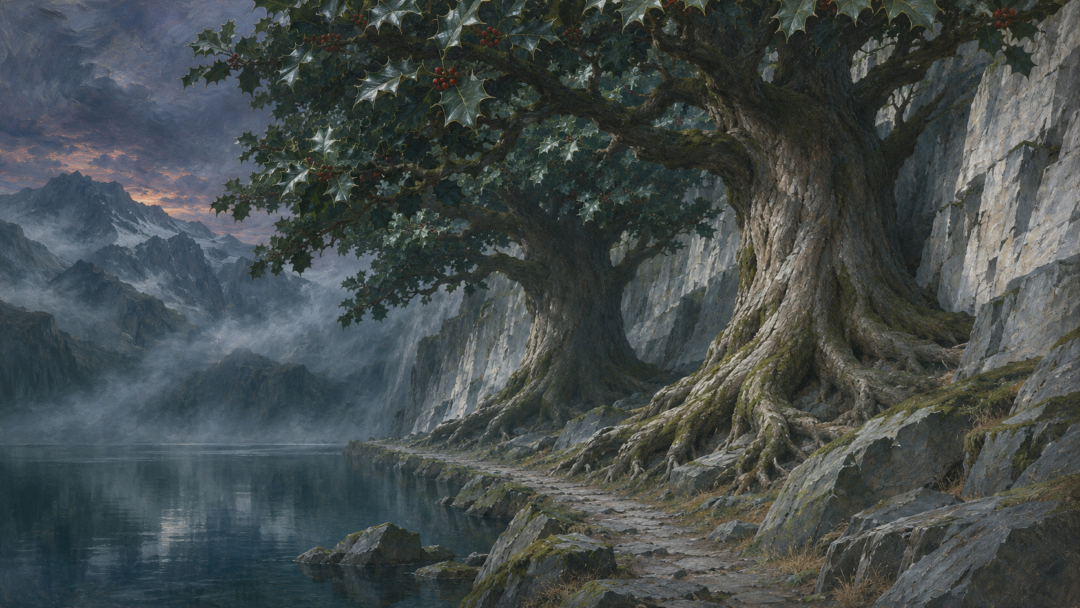
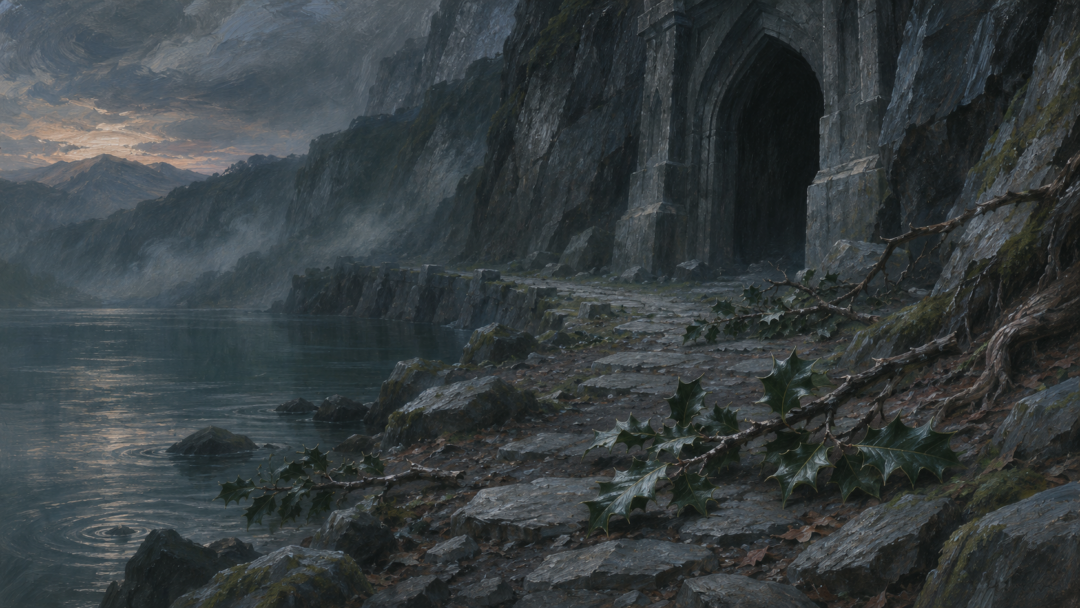
The road to Moria’s western door does not end in a welcoming courtyard. It runs towards a dark lake, past rotting wood in the shallows, and into the shadow of a cliff. Yet close against that stone stand two immense holly trees, alive where so much around them has fallen into ruin. Their roots reach towards the water, and their branches rise above the travellers like pillars.
Were these the very trees planted when Elves of Hollin traded with the Dwarves of Khazad-dûm in the Second Age? The most faithful answer is that the story does not say. Reading them as astonishingly ancient survivors is natural, especially given Gandalf’s words. But neither their individual ages nor any history of replacement is supplied. They might be the first trees, or later hollies continuing the same boundary marker. The distinction is small in wording and enormous in years.
Two living trees beside a drowned road
In The Fellowship of the Ring, the approach to the West-door is deliberately awkward. The Company has come down from the heights and must follow a narrow strip between the lake and the cliff. The old way through the valley has been overtaken by water. What should have been a road into a great Dwarven kingdom has become a place where the travellers pick their way around stones and keep their distance from the pool.
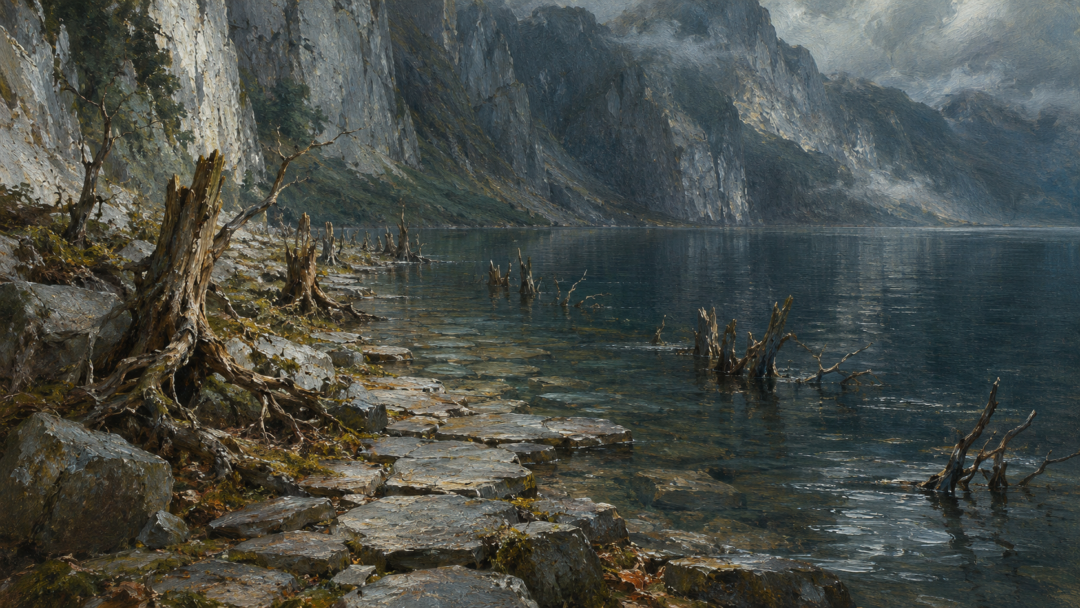
Along that shore they find traces of holly that has not survived. Stumps and dead branches lie in the shallows, apparently the remains of thickets or a hedge that once bordered the road. These are not described as the wreckage of the two great trees. Instead, they give the living pair a setting: the holly planting was once more extensive, and part of that older landscape has disappeared. The boundary is recognizable even as its surroundings have changed.
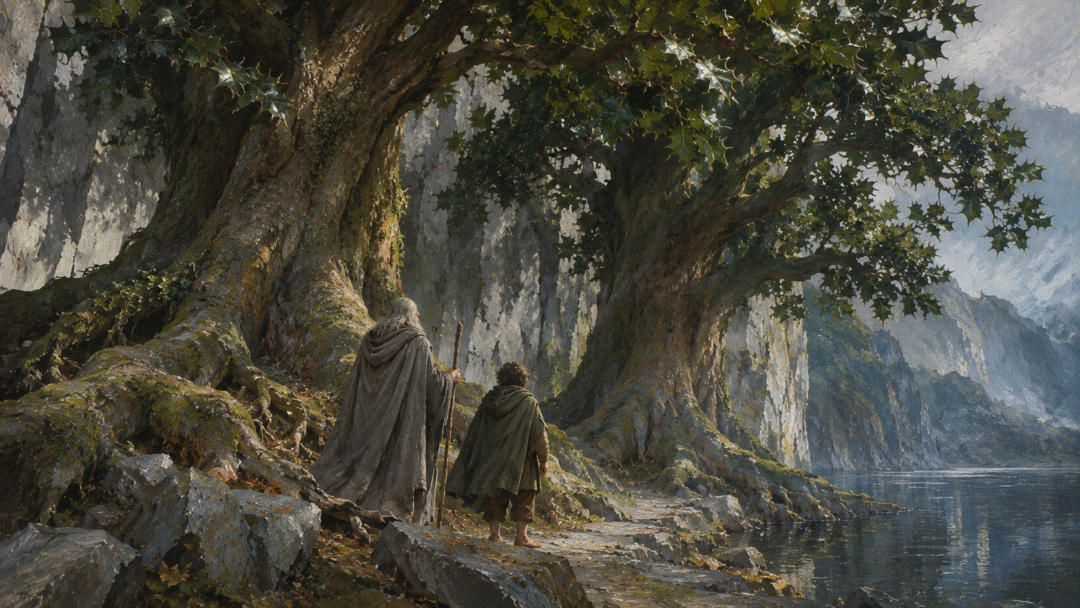
The two survivors are extraordinary to Frodo. The narrative calls them “still strong and living, two tall trees, larger than any trees of holly that Frodo had ever seen or imagined.” From the distant Stair they had looked almost like bushes beneath the enormous cliffs. Seen from below, they tower over the Company. Their roots stretch from the rock wall towards the water, making the narrow space seem occupied by the trees themselves.
Why the Elves planted holly at Moria
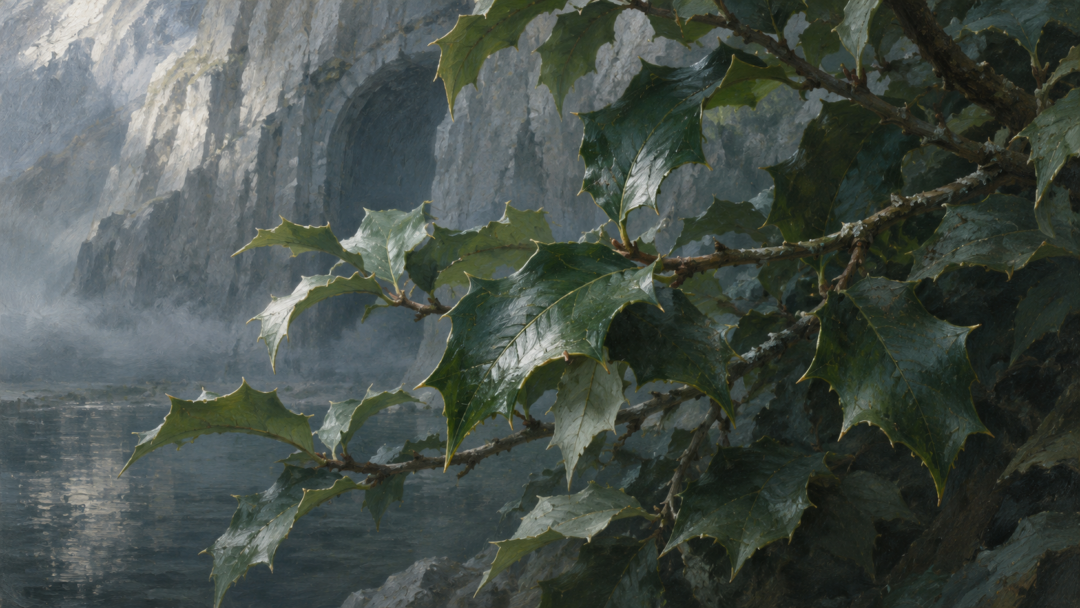
Gandalf supplies the history at exactly the point where the trees appear. The road from Hollin ended here, he explains, and holly was the sign of the people who lived in that land. His key phrase is “Holly was the token of the people of that land,” followed by the explanation that they planted it to mark the edge of their domain. The trees are not merely convenient shade or decorative landscaping. They announce where one country ends and another begins.
Hollin is the western name for Eregion, the Elven realm that lay beside the Misty Mountains. Its identity is bound to holly, so a traveller arriving at the gate would encounter a familiar emblem before passing into the Dwarves’ halls. The position matters. The trees stand where the Elven-way reaches the entrance to Khazad-dûm, a living sign at the meeting point of two peoples rather than a landmark somewhere deep inside either realm.
That meeting point was once busy. Gandalf says the West-door was made chiefly for the Elves’ use in their dealings with the Lords of Moria. The door itself bears the work of Narvi, a Dwarf, and designs by Celebrimbor of Hollin, an Elf. Those names provide a second witness to the cooperation Gandalf remembers. The stone gateway and its holly border belong to a world in which craft, commerce and friendship could cross the mountainside together.
The passage also places that friendship in the past. Eregion was destroyed during the Second Age, and by the time the Fellowship arrives the road is flooded, the gate is hidden, and its opening word has been forgotten by those standing outside. When Gimli and Legolas disagree about whose people were responsible for the old estrangement, Gandalf refuses to assign blame and asks them to be friends instead. The holly trees sit quietly beside that exchange, giving the lost relationship a visible form.
The strongest reading: ancient trees still standing
There is a good reason many readers picture the two hollies as the original plantings. Gandalf points to the surviving trees, explains that the Elves planted holly at this spot, and speaks of an earlier age of friendship. The natural flow of the scene joins the visible landmark to its founding purpose. No narrator interrupts to tell us that the original pair died and replacements grew in their place.
The trees’ physical appearance strengthens that impression. Their size amazes Frodo; their great roots seem anchored between cliff and lake; everything about their position makes them look permanent. The surrounding hedge has decayed, while these two remain vigorous. It is easy to imagine them watching the Elven road change from a route of friendship into a stranded remnant beside dark water. That is an interpretation encouraged by the scene, not a dated record of their planting.
And Gandalf later remembers that they had stood for a very long time. Unlike Frodo’s astonishment, this is the judgement of someone who understands much more of Middle-earth’s past. It supports the idea that the hollies were genuinely old, not merely unusually tall young trees. Still, being old is not the same as being identifiable as the first two planted. Gandalf gives no age and does not explicitly connect their individual lives to the day the boundary was first marked.
What the lifespan of real holly can tell us
In the ordinary world, an immense holly is not automatically a tree thousands of years old. The Woodland Trust’s guide to common holly, Ilex aquifolium, says that holly trees can live for up to 300 years. That gives a useful sense of scale: an individual tree still alive from the age of Eregion to the Fellowship’s journey would be extraordinary beside the lifespan described for a familiar real-world holly.
But the comparison is a guide, not a law imposed on Middle-earth. The narrative gives no botanical identification detailed enough to make the Woodland Trust figure a binding limit, and the quoted figure is not a universal countdown at which every holly dies. The story also includes trees whose stature and histories are exceptional. We should notice how remarkable an original survivor would be without converting a modern reference into proof that such a survivor was impossible.
If the two hollies were descendants, there are several ordinary ways the symbol could have endured. A later tree might grow from seed near an earlier one; a younger planting might take the place of a lost marker. Either would preserve holly at the end of the Elven road without preserving the first trunks. Yet the book records no such succession, no replanting, and no later keepers tending the border. A possible explanation is not evidence that it happened.
An old marker is not necessarily an original trunk
The language of a boundary marker helps explain why the question has no forced answer. A place can be said to have been marked with holly since the Second Age even if the living plants at that place have changed. Equally, a singular old tree can retain its purpose throughout all the changes around it. Gandalf describes the origin of the custom and the meaning of the location; he is not offering a gardener’s inventory of every tree that ever grew there.
Other trees in Middle-earth show how a symbol can outlast a particular trunk. In The Return of the King, Aragorn discovers a young White Tree of Gondor’s line, and it replaces the withered tree in Minas Tirith. The narrative explicitly identifies a successor and describes the replacement. That makes a useful comparison, not evidence of the hollies’ fate: an emblem may continue through descendants, but when that succession matters to the story, the reader is told about it.
The gate has a firmer historical anchor than the hollies’ ages. Its makers, Narvi and Celebrimbor, link it to the Second Age, and its inscriptions survive into the Company’s visit. But the survival of worked stone cannot date a living tree beside it. The trees and doors share a symbolic setting without having to share an uninterrupted material history. A carving can preserve a maker’s name; a holly cannot tell Frodo who planted its earliest ancestor.
The last sound of the holly trees
The trees’ final appearance makes their age feel more poignant without settling it. After Gandalf opens the West-door, something in the lake reaches towards the Company. The travellers scramble inside, and the creature’s arms slam the stone doors behind them. From within the darkness they hear terrible tearing and crashing outside. They cannot see what happens to the shore or the two trees.
Gandalf fears that boulders have been heaped against the entrance and the hollies uprooted and flung across it. He is drawing a conclusion from the sounds, not giving an eyewitness account of the wreckage. His regret is unmistakable: “the trees were beautiful, and had stood so long.” That brief farewell is the passage’s clearest statement of their antiquity, though it still stops short of telling us whether they were the original Elven plantings.
We cannot name the year those two hollies took root. We can say what they were when Frodo reached them: immense, living sentinels at the end of the old Elven road, still carrying Hollin’s sign where the road itself had sunk beneath water. Their first planting remains uncertain. Their last moment, heard from the darkness of Moria, gives that long endurance its fragile weight.
Sources & Notes
- Tolkien Gateway — Doors of Durin: the West-gate, its Second Age makers, and the Fellowship’s arrival (with references to A Journey in the Dark). https://tolkiengateway.net/wiki/Doors_of_Durin
- Tolkien Gateway — Eregion: Hollin’s boundaries and the Elven–Dwarven friendship behind the western road. https://tolkiengateway.net/wiki/Eregion
- Woodland Trust — Holly (Ilex aquifolium): real-world size and lifespan, used here as a comparison rather than a limit on Tolkien’s trees. https://www.woodlandtrust.org.uk/trees-woods-and-wildlife/british-trees/a-z-of-british-trees/holly/
Sources checked for relevance and availability.