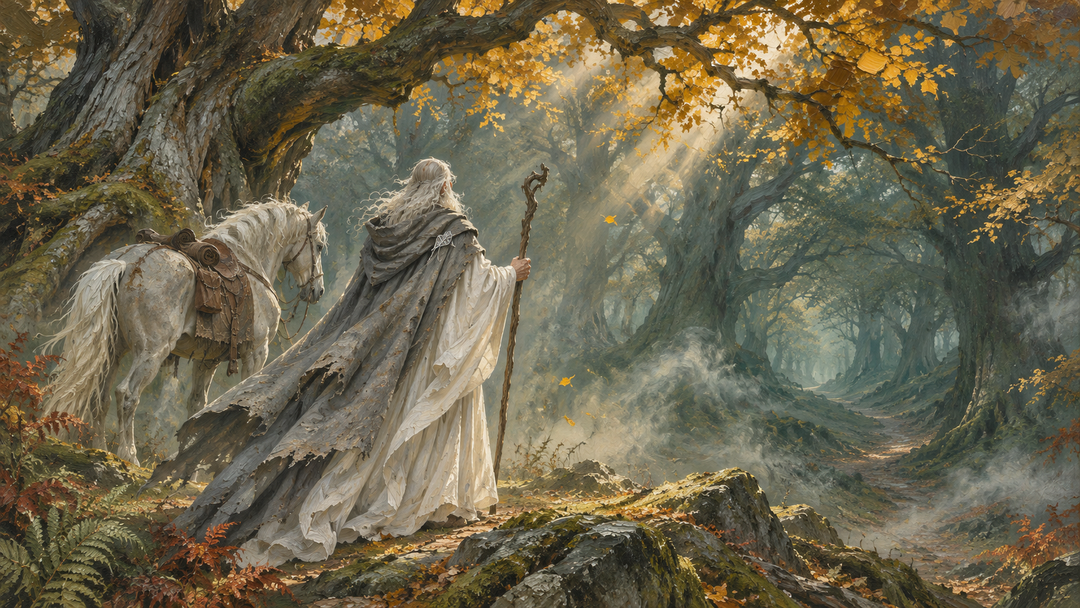
When Aragorn, Legolas and Gimli meet Gandalf again in Fangorn Forest, he appears in shabby grey clothing. Then he reveals the shining white garments underneath. How can a wizard who fell before the Fellowship reached Lothlórien wear a cloak resembling Galadriel’s gifts?
The essential answer is that Gandalf went to Lothlórien after his return to life. Galadriel arranged his rescue, and he was healed and dressed there. That journey is explicit in Tolkien’s book, although the exact origin of his grey outer cloak is not. Peter Jackson’s films make the resemblance to the Fellowship’s Elven clothing more conspicuous. They do not establish that he took one of his companions’ eight cloaks.
The cloaks were given while Gandalf was absent
In The Fellowship of the Ring, Gandalf falls from the Bridge of Khazad-dûm on 15 January 3019 of the Third Age. The other eight members escape Moria and enter Lothlórien without him. They stay with Celeborn and Galadriel, then depart on 16 February. The cloaks are presented on that departure day, in the chapter ‘Farewell to Lórien’. Gandalf is not present for the ceremony.
These are not the garments the travellers brought from Rivendell. They are newly supplied clothing, fitted to each recipient, with hoods and green leaf-shaped brooches. Galadriel and her maidens have woven them. Under the trees they seem grey, but their colours can suggest leaves, earth, stone or water in different light. They help conceal their wearers, provide comfort in changing weather and can be packed into a small space.
When Pippin asks whether the cloaks are magical, the Elves do not describe them as enchanted devices with a fixed list of powers. Instead, their workmanship embodies their affection for the things of Lórien. For Tolkien, extraordinary Elvish craftsmanship need not involve a specific spell. Nothing about the cloaks implies that their number was permanently limited or that the Elves could never make another.
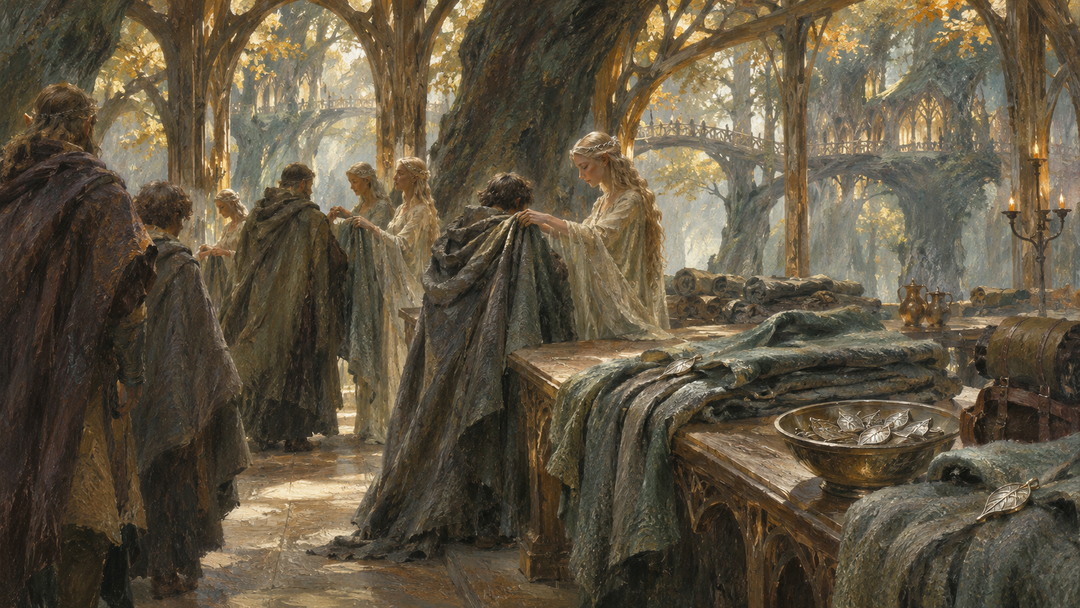
Eight travellers receive cloaks at this point: Frodo, Sam, Merry, Pippin, Aragorn, Legolas, Gimli and Boromir. Other provisions and personal gifts, including Frodo’s phial and Sam’s box of earth, are presented separately. Describing Gandalf as receiving ‘one of the cloaks Galadriel gave the Fellowship’ therefore needs care. He did not receive a cloak during the recorded farewell, and Tolkien does not say that one was put aside for him.
The leaf brooches help identify the gifts later. Pippin drops his clasp as a clue while the Orcs carry him across Rohan; Aragorn subsequently finds it. Boromir’s cloak accompanies his body in the funeral boat, and Frodo’s cloak later becomes evidence in the hands of Sauron’s servants. These possessions have individual histories; they are not interchangeable. None of these episodes records a Fellowship member handing a cloak over to Gandalf.
Gwaihir took Gandalf back to Galadriel
Gandalf’s disappearance at the bridge is not the end of his fight with the Balrog. In The Two Towers, in ‘The White Rider’, he explains that the struggle continued far below Moria, then up the Endless Stair to the summit of Zirakzigil, also called Celebdil or the Silvertine. He defeated the Balrog on 25 January but died himself. He neither escaped the fall unharmed nor immediately rejoined his companions.
Gandalf says that he was sent back and lay naked on the mountaintop. This is more than a recovery from injury. His task had not ended, and he returned with greater authority. Tolkien’s wider explanation of Gandalf’s role makes clear that this was not a resurrection performed by Galadriel. She could help the returned wizard, but she did not possess the authority to send him back from death or to appoint him Gandalf the White.
Appendix B, ‘The Tale of Years’, supplies useful dates. It places Gandalf’s return to life on 15 February and the Fellowship’s departure from Lórien on 16 February. On 17 February, Gwaihir the Windlord carried him to Lórien. His companions had sailed away the previous day. Gandalf therefore arrived too late for the farewell gifts but not too late to receive help from the same household.
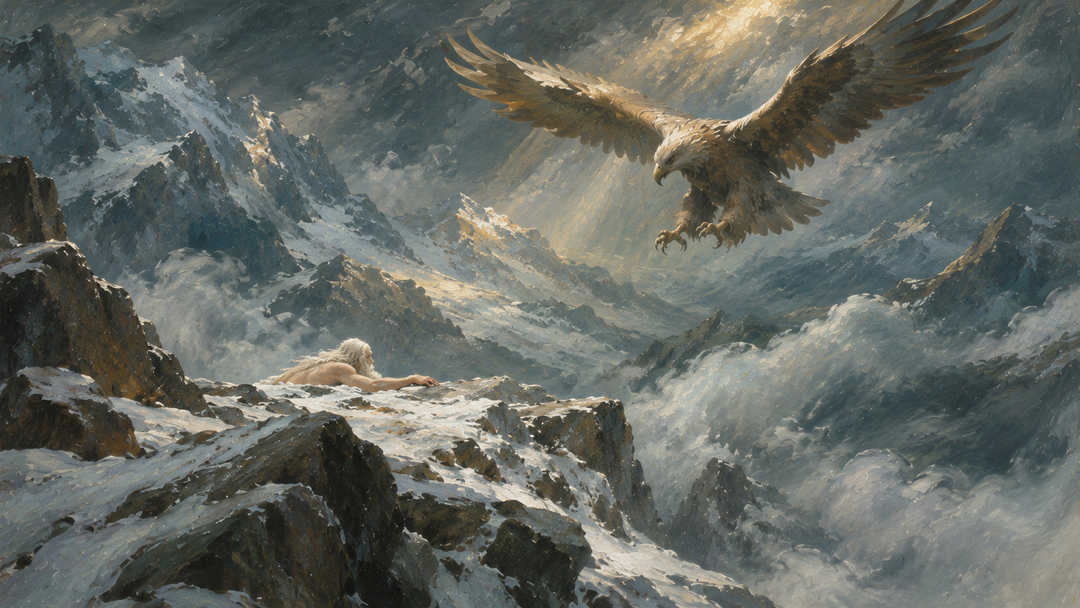
Gwaihir’s arrival was no accident. Gandalf recounts that the great Eagle had been sent to find him on Galadriel’s instructions. He asked to be taken to Lothlórien, and Gwaihir explained that this was already Galadriel’s intention. The Eagle carried him to Caras Galadhon after the Fellowship had left. Galadriel was ready to receive him.
Gandalf describes finding healing there and being clothed in white. He also says that he exchanged counsel before travelling onwards by routes he does not explain. This is the firmest answer to the clothing puzzle. Someone in Lórien equipped him after he returned, and Galadriel was directly involved in arranging his rescue and reception. The text neither itemises his clothes nor mentions a leaf brooch.
Nor does his new status require every garment he wears to be white. His title reflects a change in his role and power, particularly in relation to Saruman, the former head of the wizards. The white clothing makes that transformation visible, but garments and authority are not identical. The Elves could provide clothes without causing the change in Gandalf’s nature. His change of status and his new wardrobe are separate matters.
Why the books describe both grey and white clothing
In Fangorn, Aragorn and his companions initially see an old figure whose appearance recalls the wizard they have lost, yet also suggests the danger of Saruman. His covering is described as grey and ragged. When he throws aside the hood and outer clothing, his white garments shine. Later he takes up the grey cloak and wraps it around himself again. He wears white beneath grey.
This is not a fleeting inconsistency confined to his first reappearance. In the account of the fighting around Helm’s Deep, Gandalf throws back a grey cloak before mounting Shadowfax, and his white robes are seen in the sunlight. Tolkien is using contrast deliberately. The outer covering can make him resemble the familiar wandering Grey Pilgrim; the white beneath announces the power and changed position he does not always choose to display.
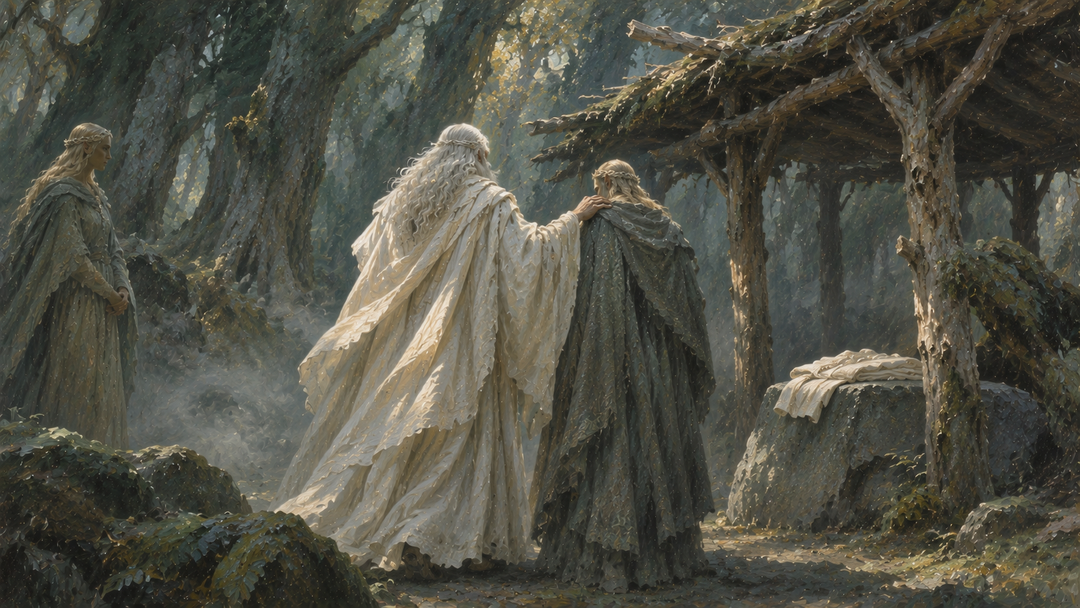
What is less clear is whether the grey garment is an Elven cloak. The Lórien connection makes that possibility attractive. Gandalf has recently been clothed in the realm where the other cloaks were woven, and a grey travelling cloak would be a practical addition to his white robes. The Elves could supply one. Aragorn’s earlier history also describes Galadriel clothing him in fine garments and a cloak of Elven-grey, showing that such hospitality was not restricted to the Fellowship’s departure.
Against that interpretation stands the condition of Gandalf’s covering in Fangorn. The narration calls attention to grey rags and a worn appearance, whereas the Elven cloaks given to the Fellowship are described as carefully made and remarkably serviceable. Tolkien does not explain this discrepancy. It could have been deliberately made to appear shabby, or Gandalf could have acquired a different covering, but neither account is confirmed. Calling it definitively the ninth Fellowship cloak goes further than the text allows.
Another suggestion is that Gandalf somehow recovered the cloak he wore before entering Moria. That is fan speculation, not an established event. He had gone through a destructive battle and explicitly says that he lay naked after being sent back. There is no account of anyone salvaging his original cloak from the mountain, and no reason to assume it survived. The safer conclusion is simply that Tolkien specifies white clothing at Lórien and grey outer clothing afterwards without supplying a complete wardrobe inventory.
It is also important not to confuse the physical cloak with its apparent colour. Lórien’s gifts can look grey, green or brown according to their surroundings, but this property does not identify every grey cloak in Middle-earth as one of Galadriel’s gifts. Likewise, a white robe does not establish whether its wearer has an Elven cloak over it. The book establishes layered clothing, not the origin of each layer.
What the films show, and what remains speculation
Peter Jackson’s The Lord of the Rings: The Fellowship of the Ring shows the remaining companions receiving matching cloaks and distinctive leaf brooches in Lothlórien. When Gandalf the White reappears in The Two Towers, his grey outer garment and Elvish-looking clasp visually connect him with those gifts. The costume makes the apparent puzzle sharper than in the novel. A film viewer can recognise an item of costume without having been shown the moment Gandalf acquired it.
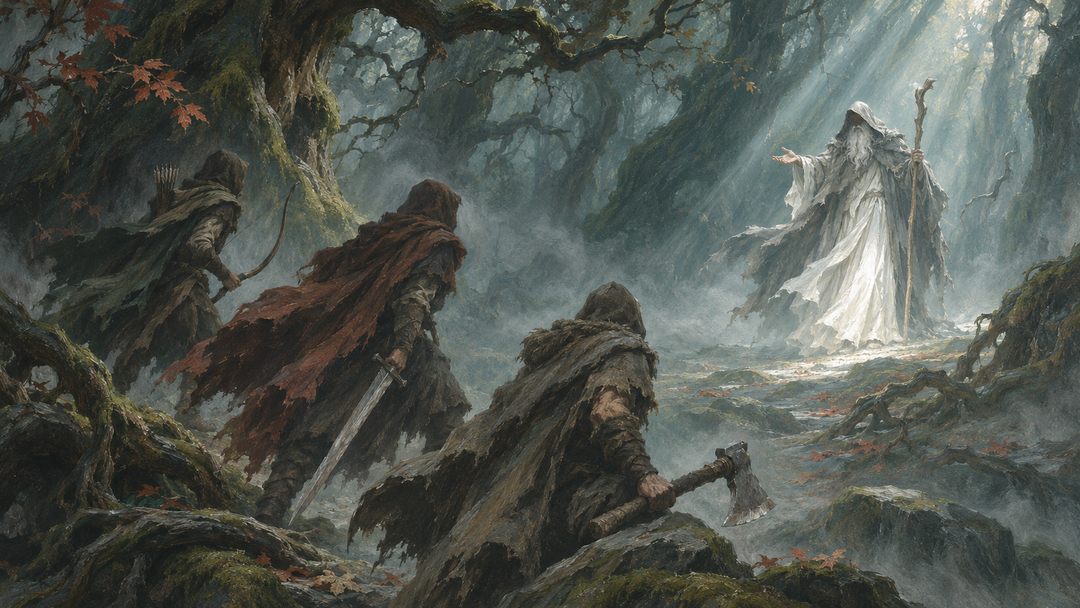
The films compress Gandalf’s experiences between Moria and Fangorn. They depict his fight with the Balrog and his return as the White Wizard, but do not give the visit to Caras Galadhon the same explicit explanation it receives in the novel. The book supplies a natural explanation: after his rescue, Gandalf was outfitted in Lórien, just as his friends had been. That is a strong continuity explanation, though not a separately depicted film scene.
There is no requirement that he took a cloak from one of the original eight. Those garments were already travelling with their owners when he reached Lórien. A ninth cloak, made or provided for Gandalf separately, would fit the chronology perfectly. The Elves could weave more. What remains unconfirmed is whether the film costume is meant to represent an identical new gift, a different cloak from the same makers, or merely a deliberate visual echo of the Fellowship’s garments.
A fan theory sometimes identifies Gandalf’s leaf clasp with the one Pippin dropped for Aragorn to find. That does not work as a straightforward explanation of his first appearance wearing the clasp. The dropped brooch is a clue discovered during the search for the captured hobbits, whereas Gandalf already has his outer clothing when he meets the hunters in Fangorn. In the book, Aragorn keeps Pippin’s brooch and returns it to him at Isengard. Resemblance between clasps is not evidence that a unique clasp changed hands.
A related counterfactual argument says that Gandalf could not have received an Elven cloak because he was dead when Galadriel dressed the Fellowship. The dates answer it. His absence on 16 February establishes only that he missed that distribution. His arrival on 17 February establishes another opportunity. The chronology allows, but does not prove, another gift. The alleged impossibility depends on overlooking the second visit to Lórien.
So the precise answer depends on how strictly the question is phrased. In book continuity, Gandalf certainly returned to Lothlórien, received healing and was clothed in white; he later wore a grey outer cloak whose origin Tolkien leaves unstated. In the film continuity, a Lórien-style cloak and clasp visibly link him to the Fellowship’s gifts, and his documented journey in the book offers the obvious explanation. Saying Galadriel supplied him with a similar cloak is reasonable interpretation. Saying Tolkien explicitly identified it as one of the eight original gifts is not.
Sources & Notes
- Tolkien Gateway — The White Rider — https://tolkiengateway.net/wiki/The_White_Rider
- The Encyclopedia of Arda — Elven-cloaks — https://www.encyclopedia-of-arda.com/e/elvencloaks.php
- Tolkien Gateway — Gandalf — https://tolkiengateway.net/wiki/Gandalf
Primary reading: The Two Towers, The White Rider; The Fellowship of the Ring, Farewell to Lórien; The Lord of the Rings, Appendix B. Gandalf's later visit to Lórien and white clothing are explicit. Identifying his grey outer cloak with one particular original gift is not; film costume continuity and a separate gift remain interpretations.