At the Prancing Pony in Bree, Frodo Baggins falls from a table and suddenly becomes invisible. The Ring has reached his finger while he was handling it in his pocket, though he cannot explain exactly how. Tolkien gives the reader a disturbing accident, not a close-up of a golden band changing diameter.
That distinction matters. The claim that the One Ring never shrank on Frodo is stronger than the evidence allows. The Lord of the Rings does not explicitly describe the Ring contracting around Frodo’s finger, but it does establish that the Ring can change size. Nothing in the narrative proves that it remained a fixed diameter whenever Frodo wore it. The real question is why Tolkien makes its movement, influence and betrayal more conspicuous than its measurements.
The books establish that the Ring can change size
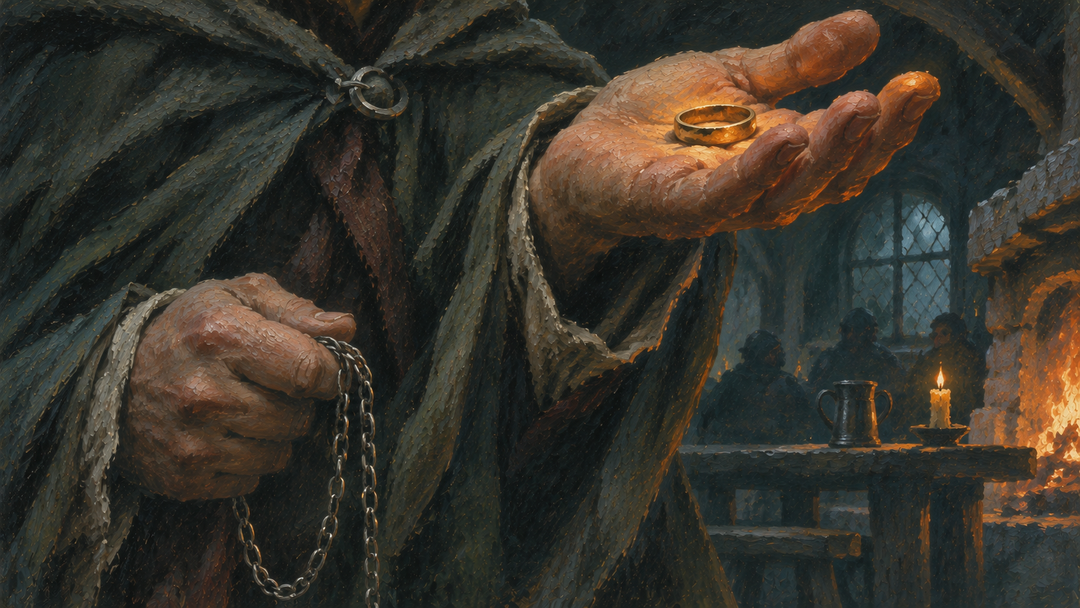
The clearest explanation comes from Gandalf in the chapter “The Shadow of the Past” in The Fellowship of the Ring. He recalls that Bilbo noticed the Ring did not always seem to have the same size or weight. It could shrink or expand unexpectedly, sometimes slipping from a finger on which it had previously fitted tightly. Bilbo therefore warned Frodo to keep it securely attached to a chain, and Frodo says that he followed this advice.
Another account appears at the Council of Elrond. Gandalf describes finding Isildur’s written record in Gondor. When Isildur took the Ring from the defeated Sauron, it burned his hand. Afterwards it cooled, and Isildur observed that it seemed to shrink. Its fiery inscription also faded. He did not explain the mechanism or provide measurements, and the cautious wording matters: he recorded what he perceived rather than a rule governing every wearer.
The contrast is nonetheless striking. Isildur was a Man, Bilbo and Frodo were Hobbits, and Sauron was no ordinary mortal wearer. A band that can pass among such different hands without becoming unusable invites the conclusion that its size is unusually adaptable. The books support that general conclusion. They do not say that the Ring automatically measures every new finger and adjusts itself at a particular moment.
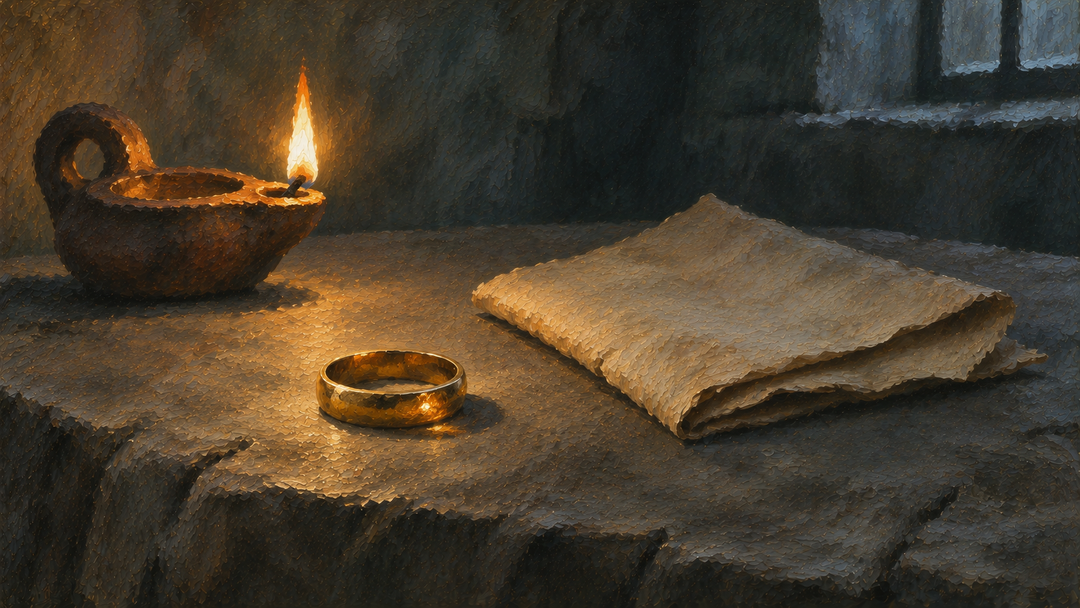
The Ring’s departure from Isildur is more consequential than its initial fit. In Gandalf’s account, it slips from his finger while he swims across the Anduin, leaving him visible to Orcs who kill him. Unfinished Tales, in “The Disaster of the Gladden Fields”, gives a fuller version of that catastrophe. Both tellings make the betrayal decisive. Whether a change of diameter immediately caused the loss is not specified, although Gandalf’s comments about slipping make it a reasonable possibility.
Gollum’s loss presents a related problem. For centuries he keeps the Ring, usually hiding it rather than wearing it continuously. Eventually it leaves him and is found by Bilbo in the tunnels beneath the Misty Mountains. Gandalf interprets this as the Ring abandoning Gollum and attempting to return towards Sauron. That interpretation concerns its tendency and purpose, not an observed scene of shrinking metal. A ring can be lost without the reader being shown exactly how it moved.
There is also a useful contrast in the history of The Hobbit. In its original 1937 edition, Gollum was willing to offer the Ring as a prize in the riddle game. Tolkien revised the episode for the 1951 edition as the Ring’s darker nature developed during his work on The Lord of the Rings. The later story treats Bilbo’s original account as a misleading version he had told. This is a genuine change in the published narrative, not evidence of an undisclosed rule about the Ring’s dimensions.
What Frodo’s encounters actually show
Frodo inherits the Ring from Bilbo while living in the Shire. Because both are Hobbits, their similar scale makes any adjustment less visually dramatic than the passage from Sauron to Isildur. But Tolkien never gives their finger measurements, nor says that Frodo’s size makes adjustment unnecessary. Such explanations may sound plausible; they remain speculation rather than stated facts.
Tom Bombadil’s house supplies an especially revealing test. Bombadil handles the Ring, puts it on his little finger and does not disappear. Frodo then wears it to check that Bombadil has returned the genuine object. Frodo becomes invisible to his companions, but Bombadil can still see him. Tolkien contrasts the Ring’s effects on different people without pausing to explain how it fitted Bombadil’s finger. The scene’s purpose is to show a limit to the Ring’s usual effects, not to settle its physical dimensions.
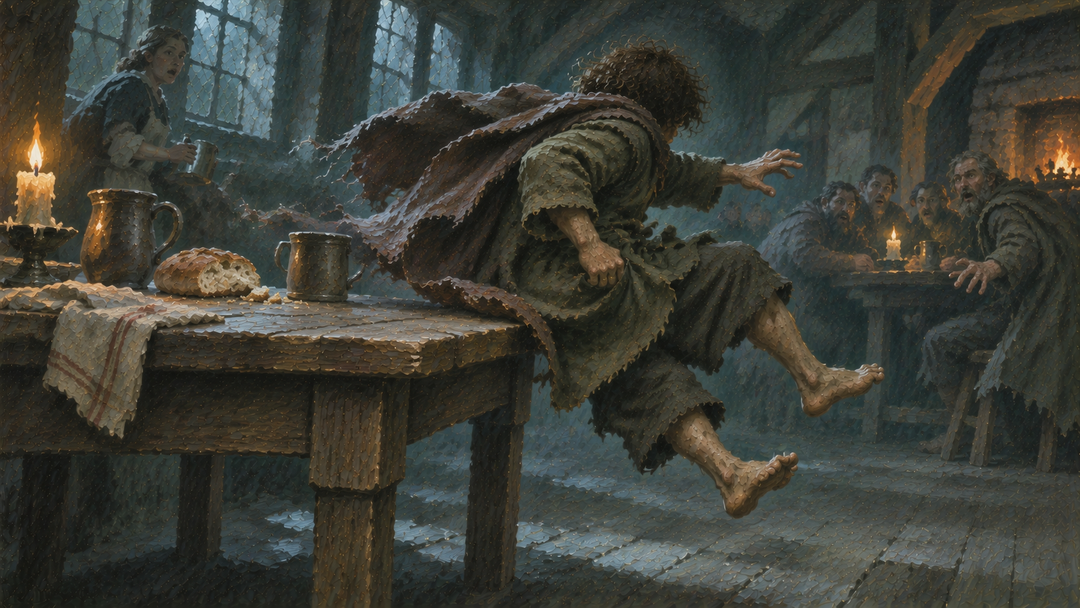
At Bree, Frodo initially resists an urge to wear the Ring when the room’s attention becomes uncomfortable. After his fall, he discovers it on his finger and wonders whether it has played a trick on him. The narrative offers his own uncertainty, not a definitive report that the Ring deliberately changed size. The danger lies in its sudden exposure at a place where hostile eyes may be watching.
On Weathertop, Frodo puts the Ring on while the Black Riders approach. Wearing it reveals a more terrifying aspect of them, and he is wounded by the leader’s blade. The episode does not ask whether the band was snug. It asks what the Ring draws its bearer towards and how fear can weaken resistance. The apparent advantage of invisibility does not mean safety from enemies who operate partly in the unseen world.
Later, on Amon Hen, Frodo wears the Ring while seated on the Seat of Seeing. His awareness expands, but he also becomes vulnerable to Sauron’s searching attention. An opposing warning urges him to remove it. Again, Tolkien dramatises a struggle over Frodo’s will, not a physical struggle to keep the band in place. The Ring can fit comfortably while placing its bearer in extraordinary danger.
Sam’s brief possession after believing Frodo dead provides another comparison. Sam, a Hobbit like Frodo, wears the Ring as he tries to continue the mission. He feels the pressure of its power and imagines what he might achieve with it. Tolkien describes temptation and the burden of bearing the Ring, but does not include a measured adjustment to Sam’s finger. The absence of that detail in several scenes is a narrative pattern, not proof of permanent physical size.

Why the films make size more noticeable
Peter Jackson’s The Lord of the Rings films work with a different storytelling medium. In the opening history of The Fellowship of the Ring, the Ring visibly contracts after passing from Sauron to Isildur. That image quickly communicates a magical property that Tolkien establishes through dialogue and an ancient written record. It also makes the transfer between an imposing dark figure and a human hand immediately comprehensible.
Film viewers are consequently primed to ask why the same transformation is not repeatedly shown when Frodo handles the Ring. Yet the absence of another conspicuous shrinking shot does not amount to a rule within the film, much less a rule in the novel. A visual adaptation must decide which actions to show in close-up. Repeating the effect every time someone wears the Ring would consume attention without necessarily advancing the story.
The Prancing Pony incident illustrates the adaptation’s priorities. In the book, Frodo has been singing and falls from a table; the Ring ends up on his finger after he has been handling it in his pocket. In the film, he falls backwards, the Ring flies into the air and lands directly over his raised finger. The altered staging emphasises uncanny coincidence and creates a memorable visual transition into invisibility. Neither version provides a general law specifying when the Ring must shrink.
Nor should the films’ towering image of Sauron be treated as an exact measurement supplied by the novel. Tolkien describes Sauron’s forms and history in several works, but does not give a practical specification for the diameter of the Ring on his finger. Fan theories that calculate how far it must have contracted, or claim that it stopped resizing once Frodo became its intended bearer, go beyond what either version establishes. They can be imaginative readings, but they are not confirmed lore.
The more important change is in the bearer
The One Ring is not a friendly piece of equipment that resizes only for convenience. It was made by Sauron to dominate the other Rings of Power and their bearers. Its ability to stay with someone, escape someone, or appear useful belongs within that larger danger. Gandalf describes it as an object that looks after itself. That language invites readers to recognise something like agency while leaving open exactly how its choices work.
Its psychological effects likewise do not follow a universal timetable. Bilbo is possessive but finally relinquishes it with Gandalf’s help. Boromir, who has never owned it, is drawn to the idea of using it to defend Gondor. Galadriel recognises what accepting it could make her and refuses. Gandalf fears taking it because his desire to do good would become a route to domination. None of these responses can be predicted by comparing finger sizes.
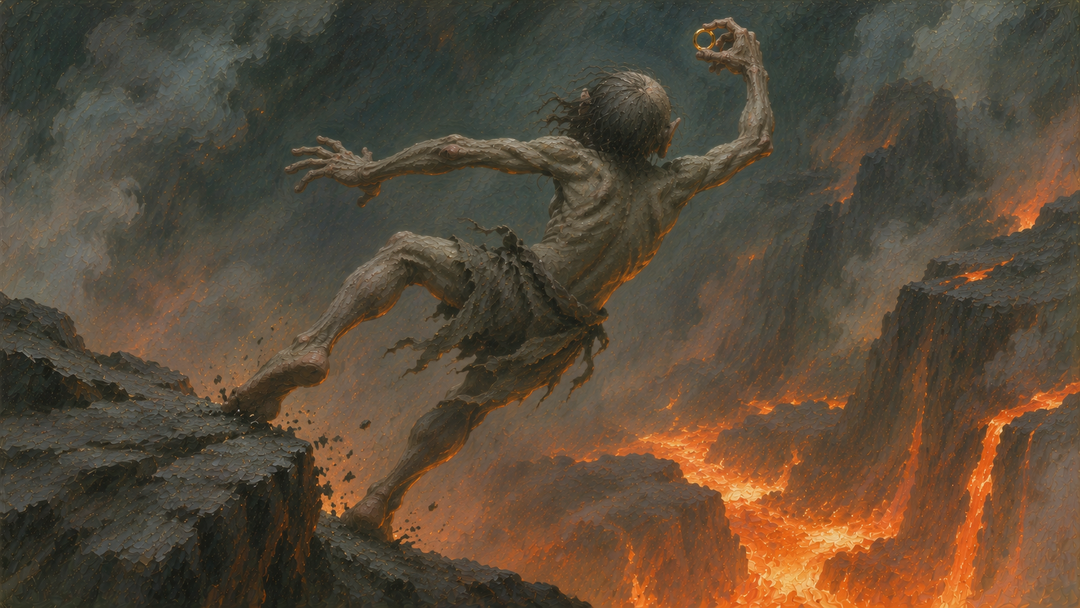
Frodo’s endurance matters precisely because the Ring’s growing hold is not solved by correct handling. He can keep it on a chain, avoid putting it on and understand the danger better than Bilbo once did, yet his resistance still wears down on the journey into Mordor. At Mount Doom he claims the Ring instead of destroying it. Tolkien does not present this as a problem of fit or a sudden failure of the clasp. It is the culmination of a contest over desire, exhaustion and will.
The destruction comes through Gollum’s attack, his seizure of the Ring and his fall into the fire. Frodo’s earlier decision to spare him becomes crucial, although Frodo could not have designed that outcome. The ending makes pity, dependence and unforeseen consequences more important than a heroic ability to command a magical object. It also prevents the story from becoming a simple demonstration that the strongest bearer can defeat the strongest weapon.
A counterfactual can sharpen the distinction. Suppose the Ring had visibly tightened around Frodo’s finger every time he wore it. That would not explain why he wanted it, why he feared losing it, or why he failed to surrender it at the end. Conversely, suppose it never changed size during his possession. Gandalf’s account of Bilbo and Isildur would still establish the Ring’s capacity to alter its dimensions. Neither hypothetical resolves the moral conflict Tolkien actually wrote.
The most accurate answer, then, is narrower than the headline’s premise. Tolkien never clearly narrates the One Ring shrinking on Frodo, but he never establishes that it could not or did not. Elsewhere, he plainly associates it with changes in size and with treacherous slipping. Its physical adaptability matters because it helps the object pass between hands and evade control. What makes it dangerous is that a perfect fit offers no protection against what the wearer may become.
Sources & Notes
- Tolkien Gateway — One Ring — https://tolkiengateway.net/wiki/One_Ring
- Tolkien Gateway — The Shadow of the Past — https://tolkiengateway.net/wiki/The_Shadow_of_the_Past
- The Encyclopedia of Arda — Disaster of the Gladden Fields — https://www.encyclopedia-of-arda.com/d/disasterofthegladdenfields.php
Primary reading: The Fellowship of the Ring, The Shadow of the Past, At the Sign of the Prancing Pony and The Council of Elrond; Unfinished Tales, The Disaster of the Gladden Fields. The Ring can alter size, but no measurement or explicit resizing sequence is given for every occasion Frodo wears it.