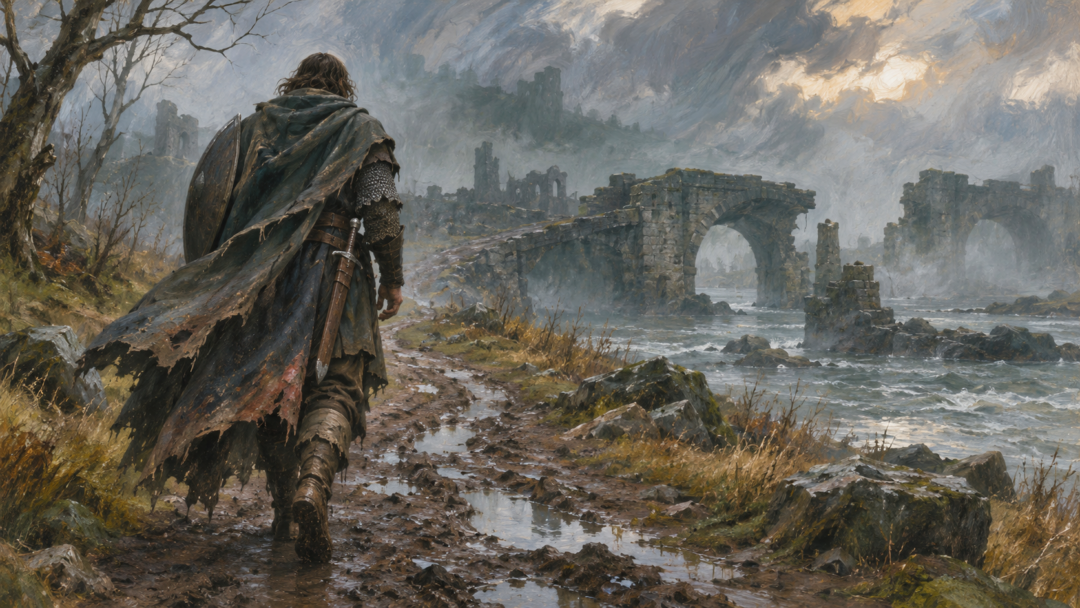
At Helm’s Deep, with Saruman’s army approaching, King Théoden turns on Aragorn’s promise of help from Gondor. “Where was Gondor when the Westfold fell?” It is a memorable challenge in The Two Towers film, and it invites a follow-up: where was Boromir, Gondor’s famous captain?
The answer is nowhere near the fighting in the Westfold. Boromir left Minas Tirith in July 3018 to seek Rivendell, joined the Fellowship, and died near Amon Hen on 26 February 3019. Saruman’s decisive breakthrough into the Westfold followed in early March. Théoden’s words accuse a kingdom of failing its ally, not a particular soldier of missing his assignment. There is an important book-and-film wrinkle, too: the famous question belongs to the film, not the dialogue of the novel.
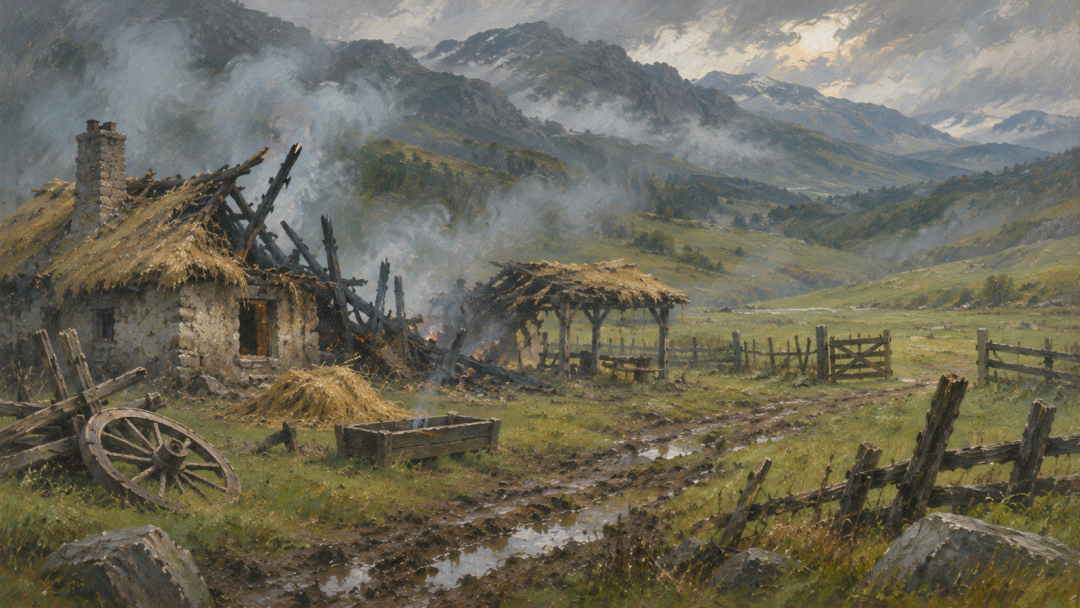
Boromir’s journey, from Minas Tirith to the Anduin
Boromir’s road north began with a defeat in the east, not an emergency in Rohan. On 20 June 3018, Mordor attacked Osgiliath, the ruined city guarding the crossings of the Anduin. Gondor lost the eastern bank, and the last bridge was broken. At the Council of Elrond, Boromir recalls that only four defenders escaped by swimming, including himself and Faramir.
Around that crisis came the strange dream that sent him away. Faramir dreamed repeatedly of a broken sword, Imladris, Isildur’s Bane, and a Halfling; Boromir also received the dream once. Denethor knew that Imladris was Elrond’s home, but little more. Faramir wished to go, but Boromir took the dangerous errand, leaving Minas Tirith on 4 July 3018.
The journey took 110 days. Boromir travelled through the Gap of Rohan, crossed the Isen and then the Greyflood, and struggled through country where the old roads had dwindled. He reached Rivendell on the night of 24 October, just in time for the Council the next day. His horse was lost at the ruined crossing of Tharbad, forcing him to continue on foot. That particular detail comes from Boromir’s later conversation with Celeborn in “Farewell to Lórien”; at the Council itself, he describes the length and loneliness of his search. No date is given for his passage through the Gap.
At Rivendell he was not recruiting an army to fight for Rohan. He sought an explanation of the dream, and he learned that Isildur’s Bane was the One Ring. He also met Aragorn, heir to Gondor’s kings, and saw a weapon he believed might save his people. When the Fellowship left on 25 December, Boromir went south with it. His intended destination remained Minas Tirith, although the Company’s mission was to take the Ring towards Mordor.
Winter carried him through Moria, into Lórien, and then down the Anduin in an Elven boat. On 25 February 3019 the Company passed between the Argonath and camped at Parth Galen beneath Amon Hen. On that same day, far to the west, Théoden’s son Théodred was killed defending the Fords of Isen. Their stories touch the same date but not the same battlefield.
On 26 February Boromir tried to take the Ring from Frodo, came to regret it, and fought to protect Merry and Pippin when Orcs attacked. He died of his wounds before Aragorn could save him. Aragorn, Legolas and Gimli laid him in a boat and entrusted him to the river. In Minas Tirith, his horn was heard that day, though its meaning was not yet understood. By the time the Westfold’s defences collapsed, Boromir’s own war was over.
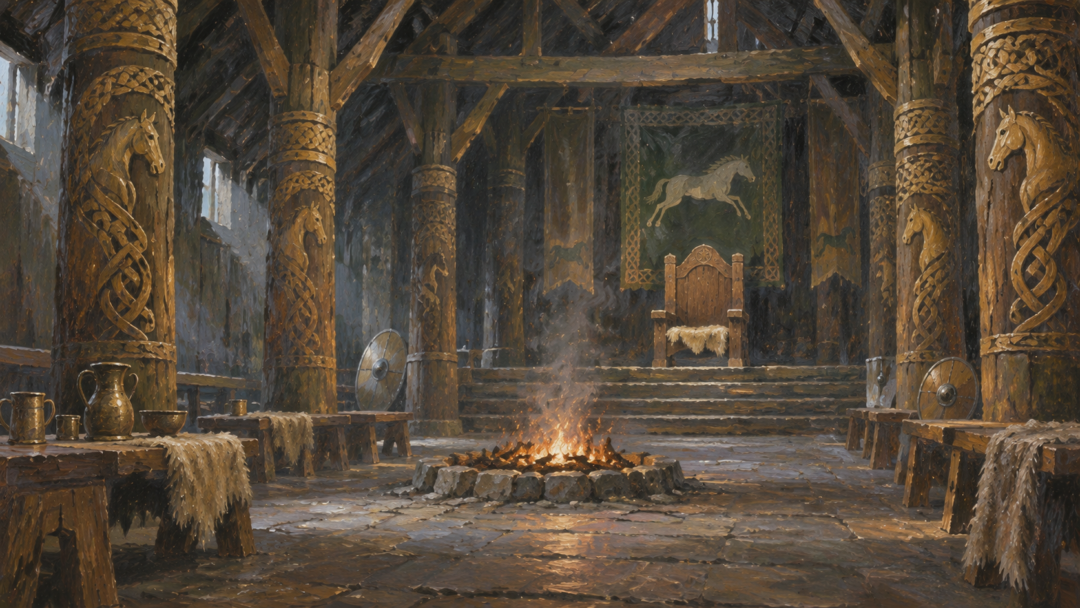
What actually happened in the Westfold?
The Westfold was not a walled town that surrendered on a single afternoon. It was a broad western region of Rohan, lying against the White Mountains, with farms, roads, settlements and the stronghold of Helm’s Deep. At the river Isen, the fords guarded the approach from Isengard. To say that the Westfold “fell” is useful dramatic shorthand. The book instead shows attacks, broken defences and a devastated countryside.
Saruman had worked on Rohan long before his armies marched. In Edoras, Gríma Wormtongue’s counsel kept Théoden suspicious, inactive and separated from men who might rouse him. Rohan still had defenders. Théodred, as marshal of the western forces, resisted the threat at the Isen; commanders including Grimbold and Elfhelm held troops in the field. Erkenbrand, lord of much of the Westfold, prepared the Hornburg and gathered its defenders. Saruman’s advantage lay partly in striking a kingdom whose leadership had been divided at the moment it needed to act together.
The first major clash came on 25 February 3019. Saruman’s forces attacked the Fords of Isen and Théodred was slain, a grievous loss for both Rohan’s army and its king. But the fords were not yet entirely lost to the enemy. The distinction is worth keeping: Théodred’s death was not itself the conquest of the Westfold. The defenders reorganized while pleas for help met delay in Edoras.
On 2 March, the second attack overwhelmed the defence of the fords. Saruman’s troops pushed through the western lands towards Helm’s Deep, while scattered Rohirrim withdrew or tried to regroup. That was also the day Gandalf reached Edoras and restored Théoden to action. The king rode west to confront the invasion, but the news from the front forced him to seek the Hornburg. On the night of 3 March, the Battle of Helm’s Deep began; at dawn, Gandalf returned with Erkenbrand and men rallied from the Westfold.
The victory did not mean the suffering had been imaginary. Farms had been burned, people killed and the king’s son lost. Later, when Théoden confronts Saruman at Isengard, the book has him challenge the wizard over the torches in Westfold and the children killed there. In the book his anger is aimed at Saruman; in the film, at the absent ally.
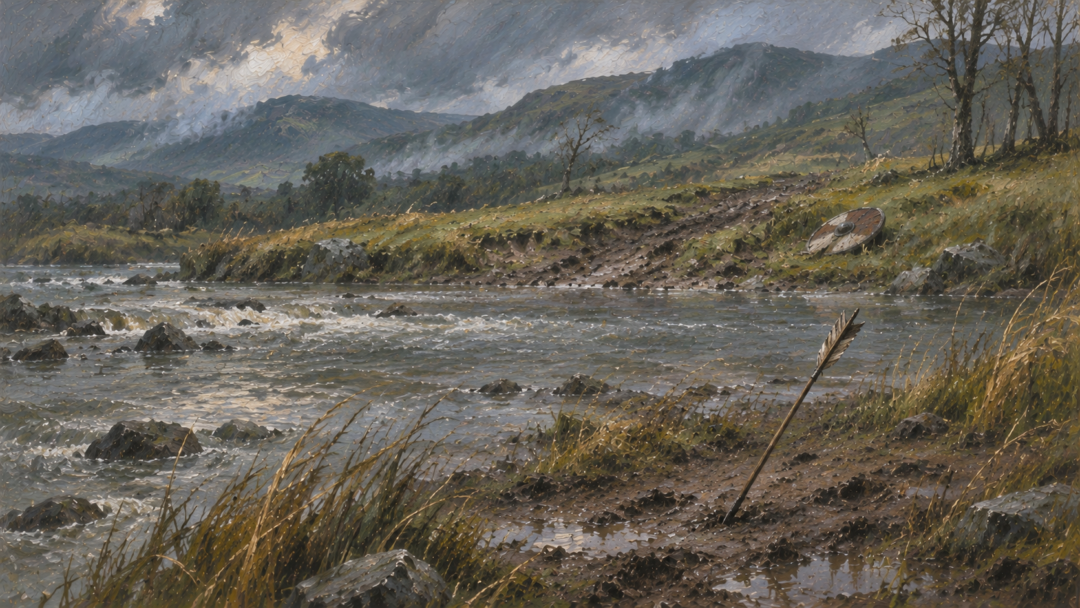
Gondor was fighting its own war
To understand Gondor’s absence, look east across the White Mountains. Boromir’s account at Rivendell describes a realm holding the western banks of the Anduin against Mordor after the blow at Osgiliath. The broken bridge was not a distant warning; it was evidence that the enemy had already reached Gondor’s defensive line. Boromir complains that others offer praise but little practical help, adding that only men from Rohan will ride to Gondor when called. That striking observation comes before Saruman’s invasion fully breaks over Rohan.
Gondor could not simply withdraw its soldiers from the river and send them across the mountains without consequences. Minas Tirith guarded the approach to its heartland, and its captains had to watch Osgiliath, Ithilien and the passages of the Anduin. That does not prove Denethor made every choice wisely, or that sending aid was impossible. It shows why a missing army is not automatically an abandoned promise. The narrative records no summons that Boromir personally received and refused.
The crisis only tightened after Helm’s Deep. On 10 March, Sauron’s forces overran Cair Andros, the fortified island crossing north of Osgiliath; in the following days Gondor’s eastern defences were forced back and Minas Tirith came under siege. Cair Andros therefore cannot be used as an event that had already prevented relief of the Westfold: its fall came later. It shows how little room Gondor had for error. While Saruman struck from Isengard, Mordor was preparing a far greater assault from the east.
The film’s confrontation compresses that wider war into a sharp argument. Aragorn insists that Gondor will answer; Théoden replies as someone who has just seen his own country burned. His disappointment has emotional force even though the military situation is more complicated. In the novel, the visit to Edoras and the ride to Helm’s Deep unfold differently, and Théoden does not ask the famous question. The political tension is recognizable, but we should not treat the movie’s exact exchange as a missing page of the book.
An alliance older than either king
There is a deeper sting in naming Gondor. Rohan itself was born from an act of rescue: in 2510, Eorl the Young brought his horsemen to save Gondor at the Field of Celebrant. Steward Cirion granted Eorl the land of Calenardhon, and the two peoples bound themselves by oaths of friendship and aid. The Westfold was part of that former Gondorian land. Théoden’s accusation, in the film, invokes not just a convenient neighbour but a relationship built on the memory of riding to another people’s rescue.
Nor had that friendship always run in one direction. After the terrible invasion and Long Winter in the days of Helm Hammerhand, Gondor sent help to Rohan once its own enemies had been defeated. Such aid was neither instant nor effortless. The history of these kingdoms is full of moments when one survives just long enough to help the other. His claim that old alliances are dead is therefore a judgment made under siege, not a fact about their entire past.
What follows gives the line its irony. On 9 March, Gondor’s messenger Hirgon brings the Red Arrow to Théoden at Dunharrow, asking Rohan for aid against Mordor. Merry, who travelled with Boromir, is startled by Hirgon’s resemblance to him; for a moment he thinks Boromir is alive. Théoden answers the call and leads his Riders to the Pelennor Fields, where he dies on 15 March. The alliance survives in the arrival of a messenger, not the return of a missing captain.
Boromir never hears that charge from Théoden, and there is no scene in which he can answer it. His last stand happens beside a distant river, defending Merry and Pippin far from the Westfold. One will ride with the Rohirrim; the other will serve in Minas Tirith. When the horns of Rohan finally sound before the White City, they are both there to hear them—and Boromir is gone.
Sources & Notes
- Boromir - Tolkien Gateway — https://tolkiengateway.net/wiki/Boromir
- Battles of the Fords of Isen - Tolkien Gateway — https://tolkiengateway.net/wiki/Battles_of_the_Fords_of_Isen
- Westfold - Tolkien Gateway — https://tolkiengateway.net/wiki/Westfold
Appendix B dates Boromir’s death and Rohan’s battles; Unfinished Tales, ‘The Battles of the Fords of Isen’, expands the western campaign. ‘Where was Gondor’ is film dialogue, not a quotation from the novel; Boromir receives no recorded summons to defend the Westfold.