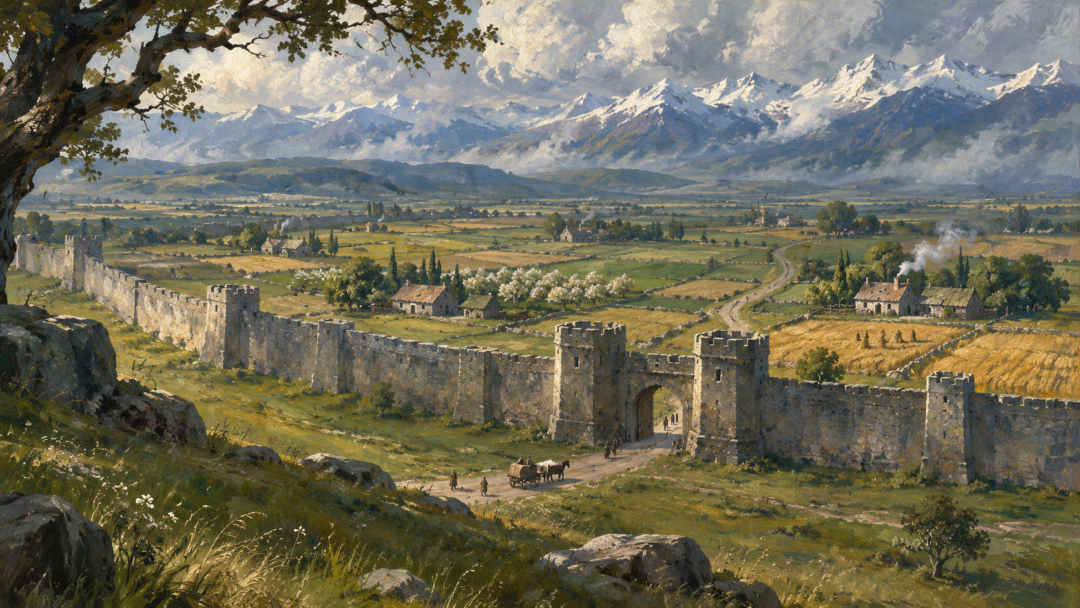
When Pippin looks out from the walls of Minas Tirith, he does not see an empty stretch of grass waiting for two armies. He sees farmsteads, barns, small boundary walls and roads busy with wagons. Below the White City lies a working countryside, already changing under the pressure of war. It is an easy detail to miss if your clearest memory of the Pelennor Fields comes from the films.
The answer is that the open, largely featureless battlefield is an adaptation choice. In The Return of the King, the Pelennor is cultivated land protected by a vast outer wall, the Rammas Echor. By the time the Riders of Rohan arrive, the people have been driven away, buildings have burned and the enemy has turned the fields into a siege camp. The emptiness is something that happens to this place, not what it was always like.
The Countryside Inside the Rammas Echor
Gandalf and Pippin encounter the Rammas Echor before reaching Minas Tirith. It is a defensive work separate from the city's seven walls. Built after Ithilien had fallen under the Enemy's shadow, it encloses the townlands between the city, the mountains and the River Anduin. The wall runs for ten leagues or more, several leagues from the Great Gate at its farthest. Gondor is defending more than its city.
A road runs through a fortified passage in the outer wall, with towers guarding the gate and a causeway leading back towards the crossings of Anduin. The Rammas is strongest on this exposed eastern side. Elsewhere it approaches the river, above the landings of the Harlond, where boats from Gondor's southern regions can arrive. Roads and river traffic connect the Pelennor to a larger kingdom.
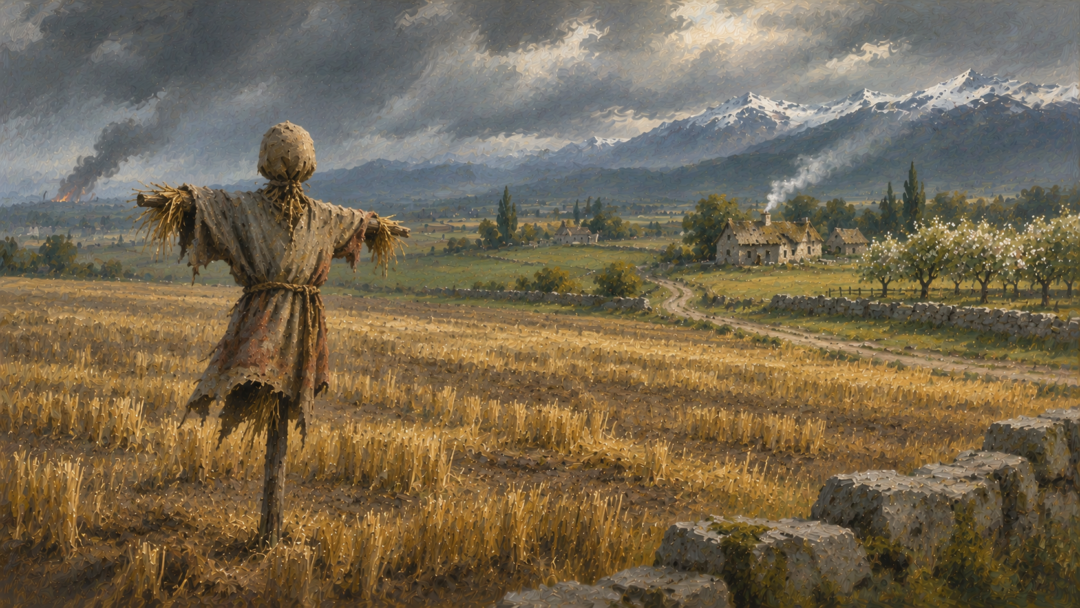
Within that enclosure, the description is unmistakably agricultural. There are tilled fields and orchards, homesteads with places to store grain, shelter animals and dry produce, and streams running down towards Anduin. They are places that take seasons of labour to maintain. The richness of the landscape is part of what Minas Tirith stands to lose.
The book says the farmers and herdsmen living there are not numerous, and that most of Gondor's people live either within Minas Tirith or in other districts, including Lossarnach and Lebennin. So the Pelennor is no belt of bustling towns. The text establishes scattered working homesteads and fertile townlands; it does not provide a list of villages or a street plan for a missing suburb.
Pippin's view from the city confirms the distinction. He can pick out little walls, farm buildings and a network of tracks, but he sees no cattle. The missing animals are already a sign of preparations for danger. From the citadel, the roads show a countryside being reorganised. There is space between its buildings, but there is no question that people have lived and worked there.
Roads That Matter Before the First Charge
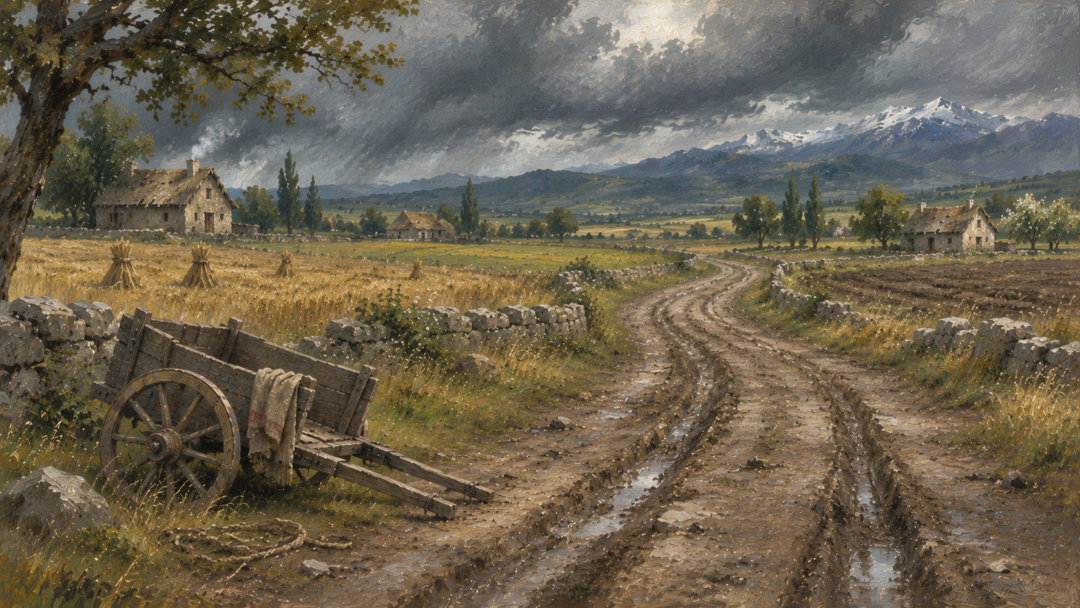
The roads have consequences. Gandalf enters from the north, through a guarded section of the Rammas where Ingold and his men are still making repairs. That route leads back towards Anórien and Rohan. Its importance sharpens as the defenders wait for Théoden: a friendly road can become an enemy approach, and a wall can protect the fields only while someone still holds it.
To the east is the broad road towards Osgiliath, the route Faramir's soldiers must defend and later retreat along. The Causeway Forts at the river crossing and the outer wall give the defenders positions ahead of Minas Tirith itself. The siege is a succession of positions lost, not an army appearing at the doorstep. Each retreat gives the enemy another part of Gondor's inhabited ground.
Another road carries a different sort of traffic. With Beregond, Pippin watches wagons and handcarts travelling south towards refuges in the valleys beyond the city. They carry elderly people, children and women ordered to leave. It is an organised evacuation. The account does not say where every Pelennor farming family goes, but the absence of livestock and the departure of civilians together show how thoroughly ordinary life has been displaced.
How the Siege Turns Farmland Into a Battlefield
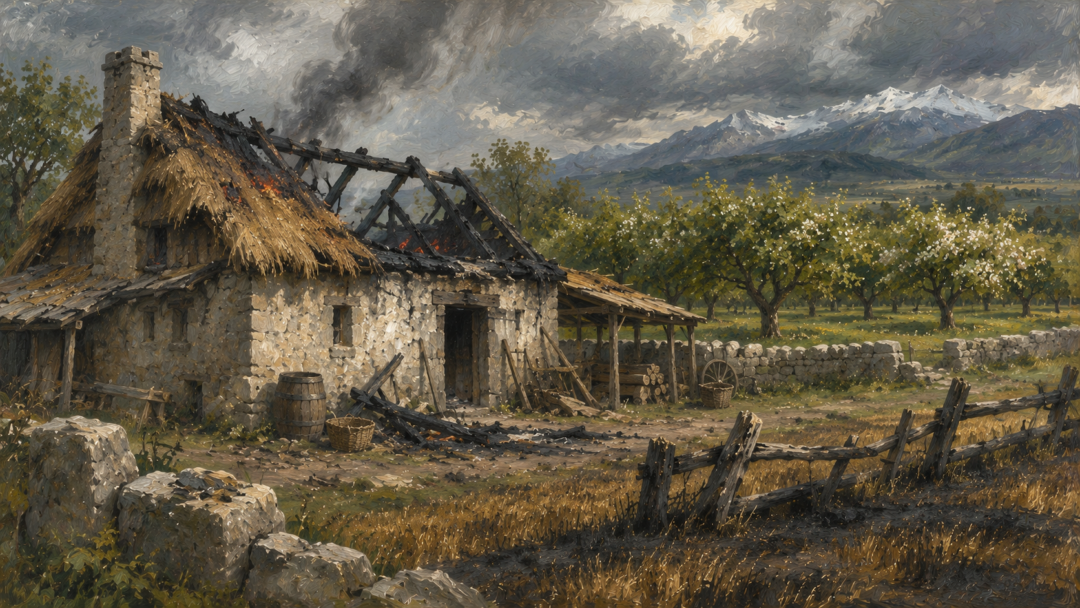
When Faramir falls back from the river, the struggle passes directly through this landscape. After the crossing at Osgiliath is lost, he withdraws towards the Causeway Forts and the Rammas. The enemy breaks through the outer defences, and watchers on Minas Tirith see fires spreading across the plain. Houses and barns are burning. Separate farms disappear in the smoke.
The flames also reveal where the attackers are moving. From the city, the watchers see streams of fire drawing together near the main road from the Gate to Osgiliath. Retreating companies struggle home, harried by the Nazgûl. Prince Imrahil leads a mounted sortie that helps save Faramir and the survivors. The trading road becomes a corridor of desperate withdrawal.
Then the Rammas is breached so widely that the Pelennor is abandoned to Sauron's forces. Ingold's men come down the northern road with news that another enemy host has arrived by way of Cair Andros and threatens the approach from Rohan. The defenders shut the Great Gate. Outside, the besiegers burn fields and trees and kill people they find abroad. No tally of displaced farmers or civilian deaths is given.
Then comes another stage. The attackers dig a ring of trenches beyond bowshot of the main city wall and fill them with fire. Behind that protection they set up their siege engines, while camps spread across the land. The defenders cannot easily stop the work. Some fear hunger as much as the engines: the roads are cut, and relief is uncertain. A city separated from its food-producing surroundings faces a different threat from a fortress standing in empty wilderness.
That does not mean the book says Minas Tirith immediately runs out of food, or that every orchard and barn is destroyed. The outer country has ceased to be a safe source of supplies and movement. Even the great walls cannot preserve what lies beyond them. The siege damages the city's livelihood as well as its defences.
When Théoden reaches the north, the broken Rammas becomes part of the rescue. The Rohirrim learn that the enemy has smashed stretches of the outer wall instead of guarding them against a counterattack. The same fortification whose collapse exposed Gondor now leaves an opening for its allies. Its presence gives their arrival a tactical logic.
What the Films Leave Outside the Frame
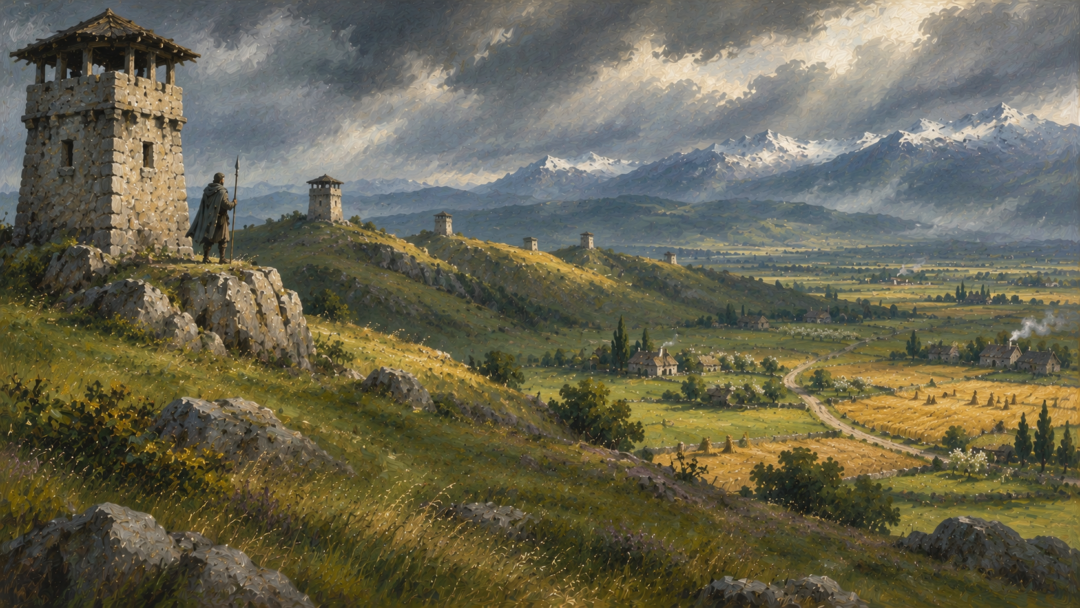
Peter Jackson's The Return of the King presents the approaches to Minas Tirith as a broad open plain. The Rammas Echor and the web of working farms do not form a visible part of its battlefield geography. The film gives viewers a clean sweep of ground between the city's walls and the approaching armies, making the siege and the Rohirrim's charge easy to follow.
That is an observation about the finished adaptation, not proof of why the filmmakers chose it. A less cluttered battlefield can make cavalry formations, siege engines and the scale of the opposing forces immediately legible on screen. Whatever the production reasoning, the effect is plain: viewers may remember the Pelennor as naturally vacant because the film offers little sign that it was inhabited before the battle.
Nor is the book's version a crowded urban battlefield that a camera would have to navigate house by house. Its residents are relatively few, with orchards, fields and separate holdings spread across a wide enclosure. Armies still have room to manoeuvre; broad stretches host camps and fighting. The decisive difference is the evidence of human use, and then of that use being violently interrupted.
The Ground the Riders Win Back
The battle chapter preserves that evidence right to the end. Théoden reaches the road from the Gate towards the river, his riders fight around siege engines and fire-pits, and the struggle moves across different parts of the Pelennor. Later, enemies continue resisting beside burned homesteads and barns, at walls and on small rises. These landmarks make it a fight across a damaged country, not an abstract field.
The river matters as much as the roads. At the Harlond, Aragorn arrives in captured ships with reinforcements from the southern fiefs; they strike north while the Rohirrim fight from another direction. The Pelennor's connections, described before the siege, help explain the relief of the city. This is also how the account of Helm's Deep works: walls, approaches and the ground between them shape what defenders and attackers can actually do.
After the fighting, the loss remains visible. Grass will grow again, and the fields can be inhabited and cultivated again, but the book has made us see the work that must precede that recovery. It is one thing to save a beautiful city from destruction. It is another to win back the orchards, roads, fields and scattered homes that made it a living place. In the Pelennor, the riders cross ground where somebody once brought in a harvest.
Sources & Notes
- Tolkien Gateway, Pelennor Fields — the townlands and fields of Minas Tirith on the Anduin's west bank, running down in slopes and terraces, home to farmers and herdsmen in small settlements, and crossed by the North-way, the South Road and the road to the Causeway Forts. https://tolkiengateway.net/wiki/Pelennor_Fields
- Tolkien Gateway, Rammas Echor — the great wall some thirty miles long that surrounded Minas Tirith together with the Pelennor Fields, its farmlands and pastures, destroyed on 15 March T.A. 3019 during the Battle of the Pelennor Fields. https://tolkiengateway.net/wiki/Rammas_Echor
- Tolkien Gateway, Causeway Forts — the two towers flanking the north-eastern gate of the Rammas Echor, from which a causeway ran across the flat land towards Osgiliath, the position Faramir defended and retreated through. https://tolkiengateway.net/wiki/Causeway_Forts
- Tolkien Gateway, Osgiliath — the ruined stone-built city spanning the Anduin between Minas Tirith and Minas Morgul, 'Old Gondor', fought over and lost during the War of the Ring. https://tolkiengateway.net/wiki/Osgiliath
- Tolkien Gateway, Battle of the Pelennor Fields — the 15 March T.A. 3019 battle fought on Minas Tirith's own farmland, in which the fields became a siege camp and battlefield. https://tolkiengateway.net/wiki/Battle_of_the_Pelennor_Fields
- Encyclopedia of Arda, Pelennor Fields — the townlands and fields of Minas Tirith, protected by the long circular wall of the Rammas Echor and crossed by the South Road and North-way. https://www.glyphweb.com/arda/p/pelennor.html
Pelennor's settlements, roads and farmland are in the book; the empty battlefield of the films is an adaptation choice. Cited the Pelennor entries, the Rammas Echor, the Causeway Forts, Osgiliath and the battle itself.