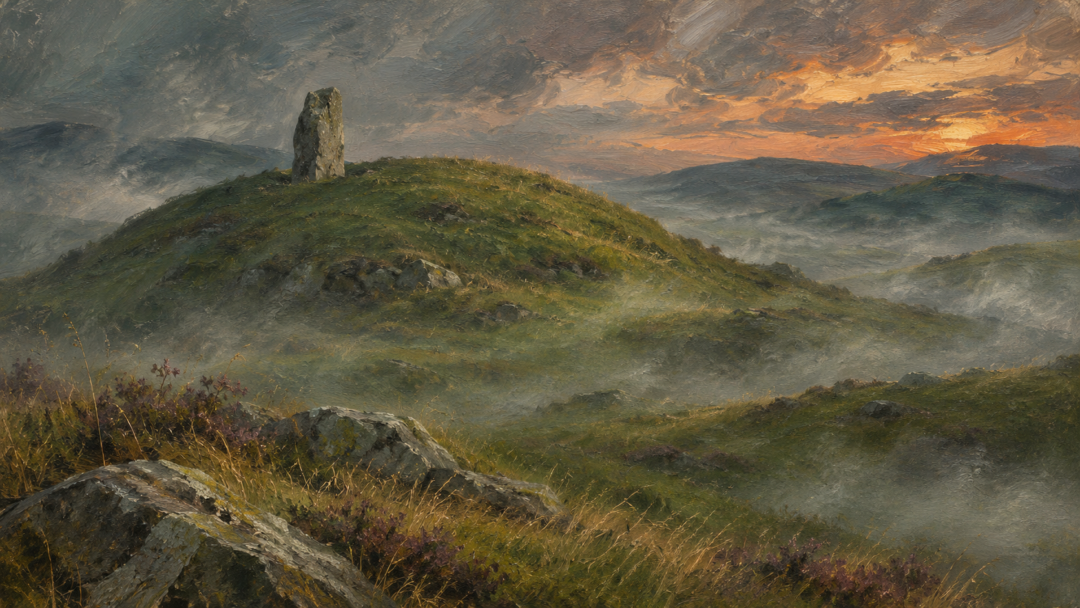
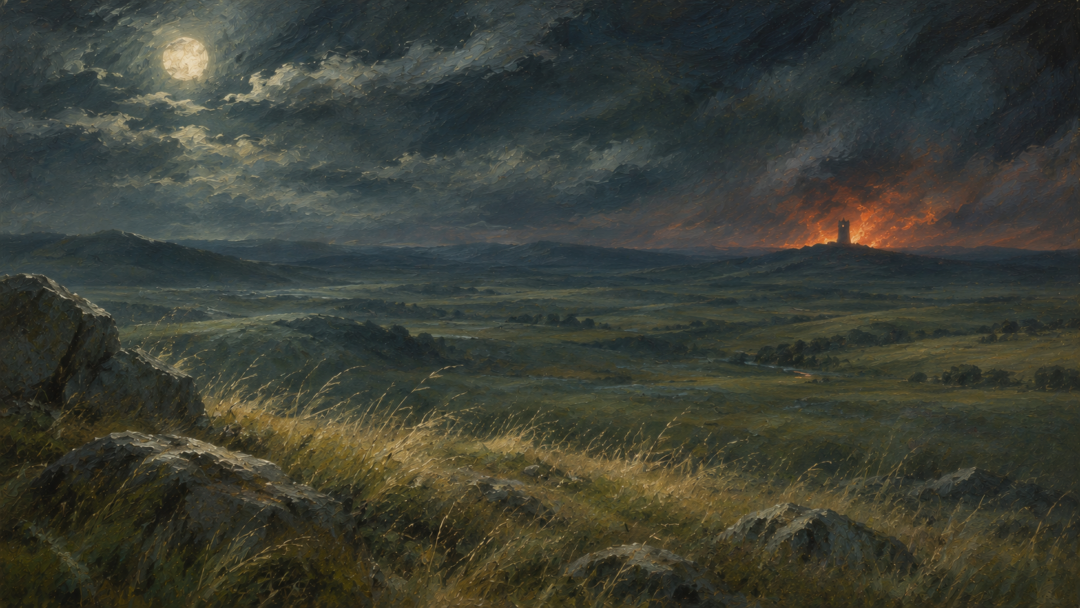
A small silver leaf lies in the grass of Rohan, almost lost among the footprints of marching Orcs. When Aragorn finds it, he recognizes the clasp of an Elven cloak and understands that one of the captive hobbits has deliberately left a sign. The remarkable thing is that Pippin, exhausted and frightened, had already imagined Strider following the trail before he found his chance to act.
Was that sudden vision something more than hope? Did Pippin receive a glimpse of events beyond his sight, or did he simply know his friends well enough to picture their pursuit?
The books allow room for wonder, but they give Pippin's practical intelligence considerable credit. His brooch-drop is a quick decision made under pressure, not a demonstrated prophetic gift. Other encounters, especially the rescue from the Barrow-downs and his later experience with the palantír, involve powers outside ordinary hobbit understanding. They are not, however, the same kind of event.
The Barrow-Downs: When Help Comes from Outside
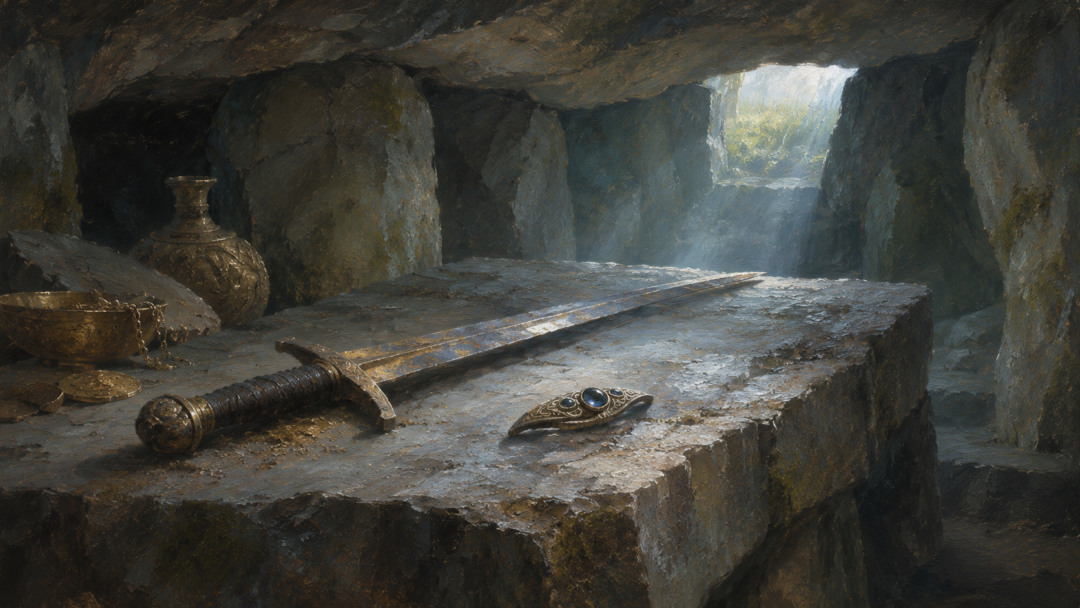
Long before the Orc-march across Rohan, the four hobbits encounter a danger they cannot overcome alone. In The Fellowship of the Ring, the Barrow-downs are covered in deceptive mist, and Frodo becomes separated from his companions. He eventually finds himself imprisoned inside a burial mound, where Sam, Merry, and Pippin lie motionless in white garments, surrounded by ancient treasure. A long sword rests across their necks, while a terrible voice chants in the darkness.
Frodo is the one who wakes and acts. As a spectral arm reaches toward his friends, he briefly considers escaping with the Ring. Instead, he seizes a sword and strikes the approaching hand. Only afterward does he remember the rhyme Tom Bombadil taught the hobbits. He sings for help, hears an answering voice, and soon sees daylight entering the chamber. Tom arrives, drives away the Barrow-wight, and carries the unconscious hobbits into the sunlight with Frodo's assistance.
The rescue is unmistakably external, although Frodo's courage and memory make it possible for him to call upon that help. Tom's extraordinary authority over the creature is shown rather than fully explained. The chapter does not identify a hidden power arranging his arrival or describe how his songs work. Pippin, meanwhile, is one of those rescued, not the source of the intervention. Any suggestion that this episode establishes a special visionary ability in him goes beyond what the scene actually shows.
The Swords, the Song, and the Vision of Strider
The aftermath of the barrow provides a particularly interesting example of how unexpected gifts can become useful later. Tom spreads the mound's treasure on the grass, breaking its association with the imprisoned dead. He selects a beautiful brooch set with blue stones for Goldberry and gives each hobbit an ancient dagger. These blades were forged by Men of Westernesse who fought against the power of Angmar. What appears to be treasure recovered from a frightening accident becomes equipment for the dangerous road ahead.
There is also a remarkable moment of shared vision. As Tom speaks about the forgotten makers of the swords, the hobbits seem to glimpse immense stretches of history, with tall warriors passing through the years and a figure bearing a star upon his brow. This is a collective impression arising from Tom's account, not a prediction delivered privately to Pippin. Even Frodo's earlier dream of a distant green country belongs to a different experience, occurring while the hobbits are guests in Tom's house.
Pippin's own intriguing vision appears much later, in The Two Towers, during the chapter "The Uruk-hai." Bound and forced to run across Rohan, he repeatedly imagines Strider bending over a trail and pursuing the Orcs. The image comes to him unbidden. That wording makes the moment feel almost uncanny, but it does not establish that he is literally seeing Aragorn from afar. Pippin knows that Aragorn is an exceptional tracker, and remembering him offers a possibility of rescue.
What immediately follows shows Pippin working through a practical problem. The Orcs' heavy footwear has overwhelmed the little footprints belonging to him and Merry. Even an expert Ranger might struggle to distinguish their passage. When the company enters a shallow depression filled with wet ground and mist, Pippin sees an opportunity. He suddenly darts away from his guards, hoping to leave recognizable tracks apart from the main trail. The Orcs pursue him, and escape quickly proves impossible.
At that instant, he unclaspes the brooch of his Elven cloak and lets it fall before his captors seize him. His private reaction is revealing: "I don't know why I did it." He doubts that anyone will ever discover the token and fears that the other members of the Fellowship have gone away with Frodo. Yet uncertainty about the outcome does not make his movement accidental. He has deliberately moved away from the Orcs' path, tried to preserve his footprints, and released a distinctive object where a tracker might find it.
The later discovery confirms the value of his decision. In "The Riders of Rohan," Aragorn notices the branching hobbit footprints and retrieves the leaf-shaped clasp. He recognizes it as evidence that Pippin was alive and capable of acting independently. When the companions reunite at Isengard, Aragorn returns the brooch, acknowledging how difficult it must have been to surrender such a precious possession. Pippin's improvisation has achieved something real: it has transformed a confused trail into a message his friends can understand.
The Palantír: A Vision Pippin Cannot Control
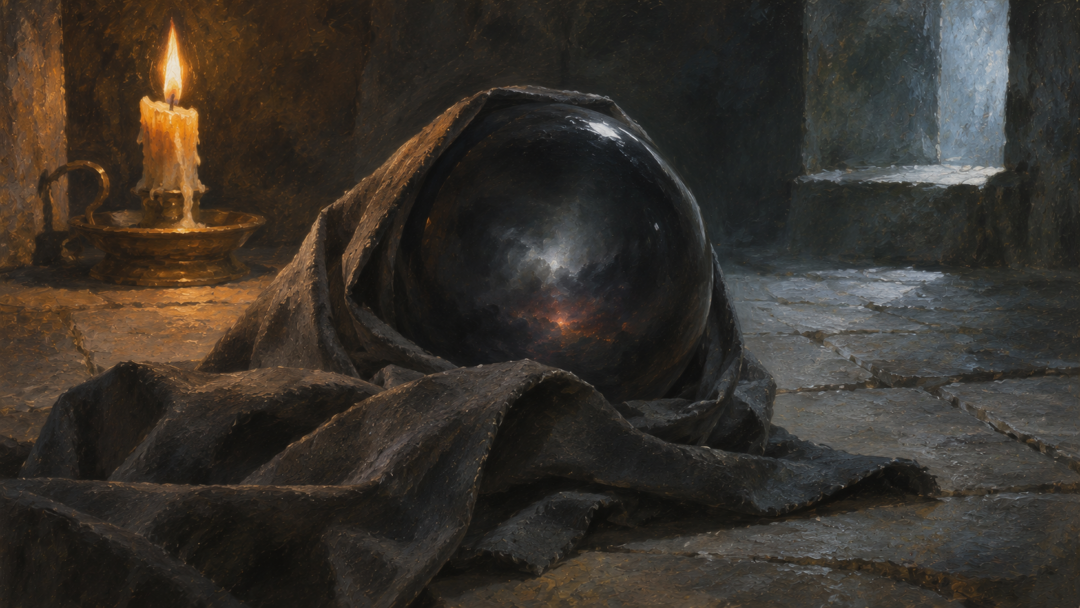
The seeing-stone of Orthanc brings Pippin into contact with a very different sort of vision. After the confrontation with Saruman, Wormtongue hurls a dark globe from the tower. Pippin retrieves it, but Gandalf quickly takes possession. During the journey away from Isengard, the mysterious object occupies Pippin's thoughts. He asks Merry about it, complains that Gandalf has offered no explanation, and grows increasingly restless as the company settles down to sleep.
His eventual behavior is both resourceful and dangerously foolish. Finding Gandalf apparently asleep, Pippin removes the covered globe and substitutes an ordinary stone wrapped in the same cloth. He knows he is doing something wrong and even rebukes himself, but curiosity overcomes his hesitation. When he finally gazes into the palantír, its darkness begins to glow. The light draws his attention until he cannot look away, and the encounter passes beyond anything he intended.
Pippin later describes distant battlements beneath a dark sky, with great winged shapes moving across the stars. One seems to approach him before another presence takes command of the vision. Sauron questions him, discovers that he is a hobbit, and sends a threatening message intended for Saruman. The experience leaves Pippin terrified and nearly helpless. Unlike his mental picture of Aragorn following the Orcs, this is actual communication through an extraordinary object, with another will exerting power over him.
The palantír is not inherently a wicked invention. Gandalf explains that the seeing-stones originated among the Elves and were used by the ancient kingdoms to observe distant places and communicate. Sauron has turned that capacity to his advantage, trapping Saruman through a connection between stones. Pippin has stumbled into this dangerous relationship without understanding it. What he sees is therefore neither a personal revelation granted for his benefit nor a vision produced by his own unusual talent.
What Gandalf Makes of the Vision
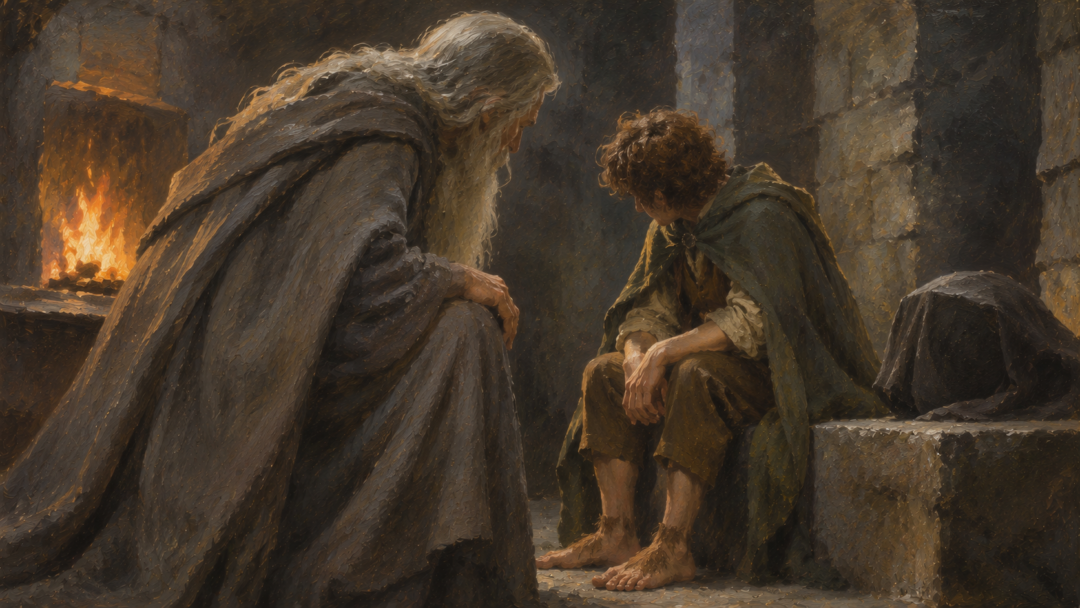
Gandalf initially responds with anger and alarm because Pippin may have exposed the Fellowship's secrets. He insists on hearing exactly what happened, examining the young hobbit's account before reaching a conclusion. Fortunately, Pippin has not revealed the quest or Frodo's whereabouts. Sauron was so eager to claim the captive he believed Saruman possessed that he did not thoroughly question the unexpected visitor. Gandalf calls their escape a matter of good fortune, while making clear that such luck cannot safely be expected again.
The encounter nevertheless provides information that Gandalf can use. He realizes how Saruman communicated with Mordor and recognizes that Sauron has probably misunderstood where the hobbit and the stone are located. The Enemy believes the palantír remains at Orthanc and that the halfling is Saruman's prisoner. That mistaken assumption may briefly confuse Sauron's plans. Gandalf also admits that he had considered examining the stone himself, an action that might have exposed his presence to the Dark Lord at a particularly dangerous moment.
But the advantage comes at a considerable cost. Gandalf must move quickly, entrust the stone to Aragorn, and take Pippin away on Shadowfax toward Minas Tirith. A winged Nazgûl passes overhead, emphasizing how rapidly danger is spreading. The sight Pippin gained was not a clear forecast of Gondor's future, and his conversation with Sauron was certainly no planned intelligence mission. The useful consequences emerge because Gandalf correctly interprets what happened and responds before the Enemy can correct his mistake.
Why These Moments Should Not Be Treated as One Gift
The distinction becomes clearer when the scenes are placed beside one another. In the barrow, Frodo remembers a song and receives help from Tom Bombadil, whose powers remain mysterious. During the Orc-march, Pippin imagines a familiar friend performing a task he knows that friend might undertake. He then uses the terrain and his Elven brooch to leave physical evidence. With the palantír, he actively seeks forbidden knowledge and becomes caught in a confrontation he cannot manage. Each event combines knowledge, action, and circumstance differently.
That variety is central to the story's treatment of fortune. Middle-earth allows unexpected rescue and extraordinary coincidences without requiring every successful choice to be explained as supernatural guidance. The leaf in the grass matters because Pippin sacrifices something valuable while knowing his attempt may fail. His decision is especially affecting after his earlier despair, when he thought of himself as little more than luggage being carried toward an uncertain fate. Here, even as a captive, he finds a way to influence events beyond his immediate reach.
There is something wonderfully fitting about Aragorn recognizing the brooch. Pippin cannot see him approaching, cannot know when the token will be discovered, and cannot make the Ranger follow precisely the route he hopes. He can only leave a sign that another person might understand.
And that is enough. The little silver leaf does not need to be a miracle to become one of the most hopeful objects lying on the plains of Rohan.
Sources & Notes
- The Uruk-hai - Tolkien Gateway — https://tolkiengateway.net/wiki/The_Uruk-hai
- The Riders of Rohan - Tolkien Gateway — https://tolkiengateway.net/wiki/The_Riders_of_Rohan
- The Palantír - Tolkien Gateway — https://tolkiengateway.net/wiki/The_Palant%C3%ADr
The Two Towers, ‘The Uruk-hai’ and ‘The Riders of Rohan’, describe Pippin’s deliberate trail-making and Aragorn’s discovery; ‘The Palantír’ describes a separate, mediated vision. No demonstrated personal prophetic gift is established by the brooch incident.