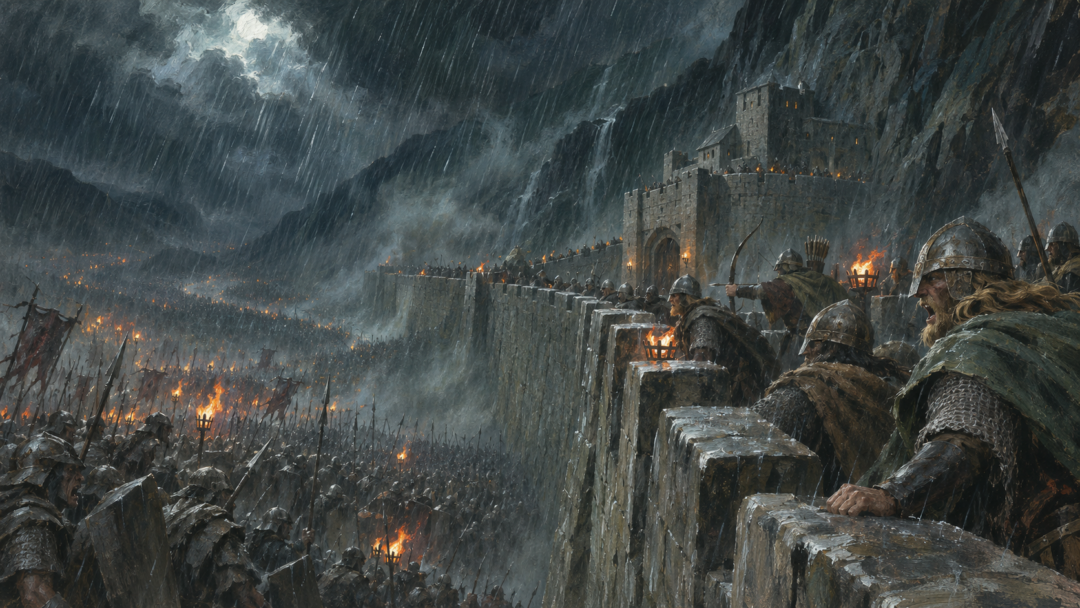
Rain sweeps across Helm’s Deep as ladders rise from the darkness and Saruman’s army advances by torchlight. Imagine one more familiar face among the Elves arriving to defend the fortress: Arwen, sword in hand, fighting beside Aragorn. That was once more than a hypothetical. The filmmakers planned for Liv Tyler’s character to join the battle, and some material was actually filmed.
Was removing her a mistake? Probably not. The finished The Two Towers is stronger for keeping its siege focused on Rohan’s desperate defense and Aragorn’s growing responsibilities. But the concept was defensible, regardless of Arwen’s absence from the battle in the book. Her presence could have solved a genuine problem with the film’s romance while creating several new ones.
What actually happened to warrior Arwen?
Asked directly in a December 2003 interview whether she preferred Arwen inside or outside Helm’s Deep, screenwriter Philippa Boyens answered: “Out.” She described the early screenplay as a selling script, shaped partly by expectations for a prominent female character. Arwen gained a more visible role. Boyens said the filmmakers later gained confidence in the quieter love story of the appendices. Her explanation suggests a changing understanding of what the film could sustain, rather than a single edict that a warrior princess had to disappear.
That account is not evidence of a formal studio order to create a sword-fighting Arwen. The plan also survived into filming. In a January 2004 interview, Tyler recalled months of physical preparation, including sword training and elaborate fight choreography. She described an elaborate Uruk-hai fight that was choreographed but never filmed. Proposed action and photographed action are not interchangeable.
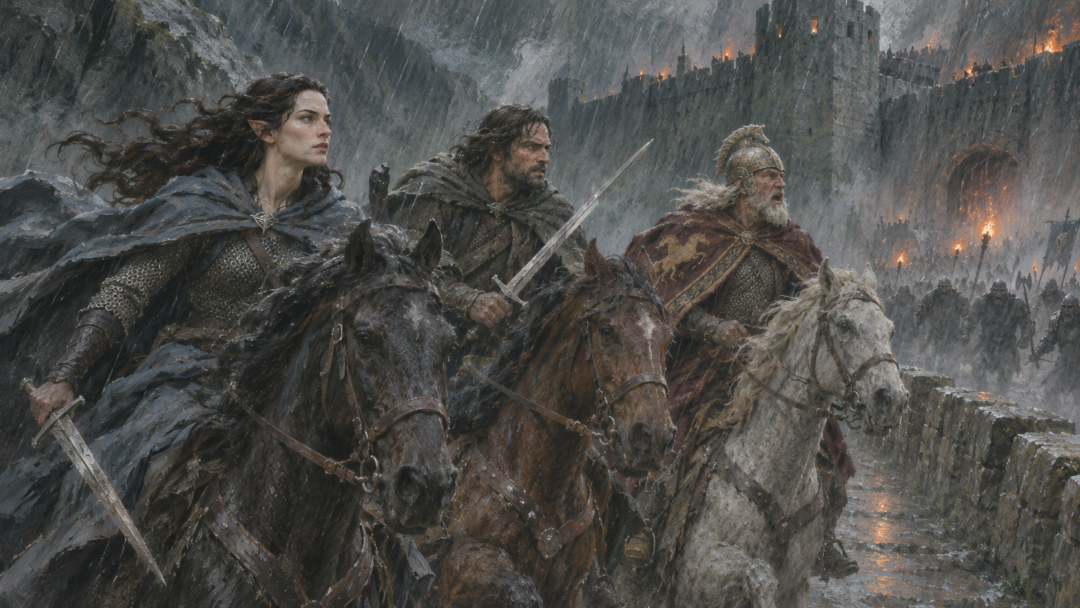
Tyler separately remembered filming a horseback scene at Helm’s Deep with Théoden and Aragorn, under attack from Uruk-hai. She found it difficult to make her blows convincing alongside the experienced male actors and stunt performers. The concept went beyond rehearsal, though not every fight was filmed. Tyler described the initial characterization as uncomfortable for her and the revised approach as something developed with the filmmakers. The extended editions restore no complete battle role.
Why putting her there made dramatic sense
Aragorn and Arwen present an awkward adaptation problem. Their relationship is decades old, yet in The Lord of the Rings they spend most of the main narrative apart. Much of its history and eventual sorrow appears in “The Tale of Aragorn and Arwen” in Appendix A. A novel can sustain their promise across chapters without bringing them together. A film needs ways to make their connection felt.
Peter Jackson discussed that difficulty in material recounted by Den of Geek: geography kept the romantic leads in different places. The movie already sends Haldir’s Elves to Helm’s Deep, unlike the book. Having Arwen accompany them would provide an immediate solution. She and Aragorn could share scenes in the present tense rather than remain connected mostly through memories, dreams, and conversations happening far away. The same rain and arrows could test their commitment.
The extended-edition commentary supplies part of that discarded route. Jackson recalls a very early draft in which Arwen and Elrond visited Galadriel in Lothlórien for advice. He also remembers filming some shots of Cate Blanchett for that strand and using them in the later montage. That supports an abandoned storyline and some photographed material, not a claim that every proposed scene was completed.
A later Den of Geek retrospective describes Arwen persuading Galadriel to send reinforcements to Helm’s Deep. It also discusses an injury as a possible way to send her home afterward, while acknowledging uncertainty about whether that was the plan. That proposed exit is not a confirmed deleted scene. These ideas give the alternative more shape than simply adding a sword to Arwen’s hands.
Aragorn is preparing to lead frightened defenders against overwhelming odds. Arwen has bound her future to his, though his road leads to a crown and hers to mortality. If she rode into danger beside him, that decision would become visible in action. A brief exchange before the assault, or their separation during a breach, might communicate an intimacy the released film sometimes struggles to sustain across great distances. That is a possibility, not a completed scene.
Her participation could also make the Elven intervention feel personal rather than ceremonial. Haldir’s arrival evokes the Last Alliance and briefly offers hope. Arwen could embody that old bond between Elves and Men, risking herself for the world Aragorn hopes to lead. She would gain deeds, not just screen time. That is the best argument against the cut.
Helm’s Deep already had a difficult job
Look at what the theatrical climax asks viewers to follow. Théoden must decide how to meet a nearly hopeless assault; Aragorn steadies the defenders; Legolas and Gimli offer different rhythms within the fighting; frightened civilians shelter behind walls beginning to fail. At Isengard, Merry and Pippin wait for the Ents to act. Elsewhere, Frodo, Sam, and Gollum face another struggle over trust and danger. The strands converge without sharing a battlefield.
The filmmakers were conscious of that balance. In the extended-edition commentary, Jackson and his fellow writers discuss adding wide shots to establish the battlefield’s geography and clarify where people are within the fortress. They contrast urgent fighting with the Ents’ slow deliberations. These remarks illuminate battle pacing, not the specific reason Arwen was removed. They show how much the sequence already carried.
A fighting Arwen would need more than one heroic glimpse to justify her arrival. The earlier Lothlórien strand offered a way to explain her journey and involvement; an injury could have supplied an exit. But establishing those developments, alongside Aragorn’s response and any reunion or parting, would take narrative space. These moments would compete with Théoden’s crisis, the Elves’ sacrifice, and the fortress’s collapse. The physical objectives work because they stay stark: defend the walls, survive the night, ride out at dawn.
The power and weakness of keeping them apart
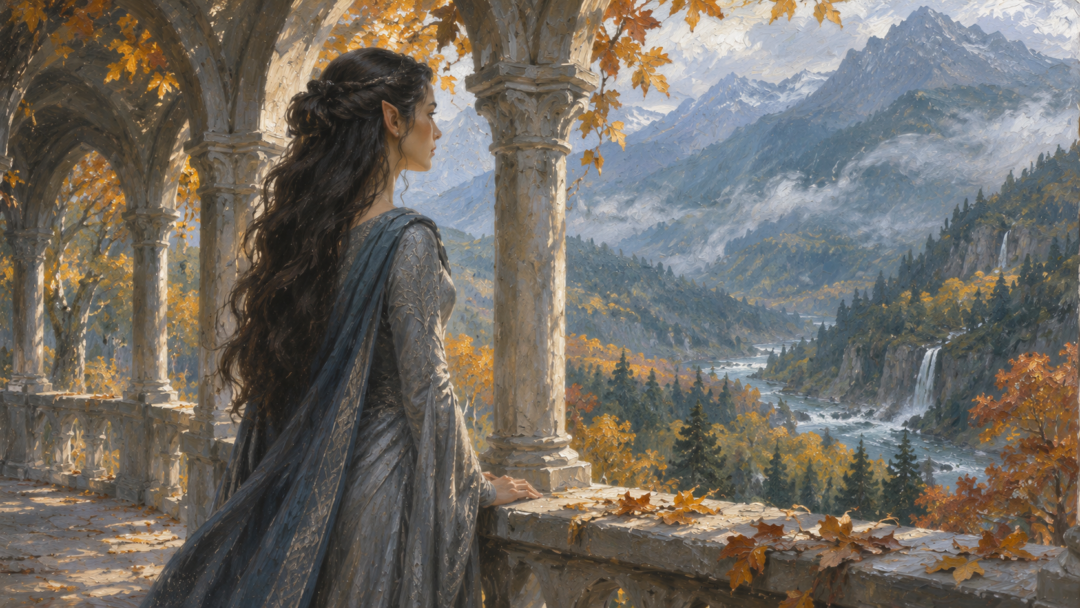
In the released Two Towers, Arwen’s scenes are less about defeating an enemy than bearing the consequences of loving Aragorn. Elrond confronts her with the prospect of his death and the grief that would follow. Her imagined future stretches beyond victory and marriage into years when the mortal world has changed and her choice cannot be undone. Distance becomes part of the romance, not merely an inconvenience.
The approach is imperfect. Romantic interludes can interrupt the film’s urgent movement. The later films give Arwen material involving departure, a vision of a child, and her failing condition. Not all of it is equally persuasive. Den of Geek has argued that a more active role at Helm’s Deep might have worked better. Longing can become thin when it merely interrupts battles.
Still, the quieter approach connects to something distinctive in the source. In the book, Arwen chooses mortality, accepting the loss entailed by a future with Aragorn. Boyens’s own example—the standard Arwen makes for Aragorn—also points to a quieter contribution, rather than an absence of will. The films reshape her story, but keep room for courage beyond killing enemies. In The Fellowship of the Ring, Arwen has already carried a wounded Frodo toward safety, defying the pursuing Ringwraiths at the Ford of Bruinen—a film role adapted from an episode involving Glorfindel in the book. The audience has seen her take risks without needing her to command an army.
Not every later invention can be blamed on the battle cut. Mortality and illness involved wider adaptation choices, not one established causal rewrite. The released films use visions, remembered conversations, and scenes with Elrond to keep her decision before the audience. Those devices yield lovely melancholy and some unsatisfying exposition; that is an assessment of the finished films, not a documented sequence of causes in the writing room. The cut solved one problem, not every problem attached to her character.
What about Éowyn?
The film brings Éowyn to Helm’s Deep with the refugees, where she watches men prepare to fight while she is expected to remain with those seeking shelter. She knows she has courage, but her society gives her little chance to prove it. Arwen arriving armed and apparently welcomed among the defenders could create an extraordinary encounter: two women with different freedoms, both drawn toward Aragorn. Such a meeting might sharpen Éowyn’s frustration—or pull the story toward romantic rivalry when it most needs to follow Rohan’s survival.
Éowyn’s eventual decision to ride to the Pelennor Fields gains power from everything she has been denied. Arwen fighting openly might heighten that contrast, but it would not automatically diminish either woman. Nor can we call their potential overlap a documented reason for the cut. The book places Éowyn with her people at Dunharrow rather than inside Helm’s Deep, while Arwen is absent from the battle and Elven forces are defending other lands. The question is how the movie distributes their distinct stories.
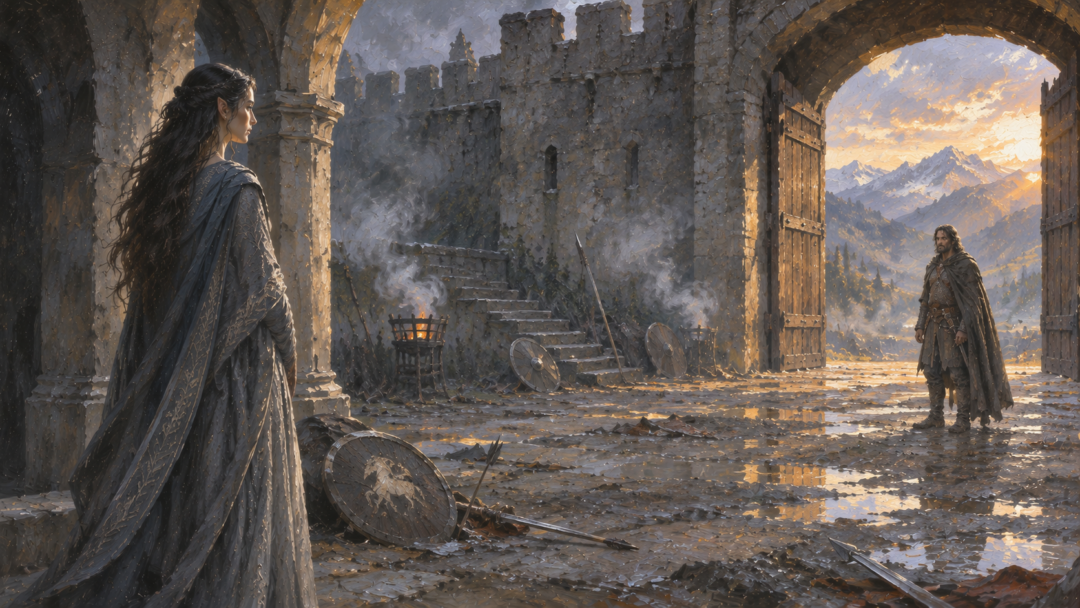
What did fan reaction really change?
Objections to warrior Arwen were real, and Tyler recalled being hurt by dismissive online comments. Den of Geek recounts that backlash while arguing the idea deserved to survive. Yet hostility alone does not establish why the filmmakers changed course. Boyens described growing trust in the material; Tyler described finding a better fit. Neither account supplies a complete edit log or definitive turning point.
The case for including Arwen remains persuasive wherever the films struggle to keep their lovers connected. Earlier proposals addressed more than whether she could wield a sword: they offered a journey, intervention, and possible departure. The harder editorial question is whether developing those strands would improve the siege enough to justify the additional narrative space. The surviving version separates those burdens. Aragorn fights beside Théoden, Éowyn waits for her chance, and Arwen faces a choice whose cost outlasts any battle.
At dawn, Aragorn rides out beside Théoden, not Arwen. That lets the moment belong to a king defending his people and a ranger learning what leadership demands. Far away, Arwen must decide what kind of life she is willing to lose for the one she loves. Cutting her scenes was probably right—not because she lacked the courage to stand on those walls, but because the film found another place to put that courage.
Sources & Notes
This article is based on close reading and interpretation of Tolkien's published works and related source material where relevant.