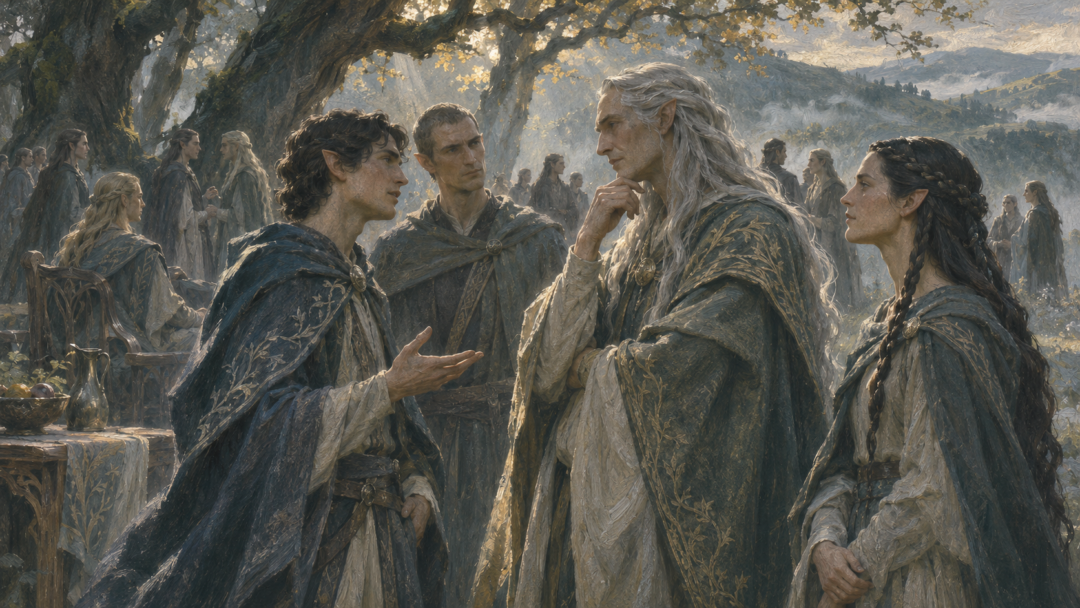
In Peter Jackson’s The Fellowship of the Ring, Legolas appears with pale hair falling past his shoulders, neatly drawn away from his face. That image became so familiar that an Elf without flowing locks can seem out of place. Then The Rings of Power introduces Elrond with soft, cropped waves and Arondir with hair cut close to his head. Both look unmistakably Elven, but their hair could belong to people walking down a street today.
The immediate answer is that the series allows more variation in how Elves look than Jackson’s films led audiences to expect. Showrunner Patrick McKay said as much when asked directly. But what have the creators actually explained, and why can one change make Middle-earth feel so different?
The question reached the showrunners themselves
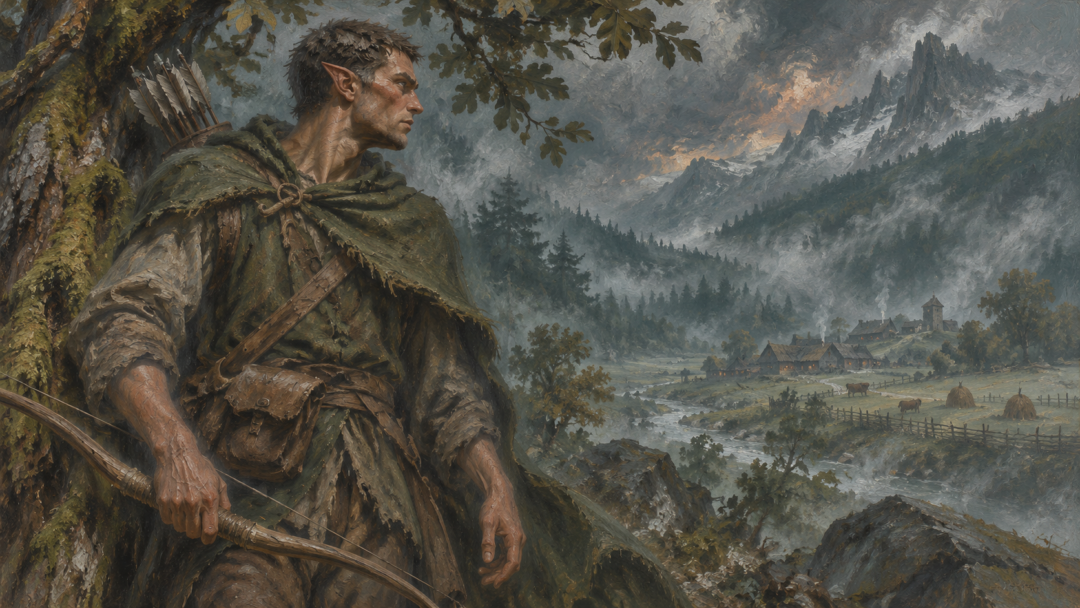
At San Diego Comic-Con in July 2022, Stephen Colbert moderated a panel for The Rings of Power. Among his rapid-fire questions was one prompted by promotional images: “Why do some elves have short hair?” According to ComicBook.com’s recap, McKay replied, “Elves don’t look the same all the time.” The answer rejected a single familiar silhouette as a requirement for an ancient people. It was striking that this question could be asked before audiences had even seen the whole first season: a few publicity images had already challenged an established expectation.
That reply establishes the production’s broad position, not a detailed history of its haircuts. McKay did not name an Elven fashion movement, identify a passage prescribing short hair, or say why Elrond’s waves differ from Arondir’s close crop. His answer leaves open whether a cut came from the actor's appearance, an individual character sketch, or a broader design idea. One can infer a wish to distinguish characters, but not assign a specific symbolism to each cut.
A later report by the Spanish entertainment outlet eCartelera adds some context. It reported J.D. Payne questioning the idea that Tolkien had supplied a hairstyle guide for thousands of years of history. McKay likewise argued against imagining Elven culture as visually unchanging over an immense span of time. That supports creative freedom, not a design brief for any individual actor.
How Legolas made long hair look like an Elven rule
For many viewers, the expectation begins with Orlando Bloom’s Legolas. His straight blond hair, narrow side braids and half-ponytail made an instantly readable image: graceful, controlled and unlike the everyday grooming of the film’s human characters. Beside Aragorn’s travel-worn appearance and Gimli’s heavy beard, the immaculate archer seemed more refined. His hairstyle communicated the difference immediately.
In a 2022 GQ article about fantasy’s enduring half-ponytail, Peter Swords King, the hair designer for Jackson’s Lord of the Rings trilogy, described the experimentation behind Legolas’s look. King said Legolas's two fishtail braids held his hair away from his face, with a small section at the back pulled into a ponytail. He separately described how Bard's half-up arrangement in The Hobbit let the hair move during action without falling into his face. That distinction matters: the same interview discusses two characters, not one explanation that can simply be transferred between them. That look was carefully created for those films, not simply copied from an explicit, universal instruction in the novels.
Its influence reached beyond Middle-earth. GQ traces how variations of long hair partially tied back became a familiar signal in other screen fantasies. One character’s style became shorthand for a genre. Flowing lengths suggested age; intricate arrangements suggested ceremony or nobility. A shorter, tidier haircut lacks that immediate visual distance, even when it belongs to a character with centuries of history.
King also expressed a useful concern about fantasy design: a haircut recognizable as contemporary can make a character appear contemporary despite the costume around it. This was a designer’s perspective, not a ruling on canon or an explanation from the show’s crew. Still, his point helps explain the reaction. Arondir’s close cut may suit his composed, alert presence, but the clean outline can remind a viewer of a modern barbershop more quickly than of an imagined ancient kingdom.
What the Rings of Power hair team actually designed
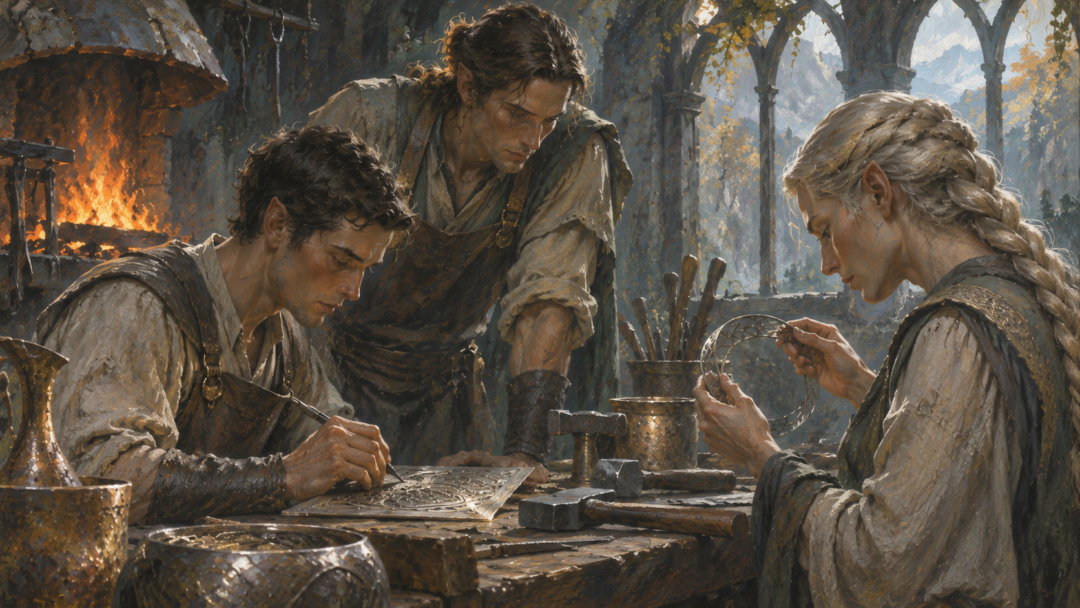
The series did not leave its characters’ appearances to chance. In a production crafts book, hair and makeup designers Vinnie Ashton and Jane O’Kane describe creating style rules for the different realms. That reveals more than theories about fashion trends. Elves, Dwarves, Southlanders and Harfoots needed recognizable appearances, with room for individuals. The same book describes mohair wigs used to give Harfoots a nature-inspired texture, and the elaborate facial transformations required for Dwarven royalty. Each people demanded a different visual language.
O’Kane described giving the Elves elevated hairlines, an absence of body hair and a flawless, healthy appearance. These choices matter because hair length is only one of the signals that tells us someone is Elven. Complexion, grooming, costume and bearing work together. In this version of Middle-earth, an Elf can have short hair without the production abandoning the other visual cues that separate the immortal Firstborn from their mortal neighbors.
The contrast becomes clearer when different Elves share the screen. Elrond’s soft, shaped hair gives him a different outline from Arondir’s close crop; Galadriel’s long hair can be braided or restrained for travel and combat, while Gil-galad retains a more flowing, regal appearance. These contrasts help distinguish characters by silhouette, but reveal no official hierarchy of hairstyles.
The crafts-book interview also describes the enormous labor behind the illusion. Main performers could spend hours in preparation, and the team had to manage crowds of extras on a television schedule. O’Kane explained that it was not possible to put everyone in a wig. Production faced constraints, but this does not prove any Elf had short hair to save money, time or wigs. Long preparation hours are evidence of a demanding craft, not a shortcut disguised as an aesthetic philosophy.
Does Tolkien say Elves must have long hair?
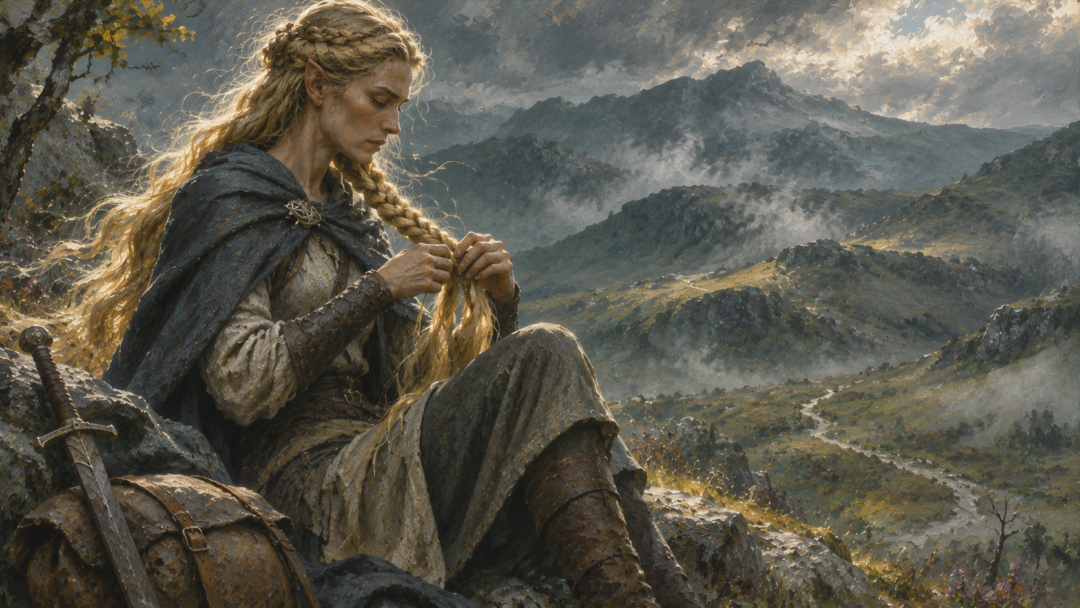
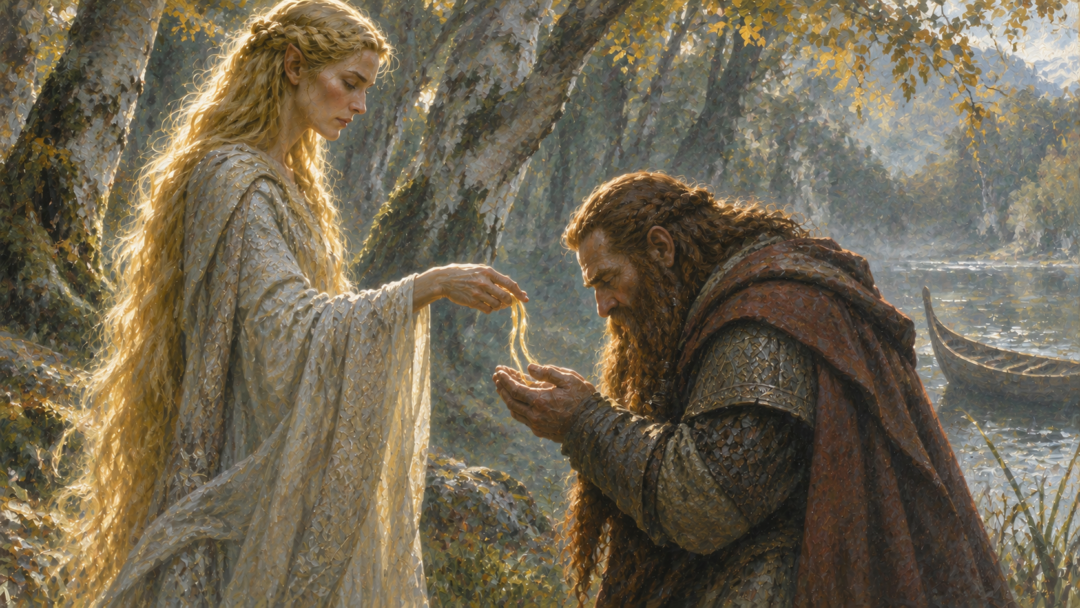
The books give readers good reasons to associate Elves with beautiful, abundant hair. In The Fellowship of the Ring, when Frodo enters the dwelling of Celeborn and Galadriel in Lothlórien, Celeborn’s silver hair is explicitly described as long and bright. Later, as the Fellowship departs, Galadriel unbraids one of her long tresses and gives Gimli three golden hairs. That small gift becomes a pledge of friendship between peoples with a troubled history.
Those scenes belong to Book II, chapters 7 and 8, of The Fellowship of the Ring: the meeting in Lothlórien and the company's departure. They describe particular characters and a particular gift, not a hairstyle regulation. A reader can reasonably value those long-haired images without treating them as proof that every Elf, in every place and period, must wear the same silhouette. The distinction is between a vivid individual description and a general rule. Neither the production interviews nor these examples supply a comprehensive chart of Elven grooming across the Ages.
A different Age, not a proven change in fashion
The Rings of Power is set in the Second Age, long before the journeys of Frodo and the Fellowship in the Third. Its Elven centers include Lindon and Eregion, and its story approaches the forging of the Rings while places familiar from the later adventure are still in very different circumstances. Audiences see cultures at a stage of confidence and ambition that the melancholy Third Age can only look back upon. In Vanity Fair’s early coverage, the production’s costumes were described as creating fashions for a Middle-earth thousands of years before the period represented by Jackson’s films.
That gap gives a screen adaptation room to construct a distinct visual period. Costumes can make Númenor feel powerful, Eregion feel devoted to craft, and Lindon feel ceremonial without simply repeating the fabrics and silhouettes of the film trilogy. Yet the chronology should not be mistaken for a claim about documented Elven haircut history. There is no established textual timeline in which Second Age Elves wore their hair short and Third Age Elves grew it long. The production is designing an earlier world, not illustrating a known sequence of changing styles.
The same separation applies to familiar characters. Elrond is a young political figure in the television story, while Jackson’s films show him as the established lord of Rivendell. The performances look distinct, but their hair does not establish a fashion trend or aging process. Elves do not ordinarily undergo mortal-style visible aging, so different hairstyles should not be read as a biological aging chart. The styling interprets an earlier chapter of their lives.
Why some hairstyles still feel too modern
Fantasy costume works partly through recognition and partly through distance. Pointed ears and elegant clothing tell us that Arondir belongs to Middle-earth; a crisp, close haircut may tell our eyes something else for a moment. The question is whether performance, setting and design overcome associations with the present. One viewer may appreciate the restraint and individuality, while another misses the otherworldly quality that long hair supplied so effortlessly. Both responses concern the effect of a design in its setting, not simply the number of inches between scalp and shoulder.
Galadriel offers a helpful comparison because her hair can be arranged without being shortened. In discussing the warrior version of the character, McKay pointed to the practical idea of braiding and securing her hair so it would not interfere with fighting. That explanation concerns how long hair is worn, rather than why another Elf has a crop. It shows how designers can keep long hair while adjusting it to a character’s actions.
The most revealing image may be Elrond standing amid the gold-lit halls of Lindon: unmistakably an Elf, yet not wearing the hair that many viewers expected. The ancient setting remains, but the visual shorthand has shifted. Whether that shift opens up Middle-earth or briefly breaks its spell depends on what each viewer sees first—the world around him, or the haircut.
Sources & Notes
This article is based on close reading and interpretation of Tolkien's published works and related source material where relevant.