The doors beneath the Dwimorberg open onto one of The Lord of the Rings' most unsettling journeys: Aragorn enters the Paths of the Dead, where an ancient oath still binds the shadowy company that follows him. They are dead men with unfinished business, and their presence matters to the struggle against Sauron. It is tempting to look at a scene like that and ask whether its author believed that ghosts could walk the real world too.
The answer is more intriguing than a simple yes or no. We know that J.R.R. Tolkien discussed ghosts with friends and explored hauntings in fiction outside Middle-earth. The evidence examined here does not establish whether Tolkien believed in literal ghostly apparitions. The difference matters, especially when “ghost” might mean a dead person's spirit, an atmosphere lingering in a building, or contact with an unfamiliar mind.
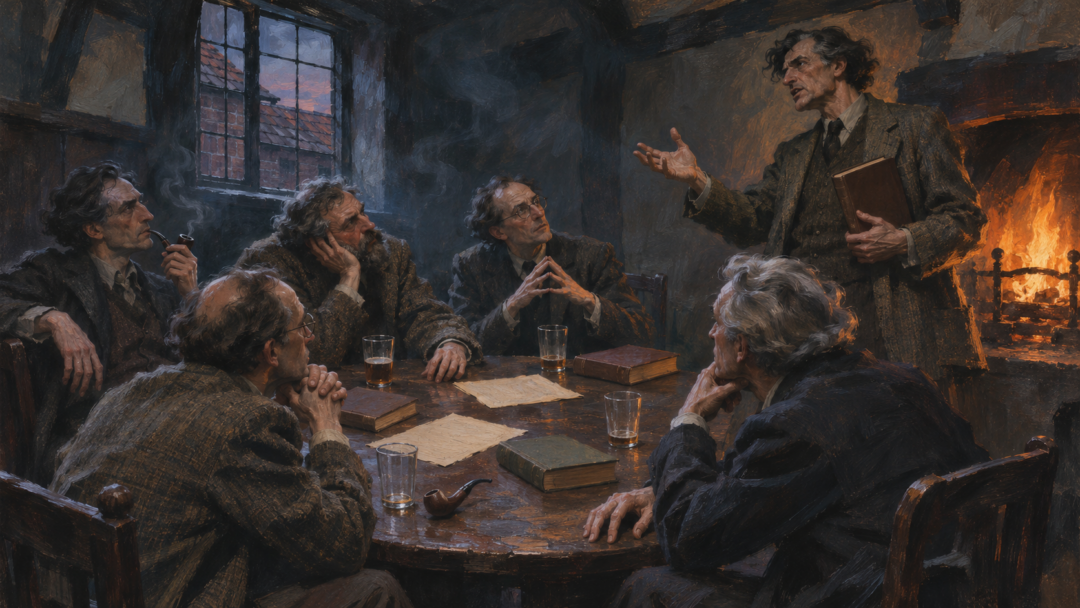
An Oxford Evening When Ghosts Came Up
On 24 November 1944, Tolkien wrote to his son Christopher about an evening with the Inklings, the circle of writers and thinkers that included C.S. Lewis. The setting was the Mitre in Oxford. According to [Tolkien Gateway's summary of Letter 90](https://tolkiengateway.net/wiki/Letter_90), the company heard Owen Barfield present a short play about Jason and Medea, listened to sonnets, argued over chance, and discussed hymns. Among these remarkably varied subjects was one especially relevant to our question: ghosts.
Here were people accustomed to debating poetry, philosophy, religion, and the fantastic, with the subject of haunting taking its place alongside everything else. The account also makes the evening sound argumentative rather than solemn. No experiment or collective judgment is recorded.
Crucially, the surviving summary does not tell us what Tolkien said about ghosts. Did he defend their existence, question it, offer an old story, or simply listen? None of those possibilities can be singled out as fact. Bruce G. Charlton, writing later about Tolkien's unfinished fiction, reports a more suggestive description of the conversation in a [2010 addition to his commentary](https://notionclubpapers.blogspot.com/2009/11/ghosts-in-notion-club-papers.html), but that secondary report cannot supply a verified declaration of Tolkien's views. Letter 90 establishes a real discussion, not a personal creed.
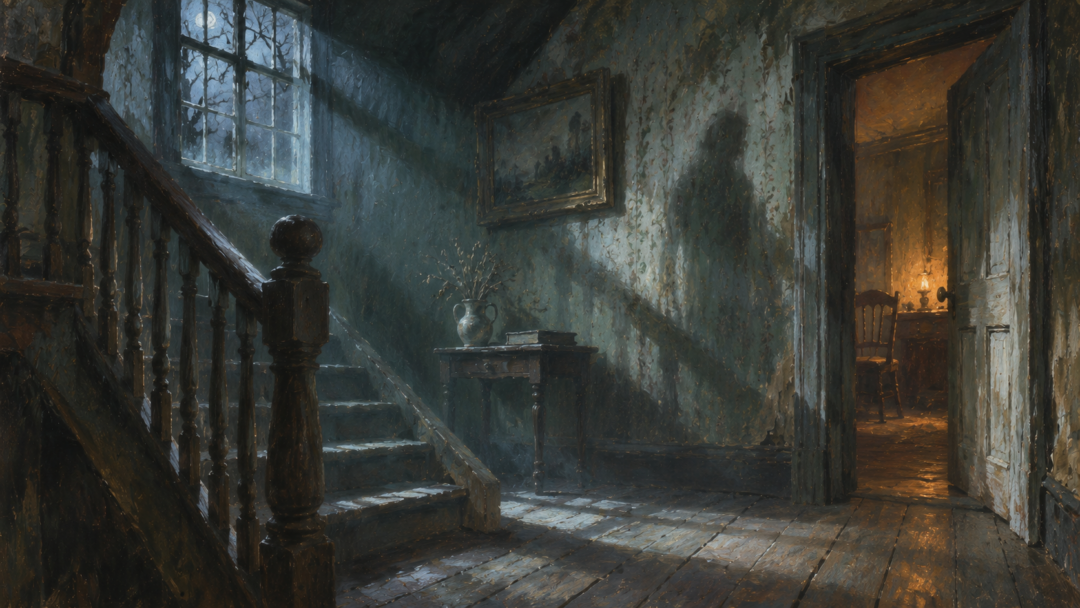
A Haunted House in The Notion Club Papers
The Notion Club Papers is an unfinished story presented as conversations among members of an imaginary Oxford club. Christopher Tolkien later published it in Sauron Defeated, part of The History of Middle-earth. Its club resembles the Inklings in broad conception, but its members are fictional. Its discussions turn to dreams, memory, and strange experiences.
In a [November 2009 commentary](https://notionclubpapers.blogspot.com/2009/11/ghosts-in-notion-club-papers.html), Charlton draws attention to an especially curious exchange. Michael Ramer introduces the example of a haunted house while considering how places and things might retain traces of their histories. Jeremy responds as though every house carries some kind of haunting, and Frankley considers whether atmosphere is something added by events rather than an intrinsic property of the building. The conversation moves almost immediately from whether haunting happens to what it could be.
A creaking staircase in a conventional ghost story might announce a frightening visitor. Here, the staircase almost becomes a philosophical problem. If a house is altered, does its atmosphere change? If it is demolished and reconstructed, would whatever haunted it survive? The fictional participants treat the shape and history of a place as potentially relevant to the phenomenon. Their ideas are speculative, but specific rather than merely spooky.
One anecdote, told by Lowdham, concerns a supposed haunting in which builders raised a floor and ghostly feet were then reported beneath the level of the new ceiling. It is an arresting image, but it remains a story told within a fictional conversation, not an authenticated report of the paranormal. Nor does Ramer's reference to psychical research establish his creator's endorsement of that field. What the episode demonstrates safely is sustained curiosity about the relationship between physical surroundings, human memory, and strange experiences.
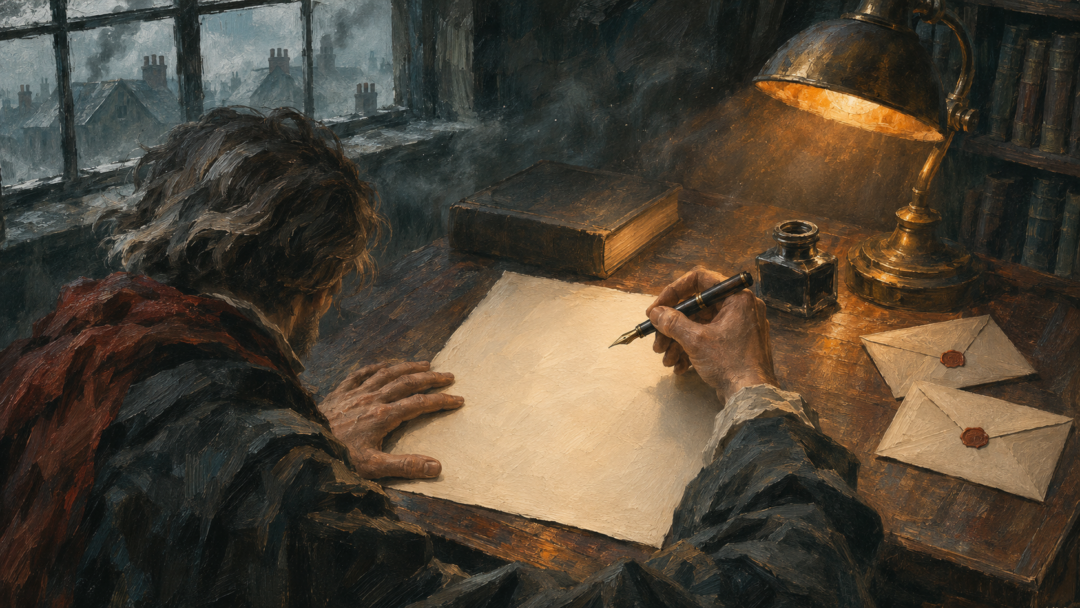
The Ghost Who Was Not a Dead Person
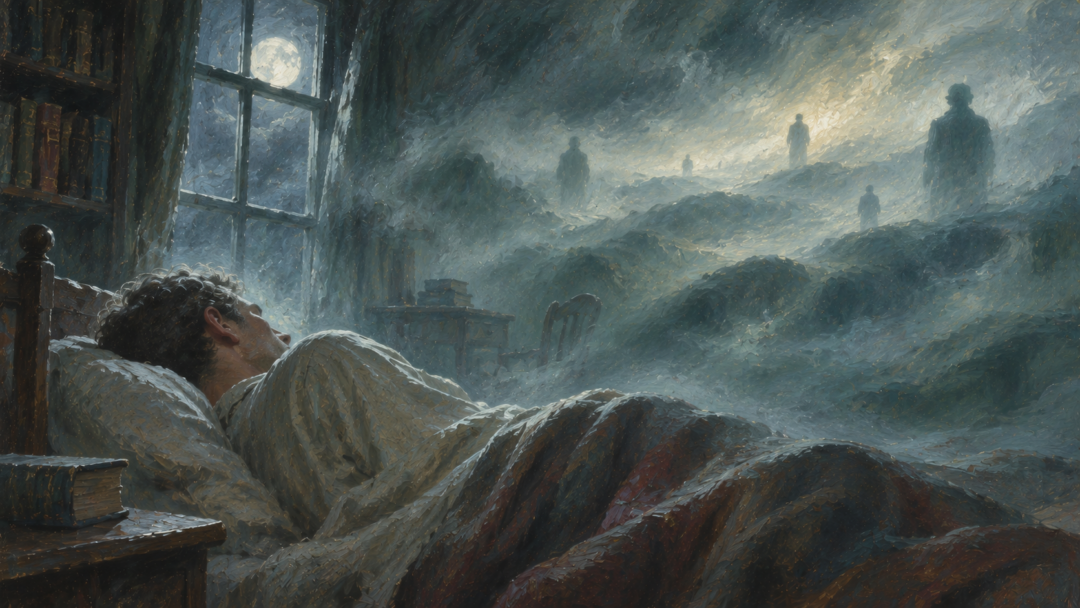
The same fictional conversations explore a different kind of encounter. Jeremy asks Ramer about minds that seem to visit him during dreams and uses the word “ghosts.” Ramer accepts the label in a broad sense, while explicitly distinguishing those visiting minds from departed human spirits, at least in his own experience. The exchange appears in [Charlton's discussion of the text](https://notionclubpapers.blogspot.com/2009/11/ghosts-in-notion-club-papers.html), and its distinction is essential: a strange intelligence is not automatically somebody's soul returned from the grave.
Dreams make this territory especially slippery. An unfamiliar voice in a dream could be treated as a product of the dreamer's imagination, a representation of memory, or, within speculative fiction, an encounter with another consciousness. Ramer entertains extraordinary possibilities involving minds and distant knowledge. The story explores those possibilities without establishing waking facts. A fictional thought experiment is not a diary entry, even when it is described with striking conviction.
Charlton goes further. His interpretation assumes that Ramer sometimes speaks for Tolkien, and from that starting point he suggests that the author may have shared beliefs about haunting and unusual experiences. But the crucial step is the assumption itself. An author can lend a character intellectual seriousness, personal concerns, or vivid language without making every statement autobiographical. The text cannot establish a personal encounter with a ghost, nor does its resemblance to the real Inklings discussion prove a direct inspiration.
What Middle-earth Can—and Cannot—Tell Us
The Dead Men of Dunharrow are probably the clearest Middle-earth example of spirits linked to an unresolved obligation. They had sworn to aid Isildur and failed to fulfil their oath; later, Aragorn summons them to discharge it. Their story has moral structure. The dead are not wandering randomly through a haunted landscape. Their fate belongs to a world where promises, judgment, and release have power, and where the past can press visibly upon the living.
A distinction from screen adaptations is worth keeping: in Tolkien's novel, the Dead help Aragorn against the Corsairs at Pelargir through terror and are released before the Battle of the Pelennor Fields; they are not a ghost army fighting on that battlefield. The relevant book passages include “The Passing of the Grey Company” and “The Last Debate” in The Return of the King. These are references for checking the fictional narrative, not records of the author's real-world paranormal beliefs.
Elsewhere, the Barrow-wights provide a useful contrast. In “Fog on the Barrow-downs” in The Fellowship of the Ring, Frodo wakes inside a burial mound with his companions laid out among grave treasures, and Tom Bombadil frees them. The larger history, addressed in Appendix A's account of the northern kingdoms, identifies the wights as evil spirits inhabiting the barrows, not simply the ghosts of the people buried there. Even within Middle-earth, therefore, a haunting need not be an ordinary dead person's return.
Catholic Faith Is Part of the Picture, Not the Verdict
Religion adds another layer, but not a shortcut to certainty. The [Tolkien Estate's timeline](https://www.tolkienestate.com/life/timeline-1892-1949/) records that his mother, Mabel, converted to Catholicism in 1900 and that, after her death in 1904, the Catholic priest Father Francis Morgan became guardian of the two boys. Those details establish a Catholic family context, but provide no statement of Tolkien's personal view of ghosts.
Within Catholic doctrine, a human being is not regarded as purely material. The [Catechism of the Catholic Church, paragraphs 362–366](https://www.vatican.va/content/catechism/en/part_one/section_two/chapter_one/article_1/paragraph_6_man.index.html) treats the unity of body and spiritual soul; paragraph 366 teaches that the spiritual soul is immortal. This is a claim about the human person and life beyond bodily death, not independent evidence that a particular house has been haunted. The Catechism is also a statement of Church teaching, not a personal explanation written or spoken by Tolkien.
It is important to separate survival of the soul from the very different claim that an apparently haunted bedroom contains a visible visitor from the dead. Catholic teaching about the soul and resurrection does not oblige believers to accept every report of a ghost. The oathbreakers cannot simply walk away from what they promised, while the Barrow-downs remain marked by a troubled past. Such patterns can be read alongside religious ideas about history and morality; they cannot settle an author's private response to a reported apparition.
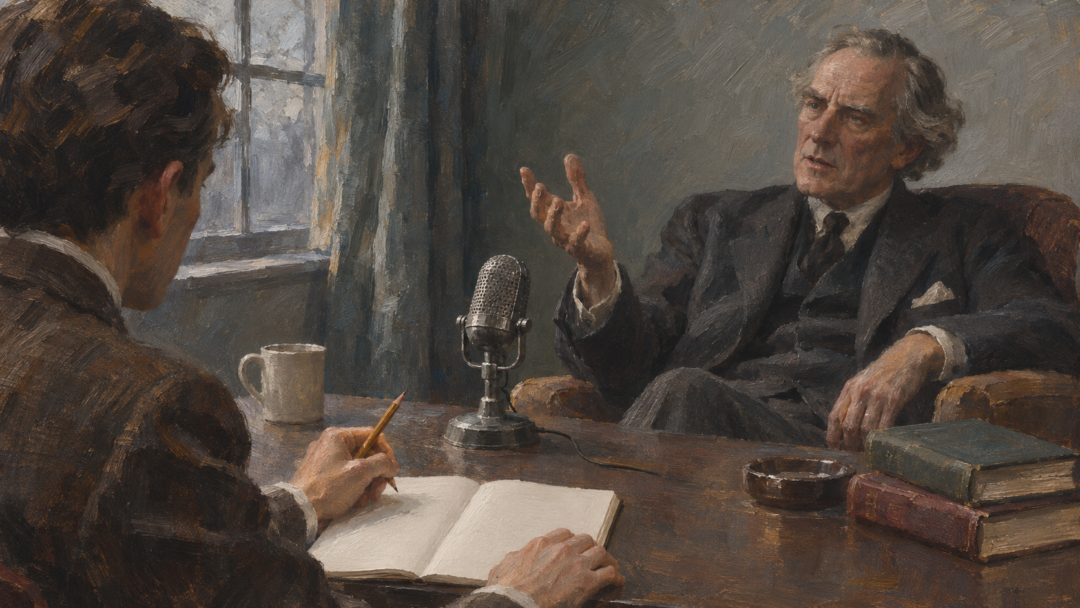
The Interviewer Who Asked About Literal Belief
A revealing parallel appears in an [unofficial, explicitly incomplete transcription](https://www.themisfortuneteller.com/Reading%20Notes/JRR%20Tolkien%201964%20Interview.html). The transcription attributes the exchange to a BBC interview by Denys Gueroult. Its date and later broadcast identification should not be treated as settled by that unofficial page alone. The interviewer asks Tolkien to step outside the framework of his books and say whether he believes, in the strict personal sense, in the Eldar or in governing spirits. The question is not about ghosts. Its value lies in the interviewer's insistence that belief inside a story and belief outside it are two distinct matters, even when the same author is discussing both.
Tolkien begins by distinguishing the Eldar from the Valar, categories that the question had brought together. They are not interchangeable, and neither is simply a synonym for a human ghost. The supplied transcript excerpt ends just as Tolkien begins his answer, so it cannot establish how he ultimately addressed the question. The truncated exchange instead warns against conflating story and belief.
The evidence, then, has different strengths. Letter 90 gives us an actual conversation about ghosts, but not each participant's conclusions. The Notion Club Papers gives us detailed fictional exploration of hauntings and unfamiliar minds. Charlton's commentary offers a possible reading of personal conviction, dependent on treating Ramer as a partial reflection of his creator. The Estate timeline and the Catechism illuminate religious context without supplying a personal ghost story. None of these supplied extracts is a direct statement that Tolkien believed he might meet a dead person's ghost; nor does any justify declaring him a firm skeptic.
The most fitting final image is not a specter at the end of a corridor, but an Oxford conversation that has reached us in fragments. Somewhere amid sonnets, mythology, and lively disagreement, ghosts entered the room as a subject worth talking about. We know they held a place in Tolkien's imaginative and intellectual world. Whether he believed they could enter the room in any other way remains an open question.
Sources & Notes
This article is based on close reading and interpretation of Tolkien's published works and related source material where relevant.