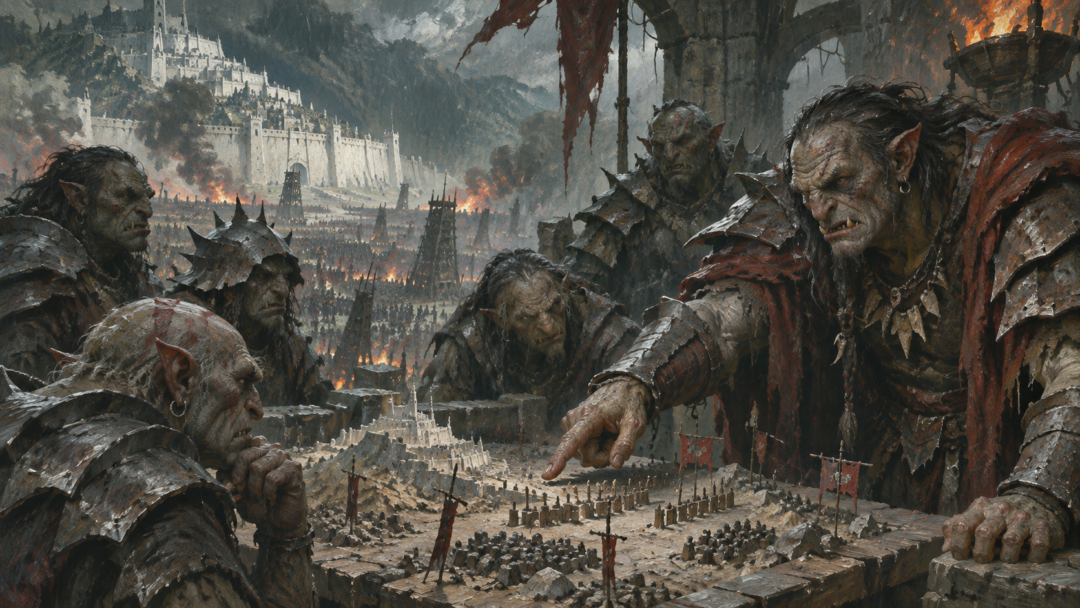
At Minas Tirith, the gates shake under the assault of Grond, and Gothmog stands among the forces pressing toward the city. In Peter Jackson’s The Return of the King, the Orc commander is memorable not only for his orders and cruelty but for his strikingly asymmetrical face. His appearance is part of the film’s nightmare vision of Mordor. Yet it raises an uncomfortable question once the battle is over: what happens when features resembling real facial differences are repeatedly placed on the faces of fictional villains?
The qualified answer is yes, such choices can contribute to the othering of people with visible differences. Recent experimental research supports concern about the broader storytelling pattern. It does not prove that Gothmog himself changed anyone’s attitudes, that his appearance represents a particular medical condition, or that the filmmakers intended a prejudicial message. Understanding that distinction makes the question more interesting, not less.
The Gothmog on the page and the one on screen
There is surprisingly little physical description to inherit from the book. In the chapter “The Battle of the Pelennor Fields,” Gothmog appears as the lieutenant of Morgul who sends reserves into the fighting after the Witch-king falls. The text does not specify his species, let alone the shape of his face. It also leaves his ultimate fate unrecorded. Readers know his military importance but are given no detailed portrait to picture.
The 2003 film makes a much more immediate character of him: an Orc officer whose presence gives Mordor’s assault a recognizable face. He commands soldiers during the siege, responds to setbacks and helps turn the gigantic movement of armies into a conflict with identifiable antagonists. The extended edition also gives him a more personal confrontation with Éowyn. These decisions belong to the adaptation; they are not missing details recovered from the novel.
In the film’s production commentary, the creators explain that Gothmog had become established enough to deserve a concluding scene, one that connected to his attacks on Éowyn. That comment is useful evidence of how he functions dramatically. It says nothing about why he was given his particular facial appearance. Treating a statement about his ending as an explanation of his makeup would fill an evidentiary gap with speculation.
The scale of the film’s visual design is easier to establish. Wētā Workshop describes six years of work creating armour, costumes, weapons, props and prosthetics for Middle-earth’s armies. That vast undertaking helps explain why individual Orcs could be visually distinctive in the middle of a crowded battle. But it does not identify the source of Gothmog’s features, or establish any deliberate resemblance to a human condition. We can discuss what his screen image communicates without pretending to know the design brief.
How a face becomes a warning sign
Cinema communicates quickly. Armour, posture, lighting, voice and facial makeup can tell an audience whom to fear before anyone has explained a character’s allegiance. Gothmog is surrounded by such signals: the machinery of siege, the brutality of his troops and his own conduct. His face is only one element. Nevertheless, because the camera gives that face prominence, it becomes part of the package through which viewers recognize danger.
The concern begins when a visible difference does more than individualize a character and starts to operate as moral shorthand. A scar, a mark, an asymmetrical feature or altered skin texture may be presented as though it reveals something sinister underneath. In ordinary life, none of those features tells us whether someone is kind, cruel, trustworthy or dangerous. Fiction can blur that boundary when its visual vocabulary repeatedly asks audiences to make the connection.
That is the argument behind Changing Faces’ I Am Not Your Villain campaign. The UK charity, which supports people with visible differences, has challenged film and television to stop using scars, burns and marks as easy signals of wickedness. Its objection is not that stories must contain only conventionally attractive villains, or that a person with a visible difference can never play an antagonist. It is to the habit of making appearance appear to explain evil.
There is also a limitation built into the wording of the question. “Facial deformities” is a broad, potentially loaded description, not a diagnosis of Gothmog. His fantasy makeup cannot establish that he has the “same condition” as any real person. Visible differences themselves vary enormously: some are congenital, some result from injury or treatment, and others have different origins. The ethical concern concerns resemblance and association, not a claimed medical equivalence between an Orc and a human being.
What the research can—and cannot—tell us
For a long time, this debate could be dismissed as a clash of interpretations: one viewer sees an effective monster, another sees a familiar source of stigma. Research now offers something more concrete. On 29 October 2026, UWE Bristol reported a randomized controlled trial involving 103 adults, assigned to positive, negative or neutral portrayals of people with visible differences. The researchers examined whether those portrayals changed participants’ appearance-related attitudes.
The negative condition produced a statistically significant increase in measured appearance-related stigma; the positive and neutral conditions did not. The published study describes participants viewing sets of images, with negative portrayals including movie villains and accompanying descriptions. That matters because the experiment tested the combined effect of imagery and framing, not the isolated influence of a single facial feature. It provides evidence that a portrayal can affect perceptions under controlled conditions, rather than a direct measurement of how one film changes society.
The limits deserve as much attention as the result. The researchers measured responses to questions about anticipated reactions toward people with visible differences, not observed discrimination in a workplace, school or street. The experiment did not establish that the effect would last for months or years. Nor did it test The Return of the King, Gothmog, or the distinctive responses of its audience. A trial of 103 people cannot settle every question about different viewers and cultures.
Changing Faces also commissioned Savanta ComRes research involving more than 1,000 respondents with visible differences. Of those surveyed, 20% recalled seeing someone resembling themselves as a hero, 15% as a love interest, and 39% as a villain. These figures describe respondents’ experiences, not the actual proportions of film and television characters. But they illuminate why another visibly marked antagonist can feel less like an isolated invention than another example of how narrowly people who look different are imagined.
Why fantasy exaggeration is a serious counterargument
An Orc is not an ordinary human character with an unfortunate complexion. Middle-earth’s armies are deliberately heightened through creature design, costume, movement and sound. Gothmog belongs to a world with Nazgûl, trolls and impossible war machines. Audiences have plenty of reasons to recognize him as threatening, most obviously his allegiance to Sauron and what he orders his troops to do. A filmmaker need not be making any claim about real patients or real faces when creating such a figure.
Nor is every unconventional face a stereotype. Fantasy thrives on silhouettes and contrasts that would look improbable in everyday life. If all distinctive, battered or irregular-looking characters had to be morally good, that would produce another narrow set of rules. A villain may have scars; a hero may have them too. The more useful question is whether facial difference has become a substitute for characterization, or whether it is simply one attribute of a fully drawn person.
Still, fantasy does not exist outside ordinary habits of perception. Its images are built from forms viewers can recognize, even when those forms have been exaggerated into something impossible. That creates room for unintended associations. The same design may work brilliantly at making Gothmog memorable while also participating in a wider convention that attaches danger to unusual faces. Acknowledging that possibility requires no accusation against the actor, director or makeup artists.
It helps to look at how the story itself identifies his villainy. Gothmog commands an attack on a besieged city, treats his soldiers harshly and threatens Éowyn. Those actions leave little uncertainty about his role. If his face were designed differently, those narrative facts would remain. That counterfactual does not prove the design caused harm; it shows that the character’s moral meaning does not depend on treating facial irregularity as evidence of corruption.
Making room for other kinds of faces
A practical answer need not involve erasing every scarred villain from fantasy. It could mean expanding who gets to have a visibly different face without being made frightening by it. A captain who inspires loyalty, a healer who is taken seriously, a beloved romantic character or an ordinary inhabitant of a city could share that visual space. Such characters would not have to exist as inspirational lessons. They would simply be allowed the breadth of motives and relationships other characters receive.
The concern has also reached film policy. The British Film Institute publicly backed I Am Not Your Villain and stated that films it funds should not depict negative characteristics through scars or facial difference. That is a commitment within its funding approach, not a law governing all cinema and certainly not a retroactive judgment on a film released in 2003. Its significance lies in recognizing that visual character conventions are choices worth examining, rather than fixed requirements of dramatic storytelling.
Gothmog remains an effective presence at the siege of Minas Tirith. But the most revealing thing about his face may be how much meaning a viewer is invited to read into it before he acts. The evidence cannot tell us that this particular Orc made anyone less welcoming toward a real person. It gives us reason to ask why a face unlike the familiar one is so often made to stand at the gates with the enemy.
Sources & Notes
This article is based on close reading and interpretation of Tolkien's published works and related source material where relevant.