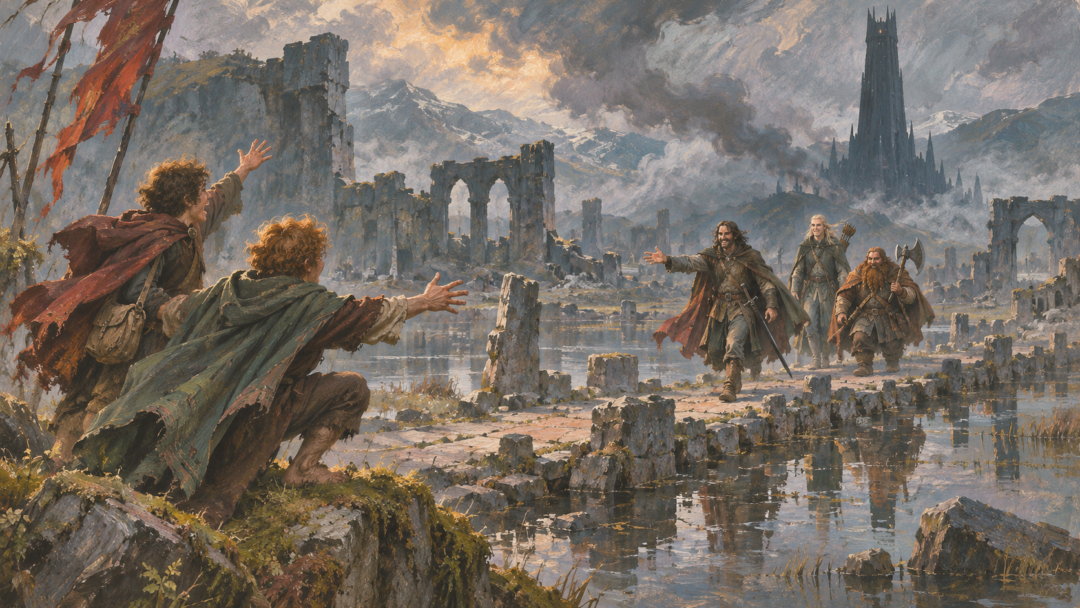
The gates of Isengard have been broken, Saruman's stronghold is half-drowned, and two hobbits are making remarkably good use of the provisions left behind. In the middle of this unlikely reunion, Gimli examines a handful of pipe-weed and Merry greets his reaction with a delighted "My dear Gimli." So yes: someone who isn't a hobbit is addressed as "my dear" in The Lord of the Rings, and the recipient is a Dwarf.
The exchange appears in "Flotsam and Jetsam," Book Three, Chapter 9 of The Two Towers. It is especially easy to overlook because the speaker, Meriadoc Brandybuck, is himself a hobbit. But the question is about the person being addressed, not the person doing the addressing. The wording gives us a clear answer, while the scene around it explains why those two little words sound so natural.
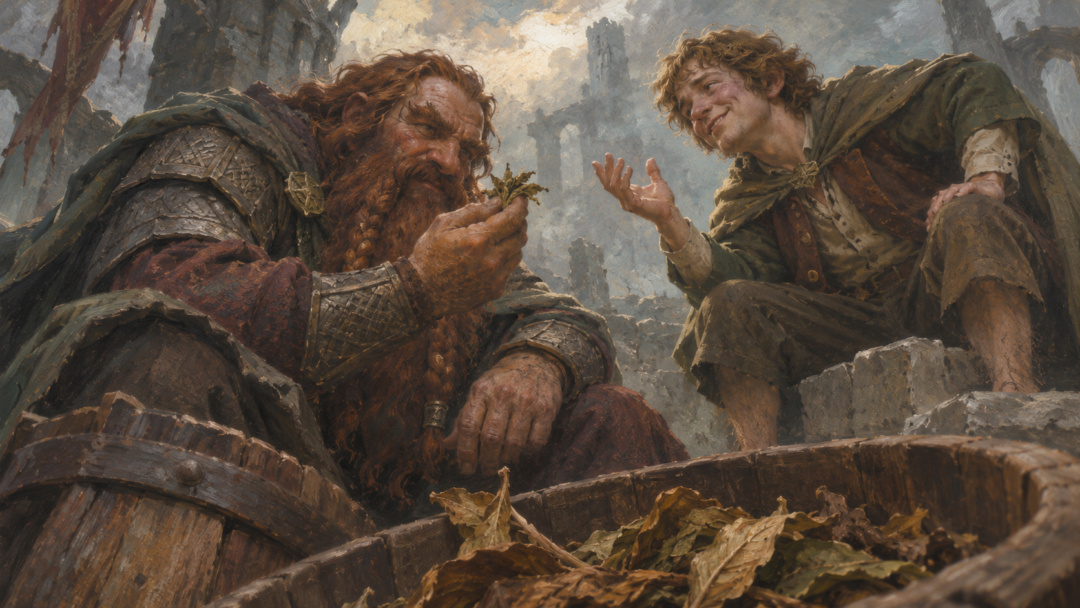
A Dwarf, a hobbit, and a barrel of Longbottom Leaf
Aragorn, Legolas, and Gimli arrive at ruined Isengard after a pursuit that began when Merry and Pippin were carried away by Orcs. The three hunters have followed clues across Rohan, met Gandalf again, and passed through the aftermath of battle. They have reason to fear for their missing companions. Instead, they find the young hobbits alive, unexpectedly comfortable, and ready to receive their friends with food and conversation. The sudden change in atmosphere is part of the pleasure of the chapter.
The destruction surrounding them is real enough. The Ents have risen against Saruman, damaged his works, and flooded the ring of Isengard, leaving Orthanc standing amid the wreckage. Merry and Pippin have seen events the others can scarcely imagine, yet their hospitality is wonderfully ordinary. They lead their visitors to supplies in a guard-house, and the reunion begins to resemble a gathering of friends rather than a military report. They have adventures to recount, but first there is something to eat.
Merry produces pipe-weed that he and Pippin salvaged after the flooding. Pippin found two small barrels washed out of storage, and the leaf inside has survived unspoiled. When Gimli takes some, he rubs it between his hands and smells it, testing what the hobbits are offering. The Dwarf knows enough to appreciate its quality; Merry knows precisely what it is. Suddenly, an unlikely treasure from the Shire becomes the center of everyone's attention.
Merry's response is the decisive line: "My dear Gimli, it is Longbottom Leaf!" He identifies the leaf with an enthusiasm that needs no elaborate explanation. The words address Gimli by name, and they come directly after the Dwarf has inspected the contents of the barrels. This is not a description of someone else's affection for Gimli, or a phrase used about an absent character. It is a spoken greeting embedded in an exchange between two companions.
The spare pipe makes the exchange even warmer
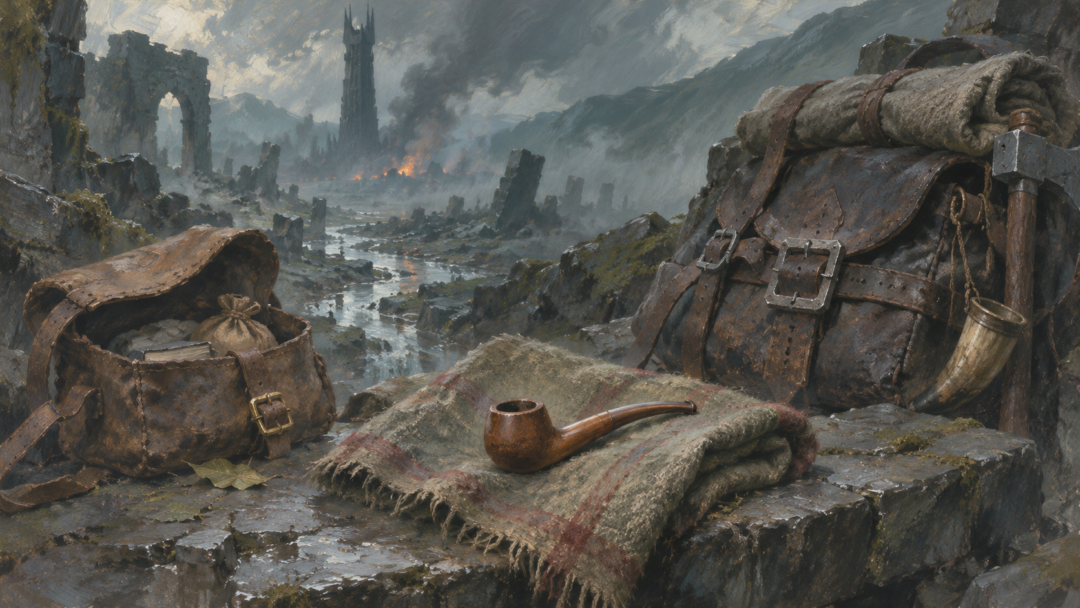
The conversation does not end with the identification of Longbottom Leaf. Gimli points out a practical difficulty: he no longer has a pipe, having lost his own in Moria or perhaps earlier. Merry cannot produce one from their salvage and suggests that friends may have to share. Then Pippin remembers a small possession he has carried throughout the journey. Alongside his old wooden pipe, he has kept an unused one, and he offers that spare to Gimli.
This detail is worth keeping straight. Merry is the hobbit who says "My dear Gimli"; Pippin is the hobbit who provides the extra pipe. The two actions belong to the same friendly scene, but they are not interchangeable. Gimli receives the gift with extravagant gratitude, declaring himself in Pippin's debt. The exchange gives the Dwarf a chance to participate in the comfort Merry has just celebrated, and it turns an ordinary object into a small token of companionship.
Before the telling of adventures resumes, Legolas and Aragorn go outdoors, and the group gathers on the stones by the ruined gateway. The mist is lifting from the valley. Aragorn, exhausted by the pursuit and fighting, can finally sit and listen. It is a wonderfully strange setting for a leisurely conversation: a broken fortress behind them, floodwater and wreckage nearby, and a company of friends trying to recover something like an evening at Bree or Rivendell. Merry's easy address belongs to that temporary pause.
Yet the barrels are not entirely innocent. Their presence so far from the Shire raises questions, and Aragorn later notices the troubling implication that Southfarthing leaf has reached Saruman's stores. A welcome reminder of home may also point to concealed dealings. That shadow gives the scene more depth without changing the nature of Merry's words. At the instant he speaks, he is celebrating recognition and sharing, not explaining the political mystery of how the tobacco arrived.
Gandalf's "my dear" sounds different in Rivendell
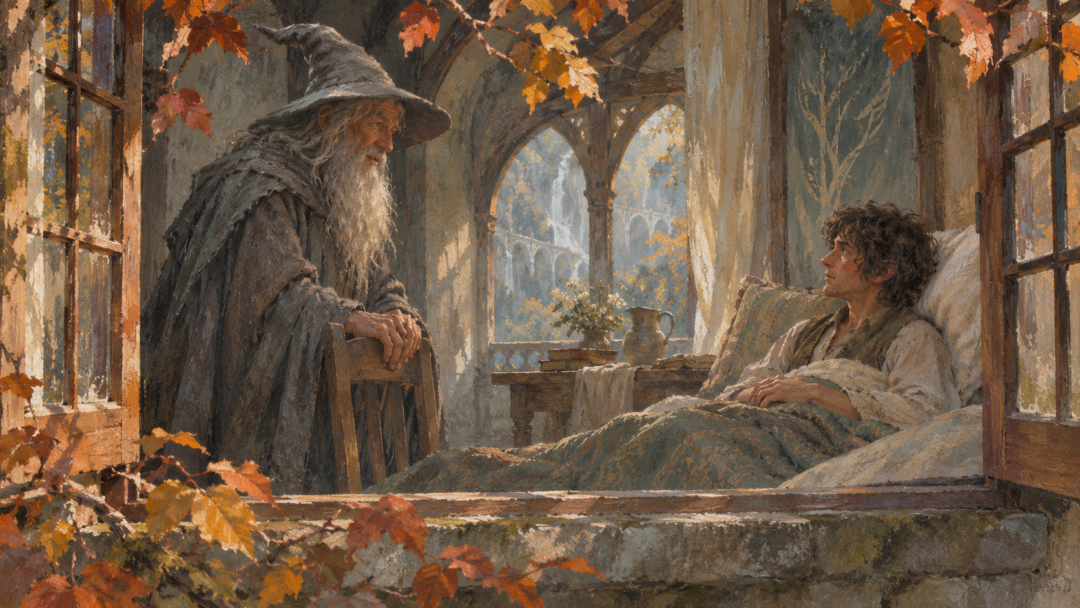
One reason the phrase may seem particularly hobbit-shaped is that Gandalf uses it memorably when speaking to Frodo. In "Many Meetings," the opening chapter of Book Two of The Fellowship of the Ring, Frodo wakes in Rivendell after the ordeal at the Ford of Bruinen. Gandalf is there, answering questions about his friends and the events Frodo can only partly remember. When he speaks of Frodo's strength in surviving earlier dangers, he calls him "my dear hobbit."
This is a very different moment from Merry's delight at Isengard. Frodo is recovering from a wound that came dangerously close to overcoming him, and Gandalf knows more about the peril than Frodo does. His address accompanies both concern and a recognition of Frodo's endurance. The adjective is gentle, but it doesn't make the danger small. Gandalf can sound affectionate while also reminding his friend how narrow their escape has been.
Later in that Rivendell conversation, Frodo struggles to understand who Strider really is. He has known Aragorn as a Ranger and is surprised to discover his connection to the ancient kings. Gandalf answers with "My dear Frodo," then explains that the Rangers preserve the line of the Men of the West in the North. Here the address opens a correction to Frodo's assumption. Gandalf's warmth and his superior knowledge occupy the same sentence; this is the voice of a familiar guide teaching his friend something important.
There is also an earlier moment in "The Shadow of the Past" when Gandalf calls Frodo "My dear Frodo" as the hobbit begins to accept that he may have to leave the Shire to protect it. That setting brings out yet another shade of the expression: surprise and appreciation at Frodo's willingness to face an unwelcome responsibility. These uses need not carry precisely the same feeling. Their common feature is that Gandalf speaks personally to Frodo, not that the phrase has a fixed dramatic meaning.
What counts as being called "my dear"?
The wording of the question matters. To call someone "my dear" is to use the phrase as direct address: the speaker turns to another person, and the words accompany that person's name or a description of them. "My dear Gimli," "my dear hobbit," and "My dear Frodo" all work that way. The noun or name changes, but the grammatical action is the same. Someone is being spoken to, not merely spoken about.
That is different from Frodo saying that Aragorn is dear to him. In Rivendell, Frodo tries to explain his growing affection for the Ranger and reaches for the word "dear" to describe it. It is a significant admission about his feelings, but it is not an instance of Frodo calling Aragorn "my dear." Likewise, an exclamation such as "Dear Bilbo!" may be affectionate without containing the two-word expression under discussion. Treating every appearance of "dear" as equivalent would blur the distinction the question is trying to make.
Nor should the possessive "my" be made to carry too much weight. In these scenes, the phrase is a familiar English form of address, not a claim that its recipient belongs to the speaker. The Isengard exchange gives no reason to read romance, a formal title, or deliberate condescension into Merry's greeting. Friendly enthusiasm is a natural reading because of what he is doing and how Gimli responds. That interpretation rests on the visible conversation, not on a supposed secret code in Middle-earth etiquette.
The evidence also has a useful limit. Merry's line proves that a non-hobbit can receive the address; it does not prove that Gimli is the only such recipient anywhere in the book. Establishing exclusivity would require a systematic check of every occurrence and its context. There is no need to make that much larger claim to answer the original question. A single unmistakable example does the job, and it lets the conversation remain what it is: a lively scene rather than an exercise in counting words.
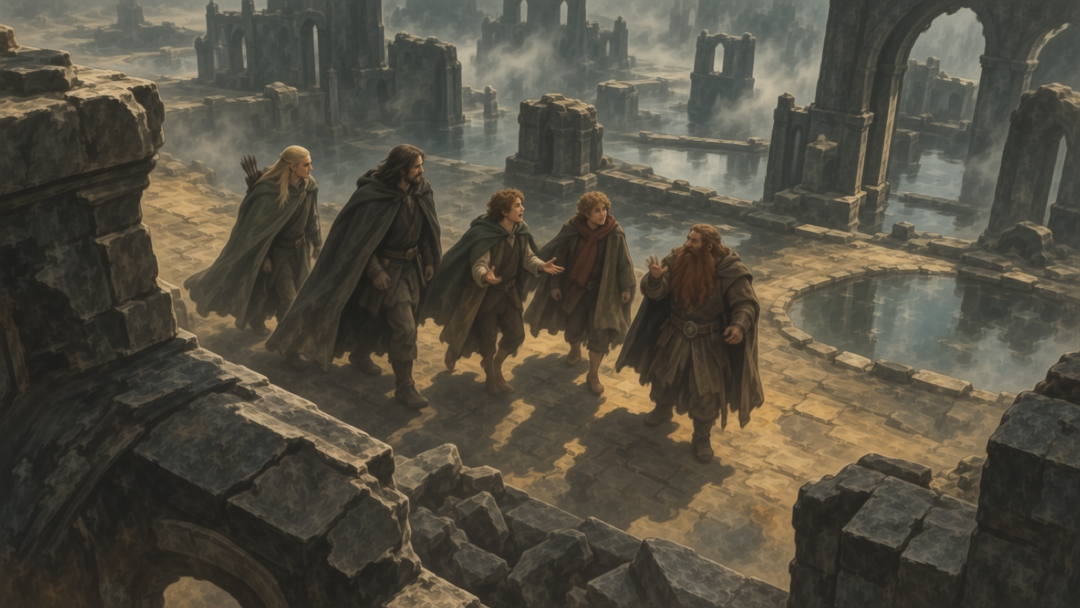
A small kindness in the shadow of Orthanc
The phrase works because its surroundings are so particular. Gimli has walked through Moria, pursued Orcs, and survived the fighting at Helm's Deep; now a hobbit is excitedly telling him about a handful of leaf. Merry has escaped captivity and watched the Ents overthrow a mighty fortress; now he is eager to offer his friends a familiar pleasure. Neither character stops being part of a great war. For a few minutes, though, their attention can rest on something recognizably ordinary.
So the answer is there, in the ruins of Isengard, and it is quite definite: Merry calls Gimli "my dear." The line is easy to miss among battles, revelations, and the great names of Middle-earth. Perhaps that is why it is worth noticing. While Orthanc rises above the wreckage, a hobbit recognizes a bit of home, turns to a Dwarf beside him, and speaks as one friend to another.
Sources & Notes
This article is based on close reading and interpretation of Tolkien's published works and related source material where relevant.