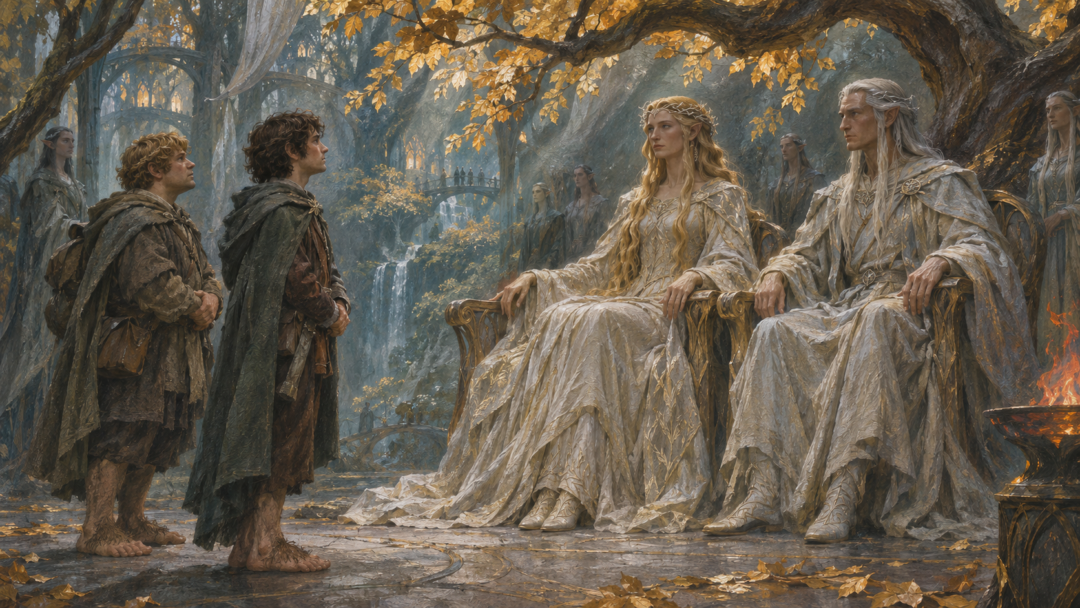
Frodo and his companions climb into the trees of Lothlórien and find two figures seated beneath a living bough: Galadriel, golden-haired, and Celeborn, silver-haired. Both are strikingly tall, and the Lady is no shorter than the Lord. For hobbits accustomed to people barely three or four feet high, the difference is striking. Yet the story offers no measuring stick beside their chairs.
So how tall are Middle-earth Elves? Late descriptions put adult male Eldar at least six feet six inches (1.98 metres), while Eldarin women are seldom below six feet (1.83 metres). Another passage places the normal height of certain Eldar, especially the Noldor, around seven feet (2.13 metres). Galadriel has an unusually specific estimate: roughly six feet four inches (1.93 metres). These are descriptions of particular groups, not every Elf.
Where the six-and-a-half-foot figure comes from
One of the clearest accounts appears in the material collected in The Nature of Middle-earth, in its discussion of Elvish heights. It describes the Quendi, the Elves as a people, as originally tall. Within that people, the Eldar who undertook the Great Journey westward were remembered as generally stronger and taller than the Elves who stayed behind. Its figures are Eldarin tradition, not population measurements.
That tradition puts grown Eldarin men at no less than six and a half feet, with some great kings and leaders taller still. Eldarin women were seldom under six feet. Both figures would give an Elf an imposing presence beside many humans. But seldom permits exceptions, and the tradition concerns the Eldar. It does not establish an immutable minimum for every Elf ever born.
A second late text, Of Dwarves and Men, published in The Peoples of Middle-earth, approaches the question by way of hobbits. It explains their name, Halflings, against the stature of Númenórean-descended Men and the Eldar, particularly those of Noldorin descent, whose normal height appears to have been around seven feet. That is a useful indication of scale, but not a census. It compares peoples; seven feet is not the exact height of each Noldo, nor does it resolve all the other estimates.
Galadriel and the meaning of man-high
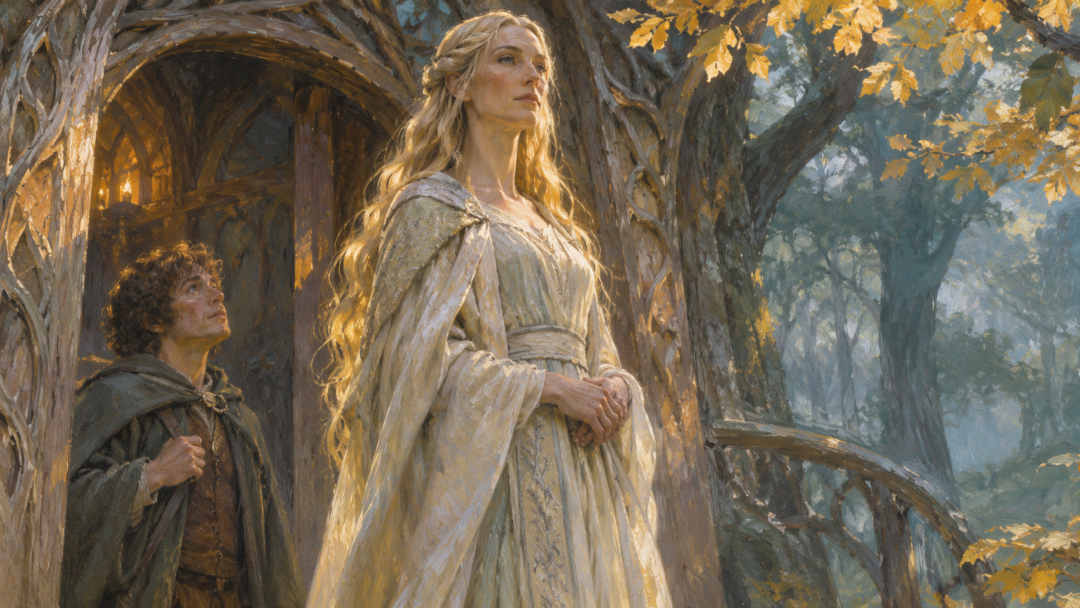
Galadriel gives us a rare opportunity to attach an approximate number to a named Elf. In an appendix on Númenórean measures in Unfinished Tales, she is described as man-high according to the reckoning of the Dúnedain and the Men of old. The relevant unit, the ranga, measured thirty-eight inches; two rangar therefore made six feet four inches. That is the basis for Galadriel's commonly quoted height.
There is an easy trap here. Man-high does not mean the height of an average man walking down a modern street. It is an approximate term from the measuring system of a tall people. The note also identifies Galadriel as exceptionally tall among the Eldarin women remembered in the tales. The estimate gives no reason to round her up to seven feet because another text uses that figure for some Eldar.
The scene in The Fellowship of the Ring supports the impression without providing a separate figure. In Celeborn's hall, the narrator makes a point of their comparable stature, placing them together in dignity rather than turning Galadriel into a smaller figure beside her husband. It would be reasonable to imagine Celeborn as similarly tall in that encounter, but the description is not a measurement of him. One character has a numerical estimate; both share a vivid comparison in the novel.
What a hobbit sees when an Elf approaches
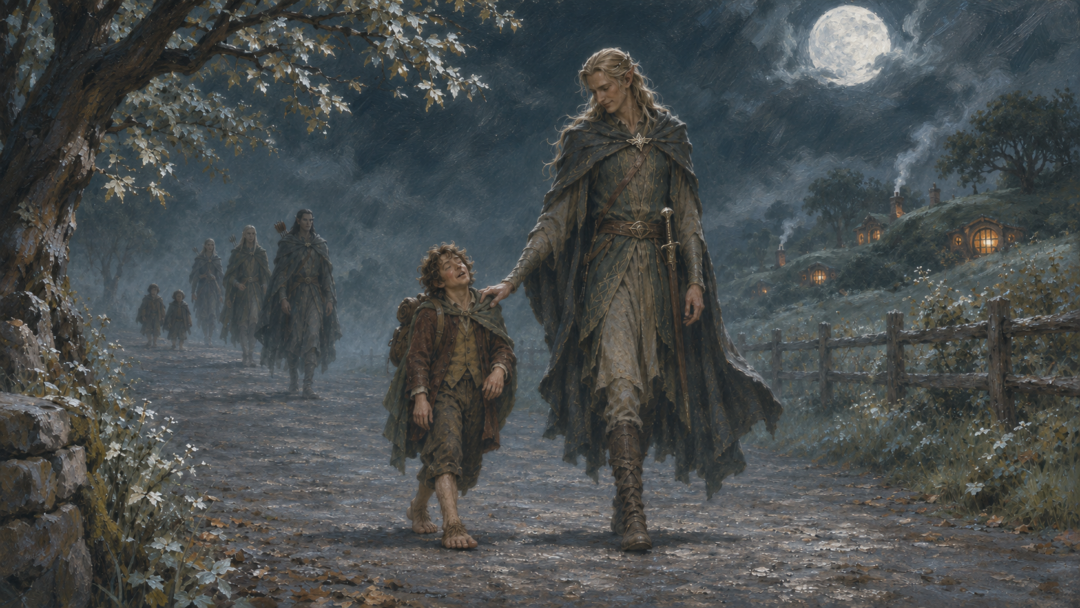
Long before the Fellowship reaches Lórien, a small encounter on a road in the Shire shows what Elvish height means in practice. Frodo, Sam and Pippin travel for a time with Gildor's company. Pippin grows sleepy and stumbles as they walk, and a tall Elf beside him reaches out to keep him from falling. The easy gesture conveys their difference in size, while the Elf's kindness makes the encounter reassuring rather than intimidating.
The comparison is especially vivid because the book's prologue describes hobbits as generally between two and four feet tall. Beside a six-and-a-half-foot traveler, such a person could seem very small indeed. That helps explain why even an unremarkable Elf might strike a hobbit as grand. The story's visual scale depends on viewpoint, not a ledger of measurements.
Legolas offers another instructive case. A description outside the main narrative likens his tall, lithe build to a young tree, while the story repeatedly shows his remarkable lightness of movement, most memorably when the Fellowship struggles across the snow on Caradhras. We can picture an agile, long-limbed Elf without assigning him an exact number of inches. Tall humans such as Aragorn and the Númenóreans rule out the notion that every Elf towers over every Man. Middle-earth has overlapping kinds of stature.
Not every Elf belongs to the same group
The names for Elvish peoples matter here because they identify whom the descriptions actually concern. Quendi is the broad name for the Elves. Eldar refers to those who accepted the summons to journey west from the place of their awakening; Avari refers to those who refused. Some Eldar completed the journey to Aman, while others, including ancestors of important Middle-earth communities, did not. So Eldar does not simply mean an Elf who lived in the Blessed Realm.
Among the Eldar were the Vanyar, Noldor and Teleri, with the latter people's history leading to groups including the Sindar and the woodland Elves. The roughly seven-foot remark singles out Noldorin descent in particular. That figure cannot set the height of every woodland archer, sailor or craftsman. The texts offer broad descriptions, not heights by community, region and age.
The Avari are especially easy to overlook. The late height account suggests that the Eldar were, in general, taller than those who did not join the Great Journey at the time of the separation. That offers a relative comparison, not a measured Avarian range. Their history is sparse in the western narratives, making any average a guess. Ancestry cannot reliably tell us any unnamed Elf's height.
Thingol: tall beyond an ordinary comparison
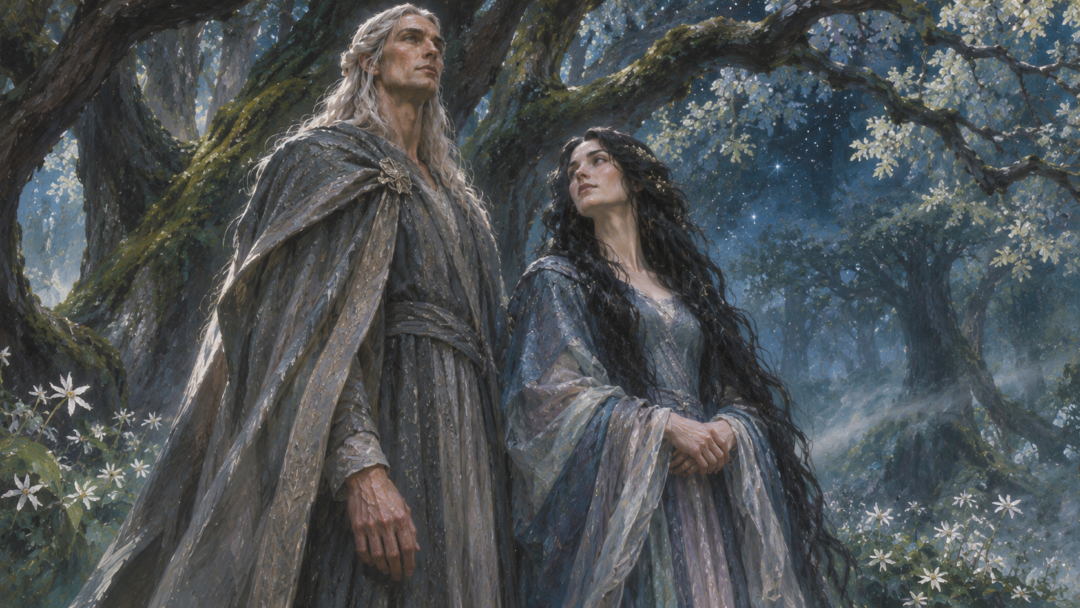
If Galadriel supplies the most helpful approximate height for a familiar individual, Thingol supplies the grandest claim. In The Silmarillion, the silver-haired King of Doriath is called the tallest of the Children of Ilúvatar. His extraordinary stature belongs to the account of his meeting with Melian and his return to his people, when his presence seems greater and more majestic than before. He stands out even among exceptionally tall Elves.
What they do not supply is a measurement. Thingol is sometimes assigned heights of eight or nine feet in discussions and illustrations, but neither number follows directly from that description. Calling him the tallest cannot be translated into inches without knowing the measured heights of everyone with whom he is being compared. Comparisons with tall Númenórean kings cannot turn a superlative into a measurement. His greatness is explicitly part of the portrait; a numerical value is not.
There are other famous tall Elves, too. Maedhros carries the epithet the Tall, and Turgon is given an exceptional ranking in another account, second only to Thingol. Such descriptions reveal how stature can distinguish an individual within an already tall people. They appear in different writings, whose exceptional-height rankings do not always agree. The sensible reading preserves the clear point—that these figures stand out—without inventing a reconciled list from tallest to shortest.
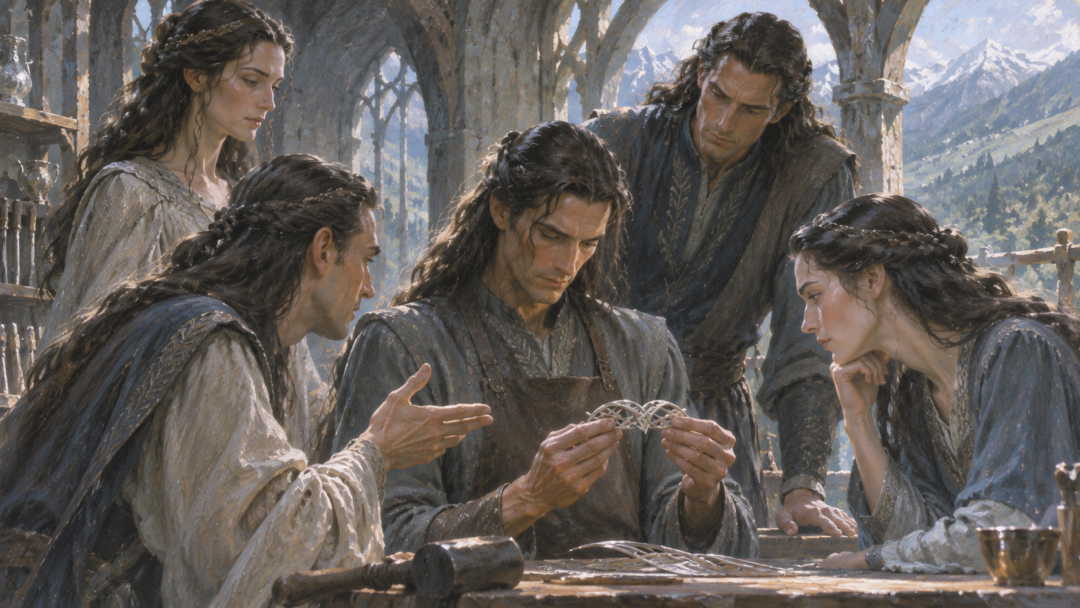
Why Elves sometimes look smaller or larger
Part of the confusion comes from the long history of the Elves as a literary creation. Early poems drew at times on the imagery of tiny fairies, and The Book of Lost Tales contains a small, mysterious cottage that initially seems to demand a visitor shrink before entering. These reflect the stories' evolving fairy-tale atmosphere. They are not evidence that an Elf alive in the Third Age once had the body of a miniature sprite and subsequently grew into a seven-foot warrior.
The opposite impression can also be misleading. When Frodo offers Galadriel the Ring beside her Mirror, he sees a terrifying vision of what she could become if she accepted it. She seems immense, almost beyond ordinary reckoning. That scene is about temptation and the perception of power; it is not a record of Galadriel physically adding feet to her height. A figure who appears overwhelming in a vision need not be taller than the same person who stood beside Celeborn under the trees.
Modern adaptations introduce yet another scale. Camera angles, casting, costumes and fan art can make Elves appear anywhere from human-sized to impossibly lofty. Those are creative interpretations, not measurements preserved in the books. The books offer something more interesting than a uniform template: tall travelers who can steady a tired hobbit, a queen whose stature has an old unit attached to it, and a king whose height remains unnumbered.
The clearest answer, then, is that many Eldarin men are described at around six and a half feet or taller, Eldarin women are seldom under six feet, and some Noldorin Eldar are placed near seven. But picture the Shire road rather than a ruler: Pippin nodding with exhaustion, a tall Elf reaching out before he falls, and a difference in height revealed through a simple act of care.
Sources & Notes
This article is based on close reading and interpretation of Tolkien's published works and related source material where relevant.