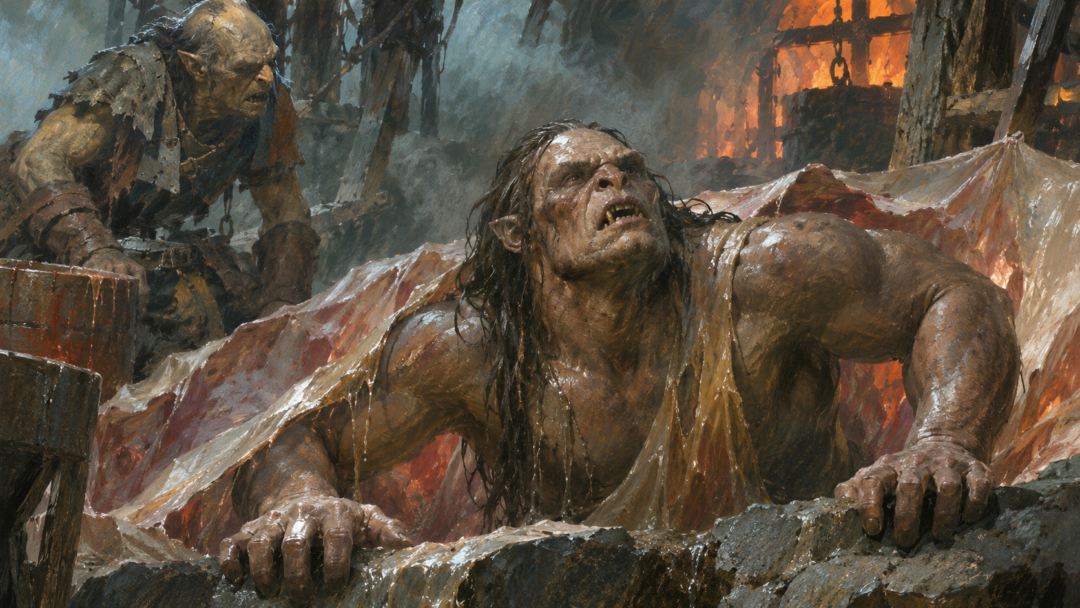
Below Isengard, the furnaces roar, Orcs hammer weapons, and a hulking figure pulls free of a wet membrane. Saruman watches as Lurtz rises to face him. It is one of the strangest images in The Fellowship of the Ring: a warrior apparently entering the world already built for war. But what exactly has happened? Is Lurtz an adult in every sense, or does he still have to learn how to move, speak, and fight?
The film's screenplay supports a narrow but striking answer. Lurtz emerges with adult-like proportions and can stand immediately; later scenes show him speaking, taking command, and fighting. They do not establish that he possessed a lifetime's knowledge at birth, or that he learned essential skills in a matter of minutes. The books present a different picture of Saruman's forces, without the membrane scene at all. Keeping those two versions separate is the key to the mystery.
What the emergence scene really shows
The screenplay reproduction for The Fellowship of the Ring sets the moment amid the industrial activity beneath Isengard. Trees feed the fires, metal is worked into weapons, and Saruman inspects the creatures being produced there. Its description calls Lurtz a "new born URUK-HAI as it escapes its birthing membrane … this is LURTZ, who rises up to stand before his master." That is unusually direct evidence for two things: the scene regards him as newly born, and he can already get to his feet.
He is no helpless infant in the ordinary human sense. The emerging figure has the size and bearing of a formidable Orc warrior, rather than the proportions of a baby requiring years of growth before standing. That visual choice makes Saruman's operation disturbing: it looks less like a nursery than a forge turning out weapons. Still, a standing body tells us little about everything inside the head controlling it. Balance and strength are visible; memories and understanding are not.
Notice, too, what the description does not supply. It gives no gestation period, no account of how Lurtz developed within the membrane, and no explanation of what Saruman or the supervising Orcs might have done beforehand. It does not show the first attempt to walk or a lesson in holding a sword. The word "newborn" marks his emergence in the scene, but it is not a biological report establishing how old his body is or how his mind works.
Speaking and fighting are later evidence, not a birth certificate
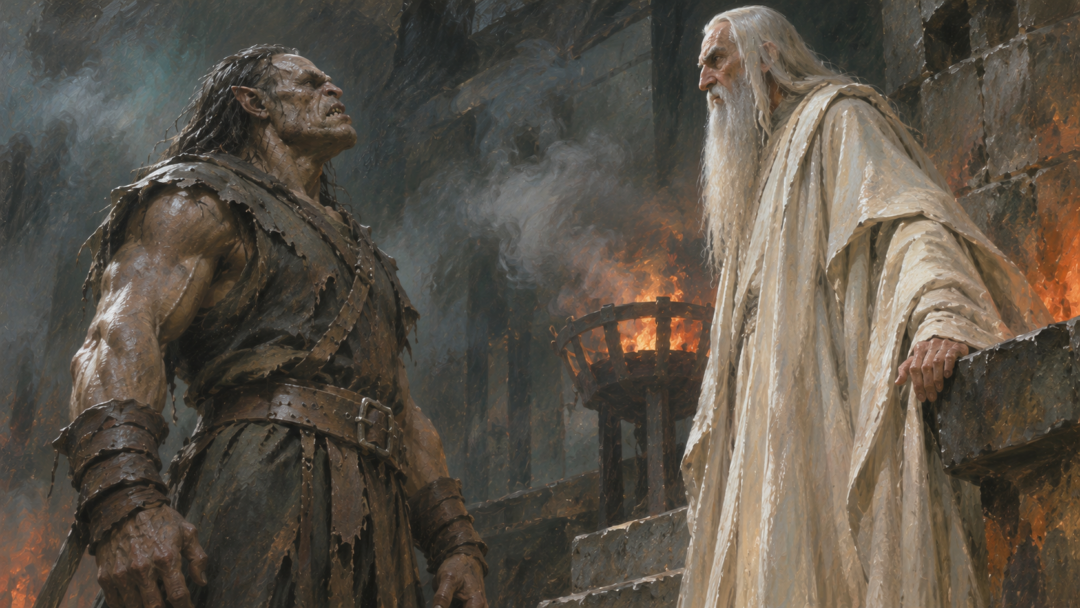
Another screenplay scene places Lurtz with Saruman in Orthanc. His eyes follow the wizard, and the description attributes intelligence to his expression. When Saruman asks whom he serves, Lurtz answers with his master's name. This establishes more than physical coordination by that point: Lurtz can respond meaningfully to a question and recognizes the authority confronting him. It does not reveal whether he understood language while still enclosed, acquired it afterward, or had it by some unexplained means.
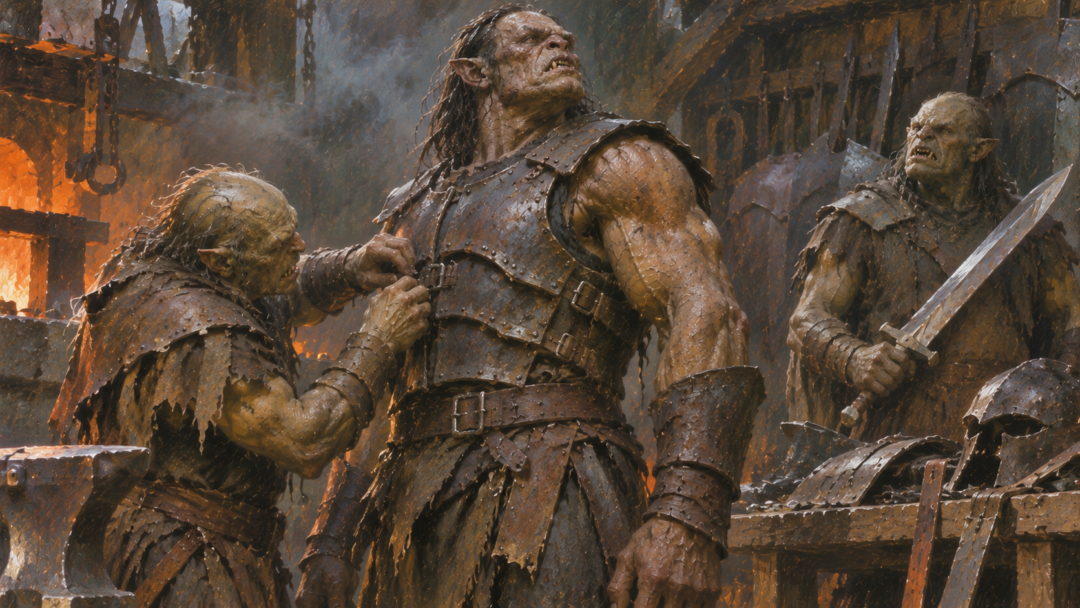
The screenplay then moves to the equipment of a soldier. In quick cuts, Lurtz receives armor, leg protection, a helmet, and a sword. Other Uruk-hai mark themselves with the White Hand. The sequence is easy to mistake for an instant conversion from birth to battle, especially because its images belong to the same grim machinery of Isengard. But being dressed and armed is not identical to being trained. Someone can place a weapon in a strong hand without showing us when that hand learned to use it.
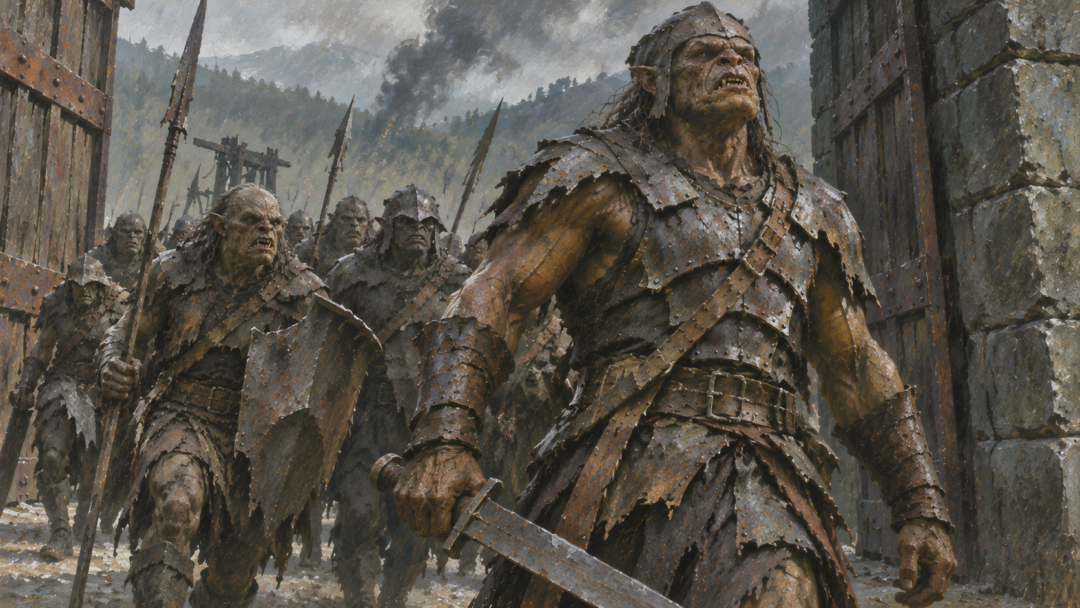
There is an important piece of collective evidence as well. The script describes Saruman addressing a crowd of armed Uruk-hai and ordering them to hunt the Fellowship. Shortly afterward Lurtz leads troops out of Isengard at speed. These are organized soldiers performing a mission, not confused creatures struggling with their bodies. The description gives a figure of 200 for that particular formation; it is not a census of Saruman's entire army, nor a statement that every soldier in sight emerged from a membrane together.
At Amon Hen, the screenplay gives Lurtz still more recognizable military behavior. He directs his followers in the search for the hobbits, uses a bow against Boromir, and fights Aragorn. Those actions are persuasive evidence of competence by the time of the attack. They cannot be carried backward unchanged to the instant of emergence. We know what Lurtz eventually does; we are not given an uninterrupted record of his development from his first breath to his final battle.
The missing hours inside Isengard
Film storytelling makes separate events feel close by placing them close on screen. Lurtz's emergence, his encounter with Saruman, his arming, and the departure of the hunting party belong to a clear narrative progression. Yet the screenplay also cuts away to the Fellowship's journey between Isengard sequences. A cut can conceal travel, preparation, or an unspecified interval. It cannot serve as a clock that proves all these events occurred in one afternoon.
That distinction changes the proposed crash course in basic functions. If the Uruk-hai had to learn walking, speech, obedience, and combat from scratch, we might expect evidence of instruction, repeated attempts, or mistakes. The supplied screenplay descriptions offer none. Their silence does not prove there was no learning; it simply means a rapid learning program is not something we can report as an established part of the story. An unseen training period remains possible, but unmeasured.
The opposite theory has the same problem. Nothing in these passages describes Saruman transferring memories, magically installing language, or giving his warriors complete combat knowledge upon emergence. His powers and experiments make that an imaginable fantasy explanation, not a documented one. In particular, responding with Saruman's name later is not proof that Lurtz knew it at the moment the membrane tore. The most responsible answer resists filling every blank with a new kind of magic.
In the books, Saruman did not invent Uruks overnight
Turn from the film to The Lord of the Rings, and the premise shifts. Tolkien's narrative does not depict Lurtz's birth; Lurtz is a film character, and there is no canonical book scene of grown Uruk-hai being pulled from muddy pits. The memorable membrane imagery belongs to the adaptation's presentation of Isengard. Reading it backward into the novels would turn a cinematic answer to "how do we show this army?" into a claim about the entire history of Orc reproduction.
Appendix B dates the appearance of fierce Uruks out of Mordor to the year 2475 of the Third Age, when they attacked Osgiliath. That is centuries before Saruman's war against Rohan. Appendix F also associates the great soldier-Orcs called Uruks with both Mordor and Isengard. Saruman may breed and improve his own forces, but he is not the first being to bring large fighting Orcs into Middle-earth. The historical background already rules out a single origin event involving Saruman and a pit beneath Orthanc.
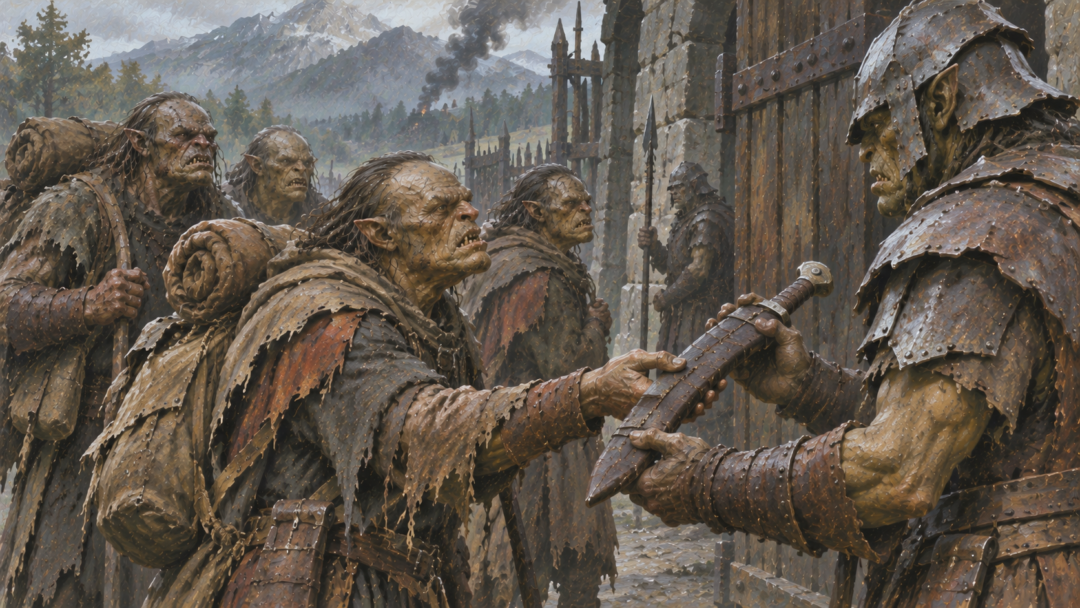
The chapters following Merry and Pippin's capture offer something more useful than an origin diagram: Orcs behaving as soldiers. Uglúk commands the Isengard contingent, disputes authority with Orcs connected to Mordor, assigns guards, keeps his captives moving, and pushes his troop through daylight. His company contains individuals capable of taking orders, arguing, forming loyalties, and making tactical decisions. These are lived-in military behaviors, not the confused reactions of creatures encountering speech or marching for the first time.
Uglúk's confidence, however, cannot tell us how quickly he grew up. Even his ability to operate in sunlight settles a different question. Saruman's Uruk-hai are notable for enduring daytime travel better than many other Orcs, but that does not prove they reached adult size instantaneously or underwent intensive training to resist the sun. Physical tolerance, bodily development, and learned military skill are three different properties. The text gives evidence for some of their capabilities, not a timeline explaining their acquisition.
Breeding an army is not the same as assembling one
Saruman's servants are not a single interchangeable category. The books describe strong Isengard Uruks, other Orcs, and troubling Orc-like Men or Man-like Orcs. Treebeard wonders about Saruman's breeding, while the defenders at Helm's Deep speak of half-orcs and goblin-men. Tolkien's later writing explicitly describes Saruman interbreeding Orcs and Men. Those details suggest ugly experimentation, but they do not authorize labeling every White Hand soldier a half-orc, or treating every account of their origin as a completely settled biological scheme.
This is relevant because "Saruman created them" can hide several different actions. Breeding a population, recruiting existing Orcs, supplying weapons, and drilling or directing an army are not equivalent. Isengard has smiths, overseers, leaders, and troops with recognizable divisions of labor. The books give Saruman an established military apparatus; the film's furnaces make that apparatus visible and frightening. Neither version requires every fighter to have begun life immediately before receiving orders to march.
Peter Jackson offered a revealing explanation for Lurtz in an interview with Creative Screenwriting. The filmmakers wanted a recognizable leader of the Orc band pursuing the Fellowship, making the threat personal when the story reached its climax. That is useful first-person evidence for Lurtz's dramatic role: instead of an anonymous attacker, the audience can recognize a particular enemy when Boromir falls. Jackson's explanation does not specify how Lurtz's brain developed or how long he spent learning to fight.
So the most vivid detail remains the simplest one: Lurtz rises from the membrane and faces Saruman. Behind that image stands a whole machine of furnaces, weapons, commands, and marching soldiers, much of whose inner working is deliberately unseen. The emergence tells us he is physically ready to stand; the later hunt shows a capable warrior. The space between those moments is where the mystery lives—and where neither film screenplay nor book gives us a stopwatch.
Sources & Notes
This article is based on close reading and interpretation of Tolkien's published works and related source material where relevant.