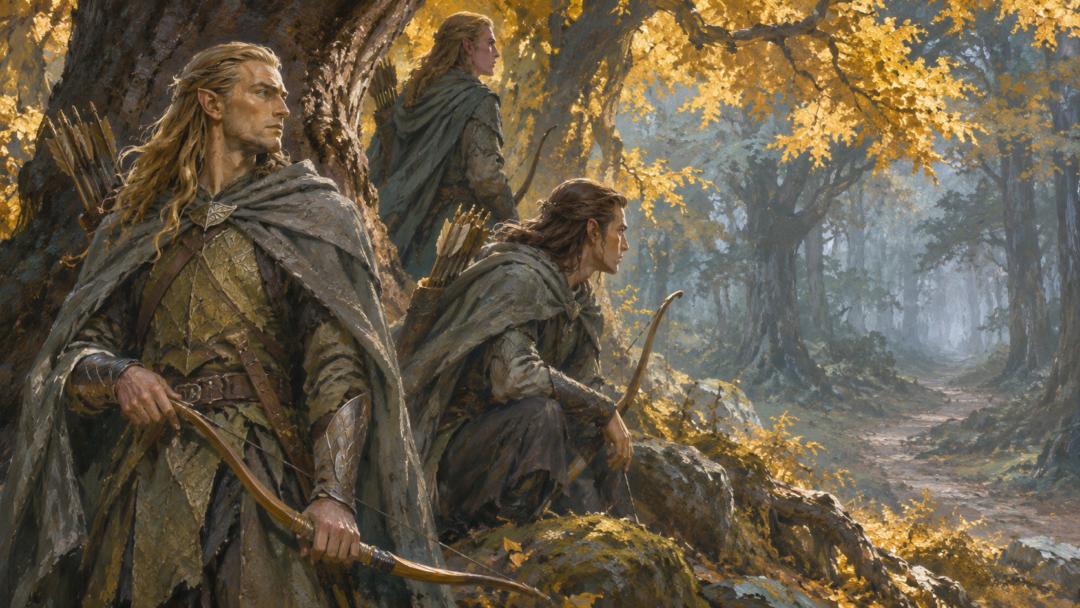
Boromir blows his great horn among the trees near Parth Galen, but no company of Elven archers comes to his rescue. Orcs carry off Merry and Pippin, and Aragorn reaches Boromir only after the fighting has done its worst. The travellers had recently found shelter in one of Middle-earth's strongest Elven realms. If Lothlórien had warriors, scouts and leaders who understood the danger, why were none there when the Fellowship needed them?
The books offer no account of Galadriel or Celeborn refusing to send help. In fact, Lórien's defenders had already fought Orcs pursuing the Company. The fatal attack took place later, beyond their guarded territory, after the Fellowship had travelled down the Anduin and become separated. That is the distinction the story gives us, rather than a secret decision to stand aside.
The Elves had already fought the Fellowship's pursuers
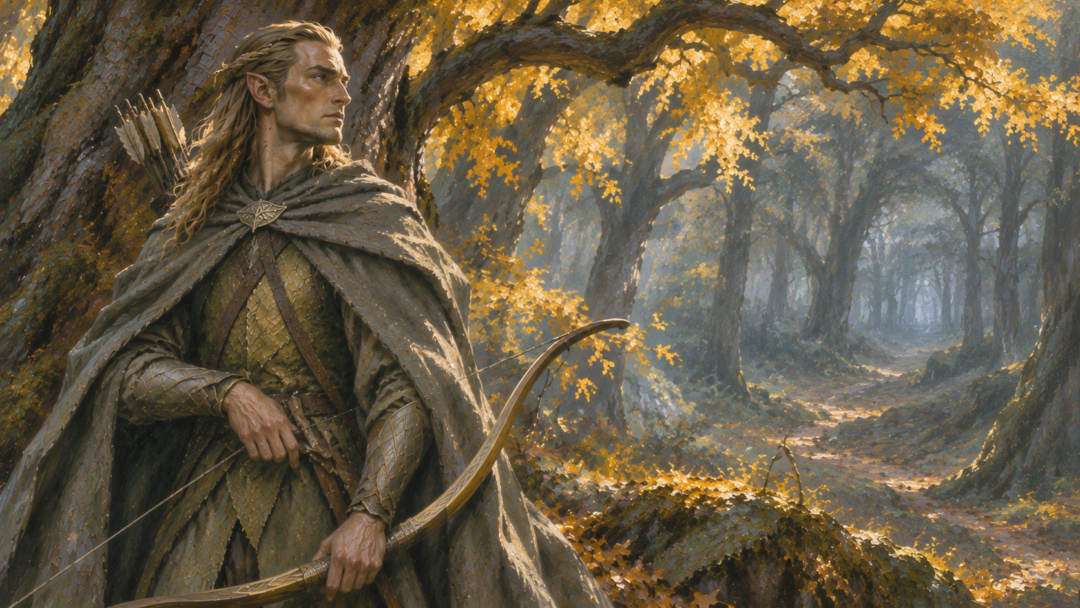
When the Fellowship escaped Moria, it did not enter an undefended woodland. Haldir and his brothers Rúmil and Orophin were watching the northern approaches to Lothlórien. They identified strangers and watched for enemies emerging from the mountains. The companions met them after Gandalf's fall, with pursuit close behind. During their first night in the trees, Orcs passed below the platforms where the travellers rested, and the wardens drew the pursuers away. The trees offered refuge, but those posted among them were soldiers on active watch, not merely guides welcoming visitors.
That watch soon became a fight. Orcs from the direction of Moria pursued the travellers into the region, and the Elven wardens dealt with them. In the chapter "Lothlórien," Haldir reports that a body of Elves had moved towards the northern borders against a possible attack. The pursuing Orcs had been intercepted; almost all were destroyed, and those remaining had fled back westward with Elves pursuing them. The account also describes the wardens drawing Orcs into a trap. This was military assistance, not an unfulfilled promise.
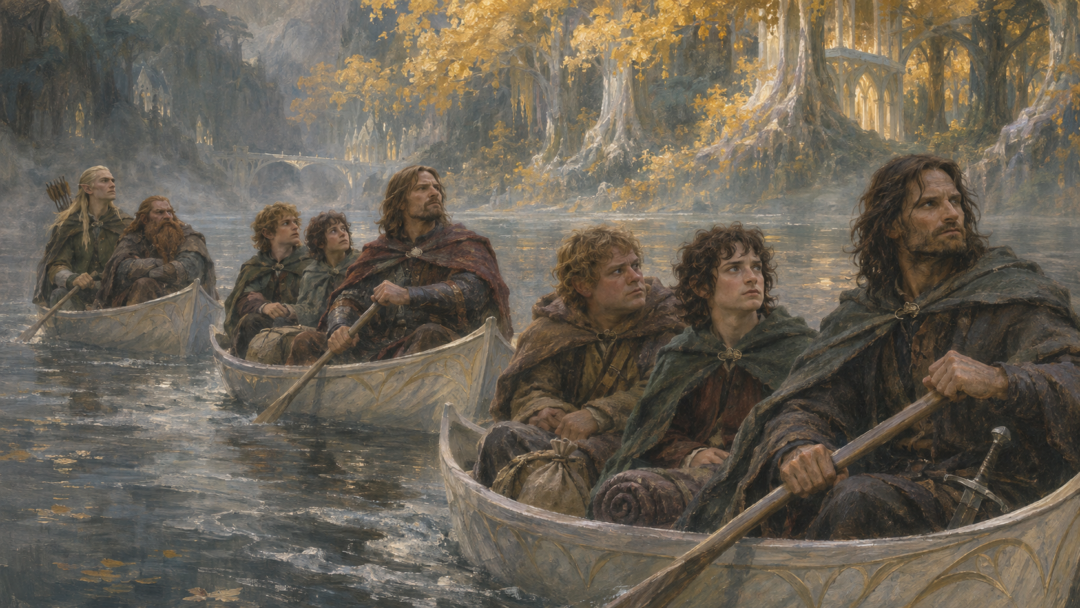
It matters which encounter we are talking about. The Orcs beaten near Lórien were pursuers from the mountains, while the Uruk-hai who later overwhelmed Boromir were encountered farther down the river. These were not one battle with Elven spectators nearby. While the Fellowship remained in Lórien, it received shelter, provisions and the chance to recover from Moria. At its departure, the Company received boats, cloaks and food. The Galadhrim helped the travellers survive and continue, even though they did not join the quest as an escort.
Lórien was a refuge with a dangerous frontier
Haldir makes the realm's caution plain. He acknowledges that the Elves place little trust in the world outside their borders, with Rivendell a possible exception, because misplaced trust could endanger their own land. That is an explanation of their guarded outlook, not a declaration that outsiders deserve no protection. The Fellowship proves the difference: the strangers were admitted, and the dispute over Gimli's passage was overcome. At first Gimli had to be blindfolded; Aragorn insisted that the whole Company share the restriction rather than single out the Dwarf. Later the blindfolds were removed. Lórien's people could be wary without being indifferent.
The geography gave that caution a practical purpose. Moria lay beyond the western approaches, and Dol Guldur, a stronghold of the Enemy, threatened from across the Anduin. Haldir's work as a marchwarden meant more than excluding visitors. He and the other guards had to notice movement, manage crossings and defend a realm that could not assume the surrounding lands were friendly. The earlier defeat of the pursuing Orcs shows what that posture looked like in action: observation followed by a strike when danger approached.
Sending a sizeable armed company far beyond these approaches might have risked the forest's security. But the narrative never says that Galadriel weighed such an expedition and rejected it, or that a particular number of soldiers had to remain at home. Lothlórien was not sealed behind a barrier that prevented Elves from leaving. Its people simply had responsibilities of their own, and no recorded arrangement required their border-wardens to follow the Fellowship downriver.
The battle at Parth Galen unfolded very differently
The Company left Lórien on 16 February 3019 and travelled south by boat. On 25 February it passed the towering Argonath and camped at Parth Galen, a grassy area on the western bank of the Anduin near the Falls of Rauros. By then the travellers were outside the woodland where Haldir's people had sheltered them. On 26 February, according to the chronology in Appendix B of The Lord of the Rings, Boromir was killed and the Fellowship was broken. It was an uncertain stopping place, not a watched approach to Lórien.
The crisis began within the Company itself. The Company faced a choice between Minas Tirith and Mordor. Frodo withdrew to think about his decision. Boromir found him alone and, overcome by his desire to use the Ring, tried to take it. Frodo escaped by putting the Ring on. When Boromir returned, the others rushed out in different directions looking for Frodo, scattering the group before the Orc attack.
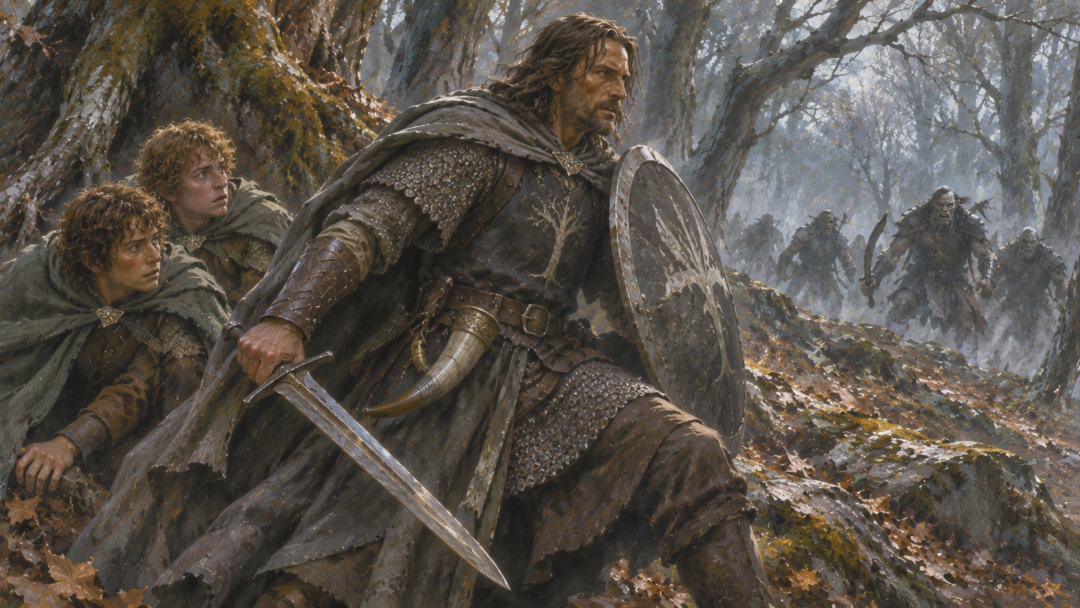
Aragorn sent Boromir after Merry and Pippin. As the two hobbits were threatened, Boromir fought to protect them, killing enemies before arrows brought him down. His horn sounded through the woods; Aragorn heard it and hurried towards the noise, but the calls ended before he arrived. Legolas and Gimli were also away from the place where Boromir made his stand, hunting Orcs elsewhere in the trees. Legolas carried the bow Galadriel had given him, a reminder that Lórien's help continued with the Company even without its soldiers. Even the nearby companions could not all defend Boromir.
When Aragorn found Boromir, the warrior was mortally wounded, his sword broken and enemies lying dead around him. Merry and Pippin had been captured. The Orc force included warriors serving Saruman, whose signs the surviving companions discovered among the dead; the wider pursuit also involved Orcs with differing masters and aims. Meanwhile Frodo and Sam crossed the river to continue towards Mordor. Aragorn, Legolas and Gimli chose to pursue the captors rather than abandon the two hobbits. Those choices set their different journeys in motion.
Could an Elven rescue force have reached them?
Imagine Galadhrim archers travelling with the boats or guarding the Company at a distance. Such an escort might have changed the struggle at Parth Galen. But that is a counterfactual, not a missing episode. No text establishes that a Lórien patrol had been assigned to trail the Fellowship, that messengers were reporting its position, or that armed Elves were waiting within reach of Rauros. The farewell in Lórien sends the companions onward with help for their journey, not with a military detachment.
Nor do we have an account of an advance warning reaching Galadriel. Her power and knowledge do not establish awareness of every encounter as it happens. Frodo's experience at Amon Hen involves extraordinary perception and a struggle against the searching Eye; it does not establish that Lórien's rulers knew Boromir was about to be attacked. Claiming that they deliberately ignored the danger would require information the book does not provide.
There is an especially sobering measure of how quickly things happened: Aragorn was close enough to hear Boromir's horn and still arrived too late. That does not let us calculate how long an Elven force would have taken to arrive from Lórien, and the book supplies no such timetable. It shows that even a nearby companion could not reach the fight in time. The absence of Galadhrim at the clearing is therefore not evidence, by itself, of a refused request for rescue.
Lothlórien fought its own part of the War of the Ring
The later history of the war puts the woodland's soldiers in sharper focus. Forces from Dol Guldur attacked Lothlórien on 11, 15 and 22 March 3019. The fighting damaged the outer woods, but the Galadhrim resisted and the assaults failed. Their opponents were no hypothetical threat. The threat across the river became a series of direct attacks on the realm, met by Elven defenders who held their ground.
Those dates must be handled carefully. All three assaults happened after Boromir's death on 26 February. It would be wrong to say that Lórien's army could not help at Parth Galen because it was already fighting the battles of March. What the later fighting establishes is the kind of strategic danger that surrounded the realm, and how real its military role became as the war widened. It explains the defensive outlook, not a retroactive order for February.
After Sauron's fall, Celeborn led Elven forces across the Anduin against Dol Guldur, and Galadriel laid bare its stronghold. This was action well beyond simple border patrols. The people of Lothlórien could fight, advance and help remove a major centre of the Enemy's power when events permitted. As the Fellowship's survivors took different roads, others were fighting beyond the view of the central quest.
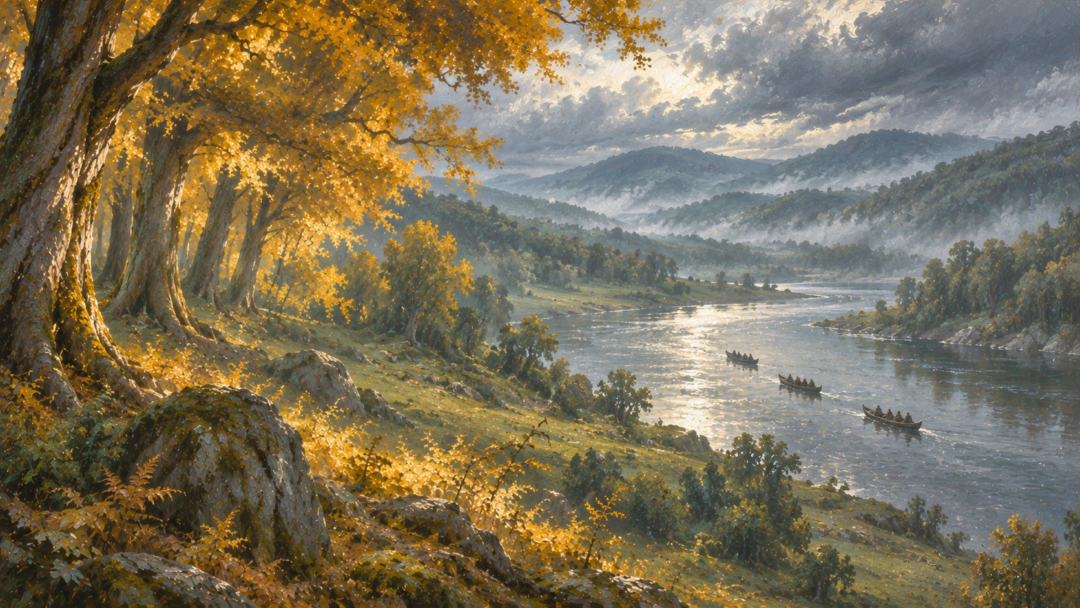
What the Helm's Deep film scene changes
Part of the question may come from remembering Haldir and a contingent of Elven archers arriving at Helm's Deep in the 2002 film The Two Towers. It shows Lothlórien aiding another people in battle. If those archers can arrive for the defence of Rohan, it is natural to wonder why none appeared when Boromir needed them. But the scene belongs to the film adaptation, not to the events of the book.
In the novel, Haldir does not lead a relief force to Helm's Deep, and his film fate is not part of his recorded literary story. Legolas fights there alongside Aragorn and Gimli, but he is a member of the Fellowship from the Woodland Realm, not a Galadhrim commander dispatched by Galadriel. The film's addition cannot establish what Lórien's rulers knew about Parth Galen, or what orders they issued. Blending these versions creates expectations the book never sets up.
At Parth Galen, the sound that went unanswered was Boromir's horn, not a summons that Lórien is known to have received. Far upstream, the golden wood had already been defended by Elves who drove back the Fellowship's pursuers. Farther south, a scattered handful of companions faced another attack, and the help that might have saved Boromir was beyond their reach in the story we have. The tragedy lies in that separation, not in a demonstrated act of abandonment.
Sources & Notes
This article is based on close reading and interpretation of Tolkien's published works and related source material where relevant.