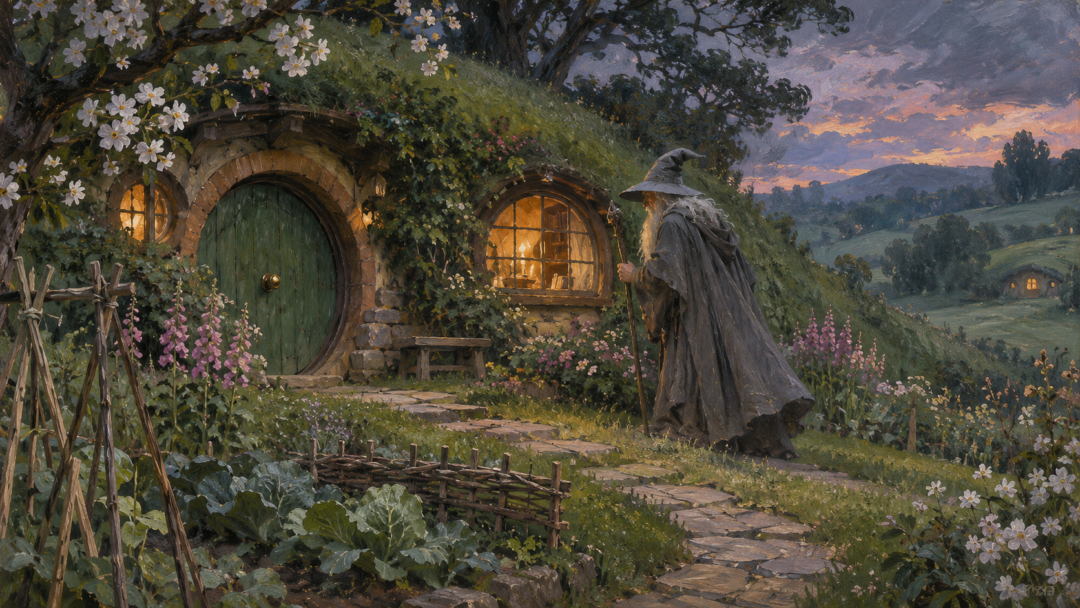
The spring light is pouring through Bag End’s study window, a fire is burning on the hearth, and Sam Gamgee is busy in the garden outside. Inside, Gandalf is about to explain why Bilbo’s little gold ring is more dangerous than anyone in the Shire imagined. Then comes a curious reference to something said the previous evening. Did we somehow miss Gandalf telling Frodo about Sauron?
Yes, within the story, Gandalf says that he did tell Frodo about Sauron the night before. But there is a small correction to the question: Gandalf makes that retrospective claim, not Frodo. The previous night’s conversation is reported by the narrator rather than printed as a complete exchange. Read the opening of “The Shadow of the Past” in order, and the apparent contradiction largely disappears.
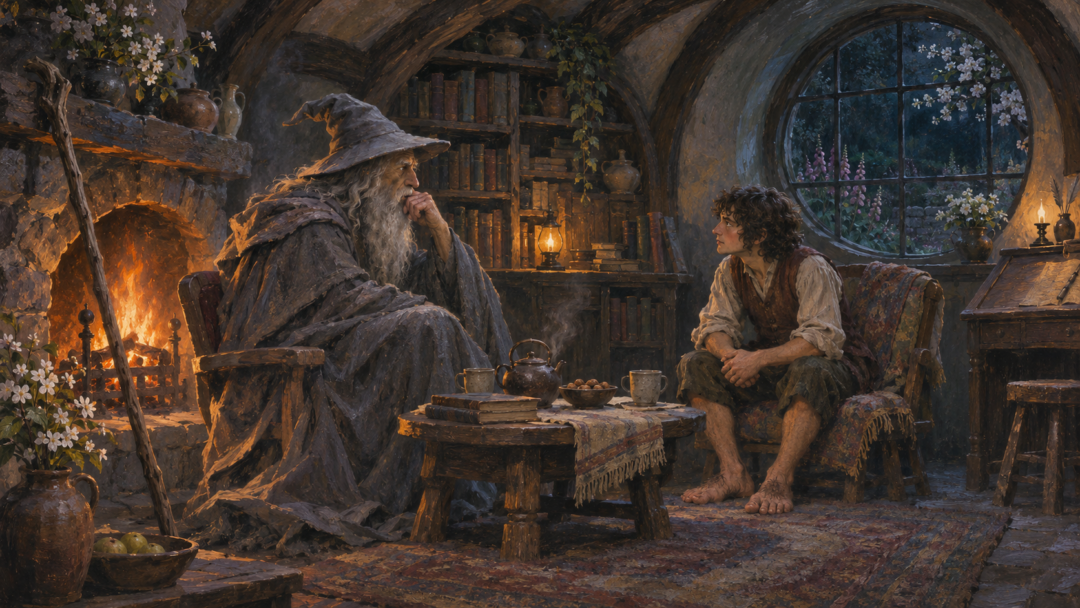
A Knock at Bag End, and a Conversation We Do Not Hear
Before Gandalf returns, unsettling news has already started reaching the Shire. Dwarves traveling west bring word of trouble beyond its borders, including whispers about the Enemy and Mordor. Most hobbits know these things, if at all, through old tales. Sam’s conversation at the Green Dragon shows how rumors mingle with ordinary Shire gossip: strange happenings are discussed, doubted, and set aside while everyday work continues. The wider world is moving, but its danger still feels far away.
Gandalf’s return gives that background a sharper edge. Frodo has not seen or heard from the wizard for more than nine years. One spring evening, as twilight fades, a familiar tapping comes at his study window. Frodo welcomes Gandalf with delight, notices that his old friend seems more careworn, and presses him for news of his travels and the world outside. There is plenty for them to discuss, even before the question of Bilbo’s ring becomes urgent.
Here the narrator does something easy to overlook: rather than give us pages of dialogue, the account compresses the reunion into a sentence. An online transcription of the chapter says the friends fell into “talk, and they stayed up far into the night.” That is a positive statement that a lengthy conversation happened. It is not a transcript, an inventory of subjects, or a promise that every significant remark has appeared on the page. The story has moved forward while letting the talk itself remain largely offstage.
That choice leaves a genuine limit on what we know. We cannot say precisely when Gandalf introduced Sauron, what words he used, or how much Frodo understood at the time. Yet it would be equally mistaken to treat the lack of printed dialogue as proof that nothing beyond a friendly reunion occurred. The narration has already established an evening spent exchanging news; the next scene will tell us that the Ring was also discussed.
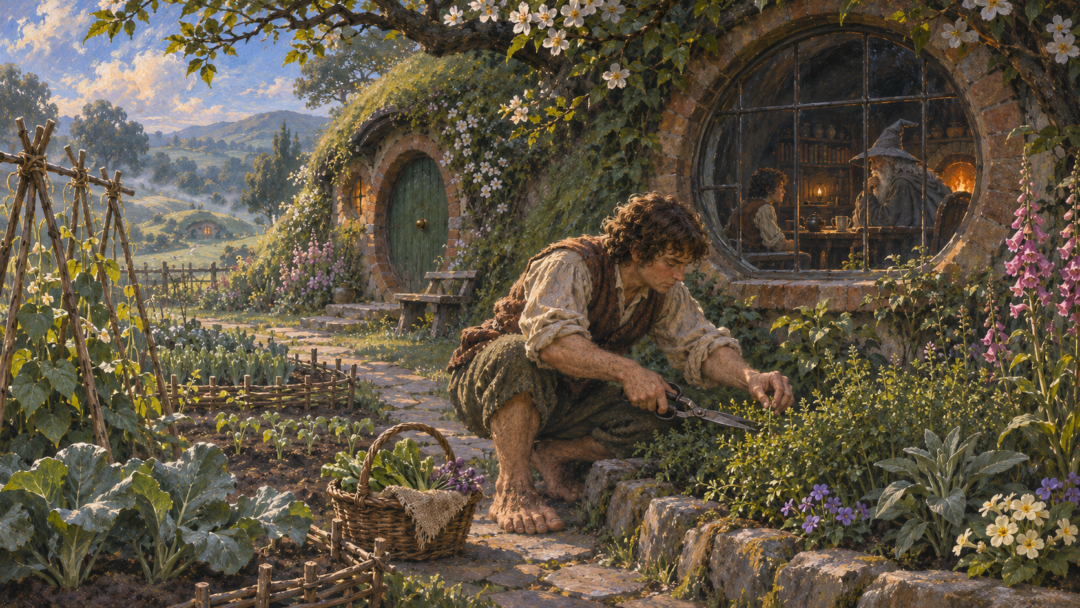
Breakfast Does Not Begin a New Subject
The chapter then marks the change of day explicitly. After a late breakfast, the two sit in Bag End’s study beside an open window. The hearth is bright, the southern wind is warm, and fresh spring growth is visible outside. Gandalf smokes while Frodo sits silently, troubled by what he has heard. The pleasant surroundings make the unease especially noticeable: whatever happened the night before has followed Frodo into the morning.
It is Frodo who restarts the conversation. He reminds Gandalf that they began discussing his ring the previous night, that Gandalf had warned him it was much more dangerous than he realized, and that the wizard had chosen to leave the subject until daylight. Frodo now wants the unfinished explanation. This is stronger evidence than a vague suggestion that the two might have exchanged ominous rumors. Frodo explicitly remembers a particular subject being opened and postponed.
The morning discussion therefore has the shape of a continuation. Gandalf does not arrive at breakfast and suddenly unveil the existence of danger to an unsuspecting Frodo. He picks up a thread that both of them already recognize. His first extended explanation concerns the Rings of Power, not a fresh introduction to Sauron: what such rings can do to mortal bearers, why unnaturally long life is no simple blessing, and how a bearer can be overcome by a power beyond himself.
Saruman Is Part of Gandalf’s Investigation, Not the Evening’s Agenda
As Frodo asks how long Gandalf has suspected the Ring, the wizard looks back over the years since Bilbo found it. Bilbo had told an odd story about acquiring the ring from Gollum, and his increasing attachment to it worried Gandalf. Gandalf also recalls that he considered consulting Saruman the White, a figure among the Wise whose knowledge of ring-making was especially deep. This is when Frodo asks who Saruman is, admitting that he has not heard of him before.
That exchange is sometimes the source of the mix-up. Readers have just seen Frodo ask about an unfamiliar name, then later hear Gandalf say he already spoke about Sauron last night. The similar-looking names can make the scenes seem to conflict when remembered loosely. But Saruman and Sauron are two different people in two different parts of the explanation. Frodo’s question about Saruman concerns Gandalf’s past efforts to understand Bilbo’s ring, not a correction to a speech about Sauron.
Gandalf identifies Saruman as the head of his order and the White Council, and explains that Saruman’s pronouncements about rings tended to quiet his fears without satisfying them. That history helps account for Gandalf’s long period of watching and waiting. The wizard is telling Frodo why his suspicions developed slowly, and why certainty took time. Saruman belongs naturally in that account because Gandalf might have sought his advice; Sauron belongs to the larger danger those suspicions eventually uncover. Frodo asks about Saruman in the morning, not in any dialogue preserved from the previous night.
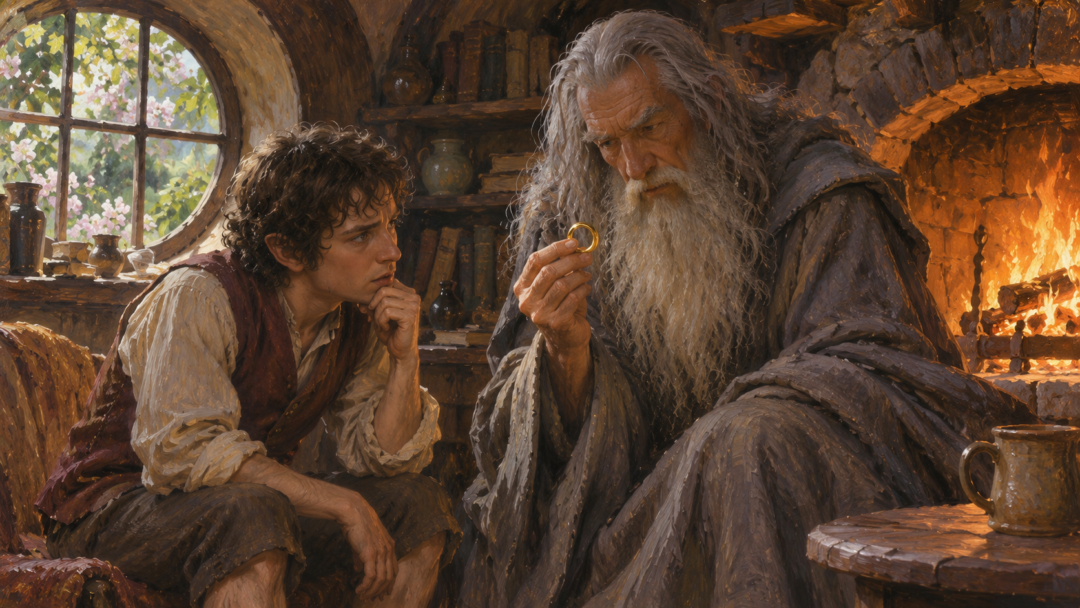
The Fire Makes the Danger Visible
Gandalf’s account of his doubts leads to a test. He asks Frodo for the ring, examines its smooth gold surface, and throws it into the fire. Frodo is alarmed. After allowing it to heat, Gandalf retrieves it and returns it to him, explaining that it is cool enough to hold. The ring that seemed plain now displays fiery writing, which Gandalf can interpret even though Frodo cannot read it.
The test shifts the conversation from suspicion to identification. This is not merely a powerful or peculiar ring of the sort Gandalf has been describing. It is the One Ring, the master of the others, and its maker wants it back. Frodo’s fear changes accordingly. He is no longer asking only what possession of a magical object might do to him; he wants to know how an object bound to a great and ancient enemy could have ended up in his own keeping.
It is at precisely this point, after the fire and the revelation, that Gandalf refers back to the previous evening. In the online transcription, his sentence is: “But last night I told you of Sauron the Great, the Dark Lord.” The speaker is Gandalf. The person addressed is Frodo. And the time phrase points backward from the daylight conversation to the night spent talking after the wizard returned to Bag End.
Gandalf then connects that earlier account to news Frodo could have heard beyond Bag End: the Dark Lord has returned to Mordor, and the disturbing rumors are real. He is not introducing a name that must be new to the reader at this exact instant. He is using the name as a known reference point while explaining why the Ring’s identity matters now. That is a natural way for someone to continue a serious discussion interrupted the night before.
What the Passage Proves—and What It Leaves Unsaid
There are three levels of information in this sequence. First, the narrator reports that Gandalf and Frodo talked late into the night. Second, Frodo recalls that they discussed the Ring’s danger and deliberately stopped before finishing. Third, Gandalf says that his account included Sauron. These statements are not identical, but they fit together without strain. One establishes the occasion, one identifies an unfinished subject, and one supplies a further detail about what Gandalf says he had told his host.
The distinction matters because a novel is not obliged to present conversations in full to make them part of its story. A character can refer truthfully to something that took place during summarized time. In this chapter, the shift from evening reunion to morning discussion is clearly signposted; the later reference asks readers to connect those scenes. The omission is in what the narration chooses to show, not necessarily in the characters’ shared experience.
There is still an element of uncertainty. We are relying on Gandalf’s retrospective account for the specific claim that Sauron was mentioned. We do not have Frodo’s separate confirmation of that precise name from the night before, nor any way to reconstruct the missing speech. But the chapter gives no reason to suppose that Gandalf is inventing a conversation, and the preceding narration provides exactly the occasion his remark requires. Tolkien Gateway’s chapter account likewise describes the talk at night and its continuation after breakfast. On this evidence, calling the line a continuity error asks the blank space to carry more weight than it can bear.
The lovely trick of Bag End is that the same window frames two very different moments: a delighted welcome in the fading evening, and a frightened hobbit beside the daylight hearth. Between them lies a conversation we are told happened but are not invited to hear. Gandalf remembers one part of it because Frodo needs that knowledge now. The words may be absent from the page, but the night is not absent from the story.
Sources & Notes
This article is based on close reading and interpretation of Tolkien's published works and related source material where relevant.