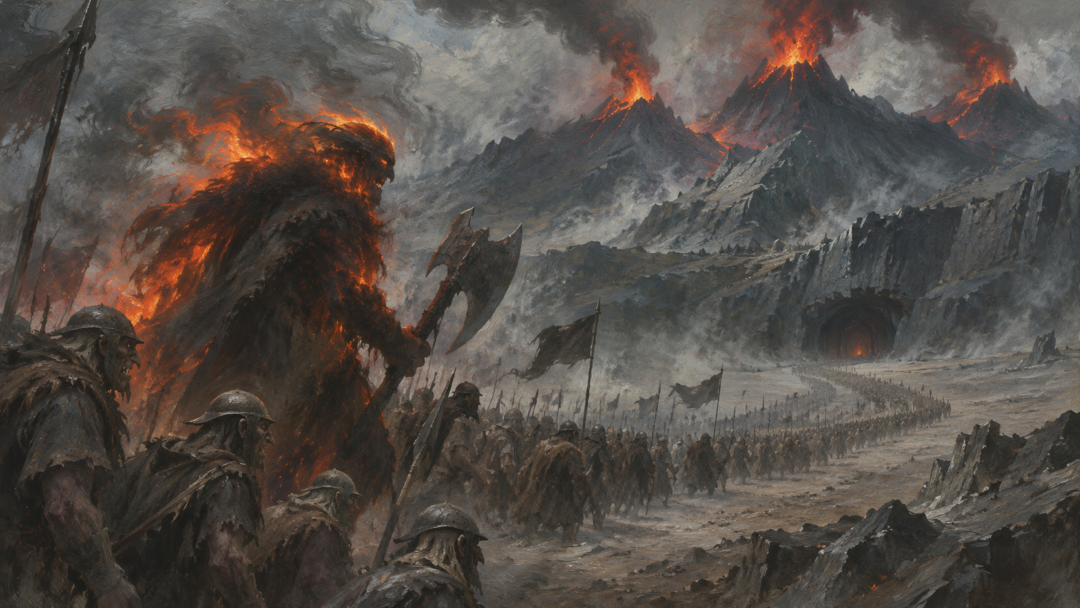
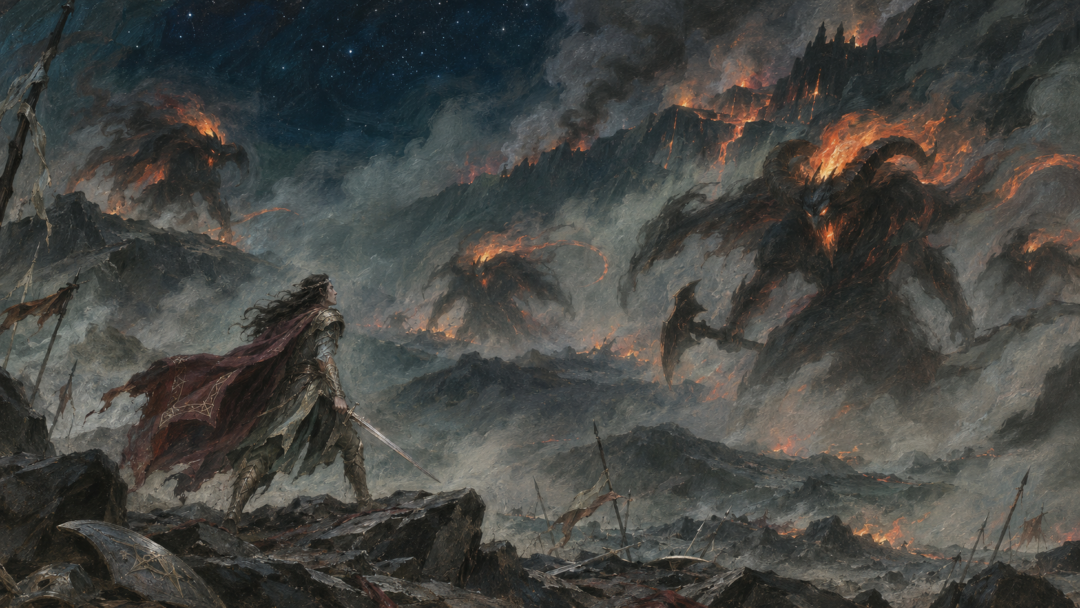
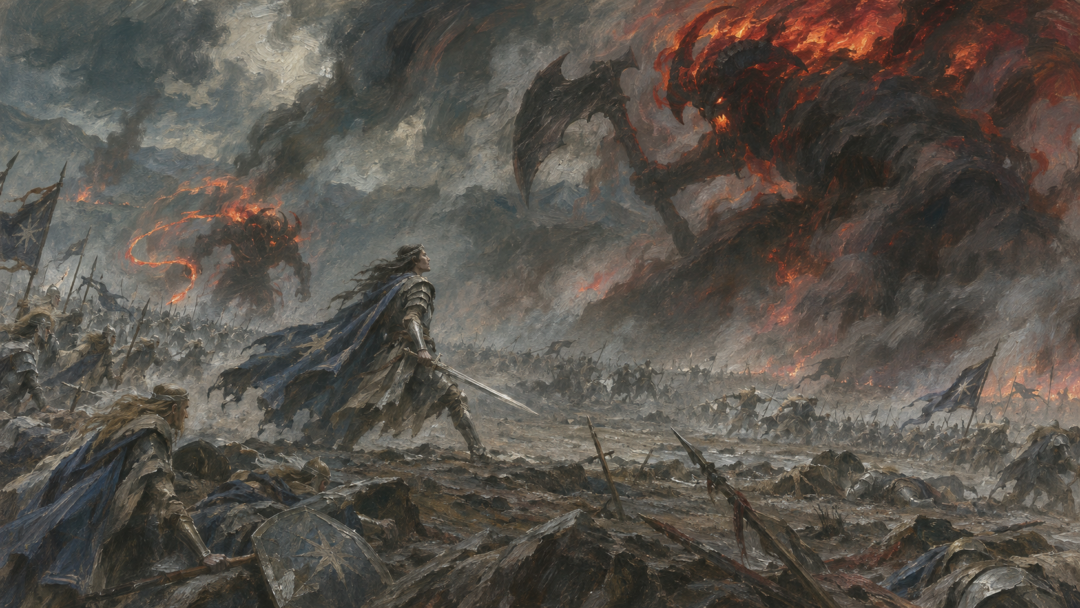
At the Nirnaeth Arnoediad, the Battle of Unnumbered Tears, the Elven king Fingon stands amid the wreckage of his guard. Gothmog, Lord of Balrogs, comes against him with a black axe, and a second Balrog moves into the fight. It explains why Gothmog appears so often in discussions of Middle-earth's greatest fighters: his victories matter, even when their circumstances are complicated.
But where does Tolkien actually say that this captain of Angband would have beaten Sauron in a martial contest? No verified passage establishing that outcome was recovered in the references examined. The available accounts identify both servants of Morgoth, describe their roles, and recount different confrontations. They neither stage a Gothmog–Sauron duel nor declare its winner. Here Gothmog means the First Age Balrog, not the later commander associated with Minas Morgul.
Titles are evidence of rank, not a duel result
Gothmog's reputation has textual foundations. The accounts of the First Age call him Lord of Balrogs and high-captain of Angband. His presence is felt where Morgoth's armies break the resistance of the Noldor, and his weapon is not a distant symbol of power: a black axe appears in the account of Fingon's death. Gothmog commands forces and enters the fighting himself. Both sides matter, and neither needs exaggeration.
Sauron's authority is equally real, but it appears in a different narrative pattern. The Valaquenta, in its account of Morgoth's servants, gives Sauron exceptional standing among those servants whose names are known. The accessible Sauron account likewise describes him as Morgoth's most trusted lieutenant. He commands strongholds, bends others to his will, employs deception, and confronts opponents through powers that go beyond weapons. That is an imposing record, though not a measured swordsmanship score.
Three questions should therefore stay separate. Who holds authority? That is a question about office, trust, and command. What does someone accomplish in a particular encounter? That requires looking at opponents, allies, surprise, and the conditions on the ground. Who would win an invented one-on-one fight? That third question asks for a prediction that the first two cannot automatically supply. A general description of Sauron as greater, or Gothmog as a formidable battle captain, does not answer it.
There is a tempting shortcut in a note attached to the Tolkien Gateway entry for Gothmog: it contrasts Sauron's supposedly more domestic role with Gothmog's front-line duties. But that aside is not presented as an independently referenced Tolkien statement. Even taken as a commentator's shorthand, 'domestic' does not mean physically weak; administering terror from a fortress is hardly evidence of an inability to fight. It is better to follow the narrated encounters than to promote a wiki observation into an authorial verdict.
What the battles with Fëanor and Fingon actually show
The first great test comes in the Dagor-nuin-Giliath, the Battle-under-Stars. Fëanor and the newly arrived Noldor have driven back Morgoth's forces. Instead of stopping with the victory, Fëanor pursues the retreating enemy far toward Angband. He presses ahead of much of his own host, driven into dangerous country where Balrogs come out against him. What follows is a desperate stand by an overextended pursuer, not an arranged contest between two champions.
Gothmog deals the mortal blow, and that is a formidable achievement. Fëanor is no ordinary Elf: his fierceness has carried him through a disastrous pursuit and into combat with enemies of fire and shadow. Yet the passage has Balrogs in the plural, and the account makes clear that Fëanor is overwhelmed and surrounded. His sons eventually come to his aid, driving the Balrogs back, but the wounds have already sealed his fate. The outcome tells us who struck him down, not what would happen against a wholly different Maia.
For anyone tracking the source, there is a small but worthwhile bibliographic snag. Tolkien Gateway's Gothmog entry labels its Fëanor reference The Silmarillion, 'Of the Flight of the Noldor.' Its separate account of the Battle-under-Stars instead directs readers to 'Of the Return of the Noldor' and to §45 of 'The Grey Annals' in The War of the Jewels. The latter is the more explicit battle locator in the accessible references. This discrepancy is worth preserving rather than smoothing over as though an edition had been personally checked.
Fingon's death is even more revealing because the sequence is so precise. During the Nirnaeth Arnoediad, Gothmog drives a wedge between the Elven hosts and separates Fingon from his allies. Fingon's guard falls, leaving the king to fight Gothmog. Then another Balrog comes from behind and catches Fingon with a fiery thong. Only after that intervention does Gothmog strike with his axe. The account appears in The Silmarillion, 'Of the Fifth Battle: Nirnaeth Arnoediad,' and the interruption is part of the event, not a detail to discard.
There is courage and danger on both sides of that scene, but it cannot honestly be retold as Gothmog defeating Fingon in an unaided fair duel. The encounter shows how Morgoth's captains destroy an army by isolating its leaders; the manner of the killing is inseparable from the collapse around it. Gothmog also takes Húrin captive in the battle after Húrin's stand against his guards. These are extraordinary military accomplishments. They establish a terrifying commander, not an automatic victory over any named adversary we care to substitute.
Sauron wins and loses in a different kind of story
Consider Sauron's contest with Finrod Felagund in 'Of Beren and Lúthien.' Finrod travels in disguise with Beren and companions, but Sauron detects and captures the company. The confrontation between the two is conducted through songs of power. Finrod resists with his own skill, yet Sauron prevails, exposes their disguise, and imprisons them. The struggle matters because language, memory, concealment, and spiritual power are weapons in this scene. It does not resemble the axe stroke that brings down Fingon.
That difference should not become a new arbitrary rule. A being who wins through sorcery is not thereby incapable of bodily combat, any more than a warrior carrying an axe is necessarily helpless against enchantment. In Tolkien's world, the spiritual and the physical continually meet, but the stories do not offer a conversion table between them. Finrod's defeat gives Sauron a serious victory against a mighty opponent on the terms of that encounter. It tells us little about a hypothetical battlefield with Gothmog.
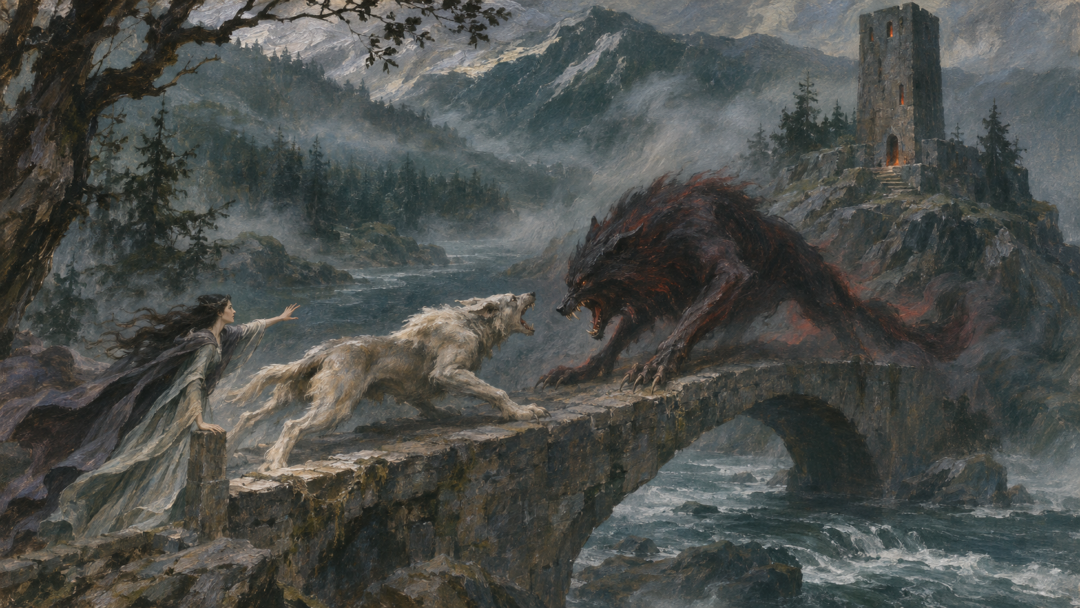
At Tol-in-Gaurhoth, the Isle of Werewolves, the test changes again. Huan comes with Lúthien to the bridge below Sauron's tower. After Huan defeats the wolves sent against them, Sauron takes the form of a tremendous wolf and advances himself. Lúthien is not merely watching: her magic helps disrupt his attack. Huan then grapples with Sauron, who cannot escape even by changing shape, and Sauron ultimately yields the island to Lúthien. He survives and flees in another form.
That is a genuine defeat for Sauron, and there is no reason to disguise it. But it happens against Huan, with Lúthien's crucial presence and assistance, in a story where Huan's foretold fate gives the choice of wolf-shape special significance. Turning that result into 'Huan beats Sauron, therefore Gothmog beats Sauron' adds a relationship the text has never demonstrated. Nothing about Huan's victory establishes how he would fare against Gothmog, or how Gothmog would fare against the shape-changing lord of the tower.
Why the early Gothmog cannot be folded into the later one
There is another trap for readers collecting impressive feats: the First Age stories developed over many years. In the early Book of Lost Tales material, the figure who becomes familiar as Gothmog was conceived as a son of Melko and the ogress Fluithuin. This belongs to an early form of the mythology, before its later account of Balrogs as corrupted Maiar was settled. The statement is fascinating evidence of the legendarium's development, not a hidden rule making Gothmog stronger than another Maia.
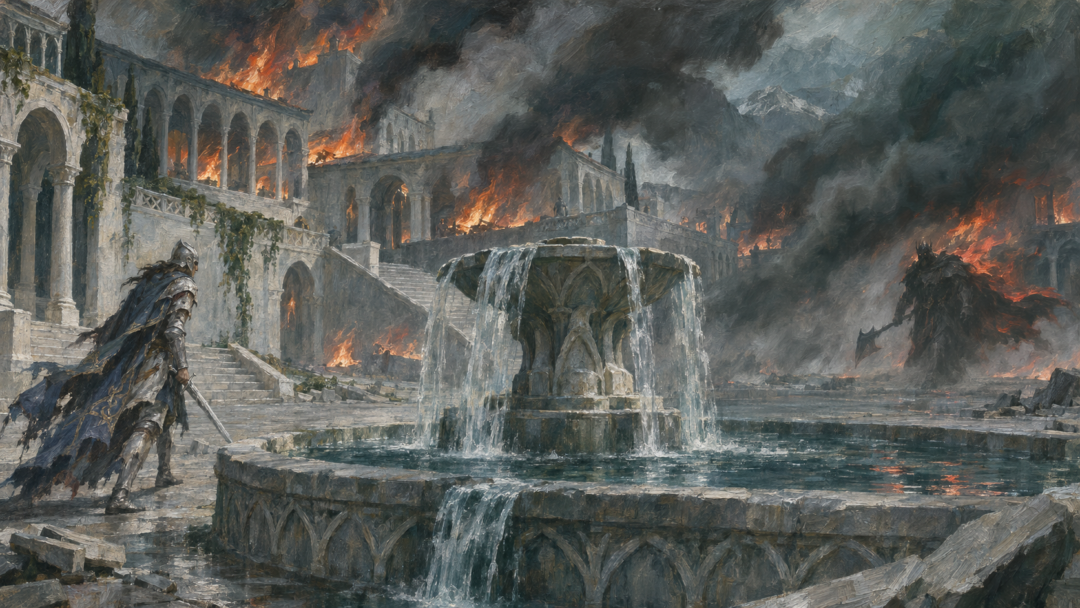
The earliest 'Fall of Gondolin' also gives the confrontation at the city's fountain elaborate physical detail. Ecthelion, already wounded, faces Gothmog in the burning city, and both perish. In the published Silmarillion, their fatal meeting is related far more briefly. It is tempting to combine the detailed early choreography with every later statement about Maiar, then calculate precisely what Gothmog could withstand. But that produces a composite combat system from different stages of a work still changing in its conception.
What a supporting citation would have to say
A real answer to the original question needs more than a character profile or a collection of battle summaries. It needs an identifiable work and passage in which Tolkien actually compares Gothmog and Sauron in the relevant martial sense, or explicitly predicts one defeating the other under stated conditions. 'Lord of Balrogs' is not that passage. Neither is Sauron's exceptional standing among Morgoth's servants. Both descriptions establish things readers should take seriously; they do not name a winner in the imagined fight.
That standard also changes how to read an online claim. If someone says Gothmog was Morgoth's greatest field commander, ask whether the cited source says that, and what the words mean in context. If the argument instead points to Fëanor or Fingon, check how many combatants are present. If it invokes Huan, remember Lúthien and the wolf-form episode. These are not loopholes designed to protect one favorite character. They are the actual shape of the evidence, which is more interesting than a stripped-down list of victories.
In the burning city of Gondolin, a terrible captain meets an Elven defender, and both perish. There is no victory parade, no reckoning of which servant of Morgoth possessed the stronger arm. The story gives Gothmog an ending, not a score against every other power in Angband. No located passage puts him opposite Sauron and predicts the result. A reader may imagine that encounter vividly; the claim that Tolkien settled it still needs the one thing imagination cannot provide: the actual words.
Sources & Notes
This article is based on close reading and interpretation of Tolkien's published works and related source material where relevant.